Is GCSE Biblical Hebrew Worth It?
Is GCSE Biblical Hebrew worth it? Explore the workload, exams, benefits and drawbacks, plus how to protect your GCSE maths revision time before choosing.

A GCSE option can look small on a form and become much larger in your week. A subject you enjoy may add purpose to school; one chosen for the wrong reasons can quietly consume the time needed for maths, English and science.
So, is GCSE Biblical Hebrew worth it? For a student who already has some knowledge of the language, enjoys close textual analysis and can access good teaching, it can be a rewarding choice. It is less likely to be worthwhile if you are starting without adequate support, dislike memorising vocabulary and grammar, or already struggle to protect revision time for core subjects.
The decision is not about whether Biblical Hebrew is universally easy or impressive. It is about fit: your interest, preparation, support and available time.
The quick decision checklist
Before choosing, ask yourself:
- Do I genuinely enjoy language, translation and analysing texts?
- Can my school provide an experienced teacher and suitable resources?
- How much Biblical Hebrew do I already know?
- Am I willing to practise vocabulary and grammar regularly?
- Can I maintain my GCSE maths revision alongside it?
- Have I looked at the specification and sample assessments?
- Do I understand that Biblical Hebrew and Modern Hebrew are different qualifications?
A mostly positive answer suggests the subject deserves serious consideration. Several uncertain answers do not automatically mean no, but they do mean you should investigate before committing.
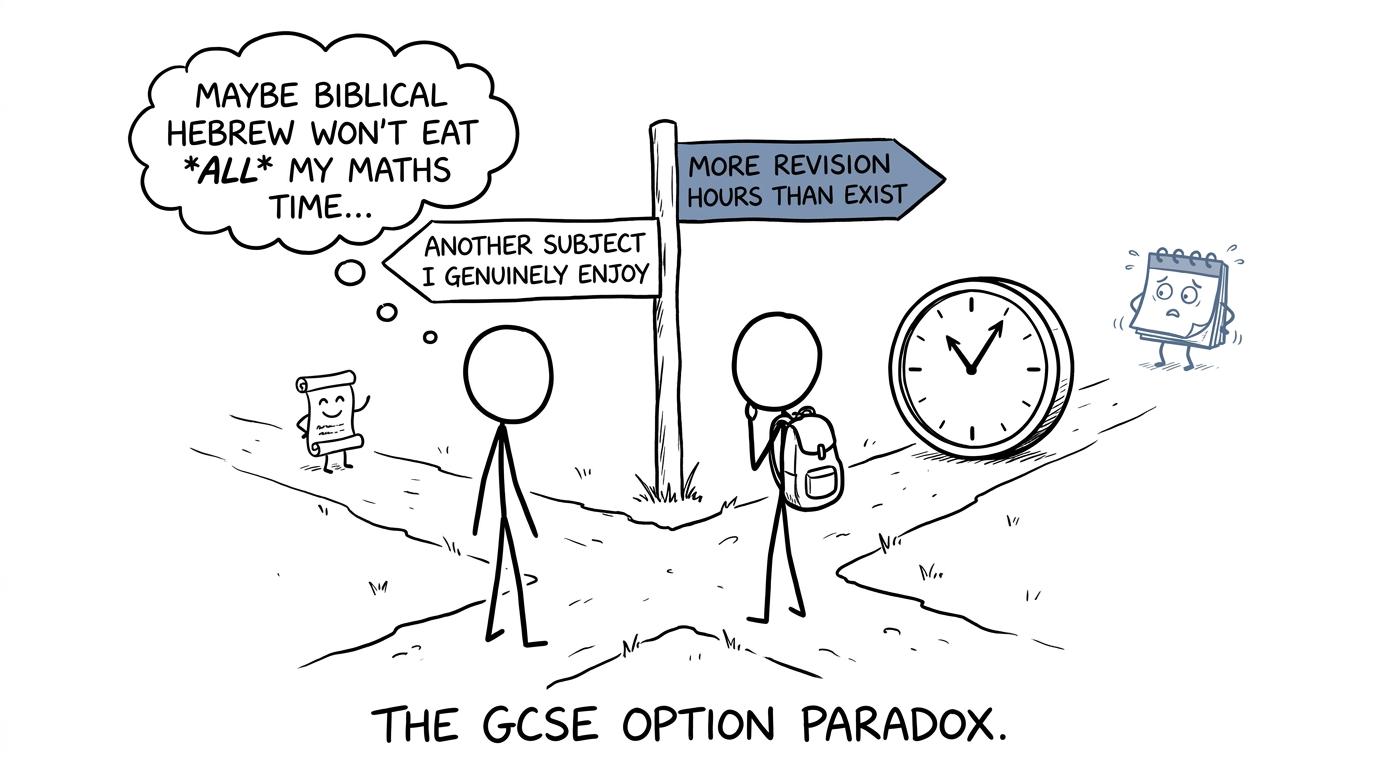 A student choosing between an enjoyable subject and an impossible revision workload
What does GCSE Biblical Hebrew involve?
The current GCSE discussed here is Pearson Edexcel Biblical Hebrew, specification code 1BH0. It is a linear, untiered qualification graded from 999 to 111. Unlike GCSE maths, there is no foundation or higher tier.
Assessment consists of two externally examined papers, normally completed in the same summer series:
| Component | Main focus | Weighting | Duration |
|---|---|---|---|
| Paper 1 | Language | 50%50\%50% | Two hours |
| Paper 2 | Literature | 50%50\%50% | Two hours |
The language paper tests comprehension of unseen Biblical Hebrew, translation into English and either grammar analysis or translation of short English sentences into pointed Biblical Hebrew, depending on the options selected within the paper.
The literature paper assesses understanding of prescribed texts. Students translate extracts, answer comprehension and grammar questions, analyse language and literary effects, and produce a comparative response using the set material.
There is no coursework or controlled assessment to spread the result across the course. Your performance rests on the final written examinations. Dictionaries are not available in the assessments, so secure vocabulary and grammatical recognition matter.
Set texts change over time. For examinations from 2026 to 2028, Pearson specifies selections concerning Joseph’s rise to power from Genesis and the miracles of Elisha from Kings. Always confirm the correct texts for your examination year with your teacher and the latest specification.
The strongest reasons to take it
You find the subject genuinely meaningful
Interest is not a soft extra. It changes how revision feels. A student who wants to understand how a text works in its original language is more likely to tolerate the repetition needed to learn forms, vocabulary and passages.
Biblical Hebrew combines language with literature. You are not merely recalling a translation. You examine grammatical structure, meaning, narrative choices and literary effects. That combination can suit students who enjoy both precise rules and interpretive questions.
You can develop disciplined analytical habits
Translation rewards attention. Endings, prefixes, verb forms and context can alter the meaning of a passage. Literature questions then ask you to select evidence and explain its significance.
Those habits can complement maths revision, even though the content is entirely different. Both subjects punish vague recognition and reward accurate recall, careful reading and a methodical response. In maths, it is not enough for a method to look familiar; you must use it correctly. The same principle applies when identifying language forms.
MathsGenie’s GCSE maths revision hub supports this kind of structured practice through topic lessons, questions, papers and solutions.
It provides a route to further study
AQA currently offers A Level Biblical Hebrew, and its specification builds towards more demanding unseen language, composition, prose and poetry. GCSE is not stated as an absolute entry requirement for that qualification, but it provides relevant preparation.
The subject may also support later interests in languages, theology, religious studies, classics, ancient history or textual scholarship. It does not commit you to any of these routes, nor does taking it guarantee an admissions advantage. Its value lies in the knowledge and skills you develop, not in the rarity of its name.
The honest drawbacks
Access to teaching may be limited
Biblical Hebrew is not available in every school. Even where a school can enter you, the amount of timetable space, specialist teaching and supervised practice may vary.
If you plan to enter privately, confirm arrangements early with an approved examination centre. A centre accepting private candidates in general may not necessarily offer this particular qualification. You may also need to arrange tuition and pay entry or administration fees, so check directly rather than assuming.
The workload is easy to underestimate
Prior knowledge can reduce the initial learning curve, but it does not remove the need for regular practice. The examination requires more than recognising familiar passages. You must deal with unseen material, grammatical detail and extended literary analysis.
Vocabulary and forms are cumulative. Missing several weeks can create a backlog because later translation depends on earlier knowledge. This is a subject better served by shorter, repeated sessions than by an occasional revision marathon.
It may compete with core-subject priorities
Every optional GCSE has an opportunity cost. An extra hour devoted to a set text is an hour unavailable for algebra, science or English literature.
That does not mean you should choose only subjects that seem practical. It means you need an honest budget for time. If maths is currently fragile, preserve regular contact with it through short sessions, such as GCSE maths mini tests, rather than allowing the subject to disappear until mocks.
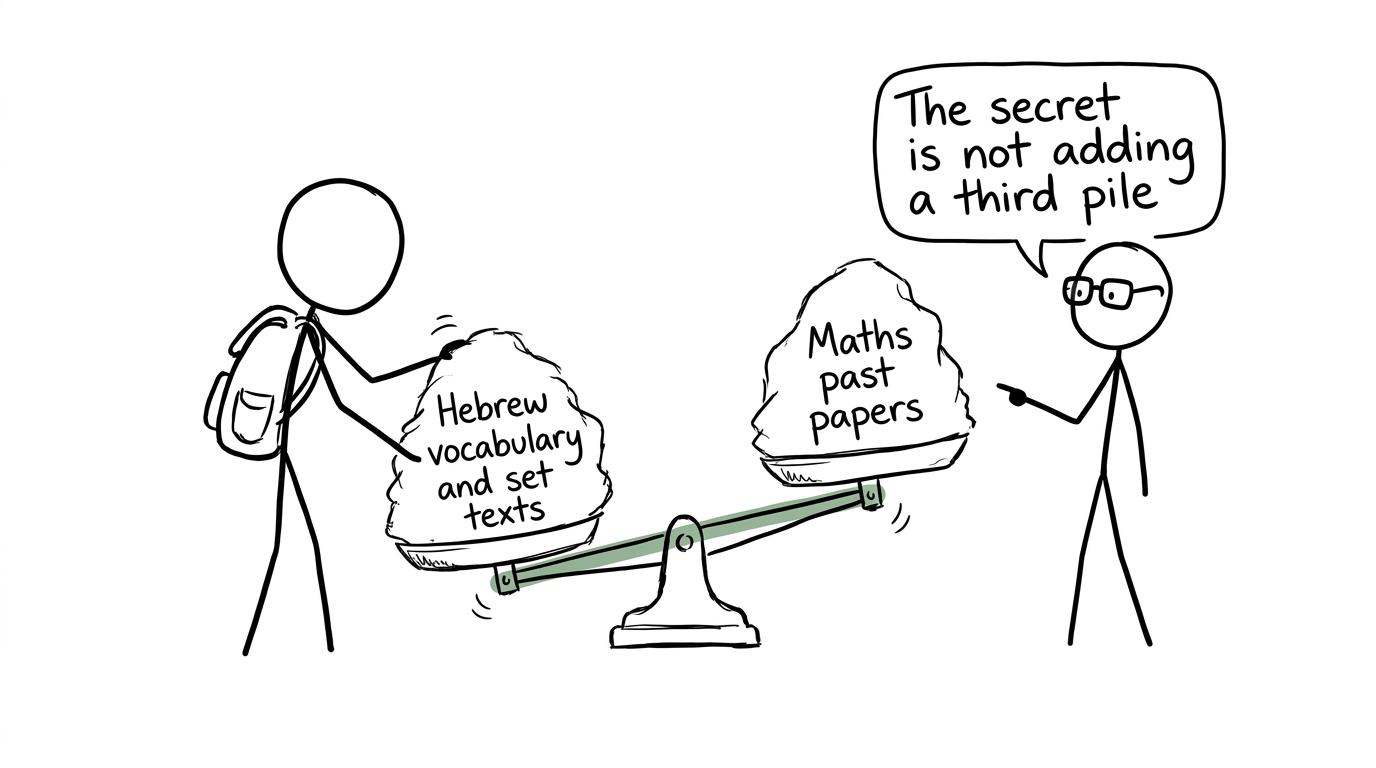 A student balancing Biblical Hebrew revision against maths past papers
How much work does GCSE Biblical Hebrew take?
There is no reliable universal number of weekly hours. The real workload depends on your starting point, the quality of teaching, your target grade and how quickly you retain vocabulary and grammatical structures.
A beginner receiving limited teaching will face a very different task from a student who already reads relevant texts and has regular specialist support. Ask your prospective teacher for a realistic outline of:
- lesson time and expected independent work;
- vocabulary and grammar requirements;
- set-text learning;
- frequency of translation practice;
- mock examinations and feedback;
- support available when you fall behind.
Then put those commitments beside your existing week. A written timetable reveals collisions that enthusiasm can hide. MathsGenie’s guide to building a GCSE maths revision timetable can help you create a plan with room for weak topics, exam practice and rest.
The key test is sustainability. Could you maintain the routine during a busy mock period, not only during a calm September?
How to protect your maths revision time
Biblical Hebrew uses memory, translation and textual analysis. GCSE maths requires continual question practice. If one subject becomes absorbing, it is easy to keep reading or making notes while postponing the less comfortable maths topic.
Use a simple boundary:
- Reserve fixed maths sessions before allocating optional-subject revision.
- Use topic questions when a method is weak.
- Use short mixed tests to maintain older skills.
- Introduce timed papers once enough content has been covered.
- Mark every attempt and turn errors into specific follow-up tasks.
If you take Edexcel maths, the Edexcel GCSE maths past papers place papers and mark schemes together. Students following AQA can use the equivalent AQA GCSE maths past papers.
Near the examinations, GCSE predicted papers can provide fresh exam-style practice. They should complement specification coverage and past papers, not replace them.
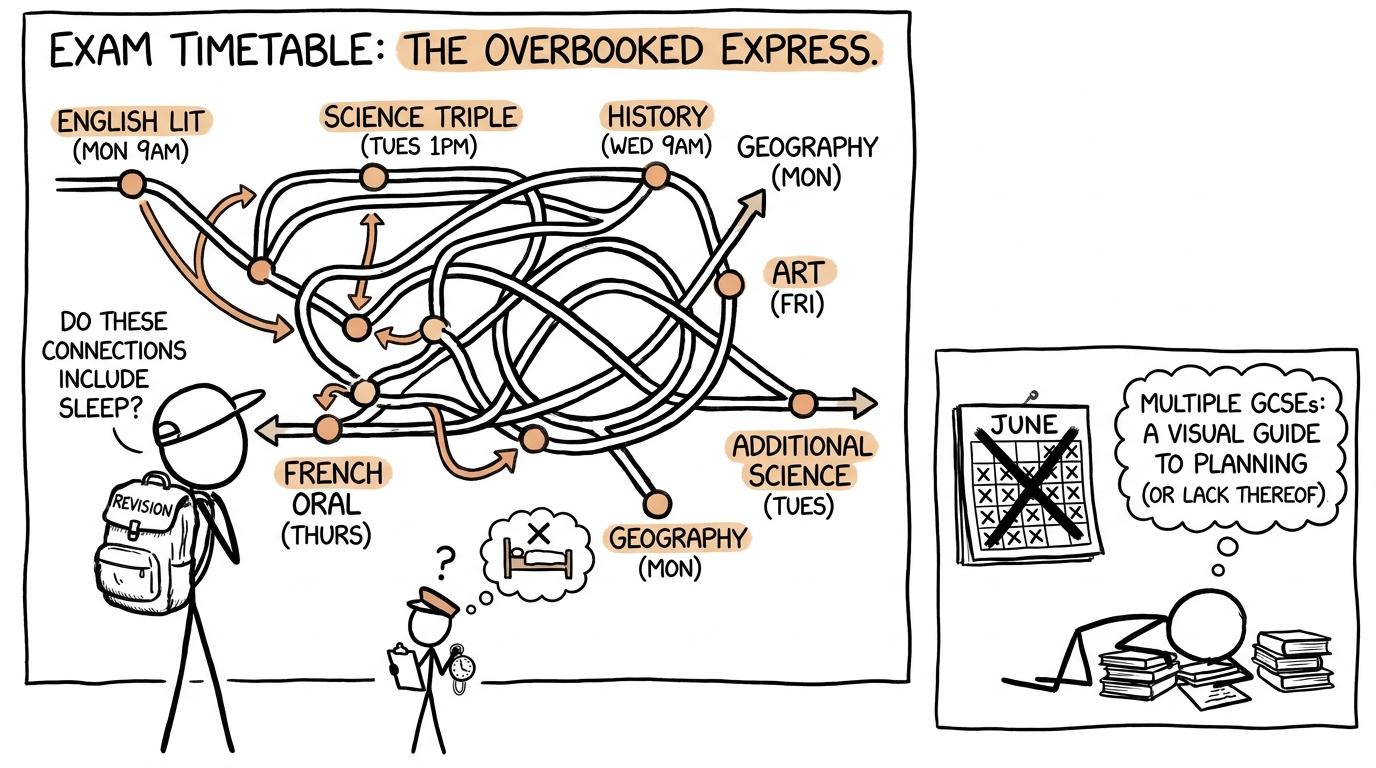 A student discovering that the exam timetable has apparently forgotten to include sleep
Who is GCSE Biblical Hebrew best suited to?
The qualification is likely to suit you if you:
- already have a foundation in Biblical Hebrew or access to strong beginner teaching;
- enjoy detailed language work rather than conversation practice;
- are interested in studying biblical texts closely;
- can memorise consistently across the course;
- respond well to written examinations;
- have enough timetable space to protect core subjects.
Think more carefully if you:
- are choosing it mainly because you think a rare subject must be easy;
- have no confirmed teacher or examination centre;
- expect it to resemble Modern Hebrew;
- dislike grammar, translation or literary analysis;
- are already overloaded or regularly abandoning maths revision.
Common mistakes when deciding
Assuming familiarity guarantees a high grade
Recognising stories or reading a passage aloud is not the same as meeting an examination mark scheme. Unseen translation, precise grammar and evidence-based analysis require deliberate preparation.
Confusing Biblical Hebrew with Modern Hebrew
These are separate subjects with different specifications and assessment demands. Confirm exactly which qualification your school offers before judging the course by your experience of the other.
Choosing it because it sounds impressive
A subject title does not compensate for weak performance elsewhere. Universities and colleges consider qualifications in context, but no GCSE option automatically unlocks a particular course. Choose it because the content and demands fit you.
Ignoring the final-exam structure
With two written papers and no coursework, weak areas cannot be hidden in a portfolio. Regular timed practice and careful use of mark schemes should be part of the course.
Planning revision subject by subject
Separate plans often claim the same evening. Build one combined schedule containing Biblical Hebrew, maths and your other GCSEs. If you are unsure when to introduce full papers, read MathsGenie’s guide on when to start GCSE past papers.
The final verdict
GCSE Biblical Hebrew is worth taking when three things meet: genuine interest, reliable support and enough time. It can offer rigorous language study, close engagement with significant texts and useful preparation for further study. Its disadvantages are equally real: specialist teaching can be difficult to access, the vocabulary and grammar need steady maintenance, and the final examinations demand both language accuracy and literary analysis.
Before deciding, inspect the current specification, speak to the person who will teach you, review sample papers and build a realistic weekly timetable. The best option is not the one that sounds most distinctive. It is the one you can study well without weakening the subjects you need most.
Whatever you choose, keep maths moving. Start with the free MathsGenie GCSE maths resources, use revision lessons and practice questions to repair gaps, then test your progress with mini tests, past papers, predicted papers, mark schemes and video solutions. A good subject choice expands your education. A good revision plan makes sure it does not crowd everything else out.