Inverse Functions Exam Questions: GCSE Guide
Inverse functions exam questions explained through three GCSE worked examples, with method marks, common mistakes and focused practice advice for exams.
Inverse functions exam questions can look unfamiliar because the notation is compact. A small −1-1−1 appears above the function, letters seem to change places, and suddenly a familiar algebra question feels much harder.
The central idea is simpler than the notation suggests: an inverse function reverses the original function. If fff turns an input of 333 into an output of 111111, then f−1f^{-1}f−1 turns 111111 back into 333.
In this guide, we will follow a hypothetical student, Maya, through three GCSE exam-style questions of rising difficulty. Each solution shows the algebra clearly and explains where method marks are likely to come from. Exact marking instructions vary between exam boards and papers, but the underlying methods remain consistent.
The inverse functions exam method
Before looking at the questions, learn this reliable process:
- Write the function as y=y=y= followed by the rule.
- Interchange xxx and yyy.
- Rearrange the equation to make yyy the subject.
- Replace yyy with f−1(x)f^{-1}(x)f−1(x).
- Check that the inverse reverses every operation in the original function.
For example, if a function multiplies by 444 and then subtracts 777, its inverse must add 777 and then divide by 444. The order reverses as well as the operations.
Students following Edexcel can review the complete Inverse and Composite Functions lesson, while the equivalent Eduqas inverse functions lesson covers the same core skill in an exam-board-specific setting.
| What the question asks | What you should do |
|---|---|
| Find f−1(x)f^{-1}(x)f−1(x) | Swap xxx and yyy, then rearrange |
| Find f−1(a)f^{-1}(a)f−1(a) | Find the inverse rule, then substitute aaa |
| Show two functions are inverses | Check that one function reverses the other |
| Solve using an inverse | Form the inverse expression, then solve |
Open the Maths Genie inverse functions lesson beside your first practice set if you want the method and questions in one place.
Question one: finding a linear inverse
Maya begins with a standard Higher tier question.
Exam-style question
The function fff is defined by
f(x)=4x−7.f(x)=4x-7.f(x)=4x−7.Find f−1(x)f^{-1}(x)f−1(x).
Step-by-step answer
First, Maya writes the function using yyy:
y=4x−7.y=4x-7.y=4x−7.She then interchanges xxx and yyy:
x=4y−7.x=4y-7.x=4y−7.Now she makes yyy the subject. Adding 777 to both sides gives
x+7=4y.x+7=4y.x+7=4y.Dividing both sides by 444 gives
y=x+74.y=\frac{x+7}{4}.y=4x+7.Therefore,
f−1(x)=x+74.f^{-1}(x)=\frac{x+7}{4}.f−1(x)=4x+7.Where the marks come from
A typical three-mark allocation might reward:
- one method mark for interchanging xxx and yyy, or clearly beginning to reverse the function;
- one method mark for a correct rearrangement;
- one accuracy mark for f−1(x)=x+74f^{-1}(x)=\frac{x+7}{4}f−1(x)=4x+7.
Maya checks the answer by following the original function with its inverse:
f−1(f(x))=(4x−7)+74=4x4=x.f^{-1}(f(x))=\frac{(4x-7)+7}{4}=\frac{4x}{4}=x.f−1(f(x))=4(4x−7)+7=44x=x.Reaching xxx confirms that the two functions undo one another.
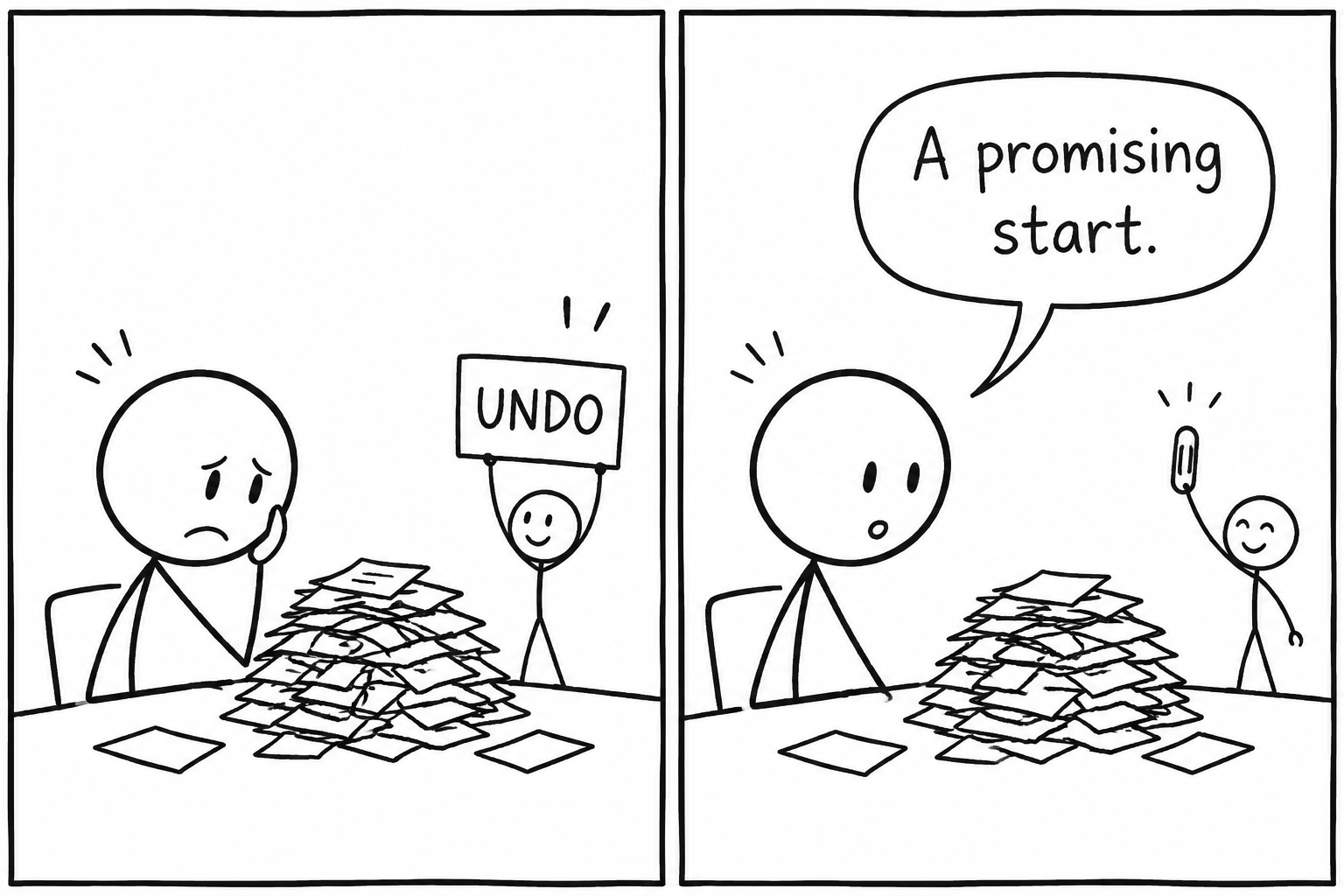 A stick-figure student watches a tiny helper begin to untangle an enormous pile of revision notes
Question two: using an inverse to solve an equation
The next question requires two stages. Maya must find the inverse and then use it.
Exam-style question
The function ggg is defined by
g(x)=x+53.g(x)=\frac{x+5}{3}.g(x)=3x+5.Solve
g−1(x)=7.g^{-1}(x)=7.g−1(x)=7.Step-by-step answer
Maya begins by finding the inverse:
y=x+53.y=\frac{x+5}{3}.y=3x+5.She interchanges xxx and yyy:
x=y+53.x=\frac{y+5}{3}.x=3y+5.Multiplying both sides by 333 gives
3x=y+5.3x=y+5.3x=y+5.Subtracting 555 gives
y=3x−5.y=3x-5.y=3x−5.Therefore,
g−1(x)=3x−5.g^{-1}(x)=3x-5.g−1(x)=3x−5.The equation in the question now becomes
3x−5=7.3x-5=7.3x−5=7.Maya adds 555 and divides by 333:
3x=12,3x=12,3x=12, x=4.x=4.x=4.Where the marks come from
An indicative four-mark structure could award:
- one method mark for interchanging the variables;
- one method mark for rearranging to obtain 3x−53x-53x−5;
- one method mark for forming 3x−5=73x-5=73x−5=7;
- one accuracy mark for x=4x=4x=4.
This is why working matters. If Maya makes a small arithmetic error at the end, the earlier correct inverse may still earn method marks.
A useful check comes from the relationship between a function and its inverse. Since g−1(4)=7g^{-1}(4)=7g−1(4)=7, it should also be true that g(7)=4g(7)=4g(7)=4:
g(7)=7+53=123=4.g(7)=\frac{7+5}{3}=\frac{12}{3}=4.g(7)=37+5=312=4.Question three: a fractional inverse
The final question is more demanding because the variable appears in both the numerator and denominator.
Exam-style question
The function hhh is defined by
h(x)=3x+2x−1.h(x)=\frac{3x+2}{x-1}.h(x)=x−13x+2.Find h−1(x)h^{-1}(x)h−1(x).
Step-by-step answer
Maya starts as before:
y=3x+2x−1.y=\frac{3x+2}{x-1}.y=x−13x+2.She interchanges xxx and yyy:
x=3y+2y−1.x=\frac{3y+2}{y-1}.x=y−13y+2.The fraction is awkward, so she multiplies both sides by y−1y-1y−1:
x(y−1)=3y+2.x(y-1)=3y+2.x(y−1)=3y+2.She expands the bracket:
xy−x=3y+2.xy-x=3y+2.xy−x=3y+2.Next, Maya collects every term containing yyy on one side:
xy−3y=x+2.xy-3y=x+2.xy−3y=x+2.She factorises the left-hand side:
y(x−3)=x+2.y(x-3)=x+2.y(x−3)=x+2.Finally, she divides by x−3x-3x−3:
y=x+2x−3.y=\frac{x+2}{x-3}.y=x−3x+2.Therefore,
h−1(x)=x+2x−3.h^{-1}(x)=\frac{x+2}{x-3}.h−1(x)=x−3x+2.The inverse is undefined when x=3x=3x=3, because this would make its denominator zero.
Where the marks come from
A question of this type might award marks for:
- interchanging xxx and yyy correctly;
- clearing the fraction;
- collecting and factorising the terms containing yyy;
- reaching h−1(x)=x+2x−3h^{-1}(x)=\frac{x+2}{x-3}h−1(x)=x−3x+2.
The decisive line is often
y(x−3)=x+2.y(x-3)=x+2.y(x−3)=x+2.Without factorising, it is difficult to isolate yyy. This is a good example of an inverse functions GCSE exam question depending on earlier algebra skills.
Common mistakes in inverse functions questions
Treating the inverse as a reciprocal
The notation f−1(x)f^{-1}(x)f−1(x) does not mean
1f(x).\frac{1}{f(x)}.f(x)1.It means the function that reverses fff. A reciprocal and an inverse function are different ideas.
Reversing operations in the wrong order
For f(x)=4x−7f(x)=4x-7f(x)=4x−7, the inverse does not divide by 444 and then add 777. It adds 777 first and then divides by 444:
f−1(x)=x+74.f^{-1}(x)=\frac{x+7}{4}.f−1(x)=4x+7.Brackets make that order clear.
Swapping the letters without rearranging
Writing
x=4y−7x=4y-7x=4y−7is an intermediate step, not the final answer. You must continue until yyy is isolated and then use inverse notation.
Losing terms when clearing a fraction
From
x=3y+2y−1,x=\frac{3y+2}{y-1},x=y−13y+2,multiplying by the denominator gives
x(y−1)=3y+2.x(y-1)=3y+2.x(y−1)=3y+2.The entire expression y−1y-1y−1 must be multiplied by xxx.
Giving only an answer
Even when you can reverse a simple function mentally, show enough algebra to establish your method. Inverse functions past paper questions often carry several marks, so an unsupported answer can put method marks at risk.
How to practise inverse functions for an exam
Use the same short routine for each question:
- attempt the question without notes;
- show the variable swap and every rearrangement;
- check the answer by composing the function with its inverse;
- compare your work with the solution;
- repeat any question where the algebra broke down.
The Edexcel GCSE Maths Question Bank lets you move from a lesson into focused exam-style practice. Do not merely read a worked solution. Cover it, reproduce the method, and then explain why each operation reverses the original one.
Turn the method into exam marks
Maya’s progress did not come from memorising three answers. It came from repeating one dependable structure: swap, rearrange, state and check. The remaining gap is applying that structure independently when the notation or algebra changes.
Start with the Maths Genie Lessons and Question Bank and answer a set of inverse functions exam questions using the four-step method.