Identities Exam Questions: GCSE Worked Examples
Identities exam questions explained through three GCSE examples, with method-mark guidance, common errors and focused Maths Genie practice for exam day.
A student can expand brackets correctly, collect like terms neatly and still feel uncertain when the word identity appears. The algebra looks familiar. The instruction does not.
The key to identities exam questions is understanding what must be true. An equation is true for particular values of a variable. An identity is true for every permitted value. In an exam, you usually demonstrate this by expanding, simplifying or comparing coefficients.
We will follow a student through three questions of rising difficulty. At each stage, the working is arranged to make the likely method marks visible. Exact allocations vary between papers and mark schemes, but clear algebra gives an examiner something to reward even when the final answer goes wrong.
The identities checklist
Before starting an identities GCSE exam question, ask:
- Does the statement use the identity symbol ≡\equiv≡ rather than the equals sign ===?
- Am I being asked to expand, prove an identity or find unknown coefficients?
- Can I simplify both sides into the same form?
- If coefficients are unknown, which matching terms should I compare?
- Have I shown each important algebraic step?
An identity such as
3(x+2)≡3x+63(x+2) \equiv 3x+63(x+2)≡3x+6is true for every value of xxx. By contrast,
3(x+2)=153(x+2)=153(x+2)=15is an equation that is true only when x=3x=3x=3.
This distinction forms part of GCSE algebra content. Questions may also ask you to show that expressions are equivalent or construct an algebraic argument. The Maths Genie proof lesson develops the same habit: replace numerical checking with a general algebraic argument.
Question one: recognising and verifying an identity
The student begins with a familiar-looking question.
Show that
4(2x−3)+5≡8x−7.4(2x-3)+5 \equiv 8x-7.4(2x−3)+5≡8x−7.The safest method is to work on one side only, usually the more complicated side.
Step one: expand the bracket
4(2x−3)+5≡8x−12+54(2x-3)+5 \equiv 8x-12+54(2x−3)+5≡8x−12+5A method mark may be available for a correct expansion, even if a later arithmetic error occurs.
Step two: collect the constant terms
8x−12+5≡8x−78x-12+5 \equiv 8x-78x−12+5≡8x−7This is now identical to the expression on the right, so the identity has been shown.
The student’s first instinct might have been to substitute x=2x=2x=2. That would confirm the statement for one value only. It would not prove that it works for every value. Algebra provides the general argument.
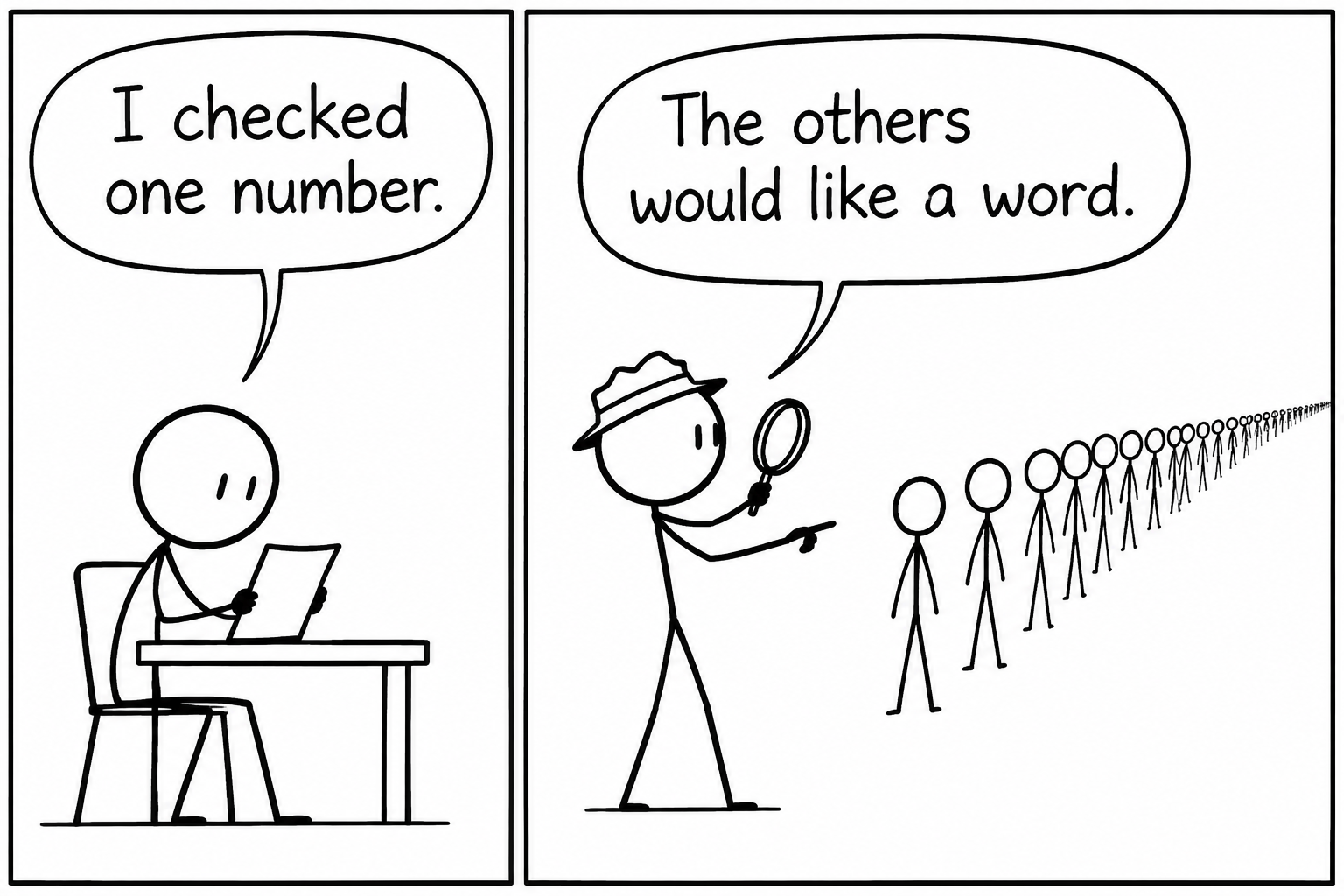 A student discovers that checking one value does not prove an identity
If expanding brackets is the difficult part, revisit the expanding and factorising lesson before attempting more identities past paper questions.
Question two: finding unknown coefficients
The next question introduces letters representing unknown numbers.
Given that
a(x+3)+b(x−2)≡7x+1,a(x+3)+b(x-2) \equiv 7x+1,a(x+3)+b(x−2)≡7x+1,find aaa and bbb.
The student cannot find the answer by choosing a convenient value of xxx alone. The coefficients of corresponding terms must match because both expressions are identical for every value of xxx.
Step one: expand the left-hand side
a(x+3)+b(x−2)≡ax+3a+bx−2ba(x+3)+b(x-2) \equiv ax+3a+bx-2ba(x+3)+b(x−2)≡ax+3a+bx−2bStep two: collect like terms
(a+b)x+(3a−2b)≡7x+1(a+b)x+(3a-2b) \equiv 7x+1(a+b)x+(3a−2b)≡7x+1This line is especially valuable. It exposes the coefficient of xxx and the constant term, creating the equations needed for the next stage.
Step three: compare corresponding coefficients
Comparing the coefficients of xxx gives
a+b=7.a+b=7.a+b=7.Comparing the constant terms gives
3a−2b=1.3a-2b=1.3a−2b=1.Step four: solve the simultaneous equations
From a+b=7a+b=7a+b=7,
b=7−a.b=7-a.b=7−a.Substitute this into the second equation:
3a−2(7−a)=1,3a-2(7-a)=1,3a−2(7−a)=1, 3a−14+2a=1,3a-14+2a=1,3a−14+2a=1, 5a=15,5a=15,5a=15, a=3.a=3.a=3.Therefore,
b=7−3=4.b=7-3=4.b=7−3=4.So the answer is
a=3,b=4.a=3,\qquad b=4.a=3,b=4.A typical mark scheme may reward expanding, forming the two correct equations, solving them and stating both values. The precise split depends on the paper, but skipping directly to the answer risks losing method marks.
You now have the core method, so use the Maths Genie GCSE Question Bank to repeat it until expanding and comparing coefficients become one continuous process.
Question three: a quadratic identity
The third question requires more organisation.
Given that
(x+p)(2x+q)≡2x2+11x+12,(x+p)(2x+q) \equiv 2x^2+11x+12,(x+p)(2x+q)≡2x2+11x+12,where ppp and qqq are positive integers, find ppp and qqq.
Step one: expand carefully
(x+p)(2x+q)≡2x2+qx+2px+pq(x+p)(2x+q) \equiv 2x^2+qx+2px+pq(x+p)(2x+q)≡2x2+qx+2px+pqCollecting the middle terms gives
2x2+(q+2p)x+pq.2x^2+(q+2p)x+pq.2x2+(q+2p)x+pq.The expressions are identical, so corresponding coefficients must agree:
q+2p=11q+2p=11q+2p=11and
pq=12.pq=12.pq=12.Step two: use the integer condition
Because ppp and qqq are positive integers and pq=12pq=12pq=12, the possible ordered pairs are
(1,12), (2,6), (3,4), (4,3), (6,2), (12,1).(1,12),\ (2,6),\ (3,4),\ (4,3),\ (6,2),\ (12,1).(1,12), (2,6), (3,4), (4,3), (6,2), (12,1).Test them in q+2p=11q+2p=11q+2p=11. For p=4p=4p=4 and q=3q=3q=3,
q+2p=3+2(4)=11.q+2p=3+2(4)=11.q+2p=3+2(4)=11.Therefore,
p=4,q=3.p=4,\qquad q=3.p=4,q=3.Step three: check the identity
Substituting the values into the original expression gives
(x+4)(2x+3).(x+4)(2x+3).(x+4)(2x+3).Expanding:
(x+4)(2x+3)≡2x2+3x+8x+12(x+4)(2x+3)\equiv 2x^2+3x+8x+12(x+4)(2x+3)≡2x2+3x+8x+12 ≡2x2+11x+12.\equiv 2x^2+11x+12.≡2x2+11x+12.The check confirms the result and presents a complete algebraic argument. You can strengthen the underlying skill using the quadratic expanding and factorising questions.
Where method marks usually come from
Identities questions reward visible structure. A strong solution normally includes:
- the correct expansion;
- like terms collected accurately;
- matching coefficients identified;
- equations formed from those coefficients;
- equations solved with sufficient working;
- a clear final conclusion.
Do not assume that an examiner will reconstruct steps completed mentally. For targeted examples showing how working is assessed, use the proof exam questions and worked solutions alongside the relevant mark scheme.
Common mistakes in identities exam questions
Treating an identity like an equation
Do not try to find one value of xxx unless the question explicitly asks you to solve an equation. An identity must hold for every permitted value.
Proving only one example
Substituting x=1x=1x=1 may help you detect an error, but one successful check is not a proof. Expand or simplify algebraically.
Losing negative signs
For example,
−3(x−4)≡−3x+12,-3(x-4)\equiv -3x+12,−3(x−4)≡−3x+12,not −3x−12-3x-12−3x−12. Multiply every term inside the bracket.
Comparing the wrong terms
In
ax2+bx+c≡5x2−2x+7,ax^2+bx+c\equiv 5x^2-2x+7,ax2+bx+c≡5x2−2x+7,compare the x2x^2x2 coefficients, then the xxx coefficients, then the constants. Terms with different powers cannot be matched.
Writing only the final values
Even a correct answer may not show enough method. Preserve the expansion and coefficient equations. The expanding and factorising question set is useful for building this disciplined layout.
Exam-style practice
Try these without looking back at the examples.
Practice A: Show that
5(3x+2)−4x≡11x+10.5(3x+2)-4x\equiv 11x+10.5(3x+2)−4x≡11x+10.Practice B: Given that
a(x+2)+b(x−1)≡8x+7,a(x+2)+b(x-1)\equiv 8x+7,a(x+2)+b(x−1)≡8x+7,find aaa and bbb.
Practice C: Given that
(x+p)(3x+q)≡3x2+14x+8,(x+p)(3x+q)\equiv 3x^2+14x+8,(x+p)(3x+q)≡3x2+14x+8,where ppp and qqq are positive integers, find ppp and qqq.
The answers are a=5a=5a=5, b=3b=3b=3 for Practice B, and p=4p=4p=4, q=2q=2q=2 for Practice C. For a longer sequence, open the proof revision guide and check each line against the worked approach rather than checking only the final answer.
Turn the method into marks
The student’s progress across the three questions comes from one change: instead of guessing what the identity means, they make the structure visible. Knowing that process is useful; following it reliably under exam pressure takes deliberate practice.
Start with the matching Maths Genie lesson, then answer identities and proof questions in the GCSE Question Bank.