

How to Use the Formula Sheet on the Resit
How to use the formula sheet on the resit: practical steps for November GCSE maths, from choosing formulas to gaining method marks through focused practice.
A GCSE maths resit often sits alongside college lessons, an apprenticeship or shifts at work. Revision needs to earn its place in a busy week.
Knowing how to use the formula sheet on the resit can make that work more manageable: learn what is included, recognise when a formula applies, match values to symbols, substitute carefully and show your working.
The sheet reduces pressure on your memory. You still need to understand the question and choose the method. Familiarity helps you make those decisions calmly.
Your formula sheet checklist
Before the November resit, make sure you can:
- find the official sheet for your exam board and tier
- locate formulas and explain their symbols
- recognise when each formula applies
- rearrange and substitute accurately
- check units and whether answers are sensible
- practise with a clean sheet during timed papers
Ofqual has confirmed that GCSE mathematics formulae sheets will continue for the remaining lifetime of the current specifications, including November examinations. Exam boards supply a clean copy with the paper.
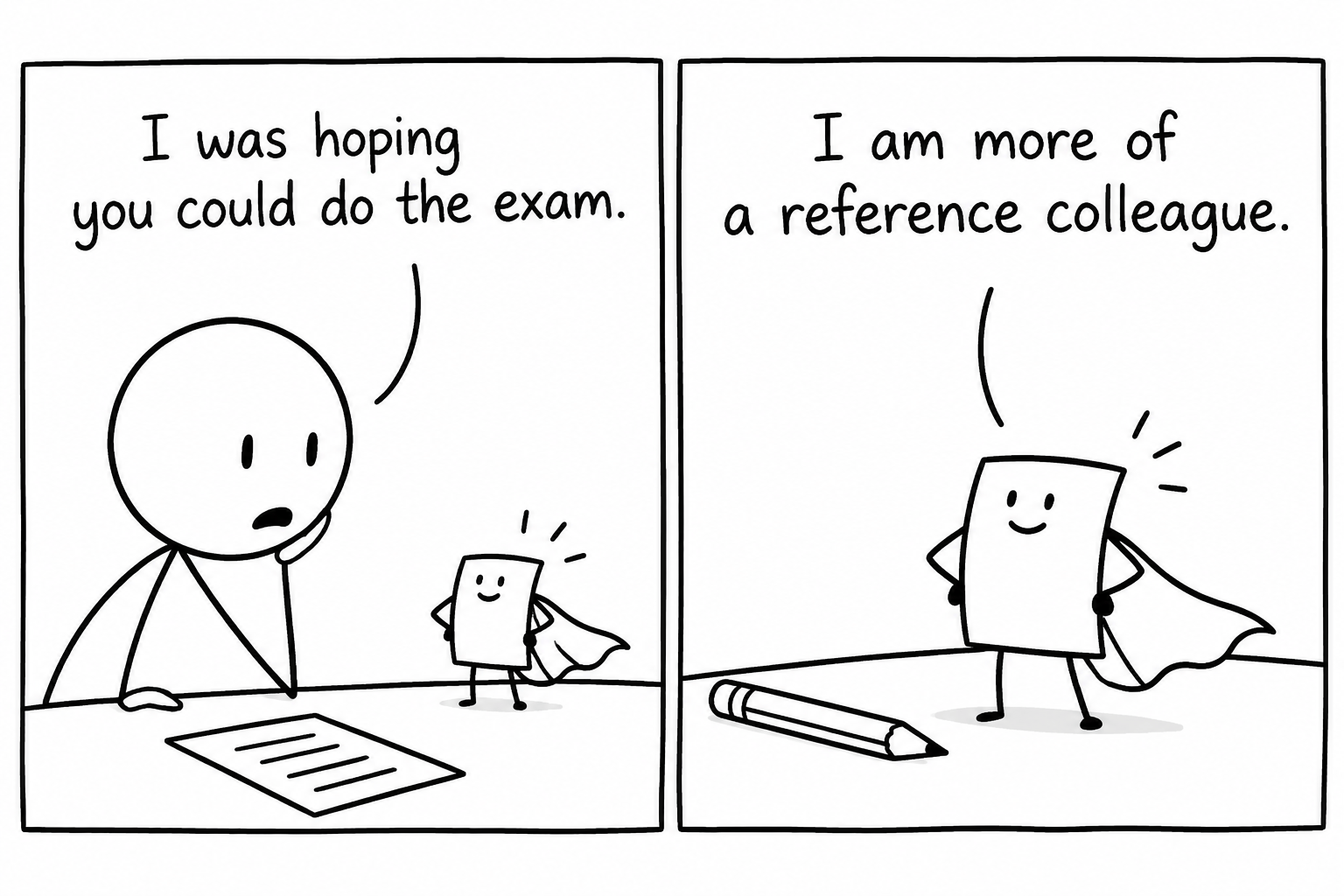 A formula sheet explains that it is a reference colleague, not an exam superhero
Get familiar with your exact sheet
Foundation and higher tier sheets differ. Check your board and tier with your college or examination centre, then use the current official version throughout revision.
Read it before attempting questions. Notice where to find geometry, percentages, probability and any higher tier formulas. You are building a mental map so that finding a formula takes less attention during the examination.
As you read, explain each relationship aloud in ordinary language. Ask yourself what information a question would need to provide and what you could calculate from it. If a symbol feels unfamiliar, return to the relevant lesson before attempting timed work. This turns a page of notation into a set of methods you can recognise and use.
Check the GCSE maths topics by exam board and tier, then use the relevant lessons, such as the Edexcel GCSE maths revision page, to connect formulas with question types.
How to use the formula sheet on the resit
Identify the topic and required quantity
Underline what you need to find and identify the information provided. A prism diagram might require volume, while a savings question might involve repeated percentage change.
Choose the formula because it connects the known information to the required quantity. Familiar symbols alone are not enough.
Read the formula and its definitions
For a prism, the sheet gives:
Volume=area of cross-section×length.\text{Volume}=\text{area of cross-section}\times\text{length}.Volume=area of cross-section×length.You may need to calculate the cross-sectional area first. The formula identifies the relationship, but the question can still require several stages.
For compound interest, the expression is:
P(1+r100)n.P\left(1+\frac{r}{100}\right)^n.P(1+100r)n.Here, PPP is the principal amount, rrr is the percentage rate per period and nnn is the number of periods.
Substitute before calculating
For an investment of £800£800£800 earning 3%3\%3% annually for two years, write:
P=800,r=3,n=2.P=800,\qquad r=3,\qquad n=2.P=800,r=3,n=2.Then substitute:
800(1+3100)2=848.72.800\left(1+\frac{3}{100}\right)^2=848.72.800(1+1003)2=848.72.The final amount is £848.72£848.72£848.72. Showing the substitution makes your method visible and may earn method marks where the mark scheme allows, even if a later calculation goes wrong.
Check the answer in context
An investment earning positive interest should finish above its starting amount. A result below £800£800£800 should prompt you to check brackets, powers and calculator entry.
Also check what the question requests. The final balance and the interest earned are different quantities. Read the final sentence again before writing your answer.
Practise choosing and rearranging formulas
The sheet cannot decide which length or value belongs in each position. You need to understand the relationship before using it.
Pythagoras' theorem states:
a2+b2=c2.a^2+b^2=c^2.a2+b2=c2.The hypotenuse is ccc. To find a shorter side, rearrange:
b=c2−a2.b=\sqrt{c^2-a^2}.b=c2−a2.Adding the known squares would give the wrong method here. Use the AQA Pythagoras revision lesson or Edexcel Pythagoras revision lesson to practise recognising the required side. Questions and video solutions help connect the printed formula with examination wording.
Make practice fit your week
A focused session can be useful even when you cannot spare an evening. Choose one topic, complete several questions with the official sheet visible, then mark them.
Record why each error happened: formula selection, rearranging, substitution, calculator use or units. That diagnosis tells you what to revise next. More questions alone will not fix a misunderstanding about which measurement represents the radius.
After correcting a question, attempt it again later without looking at your previous working. Then try a different question using the same relationship. This checks whether you can choose the method independently. As confidence improves, mix topics together so that the exercise heading no longer tells you which formula to select.
Use the Edexcel GCSE maths exam booklets for targeted practice. The GCSE maths resit revision plan helps balance topic work with papers, while the nine-day resit plan offers priorities when time is short.
Common formula sheet mistakes
Treating the sheet as complete revision
Knowing where a formula appears does not establish when to use it. Practise interpreting questions, including those where you must calculate another quantity first.
Copying inaccurately or missing brackets
Check exponents, fractions and signs against the sheet. In the quadratic formula, the whole numerator is divided by 2a2a2a:
x=−b±b2−4ac2a.x=\frac{-b\pm\sqrt{b^2-4ac}}{2a}.x=2a−b±b2−4ac.When substituting negative values, brackets matter. If b=−3b=-3b=−3, then:
b2=(−3)2=9.b^2=(-3)^2=9.b2=(−3)2=9.Entering −32-3^2−32 instead gives −9-9−9 under standard order of operations.
Ignoring units
Convert measurements to compatible units before substitution. Area requires square units and volume requires cubic units. A correct calculation with incompatible measurements can still produce an incorrect answer.
Waiting until you are stuck
Keep the sheet beside you throughout practice. Checking it should become an ordinary part of your method, rather than a rushed response when confidence drops.
If a question still feels unclear, write down the information you recognise and leave space to return. Spending too long searching the sheet can interrupt your progress through the paper. Returning after completing other questions may help you spot the relationship you initially missed.
Build an examination habit
The useful test is whether you can navigate a clean sheet under timed conditions. On MathsGenie, use free revision lessons, practice questions, past papers, mark schemes and video solutions to identify what needs attention.
Then create targeted practice with the GCSE Mock Exam Builder. Complete it with your official sheet, mark your working and revisit the decisions that cost marks. Each cycle gives your next revision session a clear purpose.















