How to Revise A-Level Maths Alongside Further Maths
How to revise A-Level Maths alongside Further Maths: build a balanced weekly plan, connect overlapping topics and practise both courses for exams.
A student sits down on Sunday evening with two specifications open. A-Level Maths has an unfinished mechanics worksheet. Further Maths has introduced matrices, while last week's complex numbers are already becoming hazy. Both subjects matter, both feel urgent, and the timetable says simply: revise maths.
That is the problem with learning how to revise A-Level Maths alongside Further Maths. The subjects overlap, but they are not interchangeable. The practical answer is to plan them as one connected programme while giving each qualification protected practice time. Secure the A-Level Maths foundations that Further Maths builds on, revisit new material at spaced intervals, and complete separate exam questions for each course.
The plan at a glance
A workable revision system should:
- map topics from both specifications before scheduling sessions;
- prioritise weak A-Level Maths foundations;
- connect related topics without merging the two courses completely;
- use short retrieval sessions between longer problem-solving sessions;
- include separate exam practice for Maths and Further Maths;
- turn mistakes into the next week's revision tasks;
- leave some unscheduled time for difficult weeks.
This approach matters because A-Level Further Maths builds on knowledge and skills from A-Level Maths. Your precise content and optional units depend on your exam board and course, so use the specifications and paper codes supplied by your school rather than following a generic online topic list.
Treat both courses as one map, not one subject
Imagine the student at the desk draws two columns. In the first are A-Level Maths topics such as trigonometry, differentiation, integration, vectors, mechanics and statistics. In the second are the Further Maths topics being taught by their school.
They then draw links between genuine dependencies. Strong algebra supports almost everything. Differentiation and integration underpin more advanced calculus. Ordinary vectors prepare the ground for more demanding vector work. Mechanics techniques may support optional Further Mechanics content where that option is studied.
This map changes revision planning. If an A-Level Maths weakness is blocking a Further Maths topic, repair the foundation first. If the topics are merely related, revise them near each other but still answer questions from both specifications.
Do not assume that practising a harder Further Maths question automatically covers the corresponding A-Level skill. The harder question may involve the foundation, but an A-Level paper can test that foundation in a different form and award marks for steps you have stopped making explicit.
Students taking Edexcel can begin by checking the A-Level Maths revision topic collection. If you use another board, confirm your specification with your teacher and choose the matching resources from MathsGenie.
Build a weekly rhythm you can repeat
The student's first instinct may be to divide every hour equally. Equal time looks fair, but it ignores current knowledge. Revision should respond to evidence.
Start each week with three categories for both courses:
- Weak: you cannot begin typical questions without notes.
- Developing: you understand the method but make errors or need prompts.
- Secure: you can complete mixed questions accurately without help.
Then build the week around four types of session.
| Session | Purpose |
|---|---|
| Foundation repair | Relearn an A-Level Maths skill that is limiting progress in either course. |
| Further Maths development | Review recent teaching and solve focused questions from the correct unit. |
| Mixed retrieval | Recall methods and complete short questions from older topics in both courses. |
| Exam practice and review | Attempt questions under realistic conditions, mark them and diagnose errors. |
A balanced week might contain two A-Level Maths sessions, two Further Maths sessions, one linked session and one exam-practice session. That is a starting structure, not a fixed ratio. Before an A-Level Maths mock, the balance may shift towards Maths. After a difficult Further Maths assessment, the next week may give that course more attention.
The important idea is protected attention. Name the course, topic and task in each timetable entry. “Further Maths: complex numbers, mixed exam questions” is actionable. “Do maths” invites delay.
If setting up those repeated sessions already feels like another piece of homework, build the structure in the MathsGenie Revision Planner rather than redrawing it each Sunday.
Use a study technique suited to mathematics
Reading notes can make an unfamiliar method look comfortable without proving that you can use it. A better session has a clear sequence.
Retrieve before reviewing
Close the book and write down what you remember: a method, relevant conditions, a diagram or the first step of a typical question. This is not a polished set of notes. It is a quick test of what remains available without support.
Then compare your recall with the lesson material. The gaps tell you what to review. This makes retrieval useful rather than ceremonial.
Practise in focused blocks
Begin with several questions on the same skill while rebuilding the method. Once it feels secure, mix it with older material. The change matters because an examination does not tell you which technique to select.
MathsGenie's revision lessons, practice questions, mini tests and video solutions can support this progression. Use the explanation when you are genuinely stuck, then close it and attempt a fresh question independently.
Mark for causes, not just marks
A mark scheme tells you where marks were available. Your error log should explain why you missed them. Useful labels include:
- knowledge gap;
- incorrect method selection;
- algebraic slip;
- incomplete reasoning;
- calculator or notation error;
- time pressure.
The label determines the response. A knowledge gap needs another lesson and focused practice. An algebraic slip may need slower written working. A method-selection error needs mixed questions where you must identify the technique yourself.
Keep exam practice separate
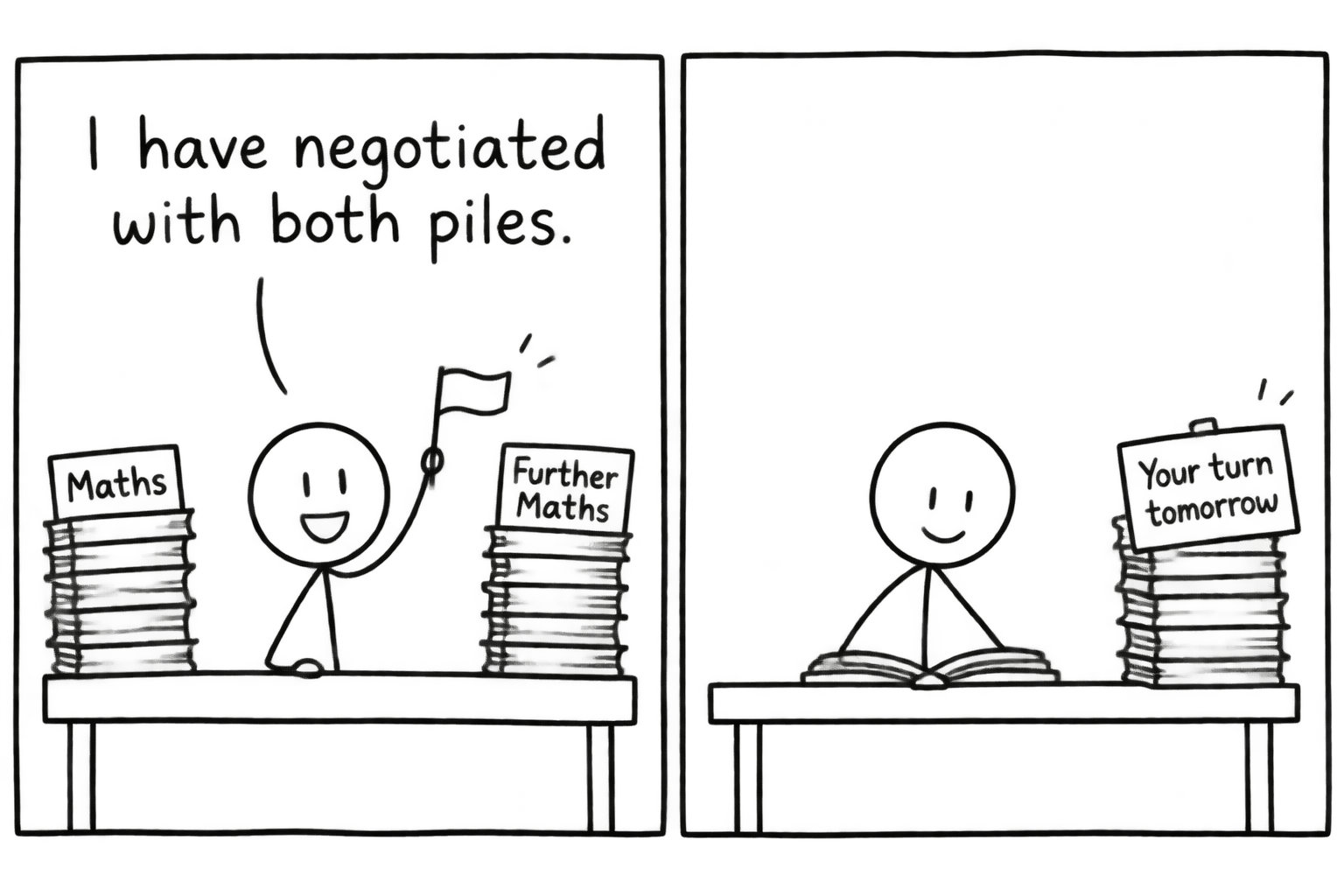 A student negotiates calmly with separate Maths and Further Maths revision piles
Linked revision is efficient during learning, but each qualification has its own papers and assessment demands. Your schedule therefore needs separate timed practice.
Start with individual exam questions when much of the course is still being taught. Move towards sections and full papers as the examinations approach. The A-Level past papers collection helps you select the right subject and exam board, while the Edexcel A-Level Maths past papers include papers and mark schemes for board-specific practice.
After every paper, spend time reviewing it. Record lost marks by topic and cause, redo the questions without the mark scheme, and schedule the weakest skill again. A paper is not merely a measurement. Used properly, it is a set of instructions for what to revise next.
Predicted papers can provide fresh practice nearer the examination period, but they do not predict every question that will appear. Use them alongside past papers, specification coverage and targeted practice rather than as a replacement for complete revision.
Protect the foundations without neglecting depth
Further Maths can feel more intellectually urgent because its ideas are newer. That creates a subtle risk: the student spends every available session wrestling with advanced content while familiar A-Level topics quietly decay.
Prevent this with brief maintenance sessions. Each week, retrieve a few secure A-Level Maths topics and answer mixed questions without notes. Give more substantial time to weak foundations and current Further Maths teaching.
A useful rule is to follow dependencies. If integration is weak and it is obstructing later work, repair integration now. If a secure statistics topic has no immediate dependency, maintain it with occasional retrieval rather than a full lesson.
Students who want a broader model for organising subjects can adapt the principles in the GCSE Maths revision timetable guide. The level is different, but the planning logic remains useful: diagnose, schedule, practise, mark and adjust. The Further Maths study planner guide also demonstrates how to work backwards from an exam date. A-Level students should apply that structure only to their own specifications and papers.
Common mistakes when revising both courses
Giving both subjects identical time every week
Fair does not always mean equal. Allocate time according to weaknesses, upcoming assessments and topic dependencies, then review the balance weekly.
Counting Further Maths as automatic Maths revision
Overlap is valuable, but it does not replace qualification-specific practice. Keep separate topic lists, error logs and paper sessions.
Spending too long making the timetable
A beautiful schedule has no value if it consumes the time meant for revision. Use repeatable session types and adjust only what the week's evidence requires.
Watching solutions before attempting questions
A video solution can clarify a method, but watching is not the same as producing it. Attempt the question first, identify the precise point of difficulty, watch only what you need and then solve a fresh question.
Completing papers without reviewing them
The marks matter less than the pattern beneath them. Every paper should lead to corrections and scheduled follow-up work.
Turn the plan into your schedule
The student no longer needs to ask which pile deserves attention each evening. The two courses have become one map with separate destinations: shared foundations, protected sessions and distinct exam practice. Knowing that structure is the first step; following it consistently as fixed exam dates approach is the harder one.
Your turn. Add your exam dates and revision needs, then let the planner organise the work you have identified into a usable schedule. Build your A-Level Maths and Further Maths schedule in the Revision Planner.