How to Plan Revision Around Ramadan
How to plan revision around Ramadan with a realistic GCSE and A Level routine that balances energy, sleep, prayer, family time and focused exam practice.

The answer to how to plan revision around Ramadan is practical: protect sleep, place demanding work in your clearest hours, and use shorter sessions with specific goals. Your timetable should fit around prayer, meals, school and family commitments.
Imagine a GCSE student called Amina. In this hypothetical example, her usual evening revision now overlaps with iftar and prayer, while waking for suhoor changes her sleep. Long sessions after school keep slipping. She needs a plan that reflects her day, with realistic expectations about what she can finish.
Your Ramadan revision checklist
Before filling a timetable:
- Add school, travel, prayer, iftar, suhoor and family commitments.
- Protect time for sleep and rest.
- Identify when you usually think most clearly.
- Separate demanding practice from lighter review.
- Give each session one specific outcome.
- Leave a weekly buffer for unfinished work.
The GCSE revision timetable guide explains how to organise subjects. During Ramadan, apply those principles while paying particular attention to energy.
Start with energy, not empty hours
Two hours may look free on paper without being suitable for difficult algebra, essay planning or mechanics. Fasting and changes to sleep can affect how you feel, but the pattern varies between students, households and seasons.
For a few days, notice when you feel alert, steady or tired. Put unfamiliar questions and difficult topics in your clearest period. Use steadier periods for ordinary practice and lower-energy moments for reviewing feedback or preparing tomorrow's materials.
Amina's revised timetable counts usable attention. That makes each session easier to place and gives her a clearer reason to move it when circumstances change.
Build sessions around your day
Relative points in your routine can be more useful than fixed clock times, particularly as prayer times and household arrangements vary.
| Session | Suitable work |
|---|---|
| Clearest period | Difficult topics, timed questions or a past-paper section |
| Steady period | Practice questions, active recall or correcting work |
| Lower-energy period | Flashcards, feedback or preparing materials |
One student might work well after suhoor or early in the day, then complete lighter review after school. Another may need to sleep after suhoor and feel more alert after iftar. Neither arrangement is a universal recommendation.
Check how each choice affects the following day. A productive late session loses value if it repeatedly leaves you exhausted in lessons.
Use the MathsGenie Revision Planner to arrange these sessions across your subjects, then adjust the schedule when you learn what works.
Give each session a finish line
“Revise maths” leaves you deciding what to do after revision has already begun. A useful task names something you can complete and check:
- Answer a set of simultaneous-equation questions.
- Recall a biology topic, then check the gaps.
- Plan an English Literature response.
- Complete and mark one exam-paper section.
- Retry yesterday's mistakes without looking at the solutions.
The GCSE maths revision resources help you select focused material. Students taking that specification can use Edexcel A Level Maths revision to connect lessons, questions and mark schemes.
Try a manageable block with a genuine break afterwards. The duration matters less than attentive work and a clear stopping point. Finish by recording what needs another attempt.
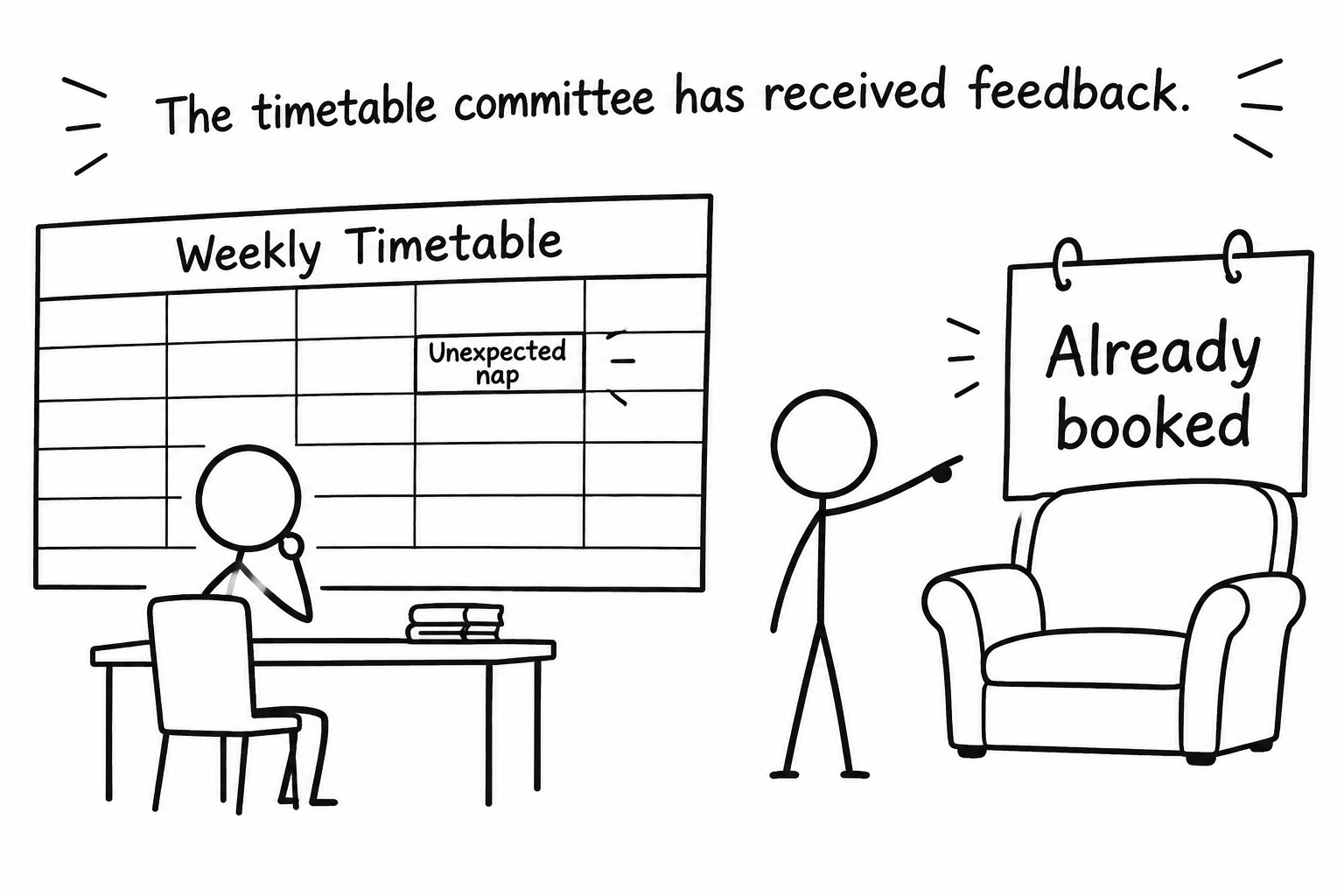 A stick-figure student receives feedback from the timetable committee about scheduling an unexpected nap
Use a simple revision cycle
Refresh your understanding
Use a revision lesson, video solution or concise notes to clarify the topic. Keep enough time to apply what you have reviewed. Watching an explanation can help, but you still need to find out whether you can work independently.
Retrieve and practise
Close the notes and produce something from memory: explain a process, recall a formula or answer exam questions. If you get stuck, identify the missing step before checking the explanation.
Check and return
Mark your work and record the precise error. Was it a misunderstood method, an arithmetic slip or a missed instruction? Your next task should address that cause.
Return to the topic on another day. The guide to spaced repetition explains how to spread reviews across separate sessions.
When ready, use Edexcel GCSE maths past papers or Edexcel A Level maths past papers. Check that resources match your qualification and exam board. A carefully corrected section can be a useful session when a full paper feels unrealistic.
Protect sleep and recovery
Put sleep and essential commitments into the timetable before allocating revision. Suhoor, prayer and family routines may divide the night, so consider your whole day's rest when choosing sessions. A short nap may suit your routine, but avoid treating every available gap as revision time.
Keep a weekly buffer for unfinished work or an unexpectedly tiring day. If nothing needs catching up, use it for rest or a brief review.
If tiredness persists or you feel unwell, tell a trusted adult. Seek appropriate healthcare advice about medical conditions or medication; a revision timetable cannot resolve those questions.
Common Ramadan revision mistakes
Keeping your old timetable unchanged. Move sessions to reflect your current commitments and energy.
Saving difficult work for your tiredest period. Give demanding questions your clearest available attention.
Relying on rereading. Include recall, practice and correction so you can see what you understand.
Recovering every missed session immediately. Use the buffer or replace a lower-priority task instead of doubling tomorrow's workload.
Build a schedule you can follow
Amina's plan becomes more manageable when it reflects her actual routine. Start with your fixed commitments, choose one clear task for each session, and review the pattern after a few days. Use MathsGenie's free revision lessons, practice questions and mark schemes to make those sessions purposeful, then build your Ramadan schedule in the revision planner linked above.