

How to Plan A-Level Maths Revision Alongside UCAS
Learn how to plan A-Level Maths revision alongside UCAS with a realistic weekly schedule, focused practice and time for application deadlines and feedback.
Imagine a Year 13 student, Sam, opening a personal statement draft after school. There is maths homework to finish, a mock approaching and another university course to compare. Every task feels urgent because none has a clear place in the week.
The practical answer to how to plan A-Level Maths revision alongside UCAS is to put both commitments in one calendar, work backwards from application deadlines and protect a manageable minimum of maths practice. Give each session a specific output, then review the plan weekly.
Sam is a hypothetical student, but the problem is familiar: an application has visible deadlines, while gaps in mathematical understanding can grow quietly. Your plan needs to make both visible.
Start with the commitments you cannot move
Before allocating revision, collect the information that determines your available time:
- Your school or college’s internal UCAS deadline.
- The UCAS deadline for your entry year and chosen courses.
- Mock exams, assessed work and homework deadlines.
- Admissions tests or interviews, where relevant.
- Lessons, employment, caring responsibilities and time to rest.
Check application dates directly with UCAS and your school. An internal deadline may be earlier than the UCAS deadline because staff need time to check applications and complete references. Avoid copying dates from an older student’s timetable.
For Sam, this changes the question from “When will I finish UCAS?” to “What needs to be ready before the school checks my application?” That is a task you can schedule.
If you are still at GCSE, the same approach works for sixth-form applications. You do not need to begin a UCAS application simply because you are considering A Levels.
How to plan A-Level Maths revision alongside UCAS
Give UCAS tasks an endpoint
“Work on my application” can consume an evening without producing a clear result. Break it into tasks such as comparing course requirements, drafting one personal statement response or checking your education details.
The current UCAS personal statement uses three questions. Treat each response as a separate drafting task, then allow time to review the application as a whole. Book a feedback session with your adviser early enough to make changes afterwards.
For each task, write down what finished means. “Record the entry requirements for my shortlisted courses” is clearer than “research universities”. When the task is complete, stop rather than drifting into another hour of browsing.
Protect a minimum maths week
Choose a baseline you could maintain during a busy application week. Three focused sessions might be a sensible starting point, but adjust this around your other subjects, current understanding and teachers’ advice.
Keep homework visible too. It takes time, but completing this week’s exercises does not necessarily revisit material you struggled with last term. Use MathsGenie’s A Level Maths revision resources to identify topics from your specification that need another attempt.
A workable week could look like this:
| Slot | Task | Clear finishing point |
|---|---|---|
| Monday, 40 minutes | Revise one weak pure maths topic | Attempt questions, mark them and record one correction |
| Tuesday, 45 minutes | Draft one UCAS response | Produce a draft ready for feedback |
| Thursday, 40 minutes | Practise statistics or mechanics | Complete and review a short question set |
| Saturday, 50 minutes | Attempt mixed maths questions | Identify the next topic to revisit |
| Sunday, 15 minutes | Review the week | Move unfinished priorities and confirm deadlines |
These timings are suggestions, not a required workload. Leave an unallocated slot where possible, and include your other A Levels before deciding the timetable is realistic. Maths homework and revision should not quietly occupy every remaining evening.
Build your maths schedule in the Revision Planner once you have identified the UCAS commitments it needs to fit around.
For the wider planning method, the revision timetable pillar guide explains how to create a realistic weekly structure. Its examples focus on GCSE, but the principle of matching tasks to available time also applies here.
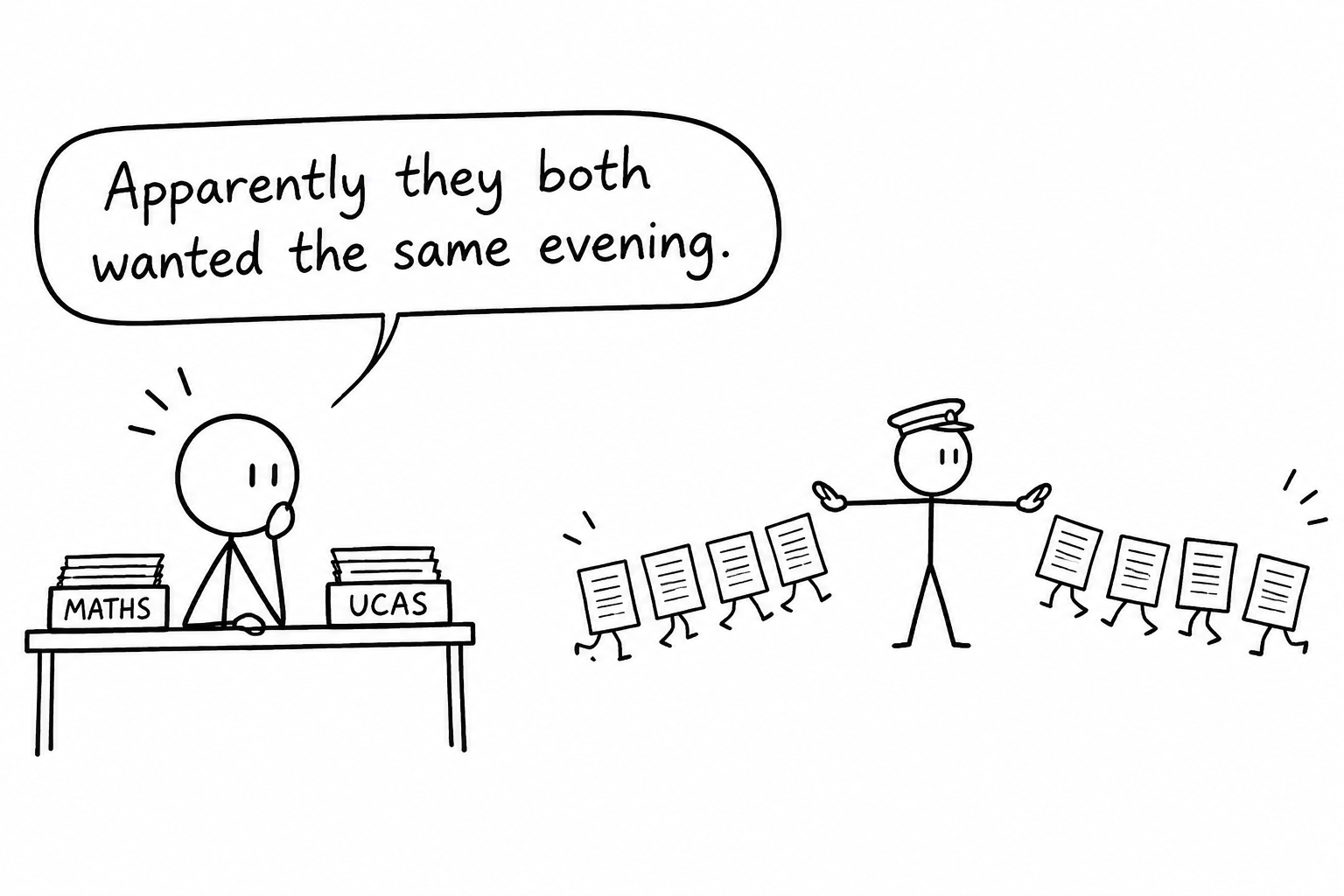 A stick-figure student watches a tiny traffic warden direct competing maths and UCAS paperwork.
Make each maths session produce evidence
A useful study technique should show you what you can do independently. Begin by attempting a question without notes. If you get stuck, identify the precise obstacle before opening a revision lesson or video solution.
Then close the explanation and try again. Mark your work and record the error briefly: choosing a method, recalling a fact, interpreting the question or carrying out the algebra. That diagnosis determines your next session more reliably than how familiar the page looks.
Use resources matching your exam board. For example, students taking that specification can organise practice through Edexcel A Level Maths revision. Keep pure maths, statistics and mechanics in view so that a favourite area does not absorb all your time.
Return to difficult material after a gap. A short attempt later in the week can reveal whether you understood the correction or merely remembered the solution. The related one-month maths revision plan gives GCSE students a shorter planning structure built around practice and review.
Adjust the balance as deadlines approach
During an application deadline week, Sam might replace one longer maths session with a brief retrieval task while keeping the other sessions. This is a temporary adjustment with an end date, rather than abandoning maths until UCAS feels finished.
Once the application is submitted, reassign those slots deliberately. Closer to mocks, use timed sections and eventually full papers from the relevant specification. For Edexcel students, A Level Maths past papers and mark schemes provide material for this stage.
Marking belongs inside the scheduled session. A completed paper without review tells you much less about what to practise next.
Common mistakes that make the week harder
Planning every spare minute. A timetable with no room for delayed feedback, difficult homework or tiredness will need constant repair. Leave some flexibility.
Polishing UCAS indefinitely. Agree a review point with your adviser and make purposeful changes. Repeatedly rewriting a sentence can displace maths without improving the application.
Treating missed sessions as debt. Do not automatically double tomorrow’s workload. Move the most valuable unfinished task and drop something less urgent.
Counting hours instead of outcomes. “Reviewed my mistakes in a mechanics question set” tells you more than “did an hour of maths”. Use that evidence in your weekly review.
Build a schedule that fits both commitments
For a student like Sam, moving the maths plan from paper into the Revision Planner gives those sessions a place alongside application commitments; the weekly review still matters. You now have the structure, and the next step is making it fit the time you actually have. Build your A Level Maths schedule around your UCAS commitments in the Revision Planner.















