How to Get a Grade 8 in GCSE English Language
How to get a grade 8 in GCSE English Language: build stronger analysis, precise writing and effective timed-paper habits with this practical revision plan.
A grade 8 can feel frustratingly difficult to define. In maths, an answer is right or wrong. In English Language, two responses may contain similar ideas yet earn very different marks because one explains them with greater precision.
The short answer to how to get a grade 8 in GCSE English Language is this: understand exactly what each question assesses, practise producing complete responses under timed conditions, and use mark schemes and feedback to improve specific weaknesses. Reading more notes may increase familiarity, but grades usually move when you write, receive useful feedback and rewrite.
Grade 8 is not awarded for using the longest words or spotting the greatest number of techniques. It comes from perceptive reading, developed evaluation, controlled comparison and writing that is deliberately shaped for its audience and purpose.
Your grade 8 revision checklist
A productive revision system should include:
- your exam board's current specification and question format
- a clear plan for each reading question
- regular analysis of unfamiliar fiction and non-fiction
- timed descriptive, narrative and transactional writing
- accurate spelling, punctuation and grammar
- official mark schemes, model responses and examiner reports
- an improvement log recording recurring weaknesses
- full-paper practice before the real examination
GCSE English Language is untiered, unlike GCSE Maths, so every candidate can access the highest grades. However, grade boundaries are not fixed permanently. Awarding organisations set them after each examination series, reflecting the difficulty of that paper and the available evidence. Focus on producing grade 8-quality work rather than chasing a remembered boundary from another year.
Learn what your exam board actually rewards
AQA, Edexcel, OCR and Eduqas do not organise their papers in exactly the same way. The extracts, question order, marks and recommended timings can differ. Before learning a strategy from a video or revision guide, check that it matches your qualification.
Across the specifications, students are assessed on closely related abilities: retrieving and interpreting information, analysing language and structure, comparing viewpoints, evaluating texts, communicating clearly, and using vocabulary, sentences, spelling and punctuation accurately. Spoken Language is reported separately as an endorsement and does not contribute to the numerical GCSE grade.
Turn your specification into a one-page map. For every question, record:
- what the instruction word requires
- which assessment skill is being tested
- how many marks are available
- how much evidence is normally useful
- a sensible time limit
- the mistake you are most likely to make
This removes a hidden source of lost marks: answering the text generally instead of answering the particular question.
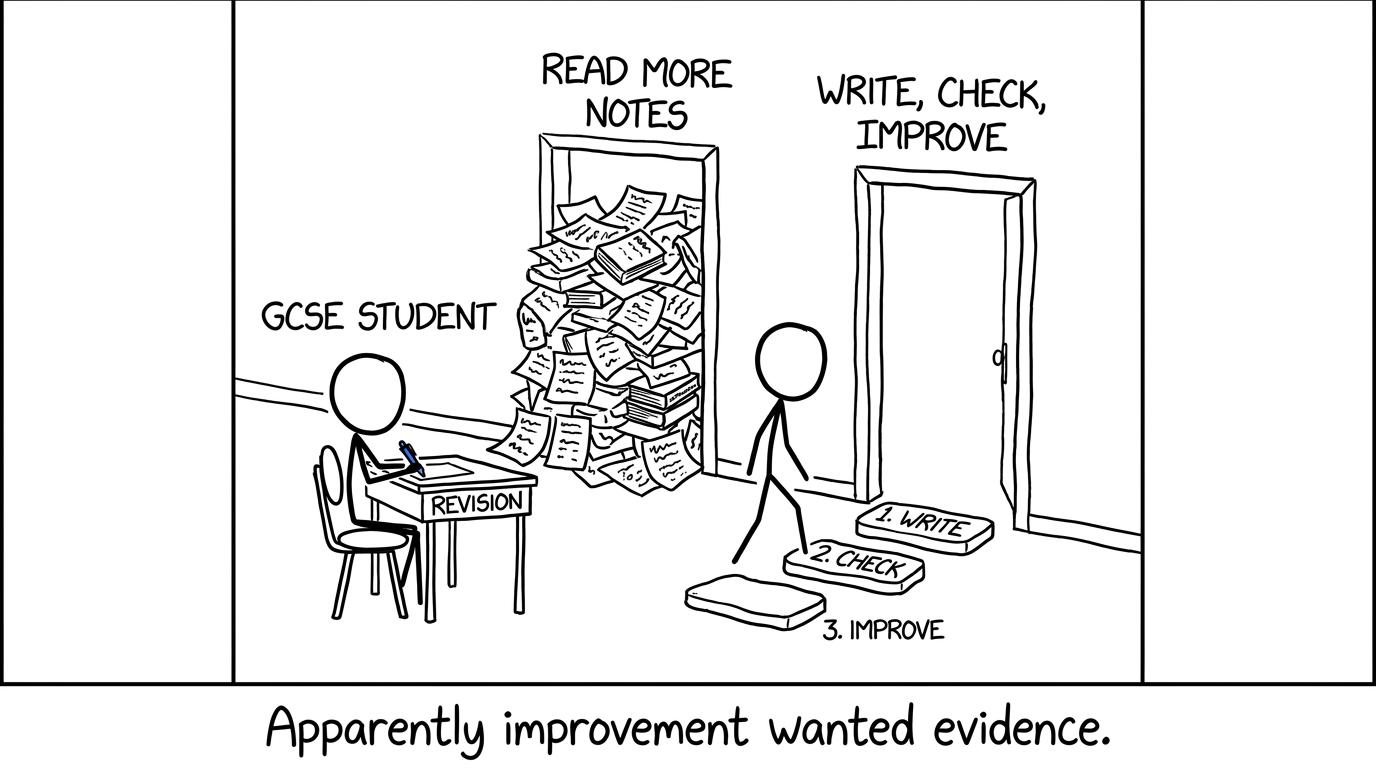 A student choosing active improvement instead of another pile of notes
Replace passive revision with a feedback loop
Highlighting terminology feels productive because it is tidy. Unfortunately, the examination does not ask whether you recognise the word “metaphor”. It asks whether you can explain how a writer creates meaning and respond convincingly within limited time.
A stronger revision loop has four stages:
- Attempt: answer a real question without looking at notes.
- Check: compare the response with the mark scheme and relevant exemplars.
- Diagnose: identify one precise limitation, such as undeveloped effects or weak paragraph links.
- Improve: rewrite the weakest section while the feedback is still clear.
This is the same deliberate structure behind effective GCSE Maths revision lessons: learn the method, attempt questions, check the solution and return to the gap. English answers are less binary, but improvement still depends on visible evidence.
Keep an error log rather than a folder of completed papers. “Need better analysis” is too vague to change your behaviour. “I identify language but do not explain how the reader's impression changes” gives you something actionable to practise.
Make reading analysis precise rather than decorative
Grade 8 analysis moves beyond naming a device. It develops an interpretation and shows how the writer's choices support it.
Before writing, ask three questions:
- What impression, emotion or viewpoint is being created?
- Which precise detail creates it?
- Why is that choice effective at this moment in the text?
The quotation should be evidence for an idea, not the starting gun for a list of terminology. Select short, rich details that allow close discussion. Explore connotations only when they genuinely fit the context, and consider alternative interpretations when they are plausible rather than forced.
Structure matters too. Look for shifts in focus, pace, perspective, setting, chronology or emotional intensity. Do not merely announce that the focus changes. Explain what the reader notices before the shift, what becomes important afterwards and why that movement matters.
For evaluation questions, make a clear judgement and sustain it. Agreement alone is not evaluation. Test the statement against carefully chosen evidence, consider the writer's methods and explain the extent to which the interpretation is convincing.
Treat comparison as a relationship between texts
Students often write about the first source, then the second, and add one comparative word at the end. That produces two analyses, not a developed comparison.
A stronger paragraph begins with a genuine relationship: both writers may distrust authority, for example, but one might sound openly confrontational while the other uses restrained irony. Evidence and analysis should then support that contrast.
Compare viewpoints, methods and tone throughout the response. Keep returning to the exact focus of the question. The goal is not to find identical techniques; it is to explain how two writers shape related ideas differently.
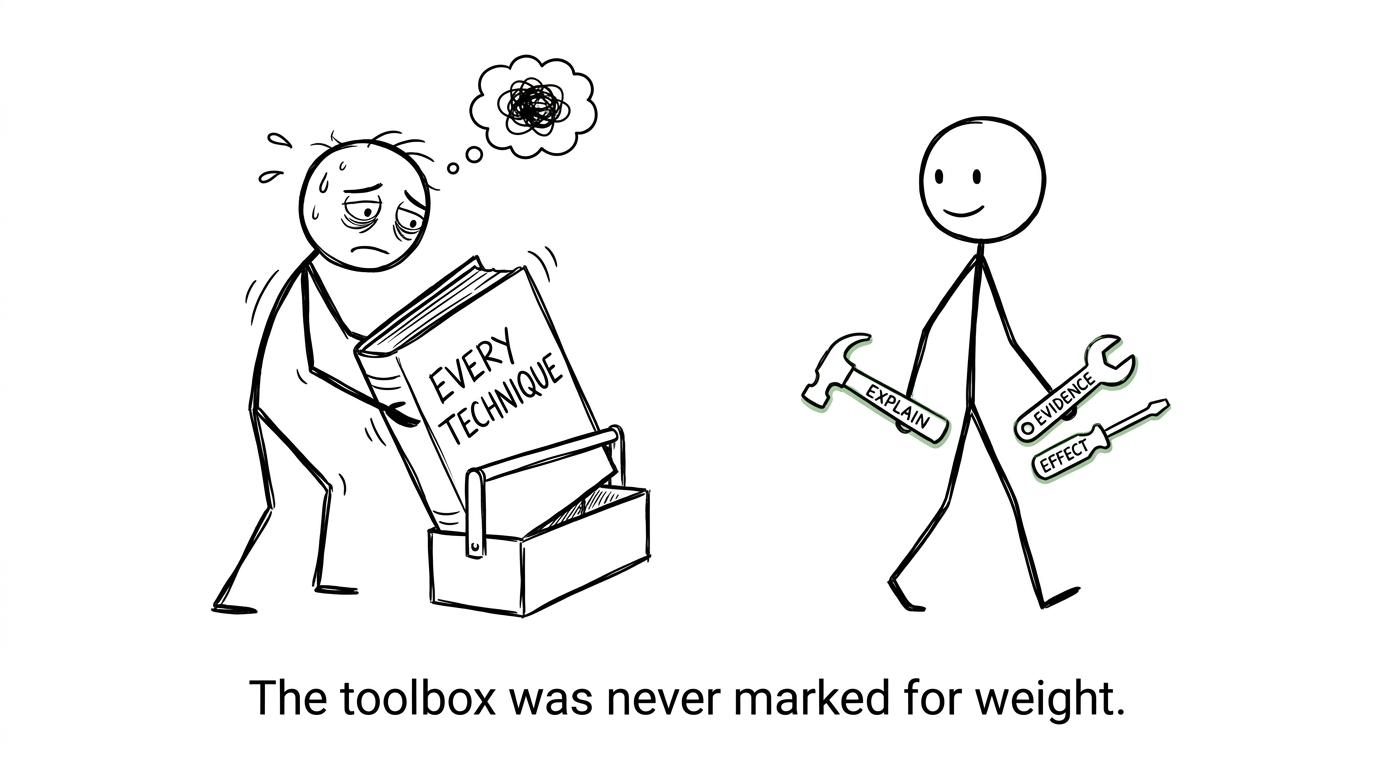 A calm student carrying a useful analytical toolbox
Build writing around purpose, not impressive vocabulary
High-level creative and transactional writing feels controlled. The writer knows what the reader should notice, feel or believe.
Improve creative writing
Prepare flexible craft choices rather than memorising an entire story. Useful choices include a controlled shift in focus, a recurring image, contrast, varied paragraph lengths and a deliberate ending. A small, well-observed moment is often easier to control than an elaborate plot containing several characters and sudden disasters.
Vocabulary should be precise. An unusual word used inaccurately weakens the writing, whereas a familiar word chosen carefully can create a sharp image. Vary sentences because the meaning demands it, not because a checklist says every paragraph needs a one-word sentence.
Improve transactional writing
Identify the audience, form and purpose before drafting. A speech should sound speakable; an article needs a clear relationship with its reader; a letter should maintain an appropriate register. Develop a small number of convincing ideas instead of racing through many unsupported claims.
Leave time to proofread. At the highest levels, technical accuracy and communication work together. Check sentence boundaries, apostrophes, commonly confused words, paragraphing and whether your tone remains consistent.
Practise under conditions that reveal the truth
Untimed practice is valuable while learning, but it can hide slow planning and overlong paragraphs. Introduce time pressure gradually:
- plan one response within a short limit
- write one paragraph under timed conditions
- complete one question without notes
- attempt one paper section
- complete a full paper in the official time
Use the timings recommended by your teacher or exam board because paper structures vary. During practice, record where you finished and which section became rushed. Adjust your plan from evidence rather than instinct.
This approach will feel familiar if you already use GCSE past papers for maths. Past papers are not simply tests saved for the final week. They are diagnostic tools. For English, obtain the correct official papers, inserts, mark schemes and examiner material for your board through your school or awarding organisation.
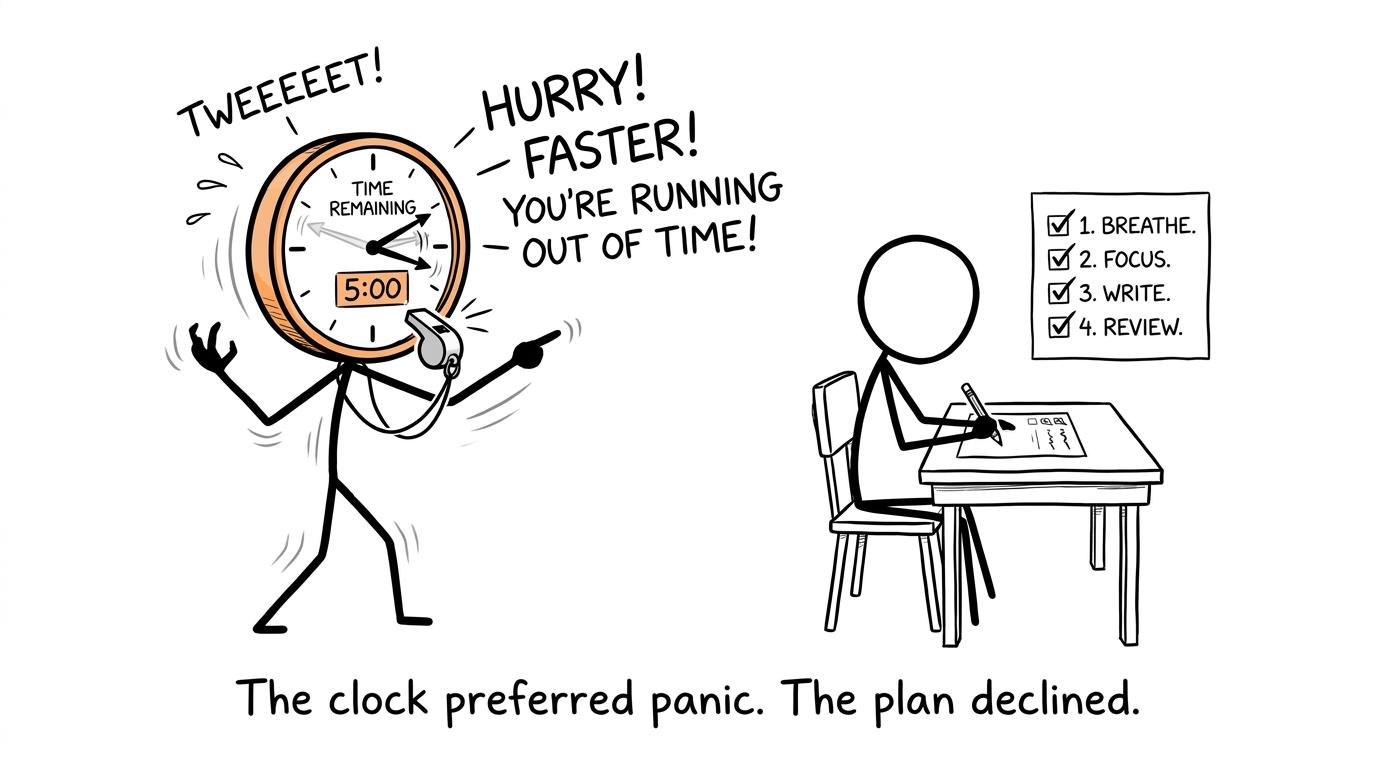 An exam clock failing to persuade a prepared student to panic
Use a weekly routine you can sustain
A grade 8 is more likely to grow from repeated, focused practice than one heroic weekend. A balanced week might contain:
- one close-reading task
- one structure, comparison or evaluation task
- one writing plan
- one timed writing response
- one proofreading drill
- one feedback and rewriting session
Rotate the weakest skill rather than repeatedly practising your favourite question. Schedule the sessions in advance, just as you would with a GCSE revision planner. Short tasks also work well alongside Maths Genie mini tests, helping you revise both subjects without allowing either to consume the entire evening.
Common mistakes that hold students below grade 8
Memorising responses
A memorised story or analysis may not answer the actual task. Prepare adaptable methods and vocabulary, but respond to the wording and material in front of you.
Listing techniques without explaining meaning
Terminology earns little by itself. Connect the choice to an interpretation, support it with precise evidence and explore its effect in context.
Writing everything you notice
More observations do not automatically mean more marks. Select the strongest evidence and develop it. Depth is usually more persuasive than a catalogue of disconnected comments.
Ignoring part of the question
Underline the focus, audience, purpose and instruction word. Return to them while writing, particularly in longer evaluation, comparison and composition tasks.
Treating proofreading as optional
A promising piece can lose control through fragments, comma splices, inconsistent tense or unclear paragraphing. Protect a final checking period and proofread for one issue at a time.
Completing papers without reviewing them
Practice only changes performance when you learn from it. Mark the response, read the feedback and improve part of it. Saving a paper in a folder is not the same as closing the gap.
Turn the ambition into a system
The difference between hoping for a grade 8 and preparing for one is usually a system. Know the paper. Write frequently. Diagnose the weakness. Improve the response. Then repeat the process with a new text.
MathsGenie specialises in free GCSE and A Level maths rather than English Language, but the revision discipline transfers directly. Use Maths Genie for revision lessons, practice questions, video solutions and mark schemes, then apply the same learn-practise-check-improve cycle to English. As examinations approach, combine official English materials with Maths Genie's predicted maths papers, past papers and revision planner. A strong timetable does not ask you to choose between subjects. It gives each one the focused practice it deserves.