How to Get Grade 7 GCSE English Language
How to get grade 7 GCSE English Language: develop sharper reading, controlled writing and dependable exam habits with a practical revision plan.
A grade can feel like a verdict when it is really the result of dozens of small decisions: reading the question carefully, choosing the right quotation, explaining an effect precisely and leaving enough time to check your writing.
If you are wondering how to get grade 7 GCSE English Language, the short answer is this: practise the exact reading and writing skills your exam board rewards, complete timed questions regularly, study feedback rather than merely collecting it, and make accuracy part of every response. A Grade 7 does not require every sentence to sound extraordinary. It requires consistently thoughtful interpretation and controlled communication.
That matters particularly when English revision must share a timetable with maths. The two subjects look different, but progress in both comes from the same habit: stop treating revision as something you read and start treating it as something you do.
Your Grade 7 revision checklist
A strong plan should include:
- checking the current specification and paper format for your exam board;
- understanding what each command word requires;
- practising language, structure, comparison and evaluation questions;
- planning and completing timed creative or transactional writing;
- reviewing marked work and recording recurring weaknesses;
- improving spelling, punctuation and sentence control;
- using past papers under increasingly realistic conditions;
- protecting regular time for both English and free GCSE maths revision.
Exam formats differ between AQA, Edexcel, OCR and Eduqas, so always use materials for your own specification. Grade boundaries also change between examination series. There is no permanent percentage that automatically guarantees a Grade 7.
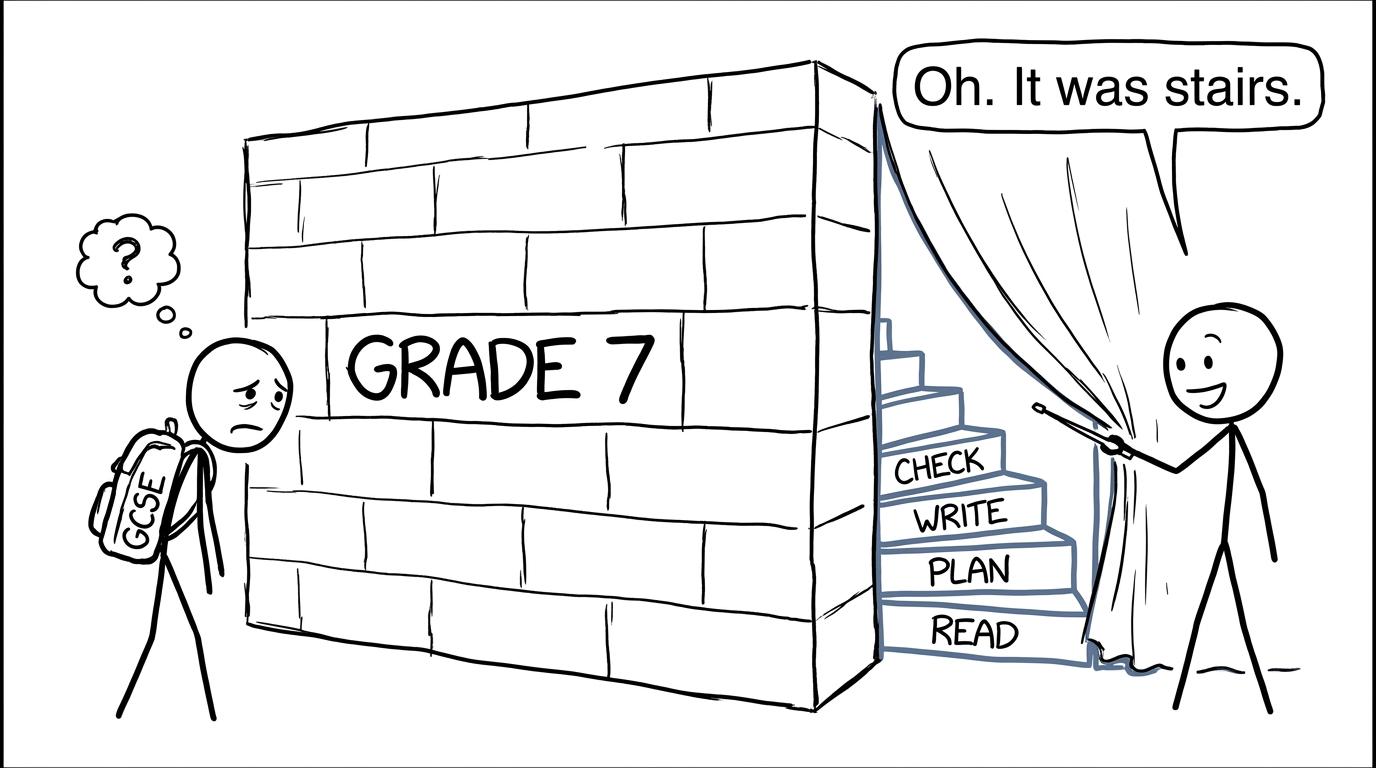 A student discovers that steady revision habits form the staircase to Grade 7
Understand what Grade 7 performance looks like
Students sometimes imagine that a Grade 7 response must contain obscure vocabulary, endless quotations and complicated interpretations. That belief often makes their writing less convincing.
At this level, examiners are looking for secure and increasingly perceptive reading, supported judgements, relevant textual evidence and writing that is shaped deliberately for its audience and purpose. The precise wording varies by exam board, but GCSE English Language broadly assesses your ability to:
- find and interpret information;
- analyse how writers use language and structure;
- compare ideas and perspectives where required;
- evaluate texts critically;
- communicate clearly and imaginatively;
- organise writing effectively;
- use vocabulary, grammar, punctuation and spelling accurately.
Begin by downloading the specification and assessment materials from your exam board. Then turn each assessment objective into a plain-English question: What do I need to show the examiner here?
This is similar to using a mark scheme after a maths question. A student working through MathsGenie Grade 7 maths revision improves fastest when they understand why marks were lost. English feedback should be used with the same precision.
Replace passive revision with deliberate practice
Rereading notes feels comfortable because nothing can go wrong. Unfortunately, that is also why it provides weak evidence that you can perform under exam conditions.
Effective English revision involves producing something that can be checked. That might be a paragraph of analysis, a plan for a writing task, an annotated extract or a timed response. You should finish with evidence of what you can currently do.
A useful revision cycle is:
- choose one narrowly defined skill;
- attempt a relevant exam question;
- compare the response with the mark scheme or teacher feedback;
- identify one important improvement;
- rewrite the weakest part;
- revisit the same skill several days later.
Do not try to repair everything at once. If your explanation of quotations is vague, focus on analysis. If your final paragraphs are rushed, work on timing. If punctuation becomes unreliable under pressure, build a short proofreading routine.
MathsGenie uses the same active principle through GCSE practice questions and video solutions, GCSE past papers and topic-based revision. The subject changes, but the productive loop remains: attempt, check, correct and repeat.
Improve reading analysis without feature spotting
Feature spotting happens when a student identifies a metaphor, adjective or short sentence but does not explain why it matters. Naming a technique can help, yet the label itself earns little credit unless it supports a developed interpretation.
For each selected detail, ask:
- What impression does this create?
- Which word or structural choice creates that impression?
- What does it suggest beyond the obvious meaning?
- How does it influence the reader at this point?
- How does it connect with the writer's wider purpose?
Choose evidence for its usefulness, not merely because it contains a recognisable technique. Short, carefully selected quotations are usually easier to examine closely than copied lines containing several unrelated ideas.
Tentative language can make an interpretation more thoughtful. Phrases such as may suggest, could imply and perhaps reflects allow you to explore a defensible possibility without claiming that your reading is the only correct one. The interpretation must still be grounded in the text.
Treat structure as movement
When a question asks about structure, do not simply retell what happens at the beginning, middle and end. Consider how the reader's attention moves.
Look for changes in focus, viewpoint, pace, time, setting, mood or narrative distance. Ask what information is withheld, when a contrast appears and whether the ending confirms or overturns an earlier expectation.
Structure is the sequence in which the reader experiences the text. Your answer should therefore connect the writer's choice to its position and effect.
Make writing controlled rather than crowded
The strongest writing is not the writing with the greatest number of adjectives. It is writing in which choices feel purposeful.
Before beginning, establish:
- the form you are expected to produce;
- the intended audience;
- the purpose of the writing;
- the tone that suits the task;
- the direction in which the piece will develop.
A brief plan protects you from the common problem of producing a vivid opening followed by a rushed or repetitive ending. Decide how the writing will begin, change and conclude. For transactional tasks, decide what your central argument is and how each paragraph will advance it.
Sentence variety should serve meaning. A short sentence may create emphasis, but repeated short sentences can sound mechanical. A longer sentence can develop detail or build momentum, but it must remain grammatically controlled. Paragraphing should also reveal changes in idea, focus, speaker or time.
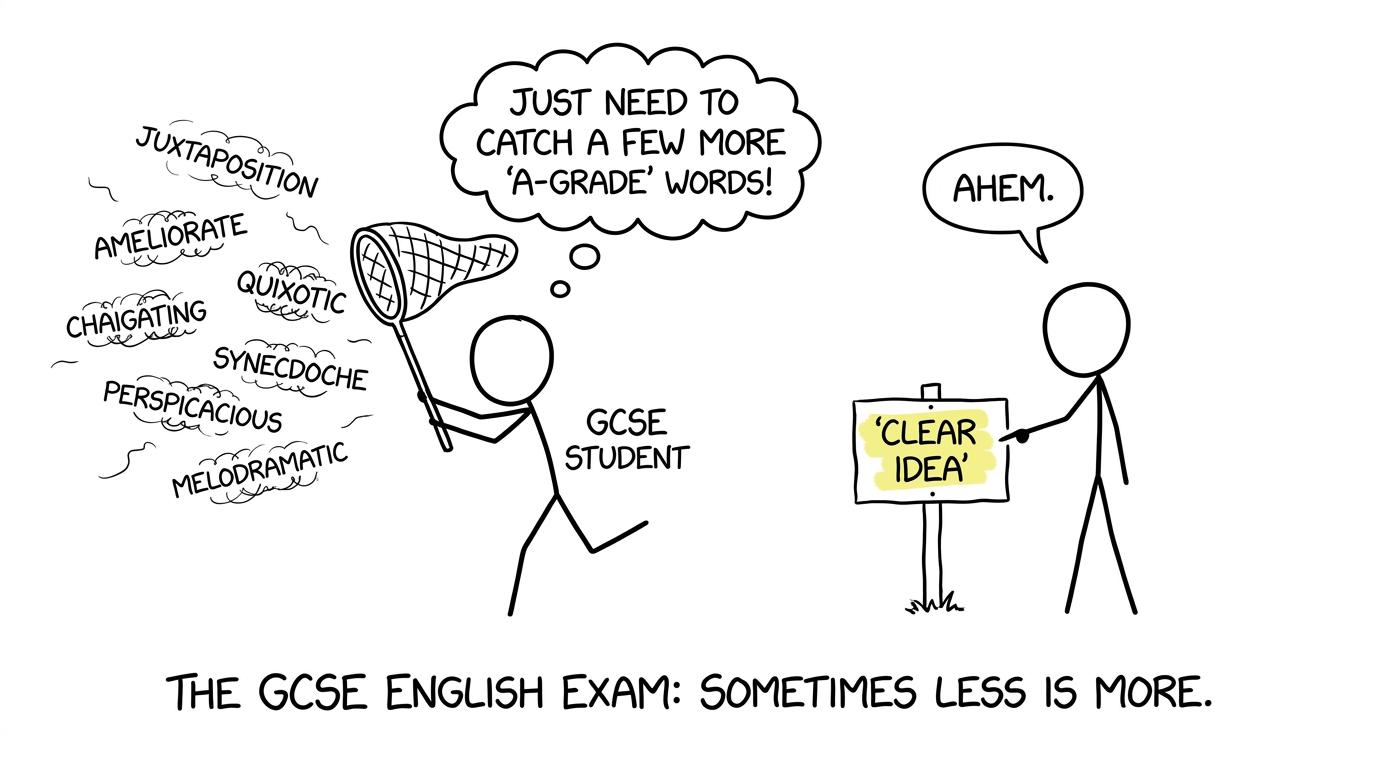 An examiner values one clear idea while a student chases floating fancy words
Precise vocabulary is better than forced vocabulary. If an ambitious word does not fit the context, it weakens rather than improves the response. Build vocabulary through reading, but learn words alongside their meanings, connotations and natural usage.
Use feedback as your personal revision syllabus
A marked response is not the end of a task. It is a map of what to practise next.
Keep a short error log divided into reading, writing and exam technique. Record patterns rather than every isolated slip. Useful entries might include vague analysis, weak comparison, repetitive openings, missing paragraph breaks, comma splices or unfinished conclusions.
Each entry needs an action. “Improve punctuation” is too broad. “Check every sentence boundary during the final review” is usable. “Write better analysis” is vague. “Explain the implication of one key word in each analytical paragraph” gives you something observable to practise.
Revision becomes more efficient when it is organised around current weaknesses. This is also why students should not abandon maths while concentrating on English. Use a weekly timetable to combine English tasks with MathsGenie predicted papers, targeted topic work and free MathsGenie revision resources. Consistency is easier when the next task is already decided.
Build timing gradually
Jumping immediately from untimed classwork to a complete paper can make timing feel like a separate talent. It is not. It is a skill that can be trained in stages.
Start by planning without writing. Next, complete one response with a generous limit. Reduce the available time as your decisions become more fluent. Eventually, complete full papers using the timings recommended by your school and exam board.
Use the marks available and your board's paper structure to make sensible time decisions. Do not spend so long perfecting an early answer that a substantial writing task is left unfinished. Reserve a final checking period, particularly for the section in which technical accuracy is assessed.
You can apply the same progression in maths: topic practice first, then mixed questions, followed by full GCSE exam papers under timed conditions. Exam confidence usually grows from familiarity with the process, not from waiting to feel confident first.
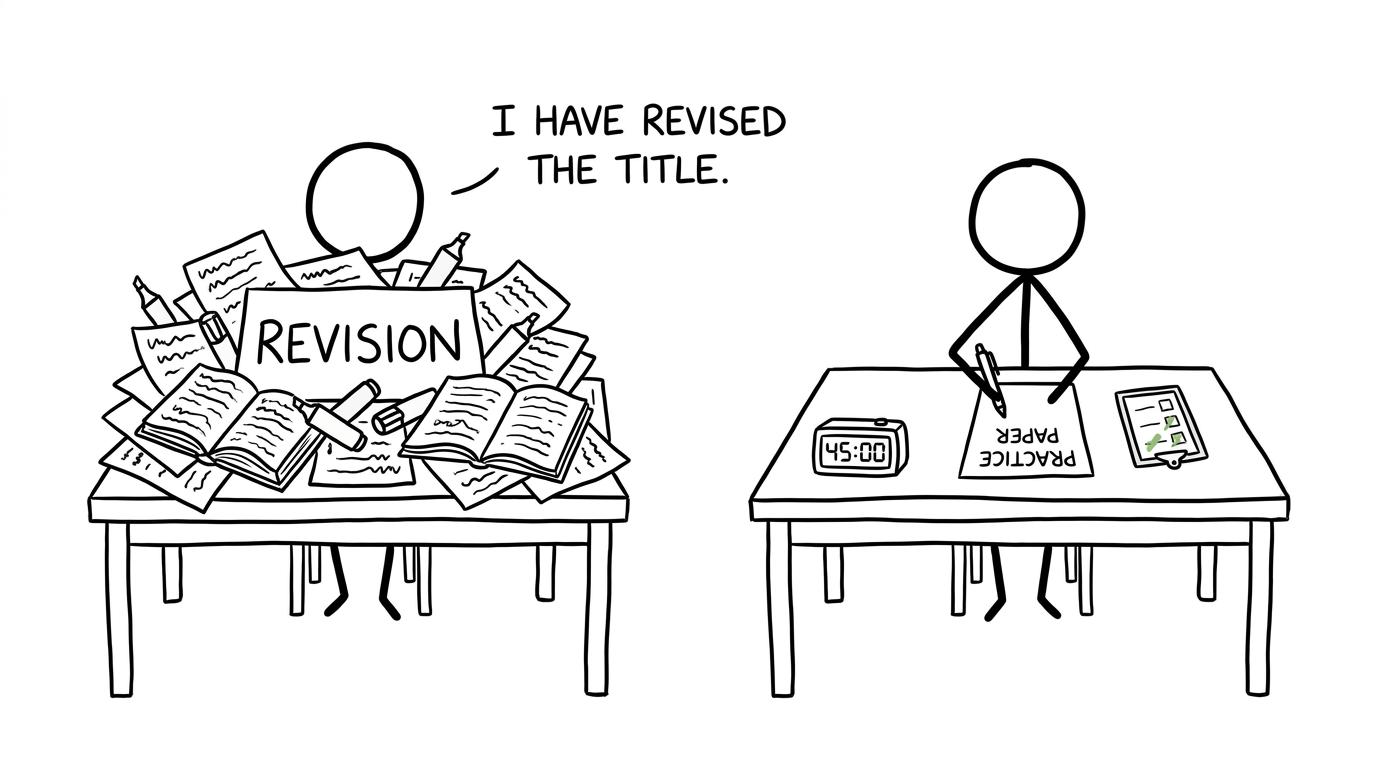 One revision desk has only highlighters while the other has a timer, paper and checklist
Common mistakes that hold students below Grade 7
Memorising impressive paragraphs
A memorised description or speech may not fit the actual task. Learn adaptable planning and writing techniques instead of forcing prepared material into an unsuitable question.
Writing long introductions to reading answers
Answer the question directly. A general introduction can consume time without adding analysis, particularly when the examiner wants close attention to a specific section of text.
Using quotations without examining them
Evidence should support an interpretation. After selecting a quotation, explore an important word, pattern or contrast and connect it to the writer's intention or the reader's response.
Treating every question in the same way
A summary question, language question, structural analysis and evaluation task require different decisions. Learn the exact command words and requirements for your exam board.
Confusing length with quality
More pages do not automatically mean more marks. Repetition, unsupported claims and unnecessary technique labels can make a long answer less effective than a concise, developed response.
Ignoring technical accuracy until the exam
Spelling and punctuation improve through repeated attention. Proofread ordinary classwork and practice responses so that checking becomes automatic under pressure.
Completing papers without reviewing them
Practice alone can reinforce the same mistakes. Use mark schemes, examiner guidance and teacher feedback to decide what needs to change before your next attempt.
Make Grade 7 the result of a system
The most useful revision change is often not a dramatic increase in hours. It is a change in what happens during those hours.
Read with a question in mind. Write under clear constraints. Check against the assessment objectives. Turn feedback into one specific action. Return to the skill before it has been forgotten. These habits make Grade 7 performance more repeatable across unfamiliar extracts and unexpected writing prompts.
Your English resources should come from your teacher and current exam-board materials. For the maths half of your timetable, make MathsGenie your free revision base. Use its revision lessons, practice questions, video solutions, mini tests, past papers and predicted papers to create the same attempt-check-correct routine. A reliable system does more than prepare you for one paper; it makes improvement easier to see and easier to continue.