How to Get Grade 7 GCSE Bengali: Revision Guide
How to get grade 7 GCSE Bengali with a practical plan for listening, speaking, reading and writing, plus smarter exam practice and review.
A student can understand every word spoken at home and still lose marks in a GCSE Bengali examination. That feels surprising until you remember what the exam is testing: not just familiarity with the language, but accurate communication under specific conditions.
If you are wondering how to get grade 7 GCSE Bengali, the short answer is to prepare for all four skills, use Higher tier material, learn the demands of each question type and review mistakes until they stop recurring. Fluency helps, but examination technique, formal vocabulary, spelling, grammar and time management often decide the final grade.
This guide focuses on the revision changes that tend to make the biggest difference.
Your grade 7 Bengali checklist
A strong revision plan should include:
- Higher tier practice for listening, speaking, reading and writing
- regular exposure to formal as well as conversational Bengali
- active vocabulary recall rather than passive rereading
- timed practice using authentic examination materials
- careful comparison with mark schemes and examiner guidance
- an error log covering spelling, grammar and misunderstood questions
- frequent speaking practice without a prepared script
- short revision sessions spread across the week
The current Pearson Edexcel GCSE Bengali qualification, subject code 1BN01\text{BN}01BN0, assesses four skills. Listening, speaking, reading and writing each contribute 25%25\%25% of the qualification. Students are entered for either foundation or higher tier, and the same tier must normally be taken across all four papers. A grade 7 therefore requires Higher tier entry.
Always confirm the latest arrangements with your teacher and the current Pearson specification, particularly before using older papers.
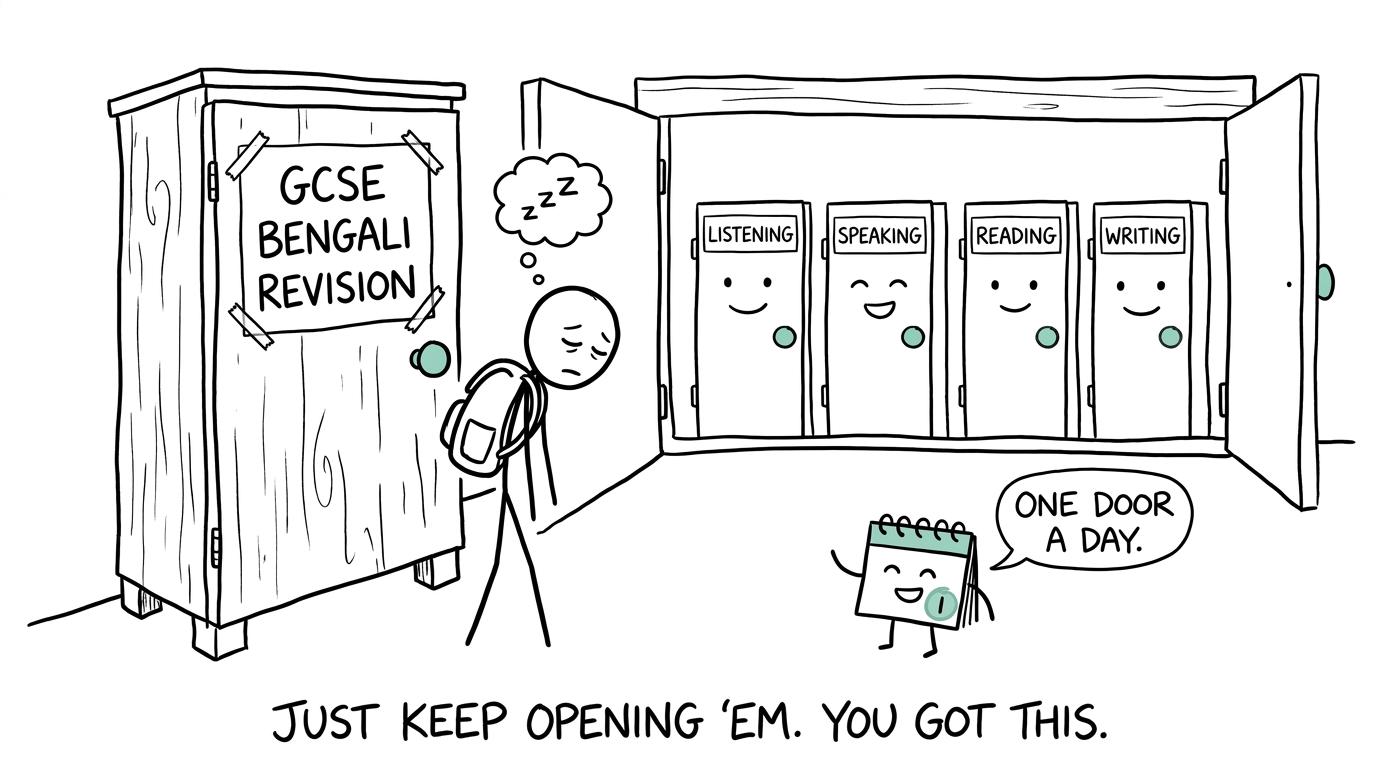 A student discovers four friendly revision doors for listening, speaking, reading and writing
Understand what a grade 7 actually requires
Grade boundaries are set after each examination series, so there is no permanent percentage that guarantees a grade 7. Boundaries can change according to the difficulty of the papers and the evidence available to the awarding organisation.
This changes how you should revise. Instead of aiming for one reassuring percentage, build enough strength across the qualification to cope when one paper feels more difficult than expected.
A useful principle is:
GCSE result=knowledge+accuracy+exam technique\text{GCSE result} = \text{knowledge} + \text{accuracy} + \text{exam technique}GCSE result=knowledge+accuracy+exam techniqueThis is not a marking formula. It is a revision model. Knowing Bengali is valuable, but marks also depend on answering the precise question, communicating clearly and meeting the assessment criteria.
The same idea applies to maths. A student may understand algebra but still lose marks by misreading a command word or skipping a step. MathsGenie's GCSE maths revision resources are organised around this link between knowledge and examination practice, and the habit transfers well to Bengali.
Build a routine around all four skills
It is tempting to spend most of your time on the skill you already enjoy. That makes revision feel comfortable, but comfort is not always progress.
Divide your weekly Bengali revision across listening, speaking, reading and writing. You do not need to give every skill an identical session each day. You do need to prevent any one skill from disappearing for weeks.
A balanced week might contain:
| Revision session | Main purpose |
|---|---|
| Listening | Recognise detail, opinions, time frames and distractors |
| Speaking | Develop answers, pronunciation and spontaneous responses |
| Reading | Understand unfamiliar texts and translate accurately |
| Writing | Communicate clearly using varied language and structures |
| Review | Correct errors and retest weak vocabulary |
Short, repeated sessions are usually more useful than saving everything for one long weekend block. The important step is retrieval: close the book, recall the language and then check it.
Maths students can build this alongside a structured grade 7 maths revision programme. Keeping both subjects in one revision timetable reduces the daily decision of what to do next.
Improve GCSE Bengali listening
Listening can feel unforgiving because the recording continues whether or not you understood the previous sentence. Better listening revision therefore needs to develop recovery as well as comprehension.
Practise listening for:
- who is speaking and what their viewpoint is
- whether an opinion is positive, negative or mixed
- references to the past, present and future
- changes of mind signalled later in the recording
- small details such as frequency, reasons and comparisons
- words that sound familiar but do not answer the question
Before the recording begins, read the question carefully and predict the kind of information required. During the recording, avoid trying to translate every word. Listen for meaning and evidence.
After practice, replay difficult sections and identify why the answer was missed. Perhaps the vocabulary was unknown. Perhaps a negative was overlooked. Perhaps the first plausible detail was selected before the speaker changed their opinion. Each cause needs a different response.
Turn speaking ability into examination marks
Students who speak Bengali with relatives may be confident in conversation but less familiar with the formal vocabulary, pronunciation expectations or task structure used in an examination. That is not a contradiction. Home communication and assessed communication serve different purposes.
For speaking revision:
- record answers and listen back critically
- practise responding without memorising an entire script
- develop reasons, opinions and supporting detail
- revise language for asking and answering questions
- rehearse moving between past, present and future contexts
- check pronunciation with a teacher or fluent, literate speaker
- practise recovering calmly when a word is forgotten
Memorised material can be useful as a bank of flexible phrases. It becomes risky when one unexpected question makes the entire answer collapse. Aim for prepared language, not a rigid performance.
A simple recording on your phone can reveal repeated words, unfinished ideas and unclear pronunciation that are difficult to notice while speaking.
Learn vocabulary that you can actually use
Vocabulary lists often create an illusion of progress. A page becomes highlighted, recognition improves, and yet the words disappear when they are needed in writing or speech.
The solution is active recall. Look at the English meaning and retrieve the Bengali word, then reverse the direction. Test spelling. Say the word aloud. Place it within a useful phrase. Return to it after a delay.
Organise vocabulary by themes from the specification, but also create smaller groups for:
- opinions and justifications
- sequencing and linking ideas
- time expressions
- descriptive language
- common verbs and their forms
- formal alternatives to conversational expressions
- words you personally miss in past-paper practice
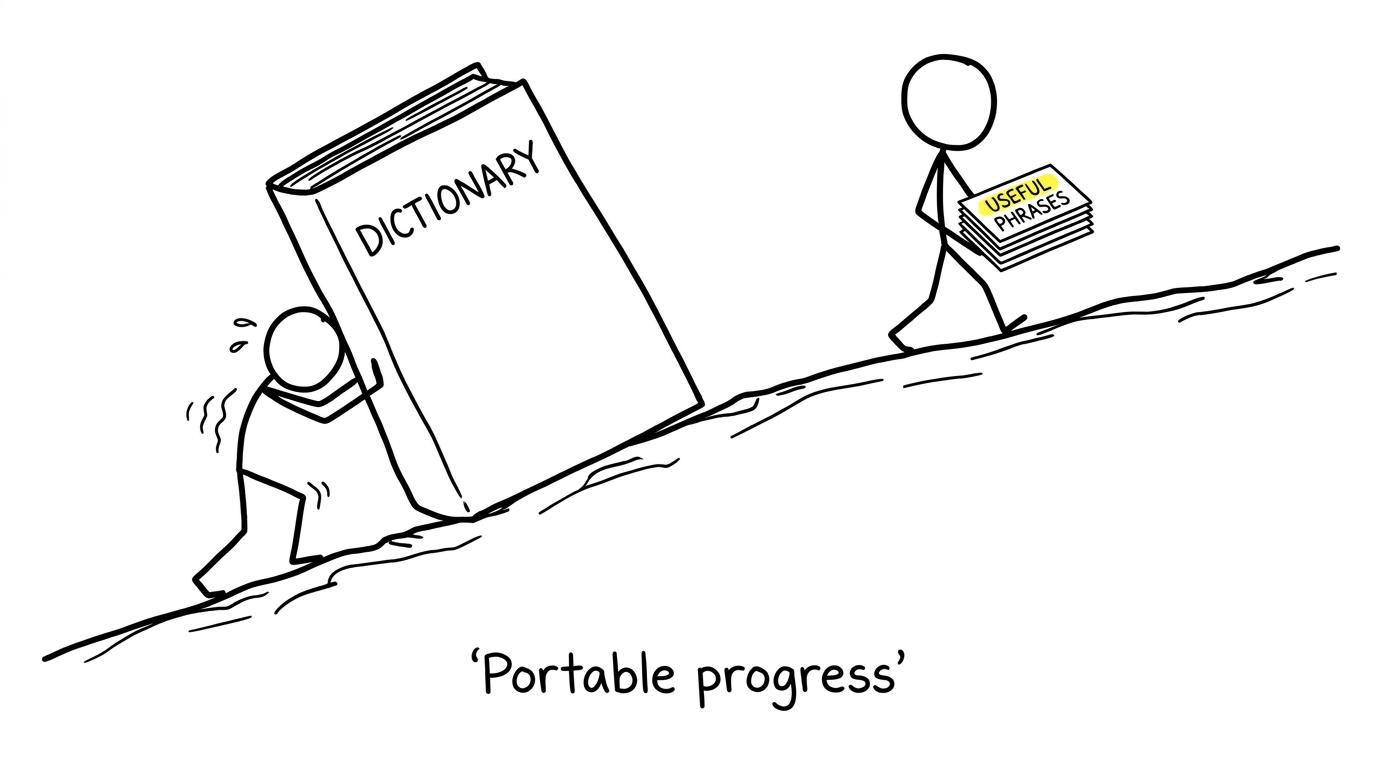 A student chooses portable useful phrases instead of carrying an enormous dictionary
A smaller vocabulary bank that you can spell and use accurately is more valuable than a huge list you merely recognise. Expand it gradually.
Strengthen reading and translation
Reading questions do not always reward a word-for-word translation of the passage. They reward the answer to the question. Read for overall meaning first, then locate evidence and check whether the required response should be in English or Bengali.
When you meet an unfamiliar word, use its context. Consider the topic, surrounding words, sentence structure and whether the writer's tone is favourable or critical. One unknown item should not cause you to abandon an entire paragraph.
Translation needs precision. Preserve meaning, tense, viewpoint and important detail rather than producing a sentence that merely sounds plausible. After translating, read your answer independently. Ask whether it communicates the original message without adding or removing information.
This resembles checking a solution against a mark scheme. MathsGenie's Edexcel GCSE maths past papers, AQA GCSE maths papers and OCR GCSE maths papers can help students develop the same disciplined cycle of attempt, check and correct in their maths revision.
Make writing accurate, varied and relevant
Strong writing is not the longest response. It is a relevant response that communicates successfully and demonstrates control.
Before writing, identify every bullet point or required detail. Plan briefly so that no part of the task is forgotten. Then use language you can control while showing suitable range through opinions, reasons, descriptions, time frames and connected ideas.
Reserve time to check:
- whether every part of the task has been addressed
- Bengali spelling and script
- verb forms and time references
- agreements or grammatical patterns required by the sentence
- repeated basic vocabulary
- accidental omissions
- whether meaning remains clear throughout
Do not force complicated language into every sentence. Complexity earns little if it damages communication. A better approach is controlled ambition: mostly secure language, with carefully chosen evidence of range.
Use past papers as a feedback system
A completed paper is not the end of revision. It is a source of information.
Start with untimed topic practice if you are still learning the course. Move towards timed sections and then complete papers under realistic conditions. Afterwards, use the mark scheme and teacher feedback to classify mistakes.
Your error log might include:
| Error type | Next action |
|---|---|
| Unknown vocabulary | Add it to active-recall practice |
| Misread instruction | Highlight command words in the next session |
| Weak spelling | Rewrite and retest the word later |
| Missing detail | Return to the evidence in the text or recording |
| Timing problem | Repeat a similar task with a clear time limit |
| Limited speaking answer | Add a reason, opinion or relevant detail |
Do not assume that an old paper perfectly reflects current arrangements. Check it against the present specification and use materials recommended by your teacher.
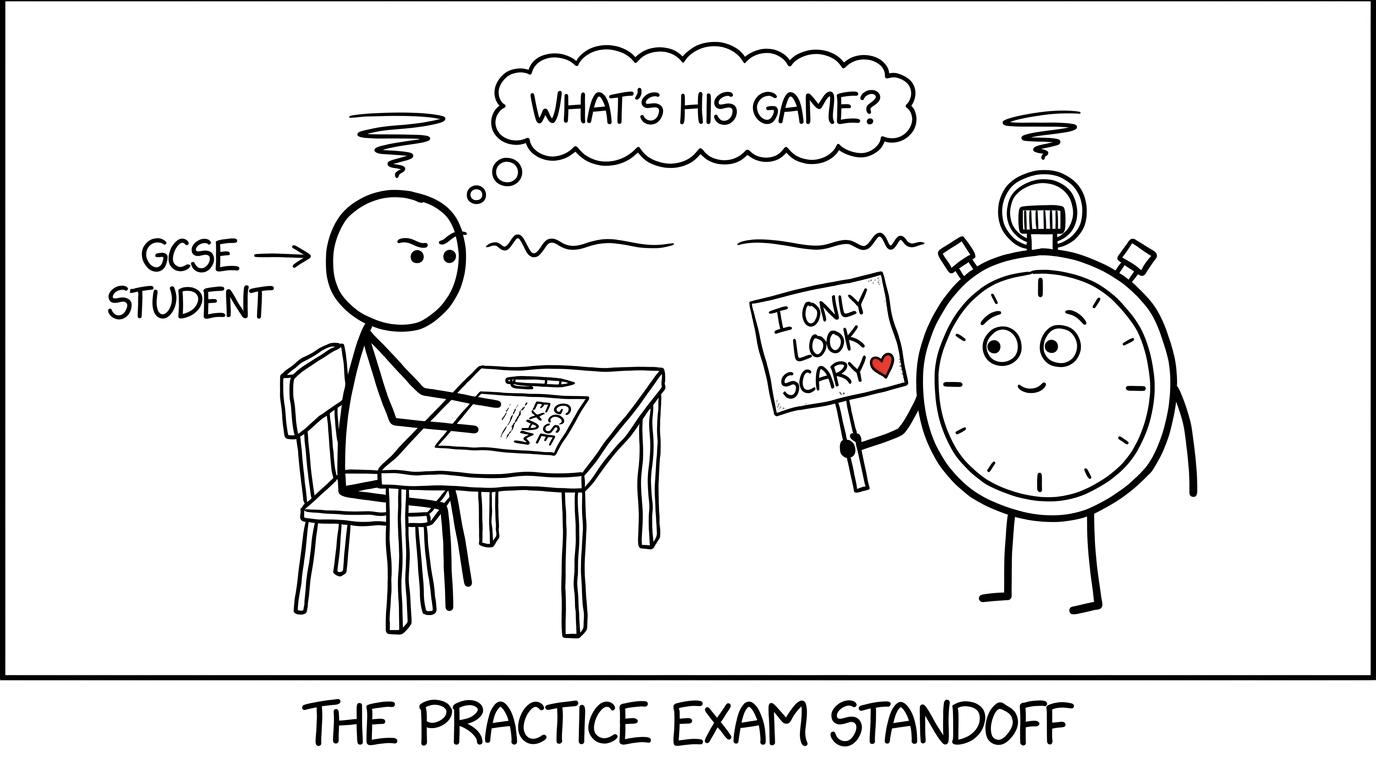 A student and a supposedly scary stopwatch face each other across an exam desk
The same review process can make maths practice more productive. Try MathsGenie's GCSE maths mini tests for focused checking, then use GCSE predicted papers as additional maths practice rather than predictions of exact examination questions.
Common mistakes that hold students below grade 7
Relying entirely on spoken Bengali
Conversation may provide excellent fluency, but GCSE success also requires secure reading, writing, translation and formal accuracy. Give literacy deliberate practice.
Revising only favourite topics
Repeatedly practising familiar themes protects confidence but leaves gaps untouched. Use your error log to decide what comes next.
Memorising one perfect speaking script
A script can sound impressive until the question changes. Learn adaptable structures and practise spontaneous follow-up questions instead.
Ignoring the language of instructions
Marks are lost when students answer in the wrong language, overlook a required detail or give a general response to a specific question. Read the instruction twice.
Counting practice without reviewing it
Five papers completed carelessly may teach less than one paper analysed properly. Correction is where much of the improvement happens.
Treating Higher tier as simply harder vocabulary
Higher-tier performance requires more than rare words. Students must interpret detail, respond precisely, handle less predictable language and communicate with greater range and control.
A calm route towards grade 7
A grade 7 is rarely created by one dramatic revision weekend. It is usually built through smaller corrections: a listening distractor noticed, a spelling error removed, a speaking answer extended and a writing task checked before time ends.
Build a weekly routine around all four Bengali skills. Practise actively, use current examination materials and let mistakes decide the next revision task. Ask your Bengali teacher to confirm your tier, assess speaking and writing, and direct you to the latest Pearson materials.
For the maths side of your GCSE timetable, make MathsGenie your free revision base. Begin with the MathsGenie homepage, select revision lessons and practice questions for your weak topics, and progress to past papers, predicted papers, mini tests, mark schemes and video solutions. Bengali and maths are different subjects, but the habit that improves both is the same: practise, check, correct and return stronger.