How to Get Grade 6 GCSE Bengali
How to get grade 6 GCSE Bengali through balanced skills practice, stronger vocabulary, timed papers, precise corrections and a realistic revision plan.

A grade can feel strangely distant when revision consists of reading vocabulary lists and hoping more Bengali will somehow stay in your memory. You recognise words on the page, yet they disappear during a listening task. You know what you want to say, yet your speaking answer ends after two sentences.
The practical answer to how to get grade 6 GCSE Bengali is to train every assessed skill regularly, learn vocabulary in context, correct recurring errors and complete timed questions using the mark scheme. A grade 6 does not usually come from one dramatic revision weekend. It grows from small improvements repeated often enough to become reliable.
Before planning anything, confirm your exam board, qualification code and tier with your teacher. Pearson Edexcel GCSE Bengali and International GCSE Bangla are different qualifications, so their specifications, papers and assessment arrangements must not be treated as interchangeable. If your GCSE entry is tiered, you must be entered for Higher tier to achieve grade 6.
Your grade 6 revision checklist
A useful plan should include:
- regular listening, speaking, reading and writing practice;
- vocabulary organised by specification theme;
- accurate use of common verbs, tenses and sentence structures;
- timed practice with the correct qualification's past papers;
- correction sessions based on mark schemes and teacher feedback;
- short speaking rehearsals recorded and reviewed;
- a weekly timetable that revisits weak skills;
- clear handwriting and careful reading of every instruction.
This is the same principle that makes structured GCSE revision effective in maths: break a large subject into visible skills, practise one weakness at a time and test whether the improvement survives under exam conditions.
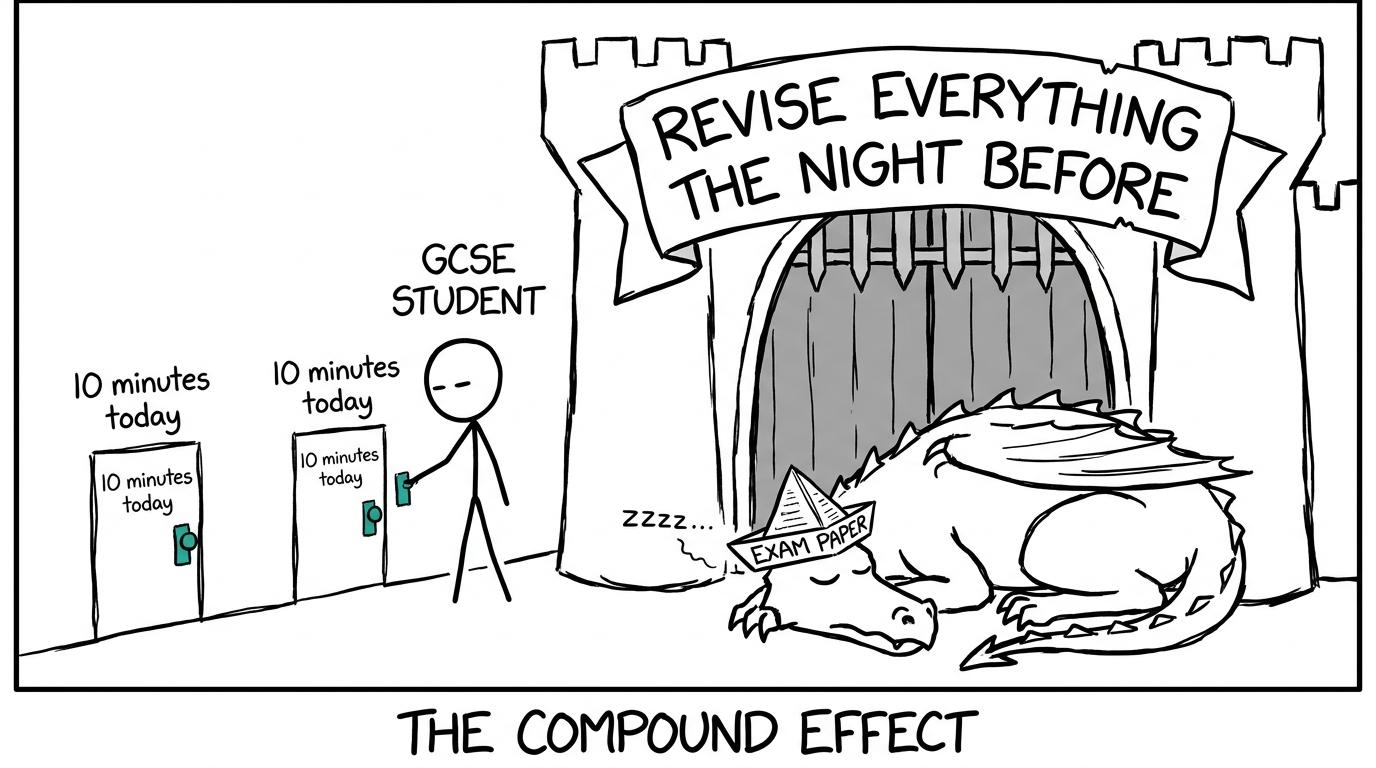 A student sensibly chooses short daily revision instead of a last-minute revision castle
Understand what a grade 6 performance looks like
Grade boundaries are set after an examination series and can change from year to year. There is no trustworthy permanent mark that always guarantees grade 6. Instead of building your plan around an old boundary, build enough control to earn marks across the whole qualification.
At grade 6 level, students generally need to understand the main message and relevant details in unfamiliar material, communicate developed ideas, use more than basic vocabulary and show reasonable grammatical control. Perfection is not required. Meaning must remain clear, however, and frequent mistakes cannot be allowed to obscure the response.
The important word is developed. A brief opinion may communicate something, but a stronger answer explains the opinion, adds a reason, refers to another time frame or develops a related detail. That creates evidence for the examiner to reward.
Your specification and teacher should be the final authorities on the assessment structure. Use materials carrying the exact qualification code shown on your exam entry rather than relying on a resource merely labelled “Bengali GCSE”.
Balance all four language skills
Students naturally revise what feels comfortable. A confident reader may spend another evening reading. Someone who enjoys conversation may avoid formal writing. The result is an uneven profile in which one neglected component limits the overall grade.
Treat listening, speaking, reading and writing as separate skills connected by the same language. Vocabulary learned for a topic should travel between them: recognise it in audio, read it in context, say it aloud and use it in a sentence of your own.
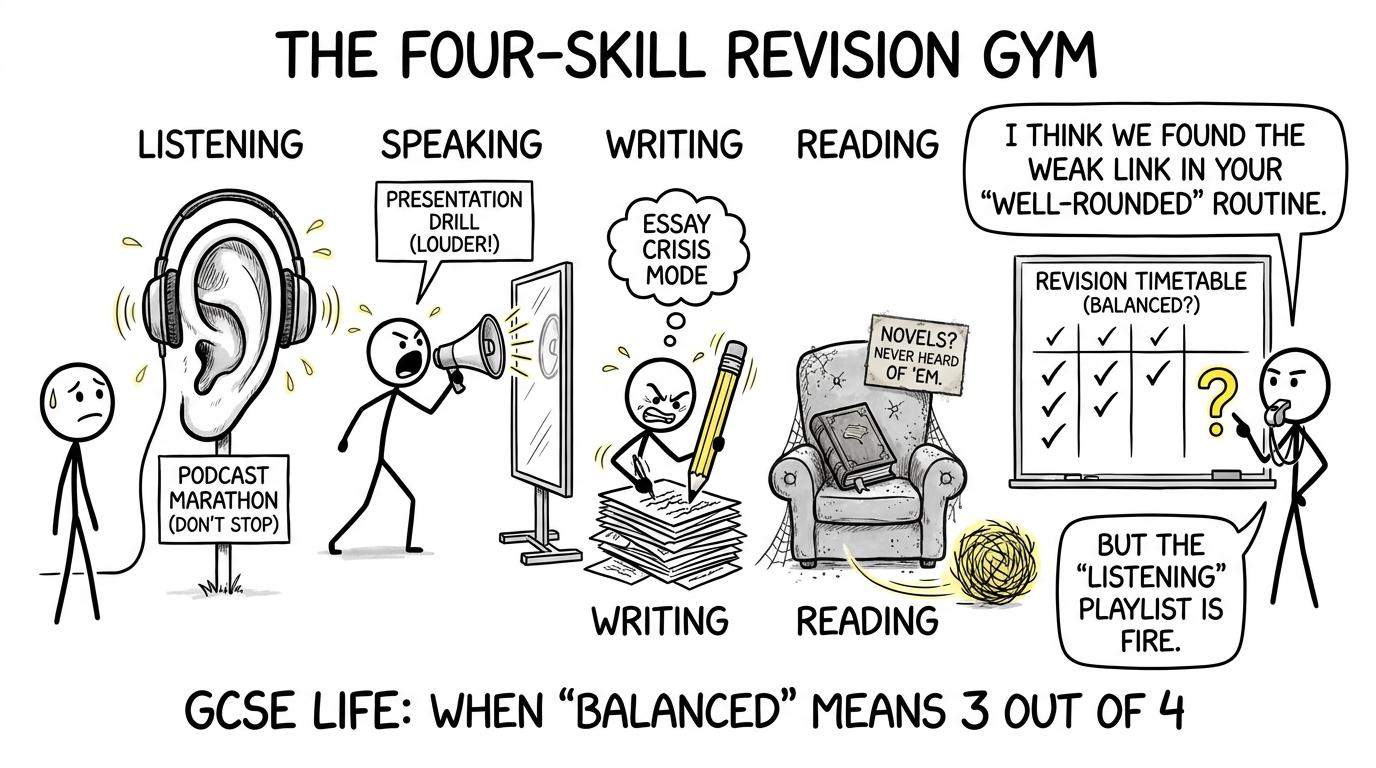 A four-skill revision gym reminds a student not to neglect one component
Improve listening through repeated short practice
Listening improves when you stop treating every recording as a one-off test. Use a short, specification-relevant clip or past-paper extract and listen in stages:
- first for the situation and overall meaning;
- again for names, times, opinions, negatives and reasons;
- finally while checking what caused each missed answer.
Keep a listening error log. Record whether you missed vocabulary, confused a negative, lost track of the speaker or wrote an answer that did not address the question. “Listening is difficult” gives you nothing to practise. “I miss changes from positive to negative” gives you a target.
Do not expect to understand every word. In an examination, identifying who is speaking, the topic, the speaker's attitude and key supporting details is often more useful than mentally translating every sentence.
Build speaking answers that can develop
Speaking becomes less intimidating when you prepare flexible language rather than memorising one long script. Create reusable building blocks for giving an opinion, explaining a reason, comparing alternatives and referring to past or future events.
Record short responses on your phone, then listen without interrupting yourself. Check whether your answer is audible, relevant and developed. Notice repeated pauses and words that are difficult to pronounce. Repeat the answer after correcting only one or two weaknesses.
Memorisation can provide confidence, but an answer learned as a single block is fragile. One forgotten phrase can make everything after it disappear. Flexible structures allow you to recover and continue communicating.
Read for evidence, not familiar words
A familiar word is not automatically the answer. Read the question first and identify exactly what information is required. Then locate evidence in the text, checking negatives, contrasts, time references and changes of speaker.
When reviewing a wrong answer, underline the words that prove the correct one. This turns marking into reading practice. It also exposes plausible distractors, details that appear in the passage but answer a different question.
Make writing accurate and ambitious in balance
The strongest writing is not the writing with the longest sentences. It is writing that communicates developed ideas clearly while showing a controlled range of language.
Plan briefly before beginning. Check that every bullet point or required detail will be covered. Use vocabulary you understand, vary sentence openings and include different time references where the task makes them relevant. Afterwards, reserve time to check spelling, verb forms, agreement, repeated words and whether any sentence has become difficult to follow.
Ambition should be controlled. One accurate complex structure is more valuable than several decorative phrases that do not fit the meaning.
Change how you learn vocabulary
Copying a word ten times can create familiarity without creating recall. Grade 6 revision requires you to retrieve vocabulary when the answer is not visible.
Learn words in small thematic sets, but include phrases and sentence fragments rather than isolated items alone. For each set:
- test from English to Bengali and Bengali to English;
- say each item aloud;
- use it in a relevant sentence;
- revisit it after a delay;
- mix old vocabulary with new vocabulary.
Give priority to high-utility language: opinions, reasons, connectives, time phrases, descriptions and common verbs. Topic-specific nouns matter, but they are much more useful when you can connect them into a clear response.
A simple revision rota works better than vague intentions. Maths students can borrow the structure of a GCSE revision planner: assign a specific skill and topic to each session, then record whether it was completed.
Turn mistakes into the next revision session
A marked paper is not the end of revision. It is the beginning of a more precise plan.
Sort mistakes into categories such as vocabulary, grammar, misunderstood instructions, missing detail, timing and illegible presentation. Look for repetition. If three writing tasks contain the same tense error, another full paper is less useful than focused correction of that error followed by a fresh paragraph.
This feedback loop is familiar to students using GCSE maths past papers. Attempt, mark, diagnose, practise and retest. The subject changes, but the learning habit does not.
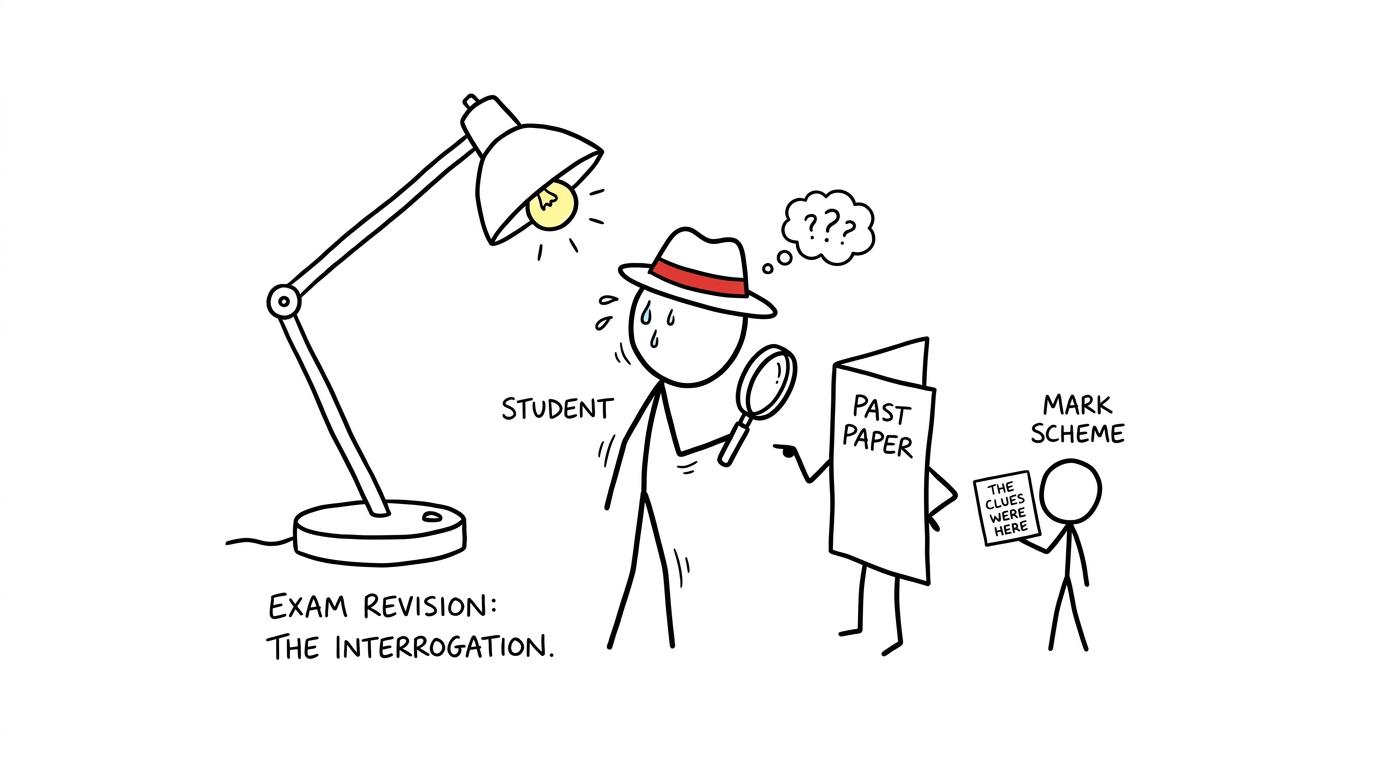 A detective student discovers that the mark scheme contains the clues
Use past papers without wasting them
Past papers are limited and valuable. Early in revision, complete individual sections while learning the technique. Later, complete whole components under the official time conditions for your qualification and tier.
Use the mark scheme to understand what the question required, but do not award marks because your answer was “close to what you meant”. Mark what is actually on the page. For speaking and extended writing, teacher feedback is especially useful because assessment depends on more than spotting a single correct word.
After marking, rewrite only the answers that need improvement. Then return to the same skill several days later with a different question. That delayed retest shows whether the correction has become usable knowledge.
MathsGenie's predicted GCSE maths papers are valuable for maths preparation, but predicted materials in any subject should supplement rather than replace official past papers and the specification. No prediction can tell you exactly what will appear.
A realistic weekly routine
Consistency matters more than designing a perfect timetable that you abandon after three days. A useful week might contain several short vocabulary retrieval sessions, one focused session for each assessed skill and one correction session.
Keep sessions specific. “Revise Bengali” is too broad. “Practise Higher-tier listening questions on school and future plans, then log every missed negative” gives you a clear finish line.
This approach also protects your maths revision. Use the free MathsGenie GCSE topic pages, past papers and mark schemes and short topic practice alongside a balanced timetable rather than allowing one subject to consume every evening.
Common mistakes that hold students below grade 6
Revising only vocabulary
Vocabulary is essential, but the examination rewards comprehension and communication. Words must be practised inside listening, speaking, reading and writing tasks.
Ignoring the weakest component
Comfortable revision feels productive. Targeted revision often feels slower because it exposes uncertainty. That discomfort is usually where the next marks are hiding.
Memorising answers without understanding them
A memorised response may not match the question asked. Learn adaptable phrases and understand every sentence you plan to use.
Missing instructions and required details
Students sometimes produce good language but omit part of the task, select too many options or answer with the wrong type of information. Circle command words and check every requirement before moving on.
Using the wrong qualification's resources
GCSE Bengali and International GCSE Bangla may have different papers, codes and assessment arrangements. Confirm the exact course before downloading practice material.
Completing papers without analysing errors
The number of papers completed matters less than the quality of the corrections. Every paper should produce a short list of topics, structures or exam habits to revisit.
Make grade 6 the result of a system
A grade 6 is rarely secured by feeling confident every day. It is secured by having a system that still works when confidence fluctuates: retrieve vocabulary, practise all four skills, complete timed questions, diagnose mistakes and return to them later.
Start with one honest audit of your Bengali skills and choose the weakest area for your next session. Then organise the rest of your timetable with MathsGenie's free GCSE revision resources, past papers, predicted papers, practice questions, mark schemes and video solutions. Bengali and maths require different knowledge, but the habit that raises grades is remarkably similar: focused practice followed by careful correction.