How Many Students Take GCSE English Literature?
How many students take GCSE English Literature each year? Explore the latest entry figures, subject popularity and what they reveal about grading.
A subject can feel strangely personal when you are revising it. Your copy of the novel is full of annotations, your poetry quotations are competing for space in your memory, and the exam seems to rest entirely on your desk. Yet hundreds of thousands of other students are preparing for the same qualification.
So, how many students take GCSE English Literature each year? The latest official provisional figure is 620,420620{,}420620,420 entries in England for summer 2026. In summer 2025, there were 649,481649{,}481649,481 entries across the UK, making English Literature one of the country's most widely taken GCSE subjects.
The figures need careful interpretation. Official publications usually count exam entries rather than unique students, and England-only data should not be confused with UK totals. But the central answer is clear: in a typical recent year, roughly 600,000600{,}000600,000 to 650,000650{,}000650,000 students enter GCSE English Literature.
GCSE English Literature entry figures at a glance
Here is the short version:
- England recorded 620,420620{,}420620,420 provisional English Literature entries for summer 2026.
- That was an increase of 0.9%0.9\%0.9% from 614,800614{,}800614,800 provisional entries in 2025.
- The final UK total for summer 2025 was 649,481649{,}481649,481 entries.
- English Literature was the fourth-largest GCSE subject by UK entry numbers in 2025.
- It is widely taught, although it is not quite as universal as English Language or maths.
- A large entry does not automatically make the qualification easier or harder.
- In England, GCSE English Literature is untiered: everyone taking a particular specification sits the same set of papers.
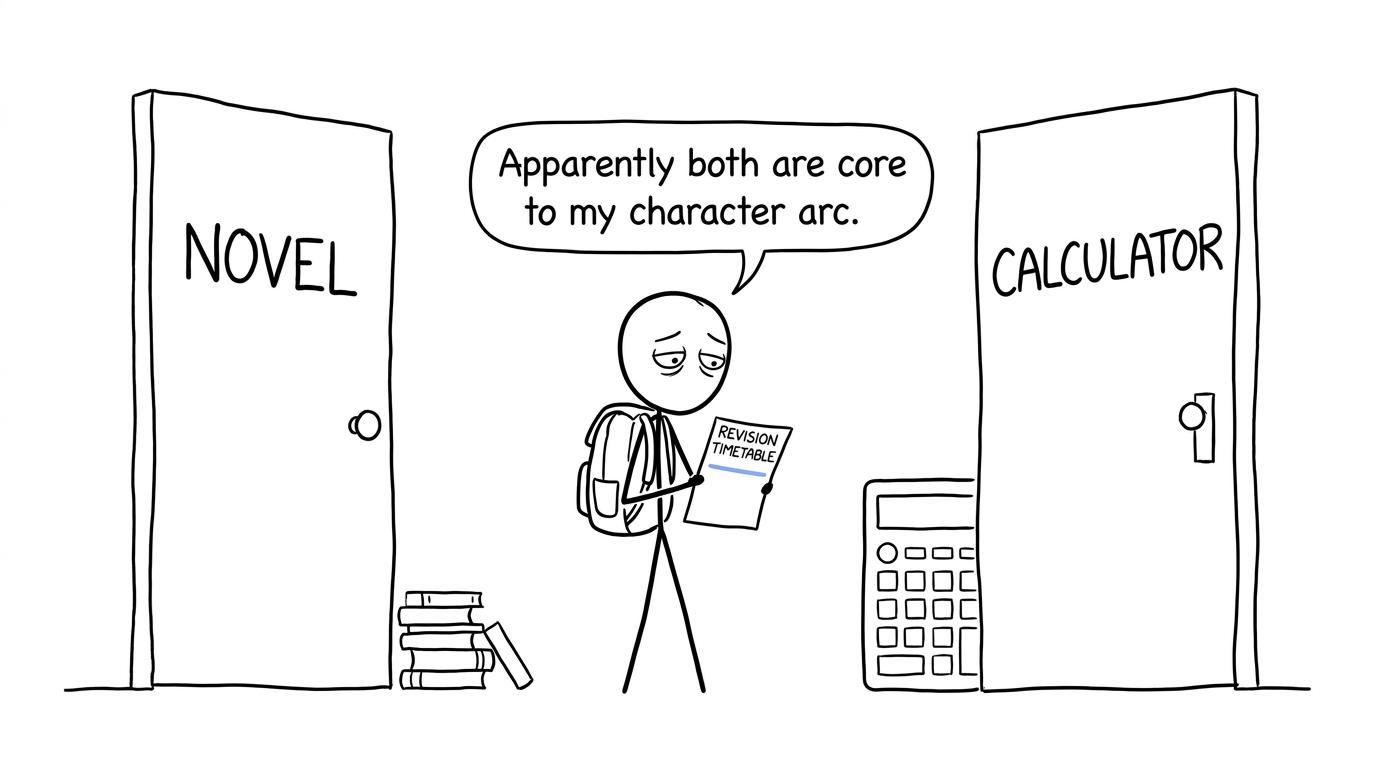 A GCSE student balancing literature and maths revision
How many students take GCSE English Literature over time?
The Department for Education's provisional summer-entry statistics provide a consistent recent series for England. The latest release, published in June 2026, covers entries submitted by schools and colleges by April 2026.
| Summer exam series | Provisional English Literature entries in England |
|---|---|
| 2022 | 582,680582{,}680582,680 |
| 2023 | 601,945601{,}945601,945 |
| 2024 | 623,590623{,}590623,590 |
| 2025 | 614,800614{,}800614,800 |
| 2026 | 620,420620{,}420620,420 |
These figures show stability rather than a dramatic rise or decline. Entries grew between 2022 and 2024, fell slightly in 2025, and then increased by 0.9%0.9\%0.9% in 2026.
There are two reasons you may encounter different numbers elsewhere. First, the figures above cover England, while the Joint Council for Qualifications publishes totals covering the UK. Second, provisional entry figures are collected before the examinations, whereas results publications count qualifications or results subsequently issued.
For example, the provisional England figure for 2025 was 614,800614{,}800614,800, while the final UK entry total was 649,481649{,}481649,481. Neither figure is inherently wrong. They measure different geographical areas and stages of the examination process.
Are entries the same as individual students?
Not exactly. Official releases normally use the word entries because they count registrations submitted to exam boards. For a single GCSE subject, one entry will ordinarily represent one candidate, so entries provide a sensible estimate of student numbers.
However, it is still better to say that there were 620,420620{,}420620,420 entries than to claim that exactly 620,420620{,}420620,420 distinct people sat completed papers. Entries can be withdrawn, amended or affected by the statistical rules used in a particular publication.
This distinction is small enough not to change the broad answer, but important enough to remember when comparing datasets.
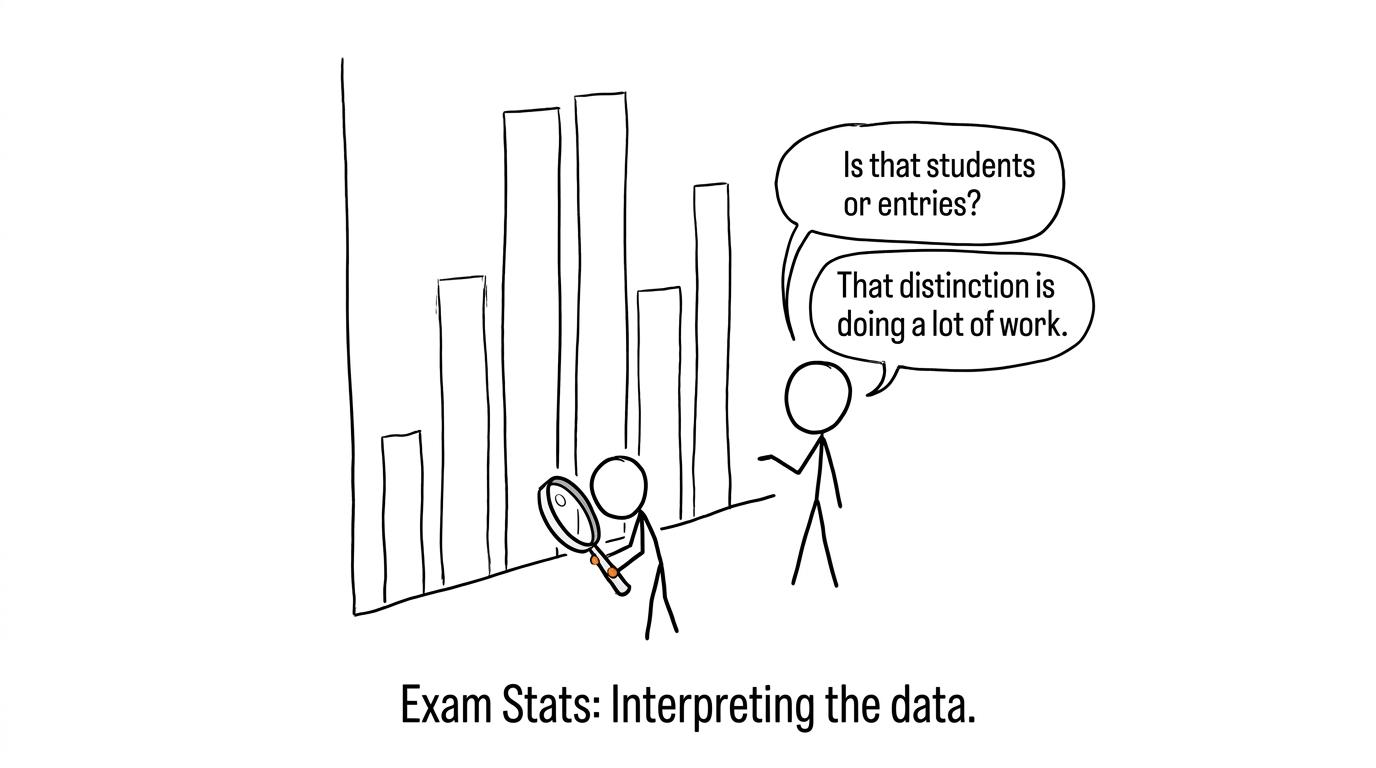 Students investigate whether a chart counts entries or people
How popular is GCSE English Literature as an option?
English Literature is exceptionally popular when compared with most optional GCSEs. In the 2025 UK figures, it ranked fourth by entry volume, behind subjects including mathematics and English Language. Its 649,481649{,}481649,481 entries were more than double the 306,759306{,}759306,759 entries recorded for History.
Yet calling Literature simply an “option” can be misleading. In England, pupils must study English as part of the key stage 444 curriculum, and English Language is normally the essential GCSE qualification. English Literature is not separately compulsory in every school, but most schools teach and enter it alongside Language. Schools may also make Literature part of their own compulsory curriculum.
That explains the pattern in the data. Literature has fewer entries than English Language, but vastly more than a typical freely selected option. Its popularity reflects school curriculum decisions as well as individual student choice.
The comparison with maths is useful. England had 876,955876{,}955876,955 provisional mathematics entries for summer 2026, compared with 620,420620{,}420620,420 for English Literature. Maths includes substantial post-161616 resit entry because students who have not secured the required standard may need to continue working towards it. English Literature does not have the same resit role.
If maths is the subject currently occupying your timetable, the GCSE Maths revision hub lets you choose your exam board and work through free lessons, worksheets and exam questions.
What does popularity say about GCSE English Literature grading?
The most important conclusion is also the least dramatic: a large number of candidates does not mean grades are rationed among them.
GCSE English Literature in England uses the grades 999 to 111, with 999 as the highest. It is an untiered qualification, unlike GCSE Maths, where students take foundation or higher tier papers. Literature candidates following the same exam-board specification have access to the full grade range through the same assessment route.
Exam boards such as AQA, Pearson Edexcel, OCR and Eduqas convert total raw marks into grades using boundaries set for each exam series. Awarding considers the demand of the papers and evidence about candidate performance so that standards remain comparable. It is not a simple rule under which a fixed percentage of a large cohort must fail.
Popularity does affect how statistics should be read
A large cohort produces robust national patterns, but those patterns do not reveal the difficulty of the subject by themselves. In England's 2025 results, roughly 74%74\%74% of English Literature entries achieved grade 444 or above, while approximately 20%20\%20% achieved grade 777 or above.
Those percentages should not be used to claim that Literature is easier than another GCSE. The Literature cohort is partly selected: some schools enter nearly everyone, while others make different decisions for particular pupils. Student attainment, school entry policies, the assessment structure and the papers themselves all influence the final distribution.
Large entry numbers therefore tell us that the qualification is mainstream. They do not tell an individual student what grade they will receive.
Marks reward defined skills, not subject popularity
The national assessment framework assigns most English Literature marks to reading, interpretation and analysis. Across a specification:
- AO1, responding to texts and supporting interpretations, contributes 35%35\%35% to 40%40\%40%.
- AO2, analysing language, form and structure, contributes 40%40\%40% to 45%45\%45%.
- AO3, understanding relationships between texts and contexts, contributes 15%15\%15% to 20%20\%20%.
- AO4, accurate vocabulary, sentence structure, spelling and punctuation, contributes 5%5\%5%.
The exact arrangement of questions varies by exam board, but the assessment objectives are shared. Your marks come from demonstrating those skills against the mark scheme, not from outperforming a predetermined number of classmates.
There is a useful parallel with maths. A maths mark scheme rewards a valid method, accurate reasoning and a correct conclusion. Literature allows more interpretive variety, but an argument still needs evidence and analysis. In both subjects, understanding how marks are awarded is more productive than trying to predict everyone else's performance.
What this means for a maths student's revision plan
English Literature and maths ask for different kinds of recall. Literature revision often involves retrieving quotations, themes and analytical connections. Maths revision requires you to retrieve methods and then apply them to unfamiliar questions. Both improve when revision moves beyond rereading.
A balanced weekly plan could include:
- short retrieval sessions for quotations and formulae;
- focused practice on one weak area at a time;
- timed responses or paper sections;
- immediate checking against a mark scheme;
- a written record of mistakes and the action needed to fix them.
MathsGenie's GCSE mini tests are useful when English revision is taking most of your evening. A short test keeps maths active without demanding another full examination session. For a broader structure, use the one-month GCSE Maths revision plan.
When you have more time, choose board-specific practice. MathsGenie provides Edexcel GCSE Maths past papers, AQA GCSE Maths past papers and an OCR GCSE Maths revision hub, with mark schemes and worked solutions where available.
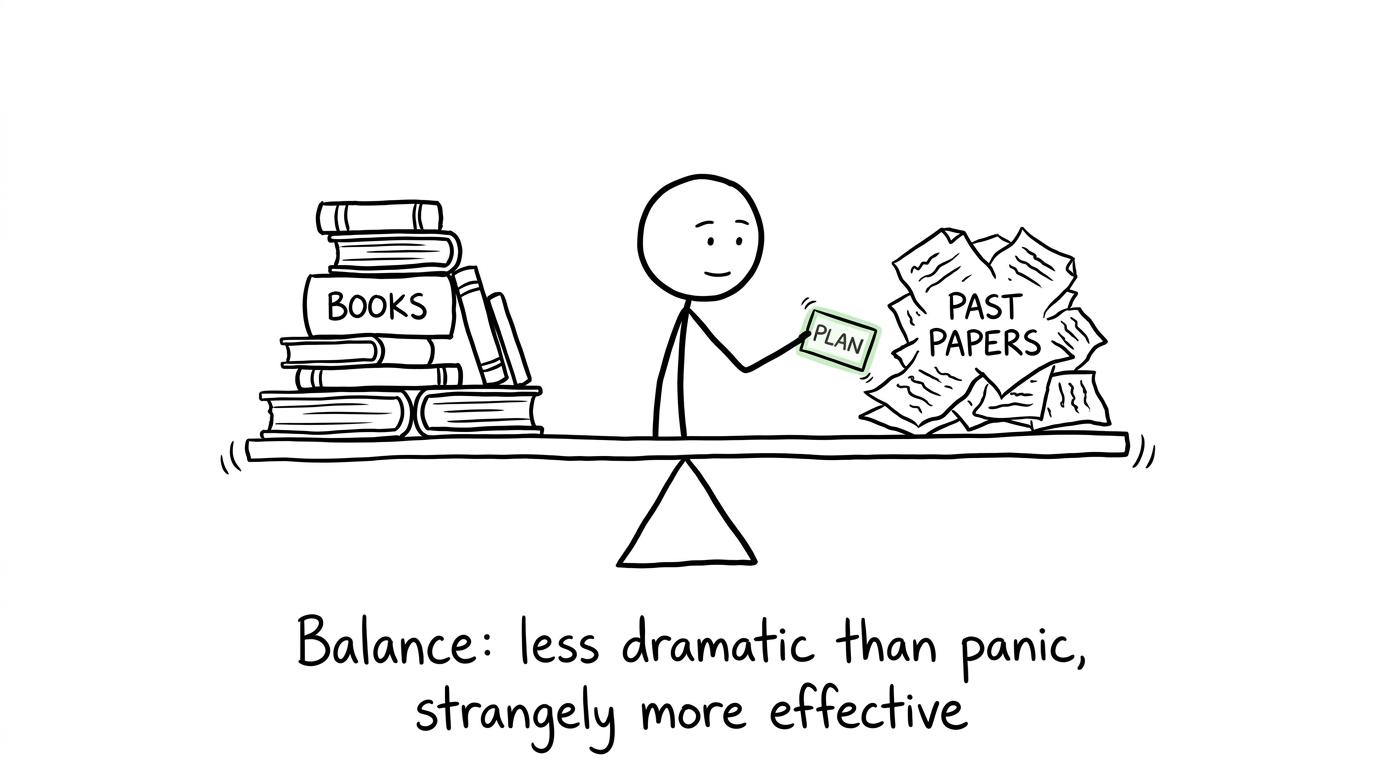 A simple revision plan restores balance between books and papers
Common mistakes when interpreting the figures
Mixing England and UK totals
The 620,420620{,}420620,420 provisional figure for 2026 covers England. The 649,481649{,}481649,481 final figure for 2025 covers the UK. Comparing them as though they describe the same population would produce a misleading trend.
Treating provisional entries as completed qualifications
An entry is submitted before the examination. Final results data may differ because of withdrawals, amendments and publication methodology.
Assuming Literature is freely optional everywhere
It is not a separately compulsory GCSE in every English school, but many schools require or strongly expect pupils to take it alongside English Language. Its high entry total is not based entirely on independent option choices.
Believing a popular subject must have easier boundaries
Grade boundaries respond to the demand of an examination and the maintenance of standards. Candidate volume alone does not make a particular raw mark worthy of a higher grade.
Comparing grades without checking the national system
England uses grades 999 to 111. Wales continues to use letter grades for many GCSEs, while arrangements in Northern Ireland differ by qualification. Always check the relevant exam board and specification before comparing outcomes.
Maths students face a similar danger when they compare papers without checking board or tier. The GCSE Maths topics by exam board and tier guide helps keep foundation and higher revision aligned with the paper you will actually sit.
The number matters less than your next action
Around 600,000600{,}000600,000 to 650,000650{,}000650,000 students take GCSE English Literature in a recent year, depending on the geography and dataset used. That makes it a major national qualification, but popularity does not determine your grade. The mark scheme rewards what appears in your answer.
The same principle applies to GCSE Maths. National statistics provide context; your own completed questions provide direction. Start at the MathsGenie GCSE Maths revision area, identify one weak topic and use the free revision lessons and practice questions to repair it. Then test the improvement with mini tests, past papers and predicted papers, checking every lost mark against the mark scheme or video solution.
Hundreds of thousands of students may share the exam season. Your next useful revision decision is still entirely your own.