How Many Take GCSE English Language & Literature?
How many students take GCSE English Language and Literature? Explore annual entry totals, why they differ, and what the separate GCSE grades mean in practice.
The strange thing about a compulsory-looking subject is that its popularity can be misunderstood. A student sees a crowded English exam hall and assumes everyone in the country must be taking exactly the same qualifications.
So, how many students take GCSE English Language and Literature each year? Recent UK summer exam data indicate roughly 850,000850{,}000850,000 to 900,000900{,}000900,000 entries for English Language and about 700,000700{,}000700,000 entries for English Literature. The figures change from year to year, and an entry is not always a different student. English Language totals include older candidates and post-161616 resit students, while many pupils enter both subjects.
That distinction tells us something important: these are two separate GCSEs with separate grades, even though they are usually taught side by side.
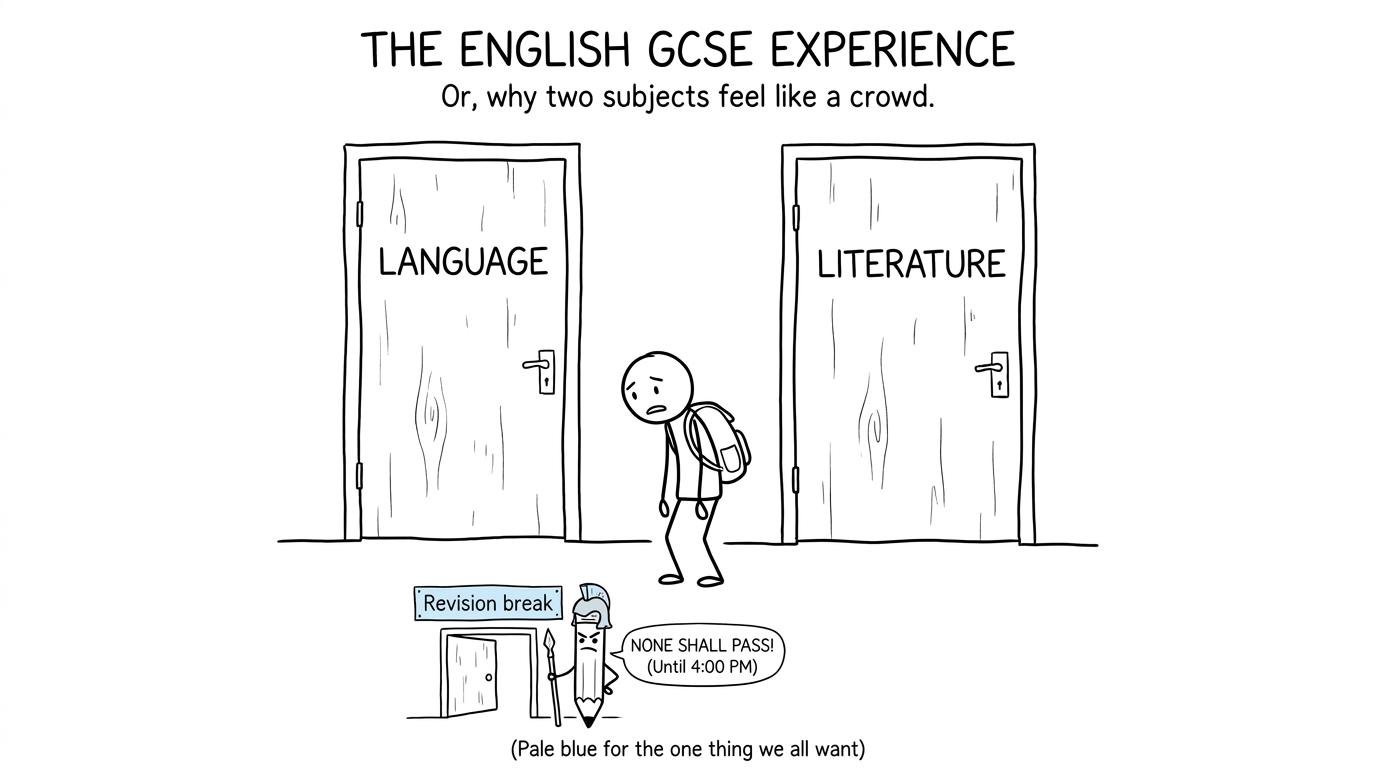 A GCSE student facing the imposing doors of English Language and Literature
The short answer at a glance
Here is the clearest way to interpret the annual figures:
- English Language usually attracts roughly 850,000850{,}000850,000 to 900,000900{,}000900,000 UK summer entries.
- English Literature attracts around 700,000700{,}000700,000 entries in a typical recent summer series.
- These figures count qualification entries, not necessarily unique students.
- Most Year 111111 pupils take English Language, and a substantial majority also take English Literature.
- English Language and English Literature receive separate grades.
- English Language has more entries partly because students who do not achieve grade 444 may continue studying it after age 161616 in England.
- UK-wide totals can combine qualifications and grading systems from England, Wales and Northern Ireland.
The latest exact total depends on the year, country, age group and dataset being used. That is why two reputable reports can display different numbers without either being wrong.
How popular are GCSE English Language and Literature?
English Language is one of the largest GCSE subjects by entry volume. Its annual entry total is normally close to that of GCSE Maths because both qualifications sit at the centre of secondary education.
English Literature is also among the most widely entered GCSEs, but its total is lower. It is better described as a mainstream qualification than as an optional subject in the usual sense. Many schools enter almost all suitable pupils for both English GCSEs, although entry policies and individual circumstances vary.
The Joint Council for Qualifications publishes UK summer results tables covering major awarding organisations. Recent tables place English Language comfortably above 800,000800{,}000800,000 entries and English Literature at approximately 700,000700{,}000700,000. Ofqual also publishes data for England, but its totals may differ because its geographical coverage and reporting categories are not identical.
Why an entry is not the same as a student
Suppose the published tables show one entry for English Language and one for English Literature. Those entries may belong to the same Year 111111 pupil. They must not be added together and described as two students.
The safest wording is therefore:
- approximately 850,000850{,}000850,000 to 900,000900{,}000900,000 English Language entries;
- approximately 700,000700{,}000700,000 English Literature entries;
- an unknown but very large overlap between the two groups.
The difference also reflects resits. A candidate can enter English Language again after an earlier attempt, so the number of entries is not a direct measurement of the number of people encountering the subject for the first time.
Why English Language has more entries
The gap is not evidence that hundreds of thousands of pupils simply dislike novels. It is mainly a consequence of how the qualifications are used.
English Language is widely treated as the essential English qualification for progression. In England, students who have not achieved grade 444 in GCSE English Language may be required to continue studying English after age 161616 as a condition connected with their education provider's funding. The precise route depends on the student's prior grade and circumstances.
There is no equivalent national resit expectation for English Literature. A sixth-form or college student may therefore re-enter Language without re-entering Literature. This adds older candidates to the English Language entry total.
English Language is also commonly requested alongside Maths by sixth forms, colleges, universities, apprenticeships and employers. Individual requirements vary, but the practical importance of the qualification helps explain why it has such a broad candidate base.
For maths students, there is a useful parallel. GCSE Maths also receives entries from post-161616 candidates working towards the standard pass threshold. That is one reason raw entry totals should not be mistaken for the exact size of the current Year 111111 cohort.
Are both English GCSEs compulsory?
The answer depends on what “compulsory” means.
English is part of the curriculum during Key Stage 444, and English Language is entered by the great majority of pupils. English Literature is often taught and entered alongside it. However, qualification entry decisions can be affected by school policy, the pupil's circumstances and the education system within the relevant UK nation.
In England, both English Language and English Literature contribute to the English element of the English Baccalaureate when the relevant entry and grade conditions are met. This gives schools another reason to teach the qualifications together.
That does not make Literature a casual option comparable with choosing between two unfamiliar subjects. For many pupils, taking both is the normal school pathway. Yet it remains a separate qualification rather than a second paper contributing to one combined English grade.
What entry numbers say about GCSE grading
A large entry does not mean it is automatically easier or harder to earn a particular grade. Nor is the number of grade 999s chosen simply because a fixed number of students must be allowed to succeed.
Awarding organisations such as AQA, Edexcel, OCR and Eduqas set papers and award grades under regulatory arrangements appropriate to the nation in which the qualification is offered. In England, GCSE English Language and English Literature use the 999 to 111 grading scale.
Exam boards use statistical evidence and examiner judgement during awarding to maintain standards when papers vary slightly in demand between years. Grade boundaries can therefore move. The underlying standard is intended to remain comparable, rather than requiring the same raw mark every summer.
Two subjects mean two separate grades
A pupil taking both qualifications receives:
- one grade for GCSE English Language;
- one grade for GCSE English Literature.
Strong performance in Literature does not mathematically average with a weaker Language result to create a combined grade. Each qualification has its own assessment structure, total marks and grade boundaries.
This matters when checking entry requirements. If a course asks specifically for grade 444 or grade 555 in English Language, a Literature grade cannot automatically replace it. Students should read the provider's exact wording rather than relying on the general phrase “GCSE English”.
What maths students can learn from these statistics
Subject-entry figures seem distant from revision, but they contain a useful lesson: context changes the meaning of a number.
An entry total is not a headcount. A UK figure is not necessarily an England-only figure. A summer-series total can include several age groups. English Language and Literature figures overlap because many candidates sit both.
That is the same habit of mind needed in GCSE Maths statistics questions. Before interpreting a value, ask:
- What exactly has been counted?
- Which population is included?
- Does one person appear in more than one category?
- Is the figure an exact count, an estimate or a rounded summary?
- Are the datasets drawn from the same year and geographical area?
Maths becomes more reliable when labels receive as much attention as calculations. You can strengthen those habits using the free GCSE Maths revision lessons, where topics are organised by grade and supported by videos and practice questions.
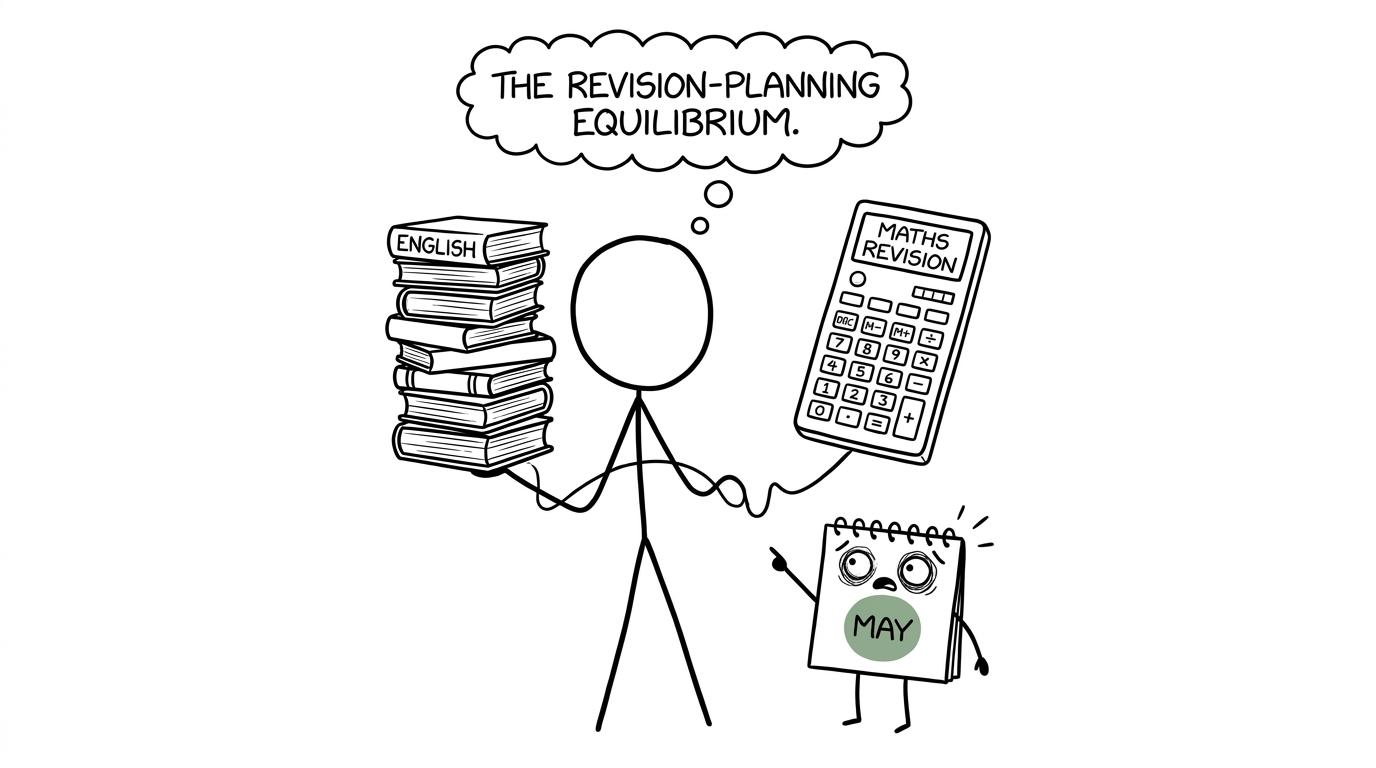 A student balancing English books with maths revision
Turning a busy timetable into a workable revision plan
The popularity of English and Maths has a practical consequence: most students are preparing for several major papers within the same exam season. The answer is not to revise every subject every evening. That creates activity, but not necessarily progress.
A better plan separates resources by purpose:
- Use topic lessons when knowledge is incomplete.
- Use practice questions to make recall less dependent on notes.
- Use mini tests to identify precise gaps.
- Use full papers when you are ready to practise timing and selection.
- Use mark schemes and video solutions to understand why marks were lost.
MathsGenie's GCSE past papers help you experience the structure of a complete exam, while the GCSE predicted papers provide additional exam-style practice before the summer series.
Students taking an international specification can use the dedicated iGCSE Maths resources. Those planning beyond GCSE can also see how current skills develop through the free A Level Maths revision programme and A Level past papers.
Common mistakes when quoting English GCSE figures
Adding Language and Literature entries together
This double-counts many pupils because the same candidate commonly takes both subjects. The result is a total number of qualification entries, not a total number of students.
Calling every candidate a Year 111111 pupil
English Language figures can include post-161616 resit candidates and other private or older entrants. The total is broader than one school-year cohort.
Mixing UK and England-only data
JCQ's UK tables and Ofqual's England data do not necessarily cover the same population. Wales and Northern Ireland also have differences in qualifications and grading arrangements.
Treating English Literature as an ordinary optional subject
Literature has fewer entries than Language, but it is still taken by a substantial majority of pupils and is commonly taught alongside Language. Its lower total does not make it a niche choice.
Assuming popularity determines fixed grade boundaries
Grade boundaries are not held at one raw mark forever. Awarding considers paper demand and evidence about performance so that standards can be maintained between exam series.
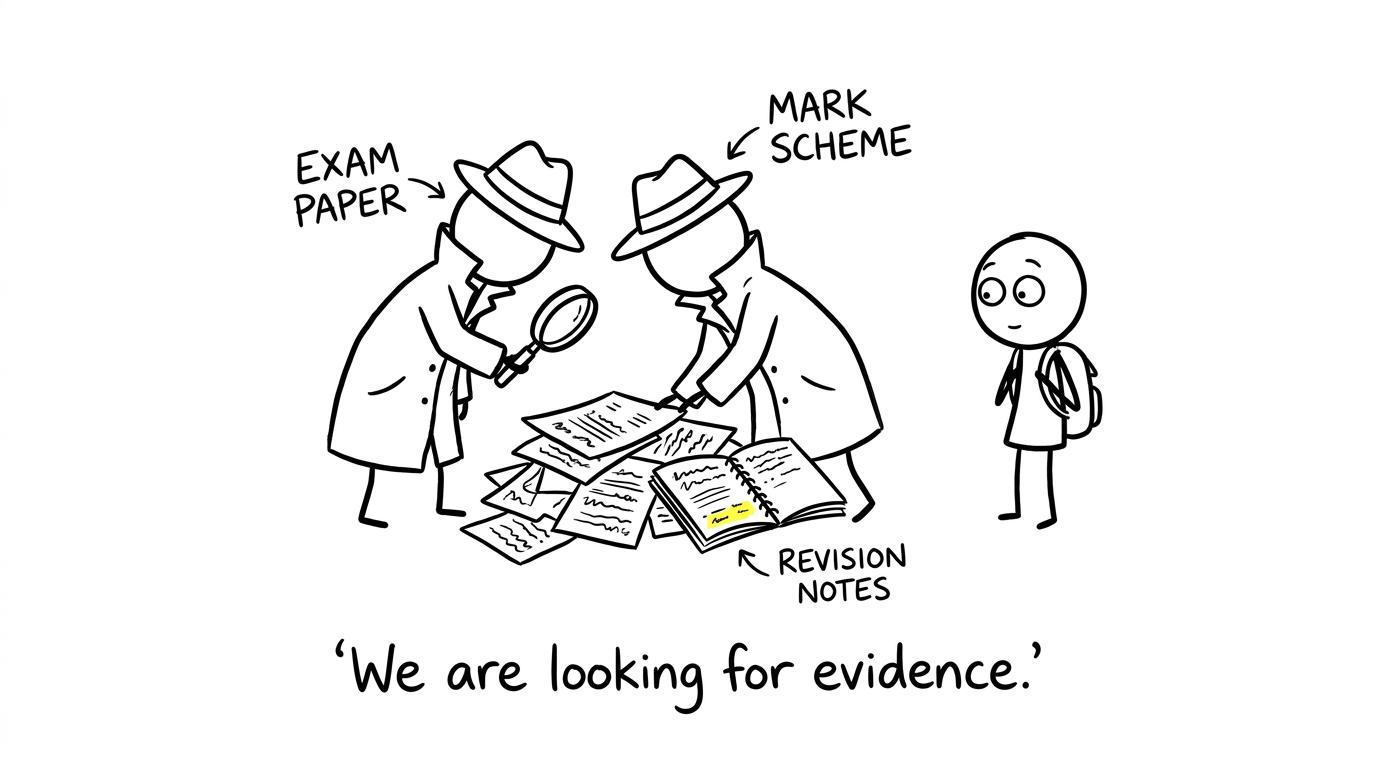 An exam paper and mark scheme searching revision notes for evidence
The number matters, but the definition matters more
Each year, English Language receives roughly 850,000850{,}000850,000 to 900,000900{,}000900,000 UK summer entries, while English Literature receives around 700,000700{,}000700,000. They are two of the country's largest GCSE subjects. Yet those figures should not be read as two separate groups of students, and they should not be used without checking the year, location and age coverage.
The wider lesson is mathematical as much as educational. A number becomes useful only when you know what it represents.
As your exams approach, apply that same care to your own results. Do not look only at the final mark. Identify the topic, inspect the mark scheme and decide what needs to change next. Start with the MathsGenie GCSE revision hub, then build towards timed past papers and predicted papers. Calm, specific practice is what turns a crowded exam season into a manageable plan.