Higher Tier GCSE Arabic Sixth Form Requirements
Higher tier GCSE Arabic sixth form guidance: learn when Foundation grade 5 is enough, when Higher matters and what to check before choosing your tier.
The worry often begins with one vague sentence: “Sixth forms prefer Higher tier.” It sounds official, but it leaves out the most important detail: Higher tier in which subject, for which course, at which sixth form?
For students searching higher tier GCSE Arabic sixth form requirements, the short answer is reassuring: Higher tier GCSE Arabic is not normally a universal requirement for entering sixth form. A strong Foundation result, particularly grade 555, may be enough where Arabic is simply being counted among your general GCSE results. However, Higher tier may become necessary if you need a grade above 555, want to continue Arabic, or are applying to a sixth form with demanding overall entry criteria.
Your GCSE Maths grade is usually a separate and more important consideration when applying for A Level Maths, science, economics or other numerate courses.
The quick answer and checklist
Before changing your Arabic tier, check these questions:
- What are the sixth form’s general entry requirements?
- Does it count your best five, six or eight GCSE results?
- Is there a minimum grade required in every counted subject?
- Are you planning to continue Arabic after GCSE?
- What are the subject-specific requirements for your chosen A Levels?
- Does the policy require a particular GCSE Maths or English grade?
- Is the published policy for the year in which you will actually enter Year 121212?
If Arabic is only contributing towards a requirement such as five GCSEs at grade 555 or above, a Foundation grade 555 may be sufficient. If you need grade 666 or higher in Arabic, it cannot be achieved through the current Foundation tier.
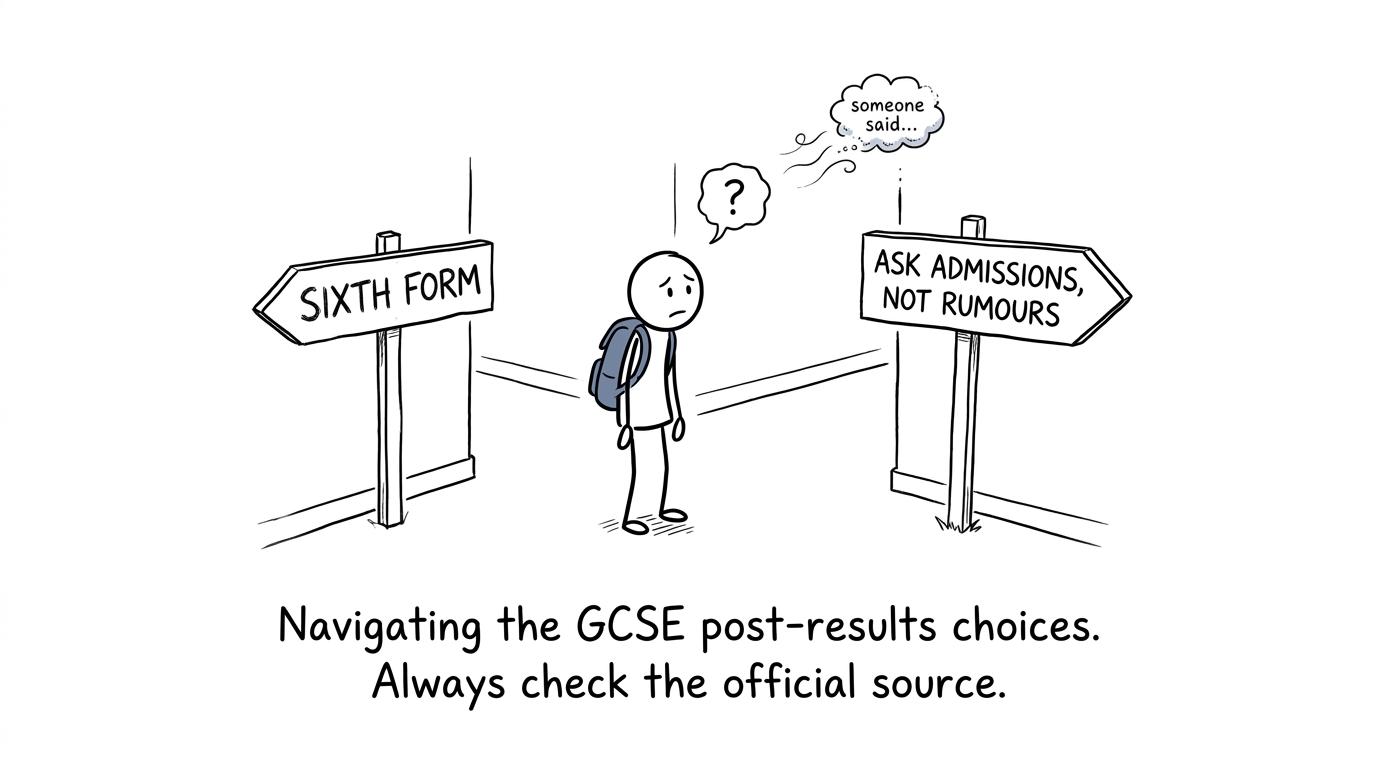 A student ignores sixth-form rumours and checks the admissions policy
How GCSE Arabic tiering works
The current Pearson Edexcel GCSE Arabic qualification has Foundation and Higher tiers. Students are entered for one tier across the qualification’s listening, speaking, reading and writing assessments.
Foundation papers target grades 111 to 555, while Higher papers target grades 444 to 999. That creates the central trade-off:
- Foundation tier provides access to grade 555 but not grades 666 to 999.
- Higher tier opens the route to grades 666 to 999, but its language and tasks are more demanding.
A grade 555 is not weakened by the word “Foundation” on your exam entry. It is still a full GCSE grade 555. Sixth forms generally evaluate the awarded grade against their published criteria rather than treating the same numerical grade as automatically better because it came from Higher tier.
The recent Edexcel GCSE Arabic grade boundaries illustrate the different grade ranges associated with the two tiers. Boundaries change between exam series, however, so an old raw-mark target should never be treated as a guaranteed boundary for your own exams.
When a strong Foundation grade is enough
A Foundation grade 555 can be enough when Arabic is being used as one result within your overall GCSE profile.
Sixth forms set their own admissions arrangements. Current published policies show substantial variation: some ask for several GCSEs at grade 444 or above, while others expect a collection of grades 555 or 666. Many also impose separate requirements for English, Maths and the subjects being continued at A Level.
This means a student with grade 555 in Foundation Arabic could satisfy a general grade-555 requirement. Arabic may also contribute to the total number of qualifying GCSEs even when the student plans to take unrelated subjects such as Maths, Biology and History.
Foundation Arabic may therefore be a sensible choice when:
- your likely outcome on Foundation is a secure grade 444 or 555;
- you do not intend to continue Arabic in sixth form;
- your intended sixth form accepts grade 555 within its general entry profile;
- your limited revision time would be better spent securing required grades in Maths, English or your proposed A Level subjects.
Tier decisions should be about likely outcomes, not status. A secure grade that meets the written requirement is more useful than choosing a harder paper because it sounds impressive.
When Higher tier GCSE Arabic may be necessary
Higher tier matters whenever the grade you require is unavailable on Foundation.
You want to continue Arabic
If a sixth form or college offers post-161616 Arabic, it may set a subject-specific GCSE requirement. Where that requirement is grade 666 or above, Higher tier is effectively necessary because Foundation is capped at grade 555.
Do not assume every sixth form offers Arabic or uses the same entry threshold. Check its current course guide and ask whether GCSE Arabic is required, recommended or considered alongside another language assessment.
Your overall offer requires several grades above 555
Suppose an admissions policy requires a particular number of GCSEs at grade 666 or higher. A Foundation Arabic grade 555 could remain a valid GCSE result, but it could not occupy one of those grade-666 places.
Whether that matters depends on your other subjects. If you already have enough qualifying grades, Arabic may not affect eligibility. If Arabic needs to be one of them, Higher tier becomes important.
You are realistically working above grade 555
A student consistently demonstrating grade-666 or grade-777 performance may be unnecessarily limiting their result by taking Foundation. The decision should be based on evidence from properly marked assessments across all four skills, together with teacher judgement.
One strong class task is not enough. Equally, one difficult mock should not erase months of secure performance.
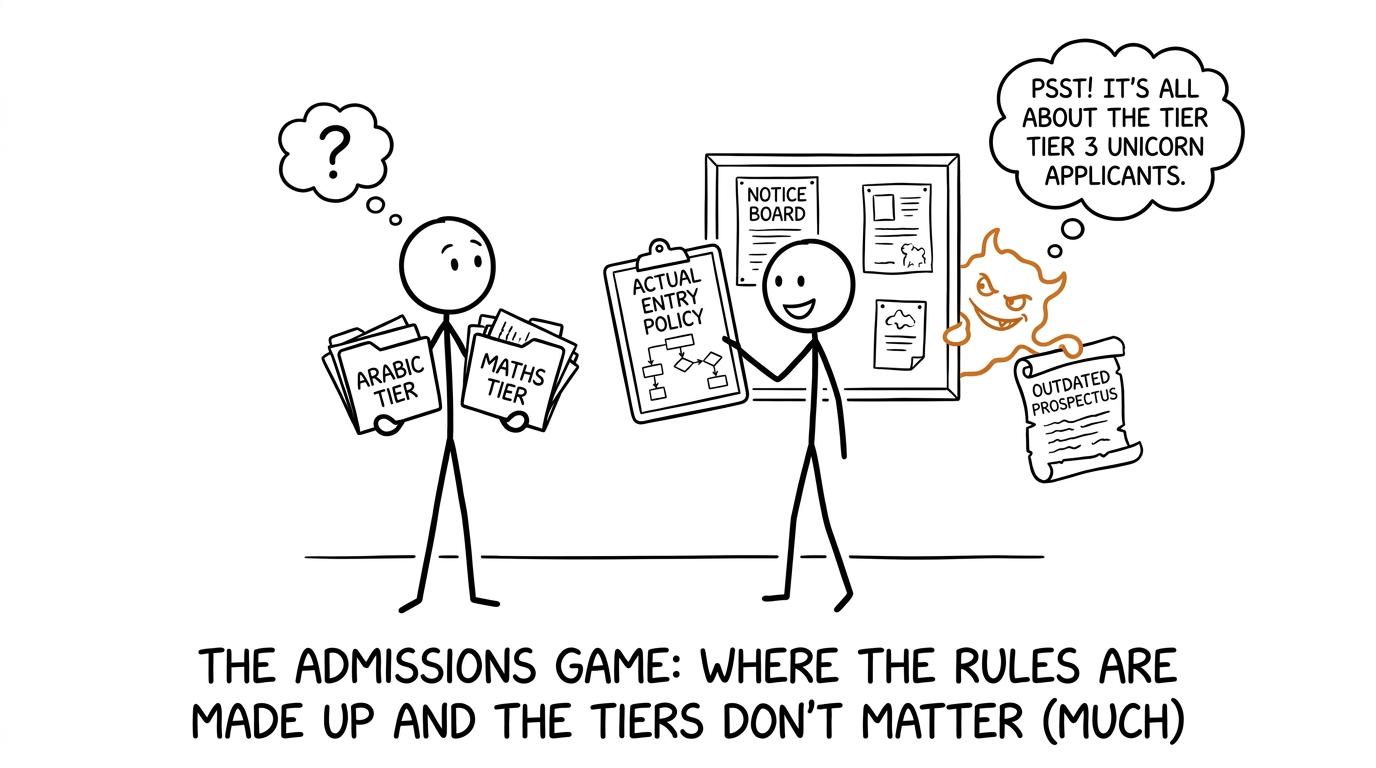 A rumour monster discovers that the current admissions policy is stronger evidence
Arabic tier does not replace the GCSE Maths requirement
For a maths-focused student, this is the distinction that matters most.
A sixth form may accept Foundation Arabic at grade 555 while separately requiring grade 777 in GCSE Maths for A Level Maths. Published requirements vary, but current school policies commonly show subject-specific Maths thresholds around grade 666 or 777, with some setting a higher threshold for Further Maths.
There is no single entry grade used by every sixth form. Read the policy for each institution on your list.
If you hope to study A Level Maths, prioritise three checks:
- the general sixth-form entry requirement;
- the specific GCSE Maths grade required for A Level Maths;
- any higher requirement for Further Maths, Physics, Computer Science or Economics.
Your Arabic grade can strengthen your overall GCSE profile, but it cannot compensate automatically for missing a stated Maths threshold. Similarly, taking Higher Arabic does not prove readiness for A Level Maths. The two subjects are assessed independently.
Use the GCSE Maths revision hub to select your exam board, tier and current grade range. If your school uses AQA or OCR, the AQA GCSE Maths past papers and OCR GCSE Maths past papers provide realistic evidence of where your Maths performance stands.
How to make the right tier decision
The best decision combines admissions information with assessment evidence.
Read the exact admissions wording
Look for two separate sections in the prospectus:
- general entry requirements, applying to the whole study programme;
- subject entry requirements, applying to individual A Levels.
Words such as “minimum”, “normally”, “recommended” and “required” do not mean the same thing. If the wording is unclear, contact admissions and ask a precise question: whether a Foundation GCSE Arabic grade 555 counts towards the stated total for your intended programme.
Keep the reply if the answer affects your application planning.
Ask what grade your evidence supports
Your teacher can compare performance across listening, speaking, reading and writing. Ask which tier gives you the strongest realistic result, not simply which tier contains the highest possible grade.
A useful discussion should consider consistency, vocabulary range, grammatical accuracy, response length, understanding under time pressure and performance on unseen material.
Protect the subjects carrying specific requirements
Revision time is finite. Sixth-form entry is usually determined by grades, not by how exhausting your timetable felt.
If A Level Maths is your goal, protect time for Maths preparation. Use Edexcel GCSE Maths mini tests to locate narrow gaps, then move into Edexcel GCSE Maths predicted papers when you are ready for timed, specification-based practice.
The most productive cycle is simple: complete questions, mark them, identify the lost marks, revise the weak topic and test it again. MathsGenie’s guide to using GCSE past papers properly explains how to turn each paper into a revision plan rather than merely recording a score.
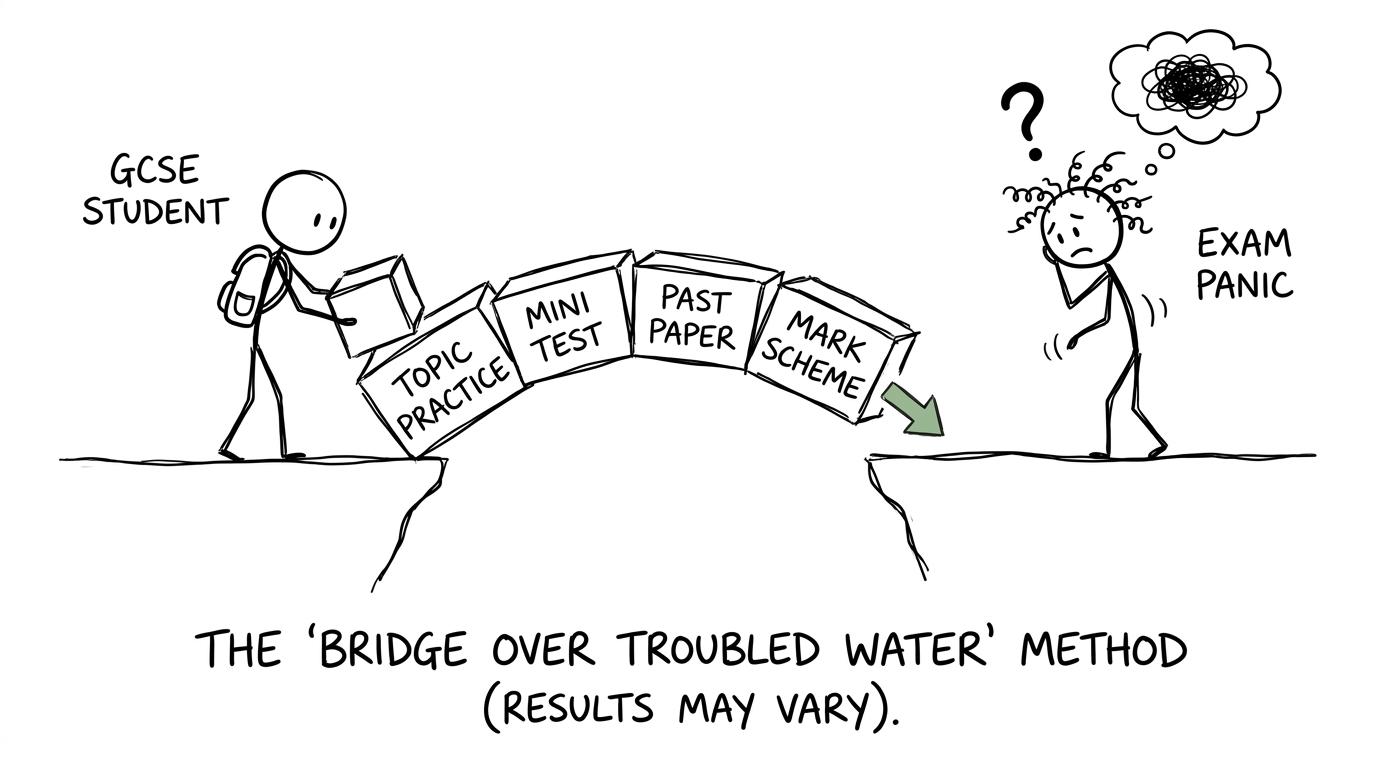 A revision bridge keeps exam panic safely on the other side
Common mistakes to avoid
Assuming every sixth form has the same rules
There is no universal requirement for Higher tier Arabic. Entry policies differ between schools, colleges, courses and application years.
Confusing tier with grade
Foundation is the route by which you sit the assessment; grade 555 is the result awarded. Admissions wording usually specifies grades. Do not reject a valid grade simply because it came from Foundation.
Forgetting the Foundation grade ceiling
Foundation cannot produce a grade above 555. If Arabic must contribute a grade 666 or higher, Foundation will not meet that condition.
Looking only at general entry requirements
Meeting the overall sixth-form threshold does not guarantee access to every A Level. Maths, Further Maths and sciences often have additional subject requirements.
Choosing Higher tier because of rumours
“Someone said” is not an admissions policy. Use the current prospectus, the formal admissions document and a direct response from the sixth form.
Neglecting Maths while worrying about Arabic
For students applying to A Level Maths, your GCSE Maths result is likely to carry a direct subject-specific requirement. Keep Arabic in perspective and revise according to the conditions that genuinely affect your choices.
Make the decision from evidence, not anxiety
Higher tier GCSE Arabic is necessary only when you need access to a grade above 555 or must satisfy a requirement that Foundation cannot meet. If Arabic simply needs to contribute a grade 444 or 555 to your overall profile, a strong Foundation result may be entirely sufficient.
Check your chosen sixth forms now, compare their general and subject-specific requirements, and discuss your tier evidence with your Arabic teacher. Then give your Maths preparation the same clarity.
Start with MathsGenie’s free GCSE Maths revision resources, use revision lessons and practice questions to repair weak topics, and build towards mini tests, past papers, predicted papers, mark schemes and video solutions. If A Level Maths is your destination, you can also explore Edexcel A Level Maths past papers to understand where the journey leads.
The calmest decisions are rarely based on the loudest rumour. They come from knowing the requirement, knowing your evidence and knowing what to do next.