

Harder GCSE Bengali or Panjabi? A Fair Comparison
Harder GCSE Bengali or Panjabi? Compare papers, scripts, skills and revision workload fairly, then choose the language that best matches your experience.
A subject can look easy from the outside and feel completely different once the exam paper opens. That is especially true of a language spoken confidently at home but rarely read or written. If you are searching for harder GCSE Bengali or Panjabi, the honest answer is that neither qualification is automatically harder. Under the current AQA specifications, they have the same assessment structure, skill weightings, tiers and broad themes.
The difference comes from you: which language you can read, write, understand and speak in the form expected by the exam. Home fluency helps, but GCSE success also depends on accurate spelling, formal vocabulary, translation, grammar and exam technique.
This comparison examines the actual workload fairly. It also considers the question that matters to a student already preparing for GCSE maths: which course can you revise effectively without allowing another subject to absorb all your time?
The short answer
GCSE Bengali and GCSE Panjabi are structurally equal in difficulty under AQA. Both assess:
- listening, worth 25%25\%25%;
- speaking, worth 25%25\%25%;
- reading, worth 25%25\%25%;
- writing, worth 25%25\%25%;
- translation in both directions;
- communication across past, present and future time frames;
- the same broad areas of identity, culture, society, global issues, education and employment.
Your best choice is normally the language in which you have the strongest complete skill set, not simply the one you speak most often.
Before deciding, ask:
- Can I read the script accurately without transliteration?
- Can I write extended answers by hand?
- Do I understand formal or standard language, not only family conversation?
- Can I respond spontaneously in a speaking assessment?
- Is a teacher or suitable course available?
- Can my school enter me for the correct qualification and tier?
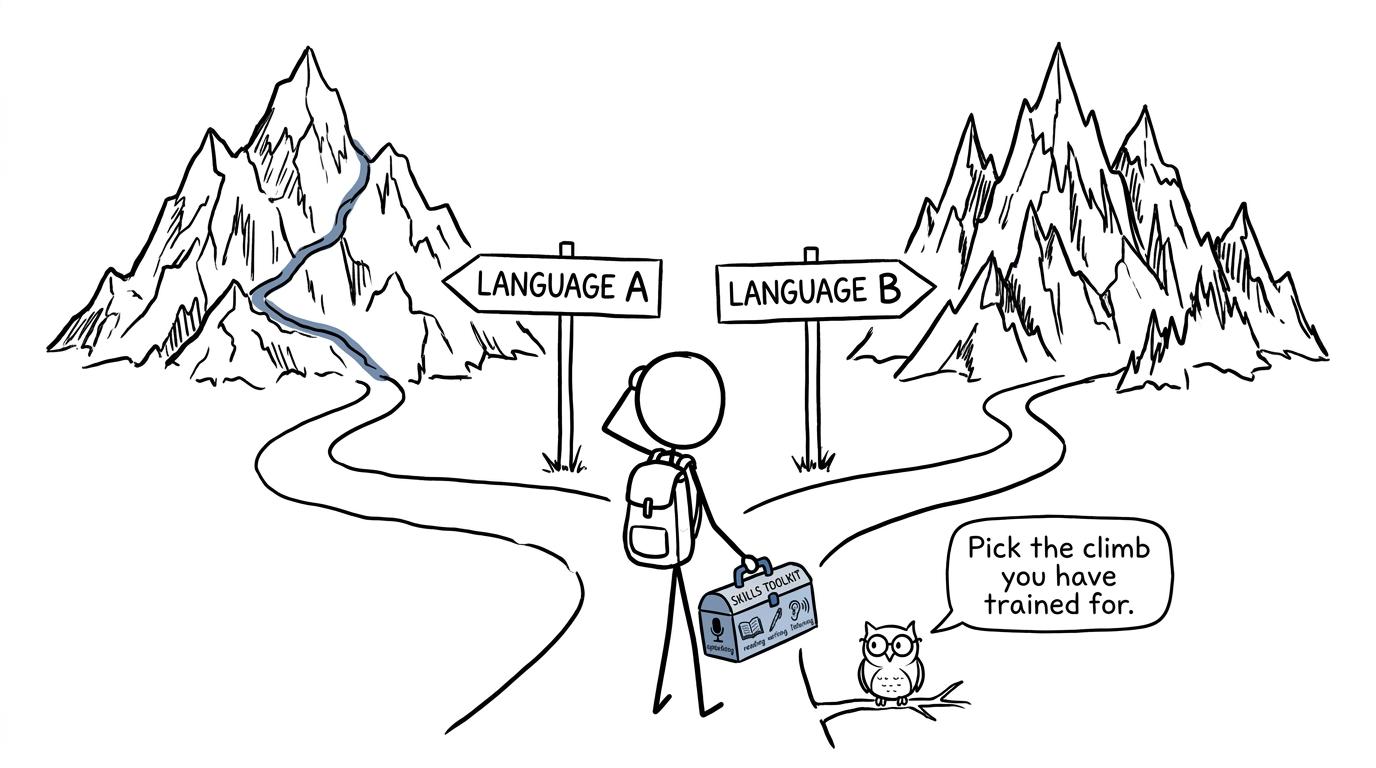 A student choosing a language using a toolkit rather than rumours
The actual exam workload is almost identical
AQA currently offers GCSE Bengali under specification 8638 and GCSE Panjabi under specification 8683. Both are linear qualifications, so students complete all assessments at the end of the course and take every component at the same tier.
Foundation tier covers grades 111-555, while higher tier covers grades 444-999. A student cannot mix tiers between listening, speaking, reading and writing.
| Component | Foundation tier | Higher tier | Weighting |
|---|---|---|---|
| Listening | 353535 minutes, 404040 marks | 454545 minutes, 505050 marks | 25%25\%25% |
| Speaking | 777-999 minutes, plus preparation | 101010-121212 minutes, plus preparation | 25%25\%25% |
| Reading | 454545 minutes, 606060 marks | 111 hour, 606060 marks | 25%25\%25% |
| Writing | 111 hour, 505050 marks | 111 hour 151515 minutes, 606060 marks | 25%25\%25% |
The speaking assessment includes a role-play, a photo card and a general conversation. Reading includes translation into English, while writing includes translation from English into the assessed language. At higher tier, students also face longer texts, more extended writing and more complex language.
On paper, therefore, neither course has a lighter route. The number of components, assessment weightings and exam durations match. Choosing Panjabi does not remove listening or translation; choosing Bengali does not create an additional paper.
Where GCSE Bengali may feel harder
GCSE Bengali may be more demanding if you speak Bengali at home but have limited experience reading and writing its script. Recognising familiar words when somebody says them is very different from producing accurate written language under timed conditions.
Students may also find a gap between the variety used within their family or community and the standard written Bengali expected in formal communication. That does not make a home variety incorrect. It means the examination requires an additional register, just as GCSE English expects forms of writing that are different from everyday conversation.
Bengali is more likely to feel difficult when:
- you rely on English transliteration;
- handwriting the script is slow;
- your spoken vocabulary is strong but your spelling is uncertain;
- formal texts contain unfamiliar words or structures;
- you have rarely translated directly between Bengali and English;
- you can understand relatives but struggle with recorded standard speech.
A student who reads Bengali regularly, writes confidently and understands a range of speakers may experience the opposite. For that student, Bengali could be the more manageable choice.
Where GCSE Panjabi may feel harder
For AQA GCSE Panjabi, students need literacy in the Gurmukhi script used by the specification. Someone may speak Panjabi naturally yet have learned to read another script, or may rarely write Panjabi at all. In that situation, the literacy workload can be substantial.
Panjabi also has spoken varieties across families, regions and communities. A student accustomed to one variety may need to broaden vocabulary and become comfortable with the standard written forms used in examination material. Again, this is not a judgement about how anybody speaks. It is a question of alignment with the assessed course.
Panjabi is more likely to feel difficult when:
- Gurmukhi reading is hesitant;
- written spelling is much weaker than speaking;
- you depend on memorised answers and struggle with unexpected questions;
- formal vocabulary is unfamiliar;
- translation exposes gaps hidden during ordinary conversation;
- you have little practice understanding recorded speech from unfamiliar speakers.
If Gurmukhi is already secure and you use Panjabi across reading, writing, listening and speaking, the course may feel considerably more accessible.
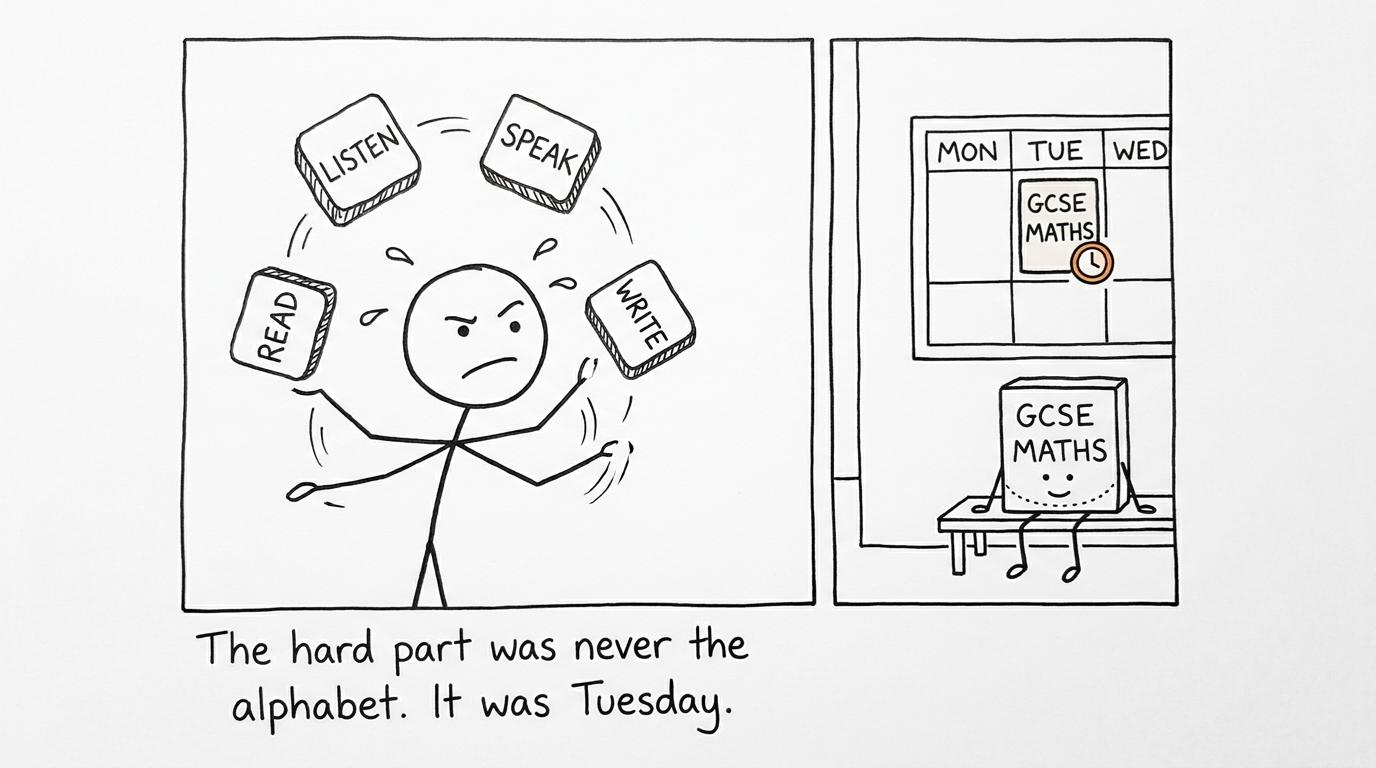 A student juggling four language skills while maths waits in the timetable
Speaking a language at home is not the whole GCSE
Home fluency is valuable. It can provide natural pronunciation, quick comprehension and confidence in conversation. But it can also create a misleading first impression: “I already speak this, so I will not need much revision.”
The examination tests more than conversational survival. You may need to express and justify opinions, refer to different time frames, understand detailed written passages, translate accurately and adapt language when a question changes direction.
Think of fluency as several connected abilities:
- Listening: understanding both overall meaning and precise details.
- Speaking: responding clearly, spontaneously and with sufficient range.
- Reading: decoding the script and interpreting unfamiliar material.
- Writing: producing accurate, coherent language under time pressure.
A student whose speaking is excellent but writing is weak does not have a small gap. Writing represents 25%25\%25% of the qualification, and reading represents another 25%25\%25%. Half of the assessment directly depends on literacy.
How to make a fair personal comparison
Do not decide from rumours about which language “gets better grades”. Published results describe different groups of candidates; they do not prove that one paper is inherently easier. Cohort size, prior fluency, teaching access, tier entry and literacy experience can all affect outcomes.
Instead, compare your present skills using equivalent tasks in each language.
Test script fluency
Read a short, unfamiliar passage in each language. Notice whether you can read continuously or must decode one character at a time. Then write a paragraph without copying. Speed matters because every written assessment is timed.
Test formal comprehension
Listen to material beyond family conversation. Can you identify opinions, reasons, time references and specific details? Familiarity with one household's speech is not the same as broad listening comprehension.
Test spontaneous speaking
Ask a teacher or fluent adult to pose unprepared questions on school, technology, holidays, work or social issues. If you can only deliver memorised paragraphs, the general conversation may expose that weakness.
Test support and resource availability
A theoretically easier language may become the harder course if you have no regular teaching, feedback or speaking practice. Confirm that your school can arrange entry, conduct the speaking assessment and support the relevant script and specification.
Comparing revision workload alongside GCSE maths
Language revision and maths revision fail in similar ways. Rereading vocabulary can feel productive without proving recall, just as watching a maths solution can feel clear until you attempt the question alone.
The solution is active practice. Build short sessions around the weakest skill rather than repeatedly practising what already feels comfortable. A weekly language plan might rotate listening, script accuracy, speaking and timed writing. Your maths plan should follow the same principle: diagnose, practise, mark and revisit.
MathsGenie's GCSE Maths revision hub keeps lessons, exam questions and paper practice together. If your week is crowded, the GCSE maths revision timetable guide can help you protect regular maths sessions while preparing for a language qualification.
Short tests are useful when a full paper will not fit. The Edexcel GCSE Maths mini tests provide focused timed practice, while the broader MathsGenie resources collection brings together additional revision materials.
The point is not to split every hour equally. It is to stop either subject becoming invisible. A language may need frequent, short contact for vocabulary and script fluency, while maths needs repeated problem-solving and careful correction.
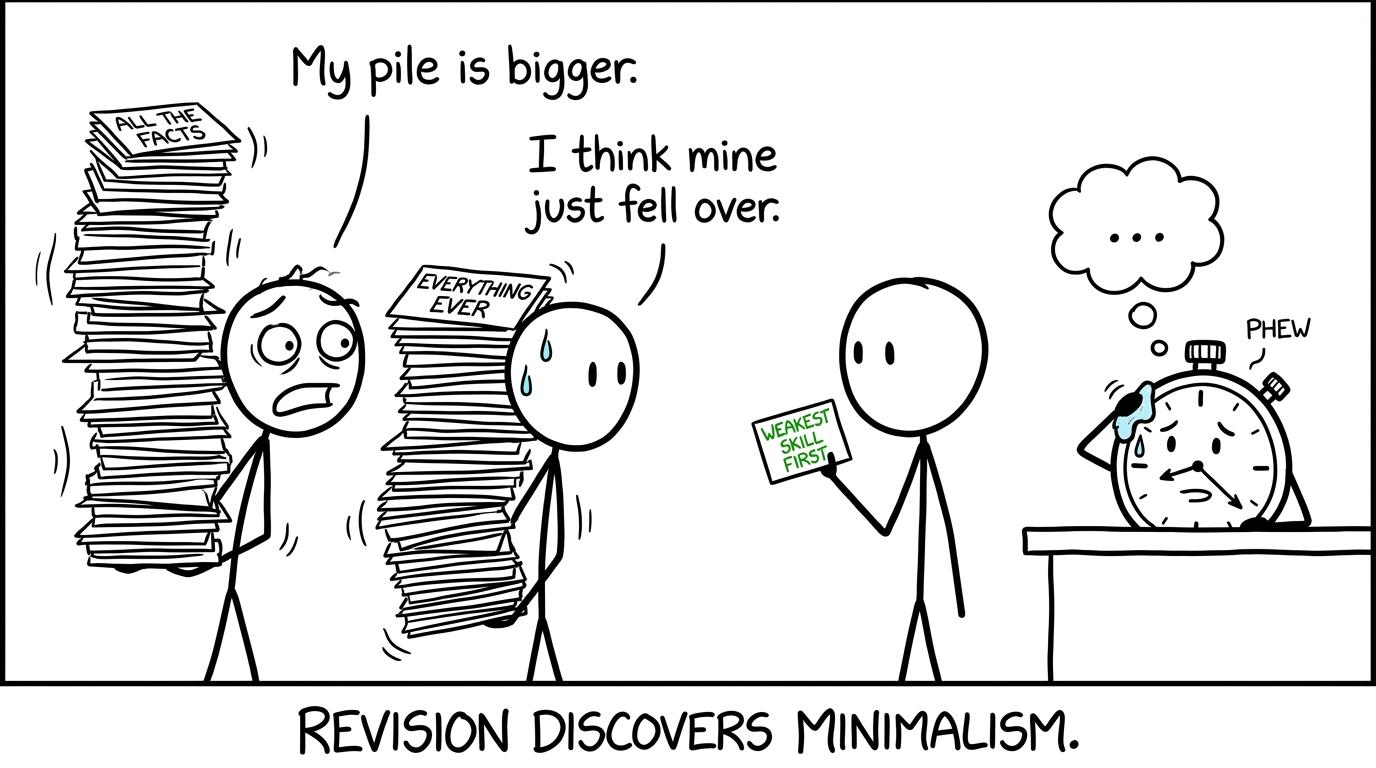 Three students discovering that the smallest useful revision target wins
Common mistakes when comparing Bengali and Panjabi
Choosing from grade statistics alone
Results cannot tell you which language is easier for you. Different candidates bring different levels of prior knowledge, and grade boundaries reflect performance in a particular series rather than a permanent difficulty ranking.
Assuming speaking fluency guarantees a high grade
Confident conversation does not automatically produce accurate spelling, translation or extended writing. Judge all four assessed skills separately.
Ignoring the required script
Transliteration may help during early learning, but it cannot replace fluent reading and writing in the script required by the examination.
Picking the language with less teaching support
Feedback matters, particularly for writing and speaking. Before entering, check who will correct your work, conduct realistic speaking practice and explain the mark scheme.
Letting language preparation displace maths revision
An additional GCSE can quietly consume the time reserved for a core subject. Keep maths measurable with topic questions and timed papers. MathsGenie provides AQA GCSE Maths past papers, Edexcel GCSE Maths past papers and an OCR GCSE Maths revision hub, so your practice can remain aligned with your board and tier.
Which GCSE should you choose?
Choose GCSE Bengali if your Bengali literacy, comprehension and access to support are stronger. Choose GCSE Panjabi if those same advantages are stronger in Panjabi. If you speak both, compare unfamiliar reading, handwritten writing, translation and spontaneous speech rather than asking which one feels more familiar at home.
The fairest conclusion is simple: the specifications create almost the same formal workload, but your starting point determines the real workload. The harder qualification is usually the one in which the gap between conversational knowledge and exam-ready literacy is larger.
Once you have made the language decision, give your maths preparation the same honesty. Start with a revision lesson, complete practice questions, check the mark scheme and record the exact reason for each lost mark. Then build timing through past papers, mini tests and GCSE predicted papers.
MathsGenie gives GCSE and A Level students free revision lessons, practice questions, mark schemes, video solutions, past papers and predicted papers. Choose one weak maths topic today and begin there; small, accurate steps are easier to sustain than a timetable built on panic.










