Graph Transformations GCSE Maths: Rules and Examples
Graph transformations GCSE maths explained with clear rules, step-by-step worked examples and exam-style questions to help you avoid common mistakes.
A graph moves left when you expected it to move right. You change your answer, check the solution, and discover your first attempt was correct. Graph transformations GCSE maths questions can feel like a test of memory, but they become much more reliable when you track what happens to coordinates: changes outside f(x)f(x)f(x) affect heights; changes inside affect horizontal positions.
Imagine a student who keeps mixing up y=f(x)+3y=f(x)+3y=f(x)+3 and y=f(x+3)y=f(x+3)y=f(x+3). They know both graphs move, but not why they move differently. We will follow that sticking point through a method, worked examples and practice until the distinction makes sense.
Graph transformations GCSE maths: the essentials
For GCSE Higher tier, the core focus is translating and reflecting a given function. You do not always need its formula. A sketch and a few labelled coordinates can be enough.
Before answering, check:
- Is the change inside or outside the function?
- Is it an addition, subtraction or negative sign?
- Which coordinate changes?
- Where do the original graph’s key points move?
The notation y=f(x)y=f(x)y=f(x) simply means that the output yyy depends on the input xxx. If f(2)=5f(2)=5f(2)=5, the graph passes through (2,5)(2,5)(2,5).
MathsGenie’s transforming graphs revision topic brings the relevant resources together. The explanations below focus on translations and reflections rather than adding stretch rules to memorise.
The rules, with a reason behind them
For a positive number aaa:
| New equation | Transformation | What happens to a point |
|---|---|---|
| y=f(x)+ay=f(x)+ay=f(x)+a | Translate upwards by aaa units | (x,y)↦(x,y+a)(x,y)\mapsto(x,y+a)(x,y)↦(x,y+a) |
| y=f(x)−ay=f(x)-ay=f(x)−a | Translate downwards by aaa units | (x,y)↦(x,y−a)(x,y)\mapsto(x,y-a)(x,y)↦(x,y−a) |
| y=f(x+a)y=f(x+a)y=f(x+a) | Translate left by aaa units | (x,y)↦(x−a,y)(x,y)\mapsto(x-a,y)(x,y)↦(x−a,y) |
| y=f(x−a)y=f(x-a)y=f(x−a) | Translate right by aaa units | (x,y)↦(x+a,y)(x,y)\mapsto(x+a,y)(x,y)↦(x+a,y) |
| y=−f(x)y=-f(x)y=−f(x) | Reflect in the xxx-axis | (x,y)↦(x,−y)(x,y)\mapsto(x,-y)(x,y)↦(x,−y) |
| y=f(−x)y=f(-x)y=f(−x) | Reflect in the yyy-axis | (x,y)↦(−x,y)(x,y)\mapsto(-x,y)(x,y)↦(−x,y) |
Outside changes are straightforward: adding to the output increases every height.
Inside changes need more care. Suppose the original function produces a particular output when its input is 222. In f(x+3)f(x+3)f(x+3), that same input is reached when
x+3=2,x+3=2,x+3=2,so x=−1x=-1x=−1. The same output now appears three units further left.
Our imagined student stops saying “plus means right” and starts asking: what value of xxx makes the inside equal the old input? That question explains the direction instead of merely recalling it.
A dependable method for sketching
Use this routine:
- Identify the transformation before drawing.
- Choose key points, such as a turning point, endpoint or labelled intercept.
- Transform their coordinates.
- Draw the same-shaped curve through the new points.
Translations and reflections preserve the graph’s shape and size. Keep the coordinate axes fixed; move the curve, not the entire drawing. If the sketch shows only part of a graph, transform that part, including its endpoints.
Start with MathsGenie’s graph transformations Lessons and use the Question Bank to practise this coordinate-tracking method without assembling your own question set.
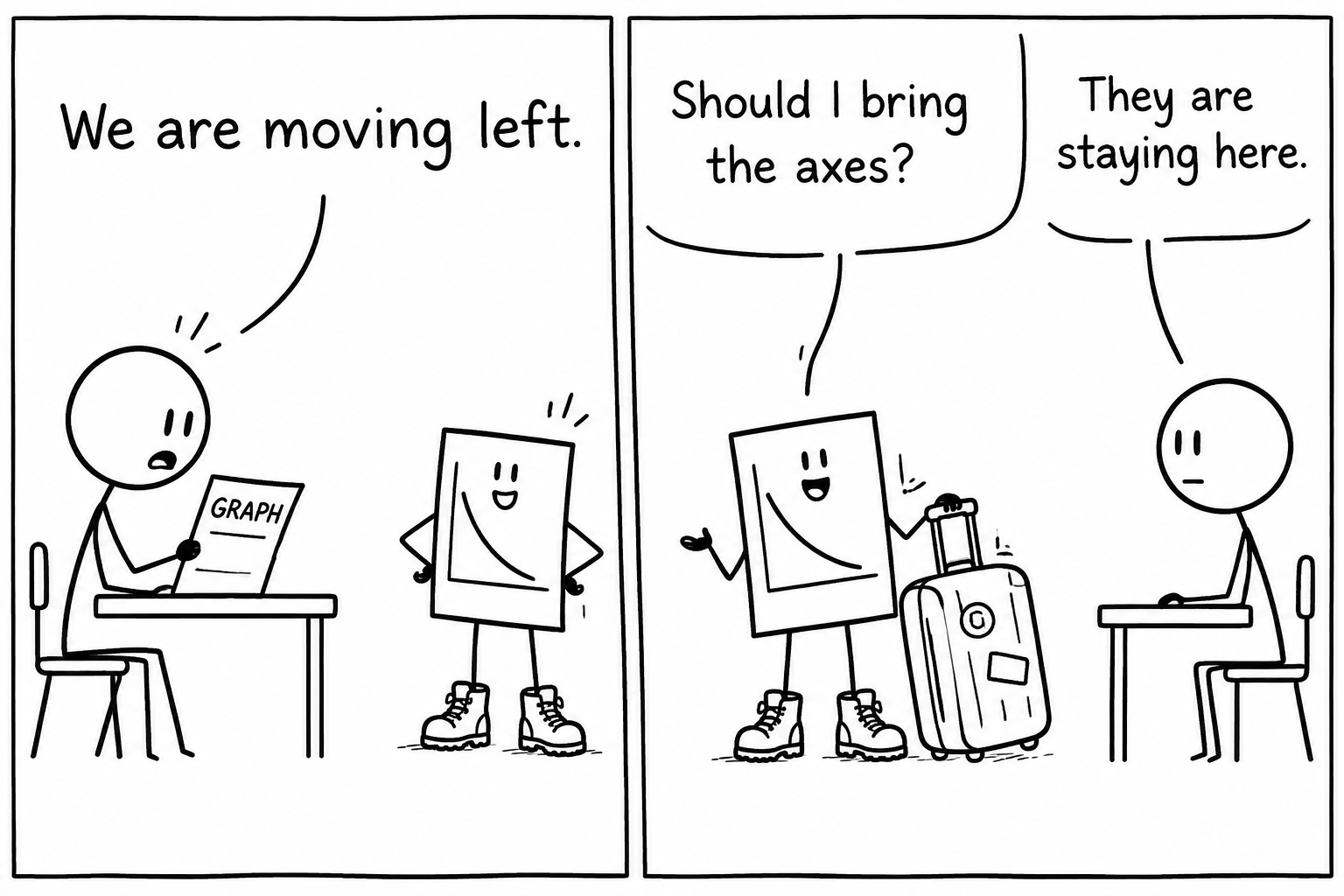 Stick-figure comic about a graph packing a suitcase while its coordinate axes stay behind
Graph transformations worked examples
Translating vertically
The graph y=f(x)y=f(x)y=f(x) has a minimum at (2,−1)(2,-1)(2,−1). Find the minimum of y=f(x)+4y=f(x)+4y=f(x)+4.
Identify the change: the addition is outside the function, so every output increases by 444.
Keep the horizontal coordinate: x=2x=2x=2 remains unchanged.
Calculate the new height:
−1+4=3.-1+4=3.−1+4=3.The new minimum is therefore (2,3)(2,3)(2,3). The graph is translated upwards by 444 units.
Translating horizontally
The graph y=f(x)y=f(x)y=f(x) passes through (2,5)(2,5)(2,5). Find the corresponding point on y=f(x+3)y=f(x+3)y=f(x+3).
Identify the change: it is inside the function, so horizontal positions change.
Recover the original input:
x+3=2⇒x=−1.x+3=2 \quad\Rightarrow\quad x=-1.x+3=2⇒x=−1.Keep the output: the corresponding height is still 555.
The new point is (−1,5)(-1,5)(−1,5). The whole graph moves left by 333 units.
This is the moment our imagined student’s approach changes. Instead of guessing a direction, they have a short calculation that checks it.
Distinguishing the two reflections
A point on y=f(x)y=f(x)y=f(x) is (−3,2)(-3,2)(−3,2).
For y=−f(x)y=-f(x)y=−f(x), negate the output:
(−3,2)↦(−3,−2).(-3,2)\mapsto(-3,-2).(−3,2)↦(−3,−2).This is a reflection in the xxx-axis.
For y=f(−x)y=f(-x)y=f(−x), negate the horizontal coordinate:
(−3,2)↦(3,2).(-3,2)\mapsto(3,2).(−3,2)↦(3,2).This is a reflection in the yyy-axis.
The axis name tells you which line acts as the mirror, not which coordinate changes. Points already on the mirror line stay fixed.
Common mistakes and how to catch them
Moving right for a positive inside change
For y=f(x+4)y=f(x+4)y=f(x+4), the graph moves left, not right. Check by setting x+4x+4x+4 equal to an original input. Avoid relying on “opposite direction” alone if you keep forgetting what it means.
Changing both coordinates
A single horizontal translation changes only the horizontal coordinate. A vertical translation changes only the vertical coordinate. Write the original and new coordinate pairs beside each other to catch accidental changes.
Naming the wrong reflection axis
For y=−f(x)y=-f(x)y=−f(x), heights change sign, so points cross the xxx-axis. For y=f(−x)y=f(-x)y=f(−x), horizontal positions change sign, so points cross the yyy-axis.
Giving an incomplete description
“Moves sideways” is not a complete transformation description. State the transformation, direction and distance, or name the reflection axis. If a question requests a translation vector, write horizontal movement above vertical movement.
For a slower visual explanation, use the transforming graphs video lessons. The written revision guide is useful when you want to revisit the rules at your own pace.
Graph transformations questions: test your understanding
Try these original exam-style questions before reading the answers.
- A curve has a maximum at (−2,6)(-2,6)(−2,6). Find its corresponding maximum after the transformation y=f(x)−5y=f(x)-5y=f(x)−5.
- Describe fully the transformation from y=f(x)y=f(x)y=f(x) to y=f(x−4)y=f(x-4)y=f(x−4).
- The point (3,−2)(3,-2)(3,−2) lies on y=f(x)y=f(x)y=f(x). Find the corresponding point on y=f(−x)y=f(-x)y=f(−x).
- A graph is translated left by 222 units. Write its new equation in terms of fff.
Answers and checks
- (−2,1)(-2,1)(−2,1): subtract 555 from the height only.
- A translation right by 444 units: the inside expression reaches each original input four units later.
- (−3,−2)(-3,-2)(−3,−2): reflection in the yyy-axis changes the horizontal coordinate’s sign.
- y=f(x+2)y=f(x+2)y=f(x+2): a positive addition inside produces a leftward translation.
If you made an error, name it before trying another question: wrong direction, wrong coordinate or wrong axis. That makes the next attempt targeted practice rather than another guess.
Turn the method into a reliable habit
Our imagined student has not gained a perfect memory; they now have a way to check a doubtful answer. Your next step is to use that check across unfamiliar graphs until recognising the transformation becomes more dependable. Start with the graph transformations Lessons, then apply your method in the Question Bank.