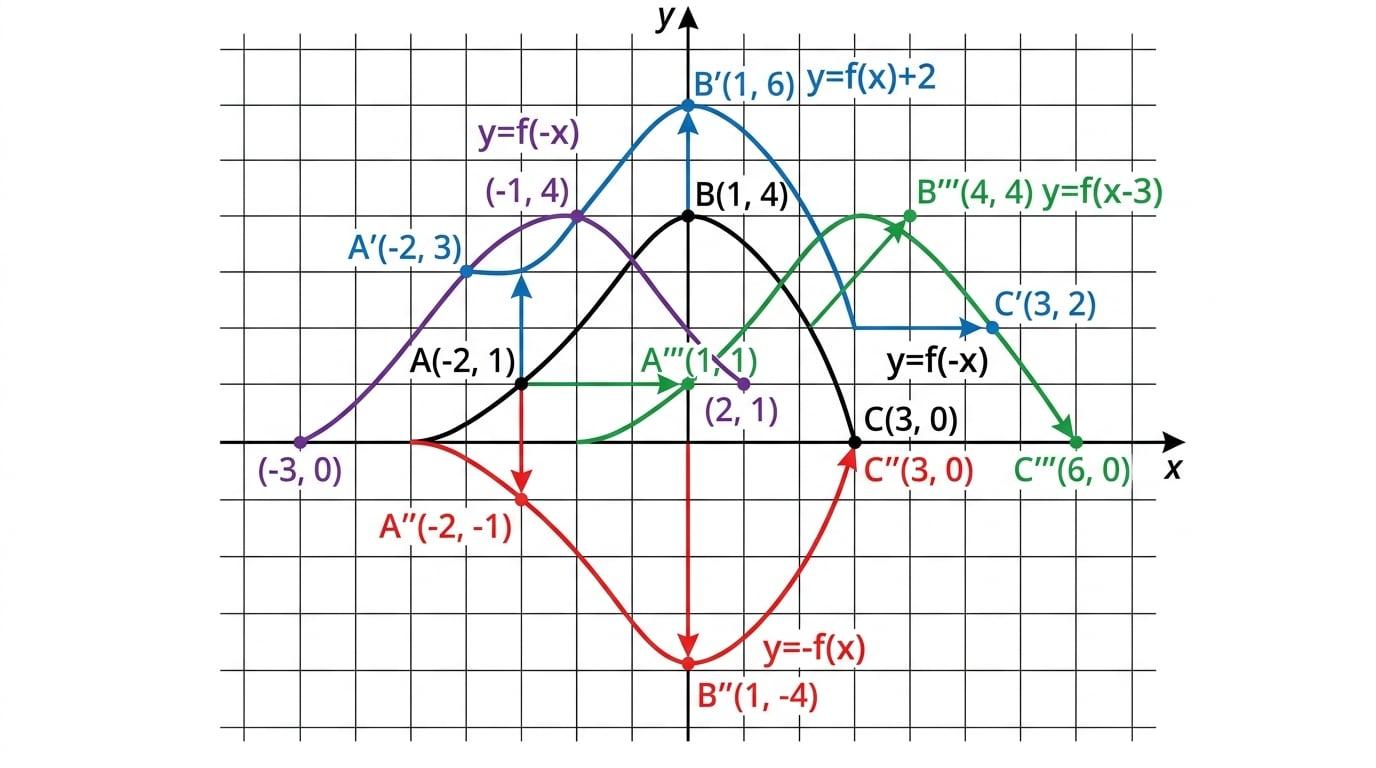
- How to treat y=f(x)y=f(x)y=f(x) as the original graph.
- How outside changes affect yyy-coordinates directly.
- How inside-the-bracket changes affect xxx-coordinates in the opposite way.
- How to transform key points when graphs are shifted, stretched or reflected.
Before transforming anything, make sure you know what the notation means.
Key language
- A function is a rule that turns an input xxx into an output f(x)f(x)f(x).
- The graph of y=f(x)y=f(x)y=f(x) is the original graph.
- A transformation is a change to a graph, such as a slide, stretch or reflection.
- A key point is a useful point to track, such as a turning point, where a curve changes direction, or an intercept, where it crosses an axis.
If a point (a,b)(a,b)(a,b) lies on y=f(x)y=f(x)y=f(x), then f(a)=bf(a)=bf(a)=b. This is the link between coordinates and function notation.
Reading a point from function notation
-
Suppose you are told that f(−2)=5f(-2)=5f(−2)=5.
-
The input is -2, so the xxx-coordinate is -2.
-
The output is 5, so the yyy-coordinate is 5.
-
Therefore the original graph y=f(x)y=f(x)y=f(x) passes through (−2,5)(-2,5)(−2,5).

Move points, then draw the curve
To sketch a transformed graph, move several key points first. Then join them with the same general curve shape.
A change outside the function happens after the function has produced the output. So it changes the yyy-coordinates.
A vertical change means up or down, parallel to the yyy-axis.
For y=f(x)+ay=f(x)+ay=f(x)+a, every point moves by adding aaa to its yyy-coordinate:
- positive aaa means up
- negative aaa means down
A translation is a slide: every point moves the same distance in the same direction.
Vertical translation: y=f(x)−3
-
Suppose the original graph has key points (1,4)(1,4)(1,4) and (−2,0)(-2,0)(−2,0).
-
The -3 is outside f(x)f(x)f(x), so change only the yyy-coordinates.
-
Subtract 3 from each yyy-coordinate: (1,4)(1,4)(1,4) becomes (1,1)(1,1)(1,1), and (−2,0)(-2,0)(−2,0) becomes (−2,−3)(-2,-3)(−2,−3).
-
The whole graph has moved 3 units down.

Changing the wrong coordinate
If the change is outside f(x)f(x)f(x), do not change the xxx-coordinates. Outside changes outputs, so it changes yyy.
A stretch changes distances from an axis by a scale factor, which is the multiplier used.
For y=kf(x)y=kf(x)y=kf(x), every yyy-coordinate is multiplied by kkk:
- if k>1k>1k>1, the graph is stretched vertically
- if 0<k<10<k<10<k<1, the graph is squashed vertically
- if k<0k<0k<0, the graph is reflected in the xxx-axis as well
A reflection is a mirror image in a line.
Vertical stretch and reflection: y=−2f(x)
-
Suppose y=f(x)y=f(x)y=f(x) passes through (−3,1)(-3,1)(−3,1), (0,−2)(0,-2)(0,−2) and (2,4)(2,4)(2,4).
-
The multiplier -2 is outside f(x)f(x)f(x), so keep the xxx-coordinates the same.
-
Multiply each yyy-coordinate by -2: (−3,1)(-3,1)(−3,1) becomes (−3,−2)(-3,-2)(−3,−2), (0,−2)(0,-2)(0,−2) becomes (0,4)(0,4)(0,4), and (2,4)(2,4)(2,4) becomes (2,−8)(2,-8)(2,−8).
-
The graph is reflected in the xxx-axis and stretched vertically by scale factor 2.

Reflection axis mix-up
For y=−f(x)y=-f(x)y=−f(x), the yyy-coordinates change sign but the xxx-coordinates stay the same, so the mirror line is the xxx-axis.
A change inside the bracket changes the input before the function acts. So it affects the xxx-coordinates.
A horizontal change means left or right, parallel to the xxx-axis.
The important rule is:
Inside changes work the opposite way for xxx-coordinates.
For example:
- y=f(x−5)y=f(x-5)y=f(x−5) moves the graph right 5
- y=f(x+4)y=f(x+4)y=f(x+4) moves the graph left 4
Why? Because the expression inside the bracket must equal the old input.
Horizontal translation: y=f(x−4)
-
Suppose the original graph has a turning point at (−1,2)(-1,2)(−1,2) and another point at (3,5)(3,5)(3,5).
-
The x−4x-4x−4 is inside the bracket, so change only the xxx-coordinates.
-
Inside changes work oppositely, so add 4 to each xxx-coordinate.
-
The turning point (−1,2)(-1,2)(−1,2) becomes (3,2)(3,2)(3,2), and the point (3,5)(3,5)(3,5) becomes (7,5)(7,5)(7,5).
-
The whole graph moves 4 units to the right.

Forgetting the opposite sign
f(x+4)f(x+4)f(x+4) moves the graph left 4, not right 4. Inside the bracket, xxx does the opposite.
For y=f(kx)y=f(kx)y=f(kx), the multiplier is inside the bracket, so it affects the xxx-coordinates.
To find the new xxx-coordinate, divide the old xxx-coordinate by kkk.
So:
- y=f(2x)y=f(2x)y=f(2x) halves the xxx-coordinates
- y=f(5x)y=f(5x)y=f(5x) divides the xxx-coordinates by 5
- y=f(−x)y=f(-x)y=f(−x) reflects the graph in the yyy-axis
Horizontal stretch and reflection: y=f(−2x)
-
Suppose the original graph contains the points (−4,3)(-4,3)(−4,3), (0,−1)(0,-1)(0,−1) and (6,2)(6,2)(6,2).
-
The -2 is inside the bracket, so the yyy-coordinates stay the same.
-
Divide each old xxx-coordinate by -2: (−4,3)(-4,3)(−4,3) becomes (2,3)(2,3)(2,3), (0,−1)(0,-1)(0,−1) becomes (0,−1)(0,-1)(0,−1), and (6,2)(6,2)(6,2) becomes (−3,2)(-3,2)(−3,2).
-
The graph is reflected in the yyy-axis and compressed horizontally by scale factor 12\frac{1}{2}21.

Quick memory
Outside affects outputs, so yyy changes directly. Inside affects inputs, so solve the bracket equal to the old xxx.
For harder questions, use a point map, which is a rule showing where each old point moves.
If an old point is (p,q)(p,q)(p,q) on y=f(x)y=f(x)y=f(x), then for a graph like y=af(bx+c)+dy=af(bx+c)+dy=af(bx+c)+d:
- solve bx+c=pbx+c=pbx+c=p to get the new xxx-coordinate
- calculate aq+daq+daq+d to get the new yyy-coordinate
This avoids guessing the order of transformations.
Combined transformation: y=3f(2x−4)+5
-
Suppose the original graph has a turning point at (2,−1)(2,-1)(2,−1).
-
The old input is p=2p=2p=2, so solve 2x−4=22x-4=22x−4=2.
-
This gives 2x=62x=62x=6, so the new xxx-coordinate is 3.
-
The old output is q=−1q=-1q=−1, so the new yyy-coordinate is 3(−1)+5=23(-1)+5=23(−1)+5=2.
-
The new turning point is (3,2)(3,2)(3,2).

Sometimes you are shown the original graph and the transformed graph, and you must write the equation.
Compare matching key points. Look at what happened to the xxx-coordinates and yyy-coordinates separately.
Writing the equation from a shifted graph
-
Suppose the original curve has a vertex at (0,0)(0,0)(0,0).
-
The new curve has the same shape, with its vertex at (5,−2)(5,-2)(5,−2).
-
The xxx-coordinate has increased by 5, so the inside change is x−5x-5x−5.
-
The yyy-coordinate has decreased by 2, so the outside change is -2.
-
The transformed graph is y=f(x−5)−2y=f(x-5)-2y=f(x−5)−2.

In the exam
-
Label two or three key points on the original graph before transforming anything.
-
Decide whether each change is outside fff or inside the bracket.
-
For inside changes, remember the opposite effect on xxx, or solve the bracket equal to the old input.
Check yourself
- If (2,5)(2,5)(2,5) lies on y=f(x)y=f(x)y=f(x), where does it go on y=f(x+3)y=f(x+3)y=f(x+3)?
- Which axis is the mirror line for y=−f(x)y=-f(x)y=−f(x), and which for y=f(−x)y=f(-x)y=f(−x)?
- For y=3f(2x)−1y=3f(2x)-1y=3f(2x)−1, what happens to the xxx-coordinates and yyy-coordinates?