Graph Transformations Exam Questions: GCSE Guide
Graph transformations exam questions explained through three GCSE examples, with coordinate methods, mark-winning steps, mistakes and focused practice.
Graph transformations can feel backwards. A plus sign sometimes moves a graph left, a multiplier can make it narrower, and one small change to f(x)f(x)f(x) can alter every coordinate. Yet graph transformations exam questions become much more predictable once you stop guessing the shape and start transforming points.
The central method is simple: choose recognisable points on y=f(x)y=f(x)y=f(x), apply the transformation to their coordinates, plot the new points, and preserve the original shape. This guide follows a hypothetical student, Maya, through three GCSE questions of rising difficulty and shows where marks are commonly available.
The graph transformations checklist
Before drawing anything, identify which coordinates change.
| New graph | Effect on y=f(x)y=f(x)y=f(x) |
|---|---|
| y=f(x)+ay=f(x)+ay=f(x)+a | Translate upwards by aaa |
| y=f(x)−ay=f(x)-ay=f(x)−a | Translate downwards by aaa |
| y=f(x−a)y=f(x-a)y=f(x−a) | Translate right by aaa |
| y=f(x+a)y=f(x+a)y=f(x+a) | Translate left by aaa |
| y=af(x)y=af(x)y=af(x) | Multiply every yyy-coordinate by aaa |
| y=f(ax)y=f(ax)y=f(ax) | Divide every xxx-coordinate by aaa |
| y=−f(x)y=-f(x)y=−f(x) | Reflect in the xxx-axis |
| y=f(−x)y=f(-x)y=f(−x) | Reflect in the yyy-axis |
The useful distinction is between changes outside and inside the function. An outside change affects the output, so it changes yyy-coordinates. An inside change affects the input, so it changes xxx-coordinates, usually in the direction that initially feels wrong.
Maya writes one reminder beside the question:
outside changes y,inside changes x\text{outside changes } y, \qquad \text{inside changes } xoutside changes y,inside changes xFor a complete explanation before attempting questions, use the Transforming Graphs y=f(x)y=f(x)y=f(x) lesson or the corresponding AQA graph transformations lesson.
Once you have this coordinate method in hand, the Maths Genie lesson and question bank let you practise it without having to assemble suitable questions yourself.
Question one: translating a graph
Maya is shown the graph of y=f(x)y=f(x)y=f(x) and asked to draw
y=f(x−3)+2.y=f(x-3)+2.y=f(x−3)+2.She first separates the two changes:
- f(x−3)f(x-3)f(x−3) moves the graph 333 units right.
- +2+2+2 moves the graph 222 units up.
Together, every point follows the mapping
(x,y)⟼(x+3,y+2).(x,y)\longmapsto(x+3,y+2).(x,y)⟼(x+3,y+2).Suppose the original graph has key points at (−2,0)(-2,0)(−2,0), (0,4)(0,4)(0,4) and (3,1)(3,1)(3,1). Maya transforms them one at a time:
(−2,0)⟼(1,2),(-2,0)\longmapsto(1,2),(−2,0)⟼(1,2), (0,4)⟼(3,6),(0,4)\longmapsto(3,6),(0,4)⟼(3,6), (3,1)⟼(6,3).(3,1)\longmapsto(6,3).(3,1)⟼(6,3).She plots these points and copies the original shape through them. If the original graph is curved, her new graph remains curved. If it contains straight sections, those sections stay straight.
For a typical multi-mark sketching question, credit may be available for showing or applying the correct translation and for drawing the completed graph accurately. Exact mark allocations vary by paper and mark scheme, so clear coordinate evidence protects Maya if the final curve is slightly imperfect.
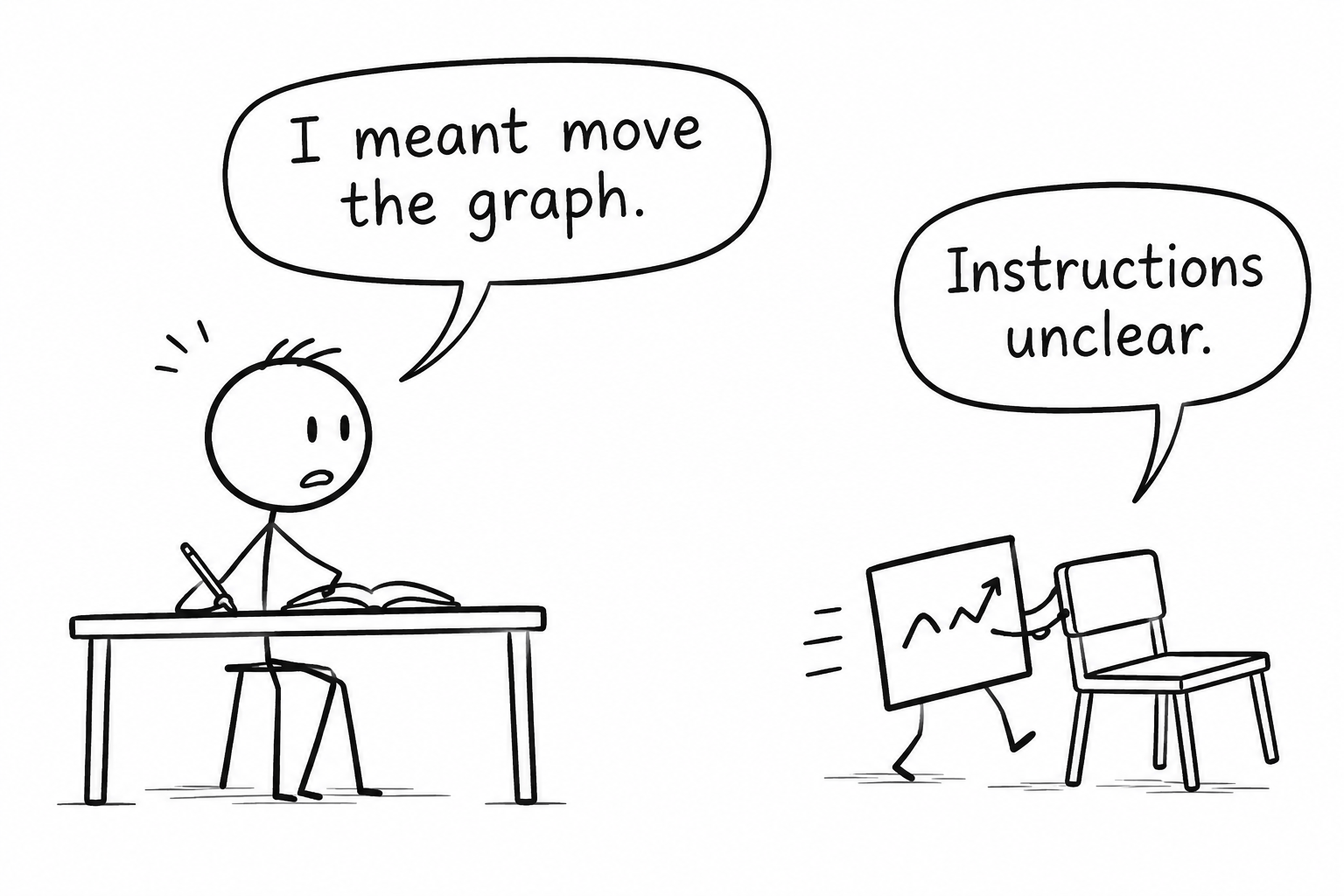 A student discovers that moving a graph is easier than moving furniture
Question two: a reflection and stretch
The next graph transformations GCSE exam question asks Maya to draw
y=−2f(x).y=-2f(x).y=−2f(x).This time the change is outside f(x)f(x)f(x), so the xxx-coordinates remain fixed. Every output is multiplied by −2-2−2:
(x,y)⟼(x,−2y).(x,y)\longmapsto(x,-2y).(x,y)⟼(x,−2y).The negative sign reflects the graph in the xxx-axis. The factor 222 creates a vertical stretch with scale factor 222.
Using three original points, Maya builds a small coordinate table.
| Point on y=f(x)y=f(x)y=f(x) | Point on y=−2f(x)y=-2f(x)y=−2f(x) |
|---|---|
| (−2,1)(-2,1)(−2,1) | (−2,−2)(-2,-2)(−2,−2) |
| (0,−3)(0,-3)(0,−3) | (0,6)(0,6)(0,6) |
| (3,2)(3,2)(3,2) | (3,−4)(3,-4)(3,−4) |
This reveals something important: points on the xxx-axis do not move because multiplying 000 by −2-2−2 still gives 000. The graph keeps the same xxx-intercepts.
Maya shows the calculation y↦−2yy\mapsto-2yy↦−2y before plotting. On an exam question, that line can demonstrate the correct method even if one transformed point is plotted inaccurately. A final accuracy mark may then depend on the complete graph, including its shape and key points.
The Maths Genie graph transformations revision guide is useful for reviewing the language of reflections and stretches. You can also watch the transforming graphs video explanations before returning to the question unaided.
Question three: combining transformations
Maya's hardest question asks her to transform y=f(x)y=f(x)y=f(x) into
y=f(−2(x−1))+3.y=f\bigl(-2(x-1)\bigr)+3.y=f(−2(x−1))+3.Trying to move the whole curve mentally would be risky. Instead, she transforms coordinates algebraically.
Let (u,v)(u,v)(u,v) be a point on the original graph, so v=f(u)v=f(u)v=f(u). On the new graph, the input to fff must equal uuu:
u=−2(x−1).u=-2(x-1).u=−2(x−1).Solving for the new xxx-coordinate gives
u−2=x−1,\frac{u}{-2}=x-1,−2u=x−1, x=1−u2.x=1-\frac{u}{2}.x=1−2u.The outside +3+3+3 changes the output to v+3v+3v+3. Therefore the complete coordinate mapping is
(u,v)⟼(1−u2,v+3).(u,v)\longmapsto\left(1-\frac{u}{2},v+3\right).(u,v)⟼(1−2u,v+3).Maya now applies it to three key points:
(−4,0)⟼(3,3),(-4,0)\longmapsto(3,3),(−4,0)⟼(3,3), (0,2)⟼(1,5),(0,2)\longmapsto(1,5),(0,2)⟼(1,5), (2,−1)⟼(0,2).(2,-1)\longmapsto(0,2).(2,−1)⟼(0,2).The graph has been reflected horizontally, compressed horizontally by scale factor 12\frac{1}{2}21, translated 111 unit right and translated 333 units up. More importantly, Maya does not need to rely on remembering the order from a diagram. Her coordinate equation handles the combined transformation directly.
In a longer question, correct substitution and rearrangement may provide evidence for method marks, while accurately transformed points and the completed curve can earn the remaining credit. The paper's mark scheme remains the authority, but written coordinate work is far safer than an unexplained sketch.
How to approach graph transformations past paper questions
Use the same routine every time:
- underline the expression that has changed;
- decide whether the change affects xxx or yyy;
- write a coordinate mapping;
- transform intercepts, turning points and endpoints first;
- plot the transformed points carefully;
- copy the character of the original graph;
- check whether any points should remain fixed.
A sketch should also respect the stated domain. If the original curve ends at a filled point, transform that endpoint and keep it filled. If it has an open endpoint, preserve that feature. Do not extend a finite section of graph unless the question indicates that it continues.
Work through the Transforming Graphs exam-style lesson resources, then compare your working with the provided solutions. For broader transformation practice, the GCSE transformations question booklet includes questions and answers, although shape transformations are distinct from transformations written with function notation.
Common mistakes in graph transformation questions
Moving an inside translation the wrong way
The graph of y=f(x+4)y=f(x+4)y=f(x+4) moves 444 units left, not right. A point previously produced by input xxx now occurs when the new input is 444 smaller.
Multiplying the wrong coordinate
For y=3f(x)y=3f(x)y=3f(x), multiply yyy by 333. For y=f(3x)y=f(3x)y=f(3x), divide xxx by 333. These transformations are not interchangeable.
Reflecting in the wrong axis
The graph y=−f(x)y=-f(x)y=−f(x) changes output signs, so it reflects in the xxx-axis. The graph y=f(−x)y=f(-x)y=f(−x) changes input signs, so it reflects in the yyy-axis.
Transforming only the turning point
One correct turning point does not define an entire graph. Transform several key points, including roots and endpoints, before drawing the curve.
Drawing without showing a method
A correct sketch can earn full marks, but an incorrect sketch with no working gives the examiner little evidence to reward. A mapping such as
(x,y)⟼(x−2,y+5)(x,y)\longmapsto(x-2,y+5)(x,y)⟼(x−2,y+5)makes the intended method visible.
Turn the method into reliable exam practice
Maya's progress comes from replacing visual guesswork with a repeatable coordinate method, but knowing the method is different from applying it accurately under exam conditions. You now have the same process for translations, reflections, stretches and combined transformations. Start the matching Maths Genie Lessons and Question Bank and practise each transformation until the coordinate mapping becomes automatic.