GCSE Psychology Year 10 Revision Head Start: Worth It?
GCSE psychology year 10 revision head start: learn whether gentle early revision improves recall without harming maths preparation or causing burnout later.
A GCSE psychology year 10 revision head start can help, but only when “starting early” means short, purposeful review rather than beginning Year 11 exam season twelve months ahead of schedule.
That distinction matters. Revisiting completed topics, testing your memory and correcting misunderstandings can make Year 11 feel more manageable. Trying to maintain an intensive revision timetable from Year 10 is different. It can consume time needed for maths, English and science while making revision feel exhausting before the pressure has even arrived.
The sensible answer is not to ignore psychology until your mocks, nor to revise it every evening. Build a light system now. Increase the intensity when assessments justify it.
The short answer: does starting in Year 10 help?
Yes, starting GCSE Psychology revision in Year 10 is likely to help if you:
- review topics after your teacher has covered them
- retrieve information from memory instead of repeatedly reading notes
- keep sessions short and spaced apart
- practise knowledge, application and evaluation
- protect enough time for cumulative subjects such as maths
- adjust your plan using class assessments and teacher feedback
It is less helpful if you:
- attempt to learn content your class has not reached
- create an exam-season timetable too soon
- spend hours making attractive resources you never test yourself on
- neglect sleep, hobbies or other GCSE subjects
- confuse feeling busy with remembering more
A head start should reduce future pressure. If it merely brings future pressure into the present, the plan needs changing.
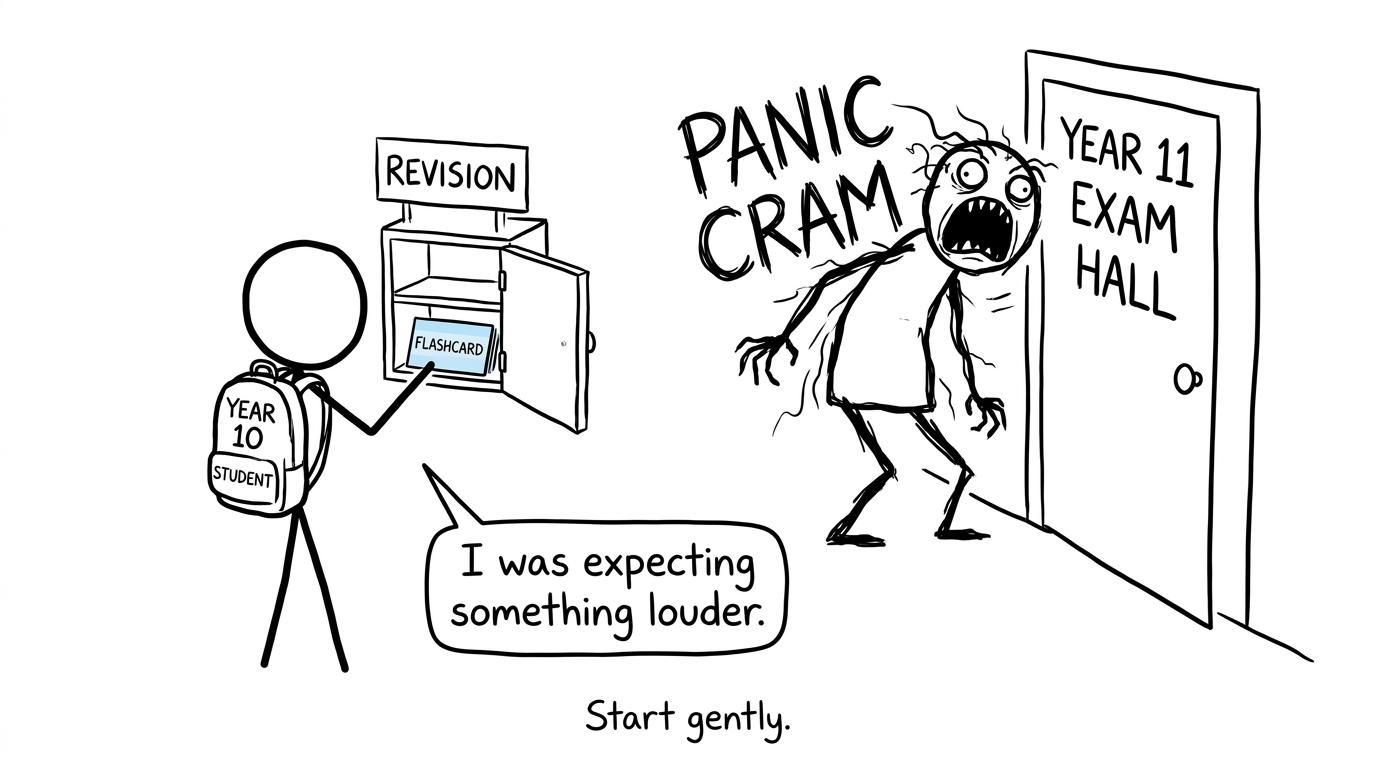 A calm flashcard faces the distant panic-cram monster
What a useful Year 10 head start actually looks like
Early revision works best as maintenance. Once you finish a topic, allow some time to pass and then try to recall its important ideas without looking at your materials.
For psychology, that might involve recalling:
- key theories and explanations
- named studies required by your specification
- research methods and terminology
- strengths and weaknesses of evidence
- ethical issues
- ways to apply knowledge to an unfamiliar scenario
After attempting retrieval, check your notes and correct what was missing. The difficult moment when you try to remember is not evidence that revision has failed. It is the part that reveals what needs attention.
A manageable weekly pattern
For many Year 10 students, one focused session of around 202020 to 303030 minutes each week is a reasonable starting point. This is not a universal prescription. Your school timetable, assessments and other subjects should determine the final balance.
A simple session could contain:
- five minutes recalling the previous topic without notes
- ten minutes checking and improving your answers
- ten minutes answering short questions or planning an extended response
- five minutes recording one weakness to revisit later
During the weeks before an end-of-topic test, you can temporarily add another session. Afterwards, return to the lighter rhythm.
Why psychology needs more than memorising definitions
GCSE Psychology is not solely a memory test. For example, the current AQA specification assesses three broad objectives: knowledge and understanding, application, and analysis and evaluation. Their approximate overall weightings are 35%35\%35%, 35%35\%35% and 30%30\%30% respectively.
That means a student who can recite a theory may still struggle to apply it to a scenario or evaluate the evidence supporting it. Early revision should therefore develop several kinds of thinking.
Knowledge and understanding
Learn precise terminology, theories, processes, studies and research methods. Short retrieval questions and flashcards can be useful here, provided you answer before turning the card over.
Application
Practise recognising psychological ideas in unfamiliar situations. When a question includes a scenario, the details are there to be used. Generic knowledge without a clear connection may not access all the available marks.
Analysis and evaluation
Build concise chains of reasoning. Do not merely label a study “unreliable” or a sample “biased”. Explain why the limitation matters and how it affects the conclusion that can reasonably be drawn.
This varied approach reflects the structure of the examination more closely than copying a textbook. AQA GCSE Psychology is currently linear, meaning the examinations are taken at the end of the course. Its two papers each last 111 hour 454545 minutes, carry 100100100 marks and contribute 50%50\%50% of the qualification. Students should always confirm their own specification and arrangements with their school because course details can change.
How early psychology revision can support GCSE maths
Psychology and maths compete for timetable space, but they do not need to compete for revision quality. Research methods in psychology may involve data, averages, graphs, distributions and interpreting relationships. More broadly, both subjects reward careful reading, accurate terminology and the ability to respond to what a question actually asks.
The difference is that maths is highly cumulative. A weakness in fractions, algebra or ratio can affect several later topics. Your Year 10 plan should therefore preserve regular maths practice rather than moving all available time towards the subject with the nearest test.
Use the MathsGenie GCSE maths revision resources to identify topics you have already met in class. A revision lesson followed by practice questions offers a clearer test of understanding than rereading a page of notes.
If you are unsure what needs attention, the MathsGenie free GCSE and A Level maths revision hub provides topic-based materials organised around the course. Short GCSE maths mini tests can also fit alongside a psychology recall session without turning an ordinary evening into a mock-exam marathon.
A balanced revision plan for Year 10
The most sustainable plan has three layers.
Keep up with current teaching
Homework and recently taught material come first. Early revision should not create a backlog in the lessons happening now.
At the end of each psychology topic, reduce your notes to a one-page checklist. Record what you must know, apply and evaluate. In maths, use the relevant GCSE maths revision lessons and questions to revisit classroom topics while they are still familiar.
Return to older material
Every few weeks, select an older psychology topic and test yourself without notes. Rotate topics rather than repeatedly choosing the one you enjoy most.
The same principle works in maths. A short mixed set reveals whether an older method is still available when the topic name is not displayed above the question.
Increase intensity near meaningful assessments
End-of-topic tests and Year 10 exams justify a temporary increase. Full past papers, however, are finite and valuable. Using too many before you have covered the course can give a distorted score and consume material that would be more informative later.
When you are ready, learn how to use GCSE past papers properly. The useful cycle is to attempt, mark, diagnose, relearn and retest. For maths, GCSE past papers with mark schemes should become increasingly important as more of the specification is completed.
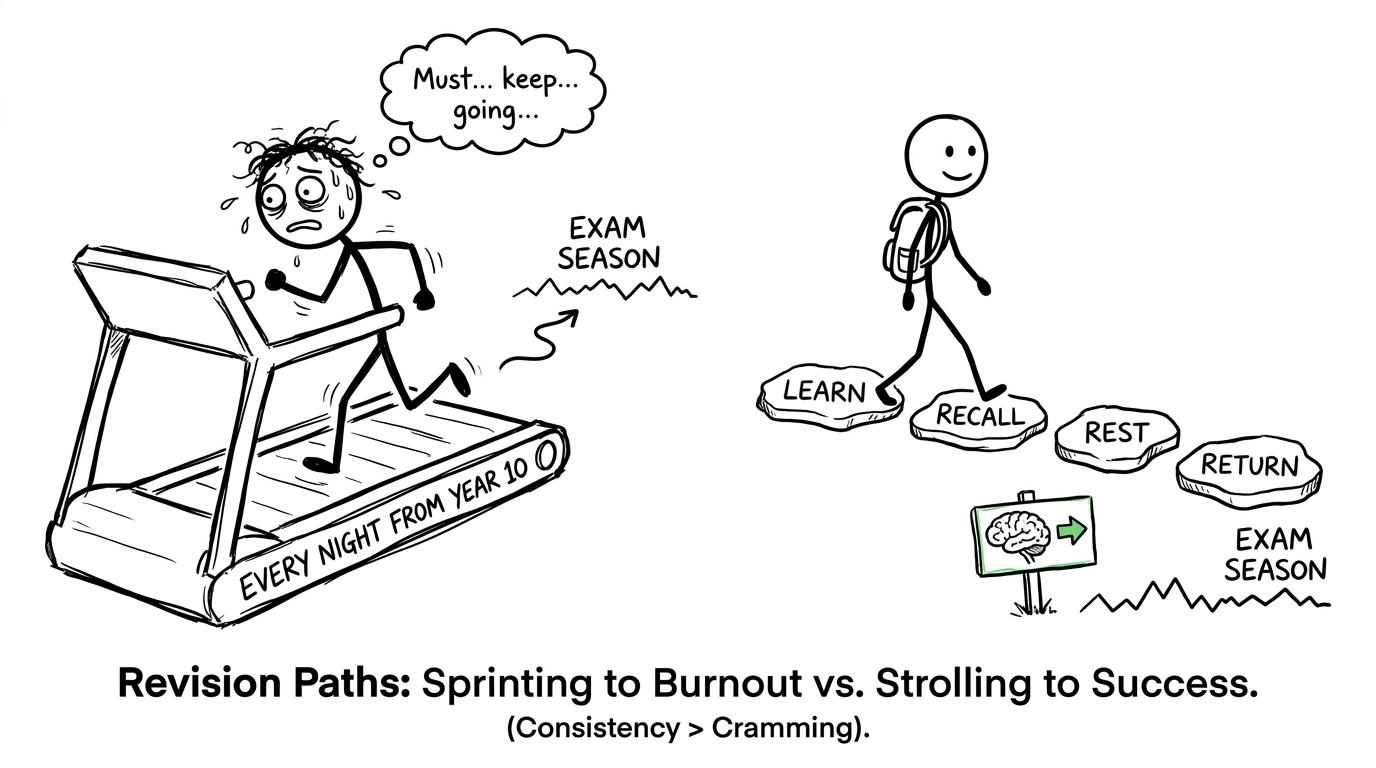 One student sprints towards burnout while another follows calm revision stepping stones
How to avoid burning out before Year 11
Burnout is not prevented merely by starting later. It is reduced by making the workload proportionate, bounded and responsive.
Set a finish time before beginning. A short session with a defined purpose is easier to repeat than an open-ended instruction to “revise psychology”. Stop when the task is complete rather than adding work because you feel guilty.
Keep some evenings free. Sleep, exercise and time away from revision are not prizes awarded after perfect productivity. They are part of a sustainable routine.
Also notice the difference between ordinary effort and persistent distress. Revision can feel challenging, but it should not make you feel continuously overwhelmed. If workload or exam anxiety is becoming difficult to manage, speak to a teacher, parent, carer or another trusted adult.
A useful test is simple: does your Year 10 routine leave you more organised and confident? If it consistently makes you tired, resentful or unable to complete normal schoolwork, reduce it.
Common mistakes with early GCSE Psychology revision
Revising ahead instead of revising back
Teaching yourself untouched material can create misconceptions and duplicate classroom work. Consolidate completed topics unless your teacher has recommended specific preparation.
Only making flashcards
Flashcards can strengthen recall, but psychology examinations also require application and evaluation. Include scenario questions, comparison tasks and short plans for extended responses.
Reading answers before attempting questions
An answer often looks obvious once it is visible. Attempt the question first, then compare your response with the mark scheme. The guidance in how to use GCSE mark schemes effectively applies beyond maths: identify exactly why a mark was gained or lost.
Treating every error as carelessness
Some mistakes come from missing knowledge. Others come from weak application, vague evaluation, inaccurate terminology or misreading the command word. Give the error a specific label and choose a matching correction.
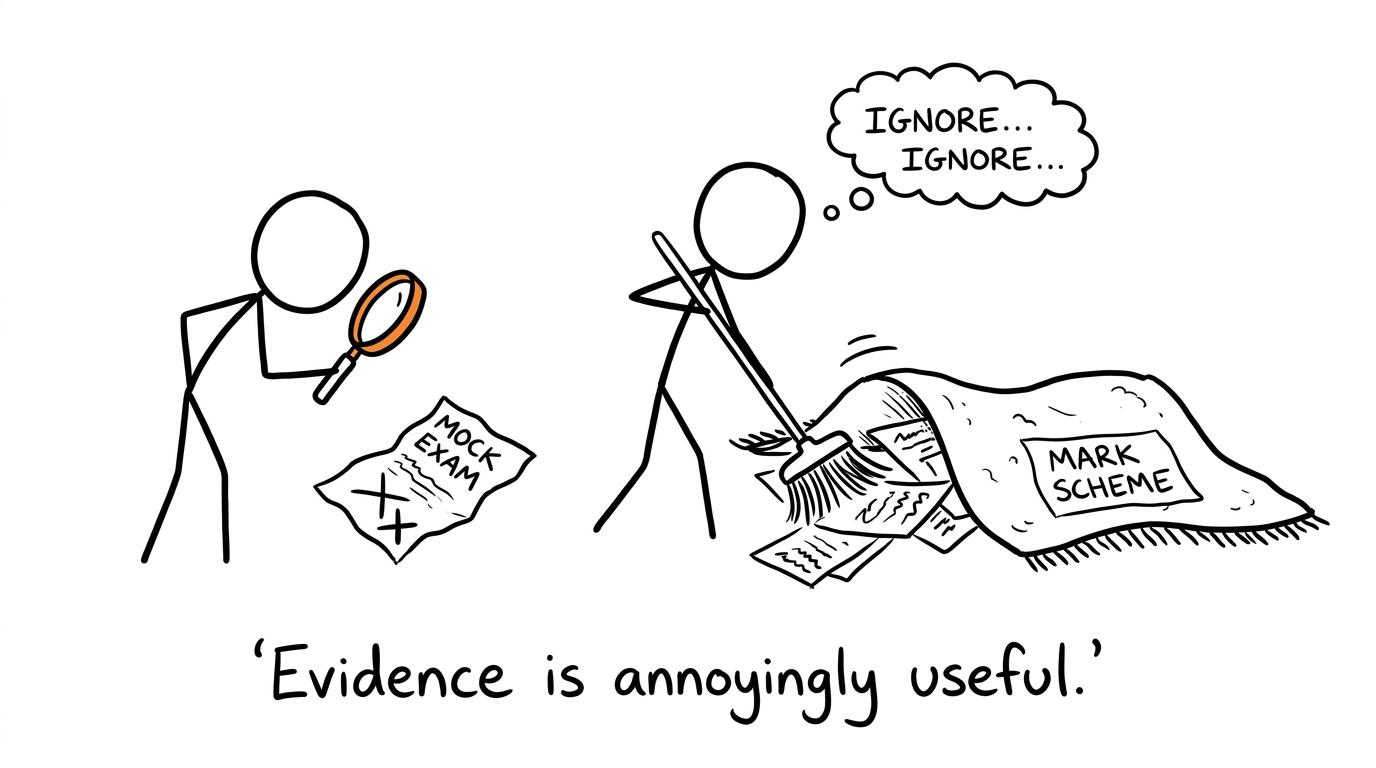 A student investigates mistakes while someone hides them beneath the mark-scheme rug
Doing full papers too early
A paper covering untaught content cannot provide a fair measure of readiness. Start with topic questions and selected sections. Save complete papers for the stage when you can learn something meaningful from the score.
Letting psychology displace maths
The most interesting subject can quietly claim all your revision time. Keep maths active through short, regular practice. Later in the course, Edexcel GCSE Maths past papers provide official mark schemes and worked solutions where available. Students following another board should choose resources matching their own specification and tier.
So, is the Year 10 head start worth it?
Yes; provided the head start is gentle.
A small weekly routine can preserve knowledge, expose misconceptions and teach you how psychology questions work. It may also prevent Year 11 from becoming the first moment you rediscover an entire year of content. What pays off is not the number of months spent revising. It is the repeated cycle of remembering, checking and improving.
Keep psychology revision light in ordinary weeks, increase it around assessments and protect regular maths practice. As the final examinations approach, use your specification, teacher guidance and performance data to raise the intensity gradually.
For maths, MathsGenie gives you a free route through that same improvement cycle: revision lessons, practice questions, mini tests, predicted GCSE maths papers, past papers, mark schemes and video solutions. Choose one weak topic today, practise it properly, and let a small head start remain what it should be: help for your future self, not pressure borrowed from the future.