GCSE Psychology Busy Schedule: A Survival Guide
GCSE psychology busy schedule? Build a realistic revision plan around sport, work and maths with short recall sessions, exam practice and clear priorities.
Typing gcse psychology busy schedule into a search box usually means the problem is not motivation. It is capacity. Training finishes late, a weekend shift absorbs Saturday, maths needs serious attention, and Psychology quietly becomes the subject you plan to rescue tomorrow.
The answer is not to invent free evenings you do not have. Build a smaller system: identify examinable gaps, retrieve knowledge in short sessions, practise the question types that earn marks and revisit mistakes. Even fifteen focused minutes can move revision forward when it has a precise purpose.
This guide shows you how to keep Psychology alive without allowing it to displace urgent GCSE maths revision or the commitments that matter outside school.
Your survival checklist
When time is scarce, keep the plan simple:
- Confirm your exam board and specification.
- Protect three or four short Psychology sessions each week.
- Revise through retrieval rather than repeated reading.
- Cover knowledge, application and evaluation.
- Keep research methods in regular rotation.
- Use exam questions and mark schemes to expose gaps.
- Maintain a short mistake list rather than rewriting everything.
- Preserve sleep instead of relying on late-night cramming.
The goal is not to produce an impressive timetable. It is to create a routine that survives contact with real life.
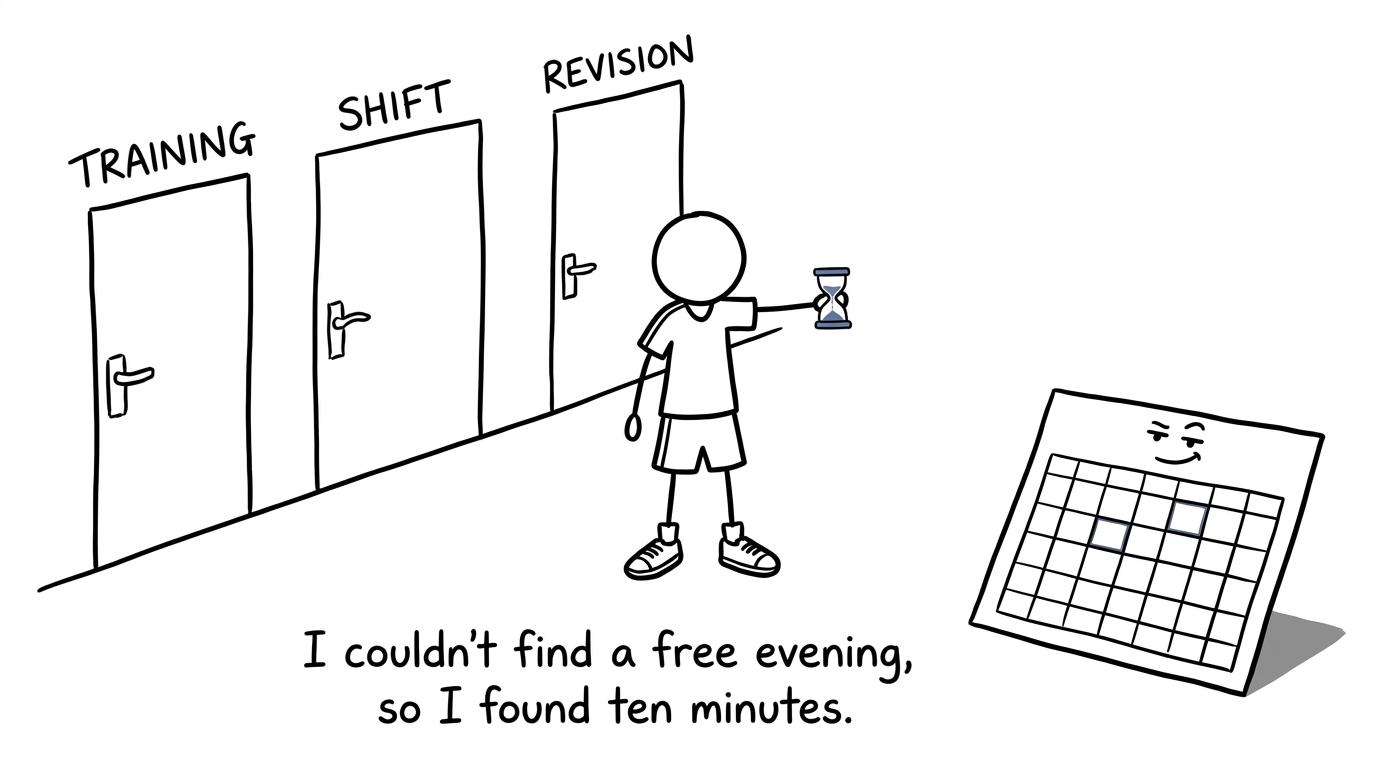 A busy student discovers that ten minutes can still count as revision
Start with the paper you will actually sit
Psychology specifications are not interchangeable. Do not revise a generic collection of interesting theories and assume they will all be examined.
Under the current AQA GCSE Psychology specification, students sit two written papers. Each lasts one hour and forty-five minutes, carries one hundred marks and contributes 50%50\%50% of the qualification. The assessment objectives are weighted approximately 35%35\%35% for knowledge and understanding, 35%35\%35% for application and 30%30\%30% for analysis and evaluation.
OCR GCSE Psychology also has two equally weighted papers, but each lasts one hour and thirty minutes and carries ninety marks. OCR specifies that research methods account for at least 20%20\%20% of the overall marks, while at least 10%10\%10% assesses mathematics relevant to psychological research.
Psychology is untiered, unlike foundation and higher tier GCSE maths. Everyone following the same specification sits the same papers. Start by writing down:
- your board and specification code;
- the topics on each paper;
- the date of each exam;
- your weakest two topics;
- the question styles you find hardest.
OCR students can begin with MathsGenie's guide to OCR Psychology topics, components and core studies. It helps separate examinable content from background information that may be useful but is not the best use of a crowded evening.
Build revision around fixed commitments
A busy schedule becomes less frightening when you stop treating every hour as equally available.
Put fixed commitments into your calendar first: lessons, travel, sport, work, meals and sleep. Then look for repeatable spaces rather than heroic gaps. The twenty minutes before training every Tuesday is more useful than a fictional three-hour Sunday session that is repeatedly cancelled.
A realistic minimum might be three short weekday sessions and one slightly longer weekend session. Give each a job:
- Recall: retrieve definitions, theories, findings and conclusions without notes.
- Application: connect psychological knowledge to an unfamiliar scenario.
- Evaluation: recall strengths, limitations and justified conclusions.
- Exam practice: answer or plan a question, then check the mark scheme.
Maths revision needs the same protection. The free GCSE Maths revision hub brings together board-specific lessons, questions, flashcards, short tests and papers, reducing the time lost deciding where to begin. A revision planner can then assign Psychology and maths separate, visible slots instead of letting whichever subject feels most urgent consume the evening.
Use a minimum viable Psychology session
When you have fifteen minutes, do not spend five of them choosing stationery. Use a fixed sequence.
Retrieve before looking
Close the book and write everything you can remember about one narrow prompt, such as the procedure of a core study, an explanation of memory or the difference between reliability and validity.
Retrieval practice requires you to produce knowledge rather than recognise it on a page. Research on learning consistently supports active retrieval and spaced review over passive re-reading for long-term retention. It also gives you something valuable when time is short: an honest diagnosis.
Check and correct
Compare your recall with the specification, class notes or revision guide. Add only what was missing or inaccurate. Your correction should be brief enough to revisit.
Apply or evaluate
Use the remaining time to answer a short question, plan an extended response or attach one evaluation point to the theory or study. This prevents revision from becoming entirely AO1-focused.
Schedule the return
Revisit the prompt after a gap. Spacing means returning to material across days and weeks rather than completing one topic in a single block and abandoning it. MathsGenie's short GCSE revision loop uses the same useful rhythm: learn, practise, mark, fix and repeat.
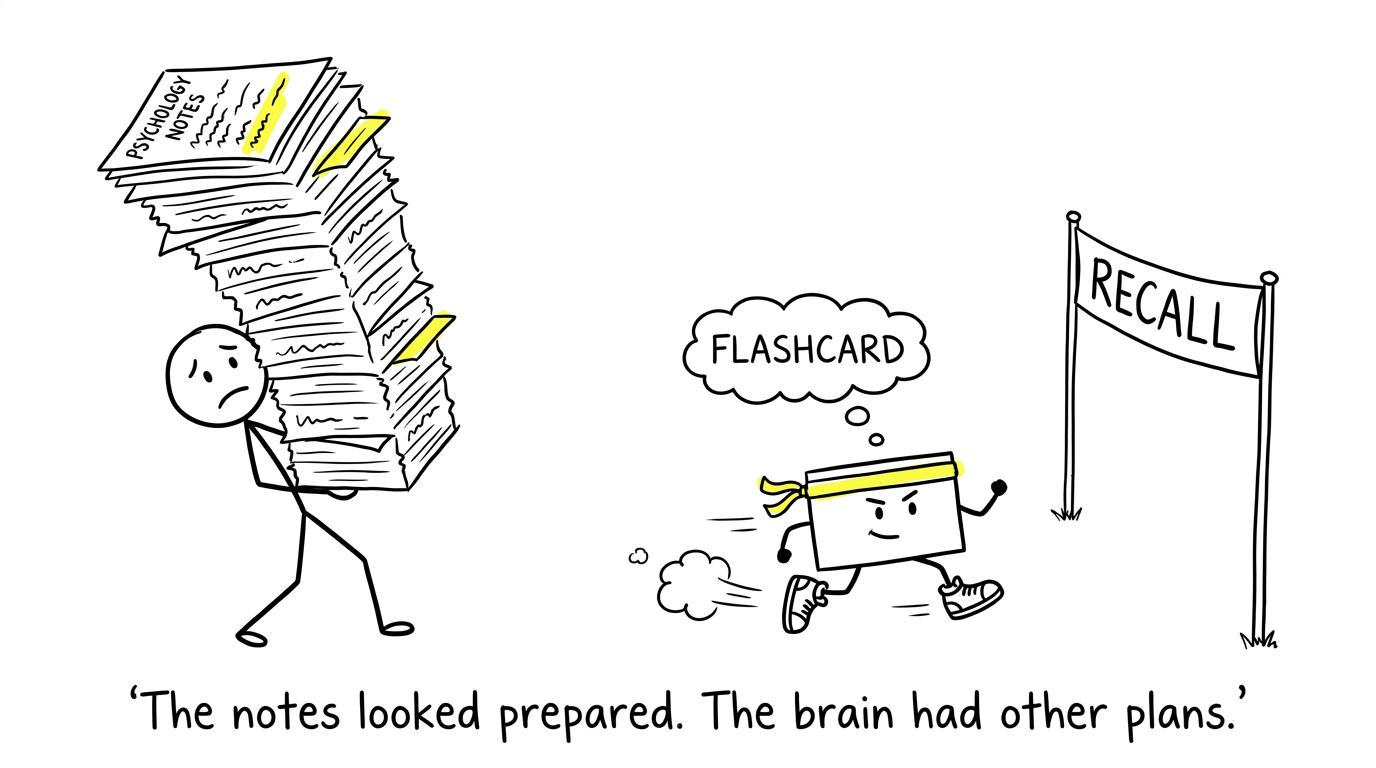 A tiny recall card outruns a tower of highlighted notes
Revise for AO1, AO2 and AO3
Knowing content is necessary, but Psychology papers do not reward knowledge alone.
AO1: know it precisely
You need accurate terminology, theories, processes, procedures and research findings. Use short-answer prompts and blank-page recall. If a study is required by your specification, learn its aim, method, results and conclusion at the level expected by your board.
AO2: apply it to the scenario
Application questions ask you to use knowledge in a new context. Practise identifying the relevant detail in the scenario and linking it explicitly to the psychological concept. A memorised paragraph that never refers to the context may demonstrate knowledge without fully applying it.
AO3: analyse and evaluate
Build a compact bank of genuine evaluative ideas: research evidence, methodological strengths and weaknesses, ethical issues, alternative explanations, usefulness and justified comparisons. Avoid memorising vague statements such as a study was unrealistic unless you can explain why that matters for the conclusion.
Command words are useful signals, but marks and context still matter. An identify question needs a different depth from explain, evaluate or discuss. Use your own board's mark schemes to see what distinguishes a relevant point from a developed one.
Keep research methods close to your maths revision
Research methods is where Psychology and maths naturally meet. Depending on your specification, you may need to understand averages, ranges, percentages, ratios, tables, charts, scatter diagrams, sampling and the interpretation of data.
This makes research methods efficient revision for a student already preparing for maths. If a statistical skill is weak, use the relevant lesson and practice questions in the GCSE Maths revision area, then return to a Psychology question where the data has meaning in context.
Keep the subjects distinct, however. Calculating or interpreting a value is only part of a Psychology response. You may also need to explain what the result suggests, identify a methodological issue or judge whether a conclusion is justified.
Research methods should appear regularly in your plan rather than being saved for the final weekend. This is especially important for OCR, where it is explicitly assessed in both components.
Make exam practice fit the time available
A full paper is useful, but it is not the only legitimate form of exam practice.
On a busy weekday, complete one short question or create a plan for an extended response. At the weekend, attempt a timed section. Save full papers for occasions when you can reproduce exam conditions and review the result properly.
The principle is the same as effective maths paper practice: an attempt is unfinished until its mistakes have changed the next revision session. MathsGenie's guide to using GCSE past papers at the right stage explains how shorter diagnostic work can precede full timed papers.
For maths, choose papers matching your board and tier. Students taking Pearson Edexcel can use Edexcel GCSE Maths past papers and mark schemes, while the wider GCSE predicted papers collection provides fresh exam-style practice near the exams.
For Psychology, use official materials supplied by your school or exam board. Mark them against the correct specification and series. Do not borrow a question from another board without checking whether its content and expected response match your course.
Triage when several subjects need attention
Equal time is not always fair time. A topic you can already retrieve accurately does not need the same attention as one you cannot explain.
At the end of each week, classify Psychology topics as:
- Secure: you can retrieve and apply the content accurately.
- Unstable: you recognise it but struggle without notes.
- Missing: you cannot yet explain the required idea.
Spend most available time on missing and unstable areas, but keep a small amount of mixed retrieval for secure content. For maths, use mini tests and paper questions to make the same diagnosis. The article on revising Edexcel GCSE Maths without wasting time shows how to turn lost marks into targeted topic practice rather than revising everything equally.
This approach also reduces decision fatigue. Tomorrow's task should be written before today's session ends.
Common mistakes when revision time is scarce
Waiting for a free evening
Long, empty evenings often do not appear. Begin with the smallest repeatable slot and expand only when time genuinely becomes available.
Rewriting attractive notes
Neat notes can feel productive because the page changes visibly. Your memory may not. Retrieve first, then make corrections only where they are needed.
Revising only favourite topics
Familiar topics create reassuring sessions but leave predictable gaps. Let your retrieval results and marked questions choose the next task.
Learning AO1 without practising application
A student can know a theory and still struggle to apply it to an unfamiliar person, study or situation. Include scenario questions from the beginning.
Ignoring the mark scheme
The mark scheme reveals required precision, development and use of context. Record why each mark was lost: missing knowledge, weak application, undeveloped evaluation, misreading or poor timing.
Sacrificing sleep for one more chapter
Exhausted revision is often slow and inaccurate. Set a stopping time, prepare tomorrow's first task and sleep. If an exam is imminent, the GCSE maths night-before plan offers a calm model that can also inform your wider exam routine.
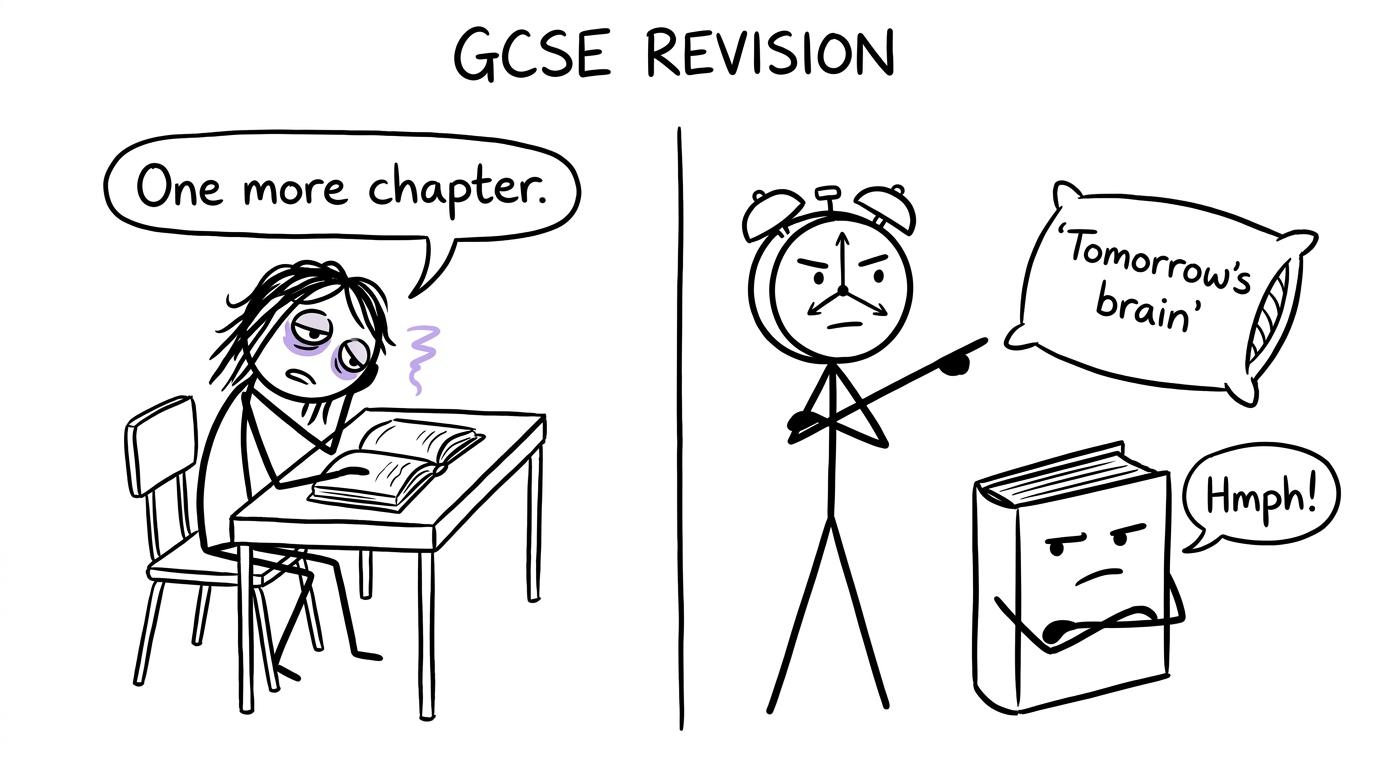 An alarm clock defends tomorrow's brain from another late revision chapter
A small system can carry a busy term
When sport, work and other GCSEs occupy your evenings, Psychology revision has to become smaller, not invisible. Confirm the specification, protect short sessions, retrieve before checking, cover all three assessment objectives and let marked questions determine what happens next.
Then give maths the same disciplined structure. Use MathsGenie as your free revision base: begin with focused revision lessons and practice questions, check methods through mark schemes and video solutions, diagnose gaps with mini tests, and build towards past papers and predicted papers. Open the MathsGenie GCSE revision hub, choose one precise task and complete it today. A crowded schedule may limit the size of each step. It does not prevent the steps from adding up.