

GCSE Maths Results Day: What to Expect
GCSE maths results day explained for students and parents: understand grades, check grade boundaries, explore reviews and resits, and plan your next steps.

Imagine a student opening their results envelope while a parent waits beside them, trying to read their expression. Before either person reacts, there is one useful thing to remember: GCSE maths results day gives you a grade and the information needed to decide your next step. You will receive your results through your school or college, check whether you have met your course requirements, and speak to staff if you need advice about a review of marking or a resit.
For the summer 2026 exam series, GCSE results day is Thursday 20 August 2026. Schools can release results from 8 am, but your own collection arrangements may be later. Check the instructions from your school rather than assuming everyone collects results at the same time.
Before you open the envelope
The evening before results day can make small uncertainties feel enormous. A little preparation helps you focus on the result when it arrives.
Have these details ready:
- Your school's collection time, location and identification requirements.
- Instructions for receiving results if you cannot attend.
- The maths entry requirements for your intended college, sixth form or apprenticeship.
- Contact details for admissions staff and your school's exams officer.
- Any enrolment instructions or deadlines you have already received.
If you are a parent, ask your child whether they would like company and where they want to open their results. Giving them that choice can make a busy morning feel more manageable.
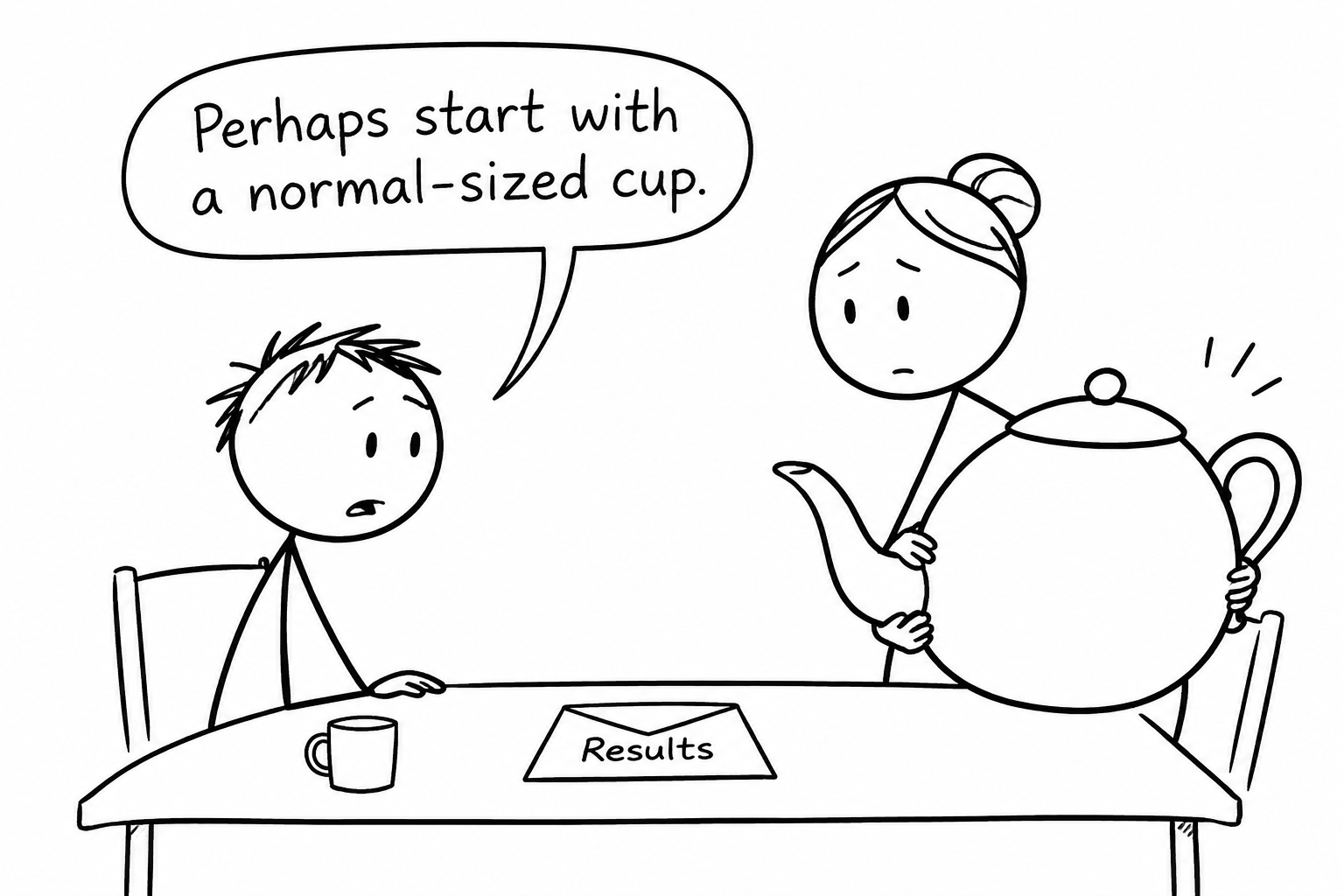 A stick-figure parent prepares an enormous pot of tea while a GCSE student waits beside a results envelope.
Understanding your GCSE maths grades
Your results statement records your qualification outcome. It is usually a provisional statement of results; your formal certificate comes later through your school or exam centre.
For GCSEs using England's grades 9-1 system, grade 999 is the highest grade. Grade 444 is described as a standard pass, and grade 555 as a strong pass. Foundation tier allows grades 111 to 555. Higher tier targets grades 444 to 999, with a grade 333 available in certain circumstances below the grade 444 boundary.
These descriptions do not replace individual entry requirements. A course may ask for a particular maths grade, so compare your result with the actual offer you received. Ask admissions staff if anything is unclear.
This guide focuses on the numbered grading system used in England. If your qualification uses letter grades, follow your school and awarding body's guidance.
How GCSE maths grade boundaries work
GCSE maths grade boundaries are the minimum marks needed for each grade in a particular exam series. They depend on the exam board, qualification and tier. Boundaries are set after exams have been taken and marking is sufficiently complete, helping account for differences in paper difficulty between years.
There is no permanent percentage that guarantees a particular grade. A friend's mark from another board, or a boundary from a previous summer, cannot reliably tell you what your result should be.
When checking a boundary, match all of the following:
- The exam series and year, such as June 2026.
- Your exam board, such as Edexcel, AQA, OCR or Eduqas.
- Your qualification and specification.
- Foundation or higher tier.
Use the overall qualification boundary when interpreting the final grade. A notional boundary for an individual paper does not mean you receive a separate GCSE grade for that paper.
AQA states that it publishes grade boundaries at 8 am on results days. Check your own board's published information rather than relying on screenshots circulating in group chats.
If you got the grade you needed
Let yourself enjoy it before moving straight to the next target. Then complete the practical steps: confirm your place, follow enrolment instructions and keep your results statement safe.
If you are continuing with maths, ask your new teacher which skills would be useful to refresh. The MathsGenie GCSE maths revision hub provides a starting point for finding resources for your exam board.
There is no need to turn results day into another revision session. A short, purposeful refresh nearer the start of your course can be enough to uncover anything that has become rusty.
If your result was lower than expected
The first conversation should be with someone who can explain your options: a maths teacher, exams officer or admissions adviser.
Ask whether your intended course can still accept you. Entry decisions depend on the provider, so avoid assuming that missing an advertised requirement automatically settles the matter.
If there is reason to question the marking, ask your school about accessing your script and requesting a review. A review checks whether marking was applied correctly. Marks and grades can go down, stay the same or go up. Being close to a boundary does not automatically mean extra marks will be awarded.
Ask about consent, fees and the applicable deadline promptly. Let a teacher help assess the evidence rather than making the decision from disappointment alone.
Planning a maths resit
GCSE maths has a November exam opportunity as well as the summer series. Discuss entry arrangements, eligibility, tier choice and preparation time with your school or college.
If you are continuing in education in England without grade 444, ask your provider how the maths study requirements apply to you. Your programme and circumstances matter.
For revision, begin with evidence from your answers. The guide to finding your weakest GCSE maths topics explains how past papers, mini tests and mark schemes can reveal recurring gaps.
Choose topics where improving one method could unlock several questions. Depending on your gaps, these might include fractions, decimals and percentages, ratio or percentages. Select resources that match your board and tier.
Watch a revision lesson, attempt practice questions independently, check the mark scheme, then revisit the skill later. Use a realistic revision timetable to make that cycle manageable. Predicted papers can provide extra practice, but they cannot guarantee what will appear.
Common results-day mistakes
Comparing before understanding. Read your own result and course requirements before comparing grades with friends.
Treating a boundary gap as a marking error. A small gap is a reason to ask informed questions, not proof that the result is wrong.
Waiting to contact your next provider. Admissions staff can explain your options while you investigate the result.
Revising everything equally for a resit. Let marked work show you where focused practice will help most.
For the student and parent beside that envelope, the next useful question is: “What do we need to do now?” Sometimes the answer is enrol and celebrate. Sometimes it is seek advice and make a new plan. When revision is the next step, open Maths Genie Lessons through the GCSE revision hub and start with the topics where your own work shows the greatest opportunity to gain marks.















