GCSE ICT Exam Board Differences: Does It Matter?
GCSE ICT exam board differences explained: learn whether one board is harder, what qualification you take and how to revise the correct specification.
It is easy to blame the badge on the front of an exam paper. A difficult question appears, somebody says another board is easier, and suddenly it feels as though your grade was decided before revision even began.
The truth about GCSE ICT exam board differences is more useful: no recognised board is consistently the easy option. However, the qualification title, content, assessment structure and style of questioning can differ substantially. In England, the old GCSE ICT qualifications have been withdrawn, so a course described casually as “ICT” may actually be GCSE Computer Science or a vocational IT qualification. Wales and Northern Ireland have their own digital qualifications.
That distinction matters far more than rumours about which paper is hardest.
The short answer
Before comparing exam boards, check these five things:
- the exact qualification title;
- the exam board and specification code;
- whether you are taking GCSE Computer Science, Digital Technology or a vocational IT course;
- how much is assessed by examinations and how much by non-exam assessment;
- which specification and assessment year apply to you.
An exam board matters because it controls what you must learn and how your knowledge is assessed. It does not give you a reliable shortcut to an easier grade.
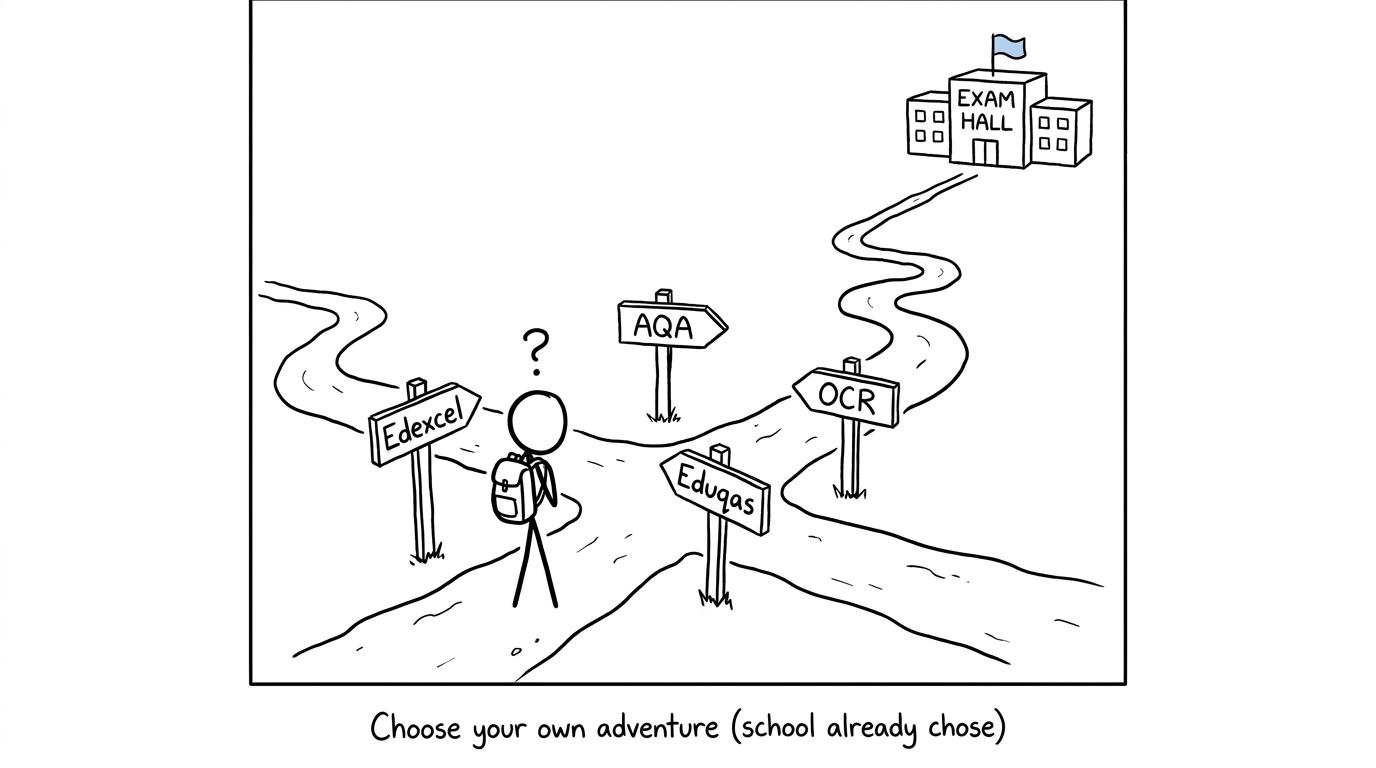 A GCSE student discovering that every exam-board path leads to an exam hall
Is GCSE ICT still a current qualification?
This is where many comparisons go wrong. “ICT” is still used informally in schools, but it does not always describe the qualification printed on a student's certificate.
In England, reformed GCSE Computer Science replaced the old GCSE ICT route. AQA, Pearson Edexcel and OCR offer GCSE Computer Science specifications, while schools can also choose vocational qualifications in information technology. These are not interchangeable courses. Computer Science places greater emphasis on computation, algorithms, programming, data representation, networks and computer systems. Vocational IT courses tend to focus more heavily on the practical use of digital systems and technology in organisations.
The position is different across the UK:
- Wales: WJEC offers GCSE Digital Technology. A new made-for-Wales specification begins teaching in September 2026, with the first full award in summer 2028. The outgoing specification has its final full assessment opportunity in summer 2027, followed by a conditional examination resit opportunity in January 2028.
- Northern Ireland: CCEA uses the title GCSE Digital Technology rather than GCSE ICT.
- England: Eduqas is WJEC's brand for qualifications designed for England, but that does not mean every WJEC qualification available in Wales has an identical Eduqas equivalent.
- Scotland: Students take qualifications such as National courses rather than GCSEs.
Therefore, a student asking whether AQA GCSE ICT is harder than OCR GCSE ICT may be comparing qualifications that no longer exist under those names. The first task is identification, not judgement.
What actually differs between exam boards?
Exam boards work within national regulatory requirements, but their specifications are not identical documents. Several practical differences can affect how the course feels.
Content and emphasis
Two Computer Science specifications can cover many common areas while organising or emphasising them differently. One may divide computer systems into several detailed sections; another may place topics together under broader headings. Required programming concepts, terminology and the treatment of ethical or legal issues can also vary.
A Digital Technology or vocational IT qualification may be further away from GCSE Computer Science. It could include website production, data handling, digital media, user needs or project-based assessment. Calling both courses “ICT” hides the most important differences.
Assessment structure
The number of papers, their duration, whether an assessment is completed on screen and the role of non-exam assessment depend on the precise qualification.
For example, the new WJEC GCSE Digital Technology for Wales contains one digital examination and two non-exam assessment units. The examination contributes 40%40\%40%, while the two non-exam assessment units contribute 40%40\%40% and 20%20\%20%. GCSE Computer Science specifications in England use their own assessment arrangements.
This can make one course suit a student's preferences better. Someone who enjoys developing and refining a digital product may respond differently to non-exam assessment than someone who prefers written examinations. That is a question of fit, not automatic difficulty.
Question wording and mark schemes
Boards develop recognisable house styles. Command words, layout and the balance between short responses and extended explanations may feel different. Mark schemes can also express acceptable answers in different ways.
These differences matter during revision because knowing the topic is only part of examination performance. You must also recognise what the question is asking, select relevant detail and communicate it precisely.
This principle applies directly to maths. When using MathsGenie's GCSE revision lessons, you build the underlying method; when you move to GCSE maths past papers, you learn how that knowledge appears under exam conditions.
Is one GCSE ICT exam board genuinely harder?
Not in a simple, dependable sense.
A particular paper can be harder than expected. One specification may contain topics that an individual student dislikes. A board's wording may initially feel less familiar. None of that establishes that one board always awards lower grades for the same level of performance.
Awarding organisations set grade boundaries after reviewing evidence from an examination series. Boundaries can move when papers differ in demand, so the raw mark needed for a grade is not fixed permanently. Ofqual also monitors standards across regulated GCSE qualifications in England.
This means that comparing raw boundaries alone is misleading. Suppose one paper requires a higher proportion of marks for a particular grade. That does not prove the board is harsher; the paper may have been more accessible. Likewise, a lower boundary may reflect a more demanding paper rather than an easier route to the grade.
The better question is not, “Which board is easiest?” It is:
“What does my specification require, and can I demonstrate it in the form my assessment expects?”
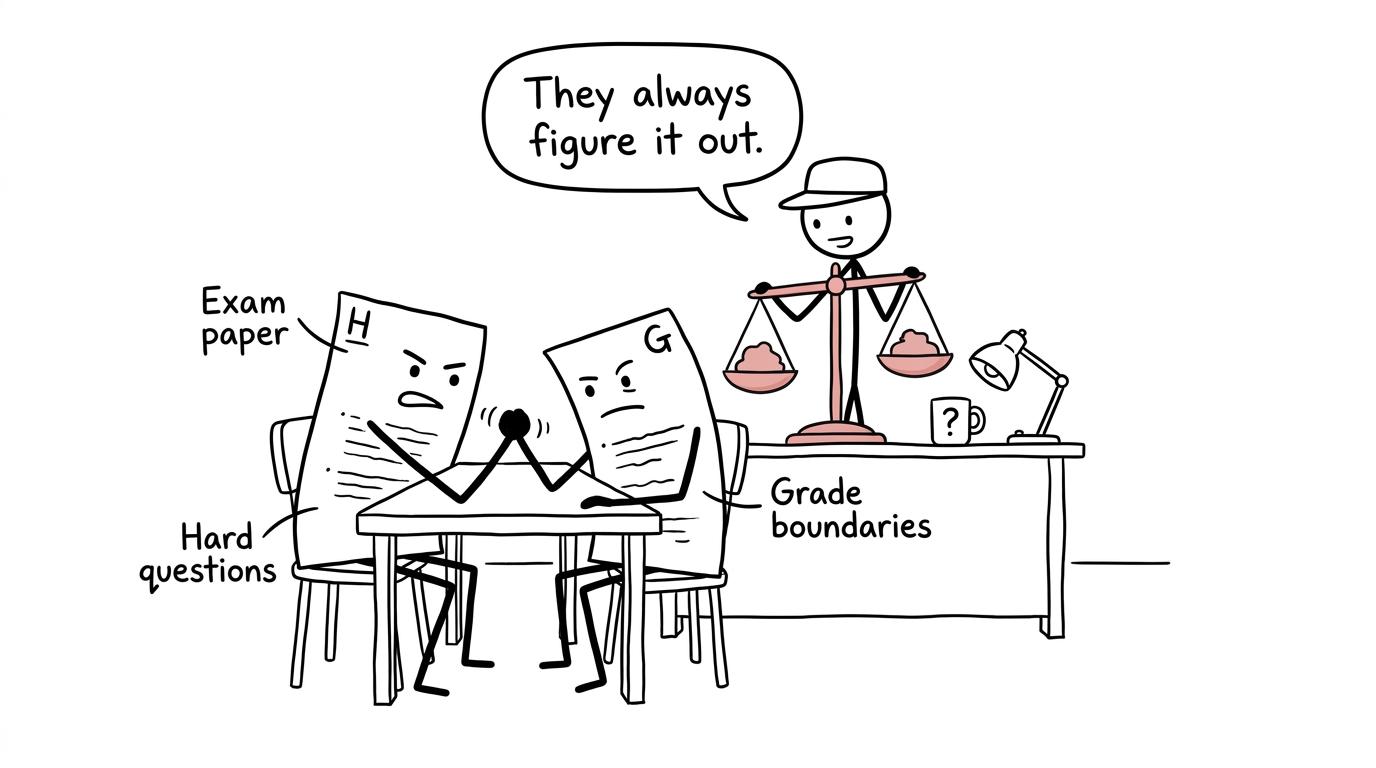 Exam papers arm-wrestling while grade boundaries balance the difficulty
Why students perceive some boards as harder
The feeling is real even when the conclusion is unreliable.
First, familiarity changes difficulty. A question written in the style you have practised often feels straightforward; the same knowledge presented through unfamiliar wording can feel obscure. This is why switching randomly between boards is not always productive close to the exam.
Second, different strengths produce different opinions. A student who enjoys programming may prefer a Computer Science course. Another who is strong at planning, designing and evaluating digital products may prefer Digital Technology or vocational IT. Their verdicts describe personal fit, not an objective hierarchy.
Third, online comparisons often ignore assessment year. Specifications change, legacy papers remain online and qualifications with similar names can belong to different UK nations. A comment about an old controlled-assessment course may tell you nothing about your current specification.
Finally, teaching and resources influence experience. A well-sequenced course can make a demanding specification feel manageable. Poorly matched revision materials can make any course feel unnecessarily difficult.
How to revise for the board you actually take
Begin with the front of a recent paper or ask your teacher for the qualification title and specification code. Do not rely on a folder labelled simply “ICT”.
Download the correct specification and turn each content statement into a checklist. Label items as secure, developing or not yet revised. Then use materials in this order:
- learn or revisit the content;
- answer focused practice questions;
- check responses against the relevant mark scheme;
- complete timed sections;
- attempt full papers from your qualification and specification;
- record recurring gaps and revisit them.
Use specimen assessment materials if your specification is new and has few live past papers. If it is being replaced, confirm which papers belong to your assessment route rather than assuming the newest document is yours.
The same disciplined approach strengthens maths revision. MathsGenie's grade-organised GCSE resources help you choose an appropriate starting point, while GCSE predicted papers provide further exam-style practice. MathsGenie's revision scheme can also help you organise topics rather than revising whichever subject happens to feel urgent that evening.
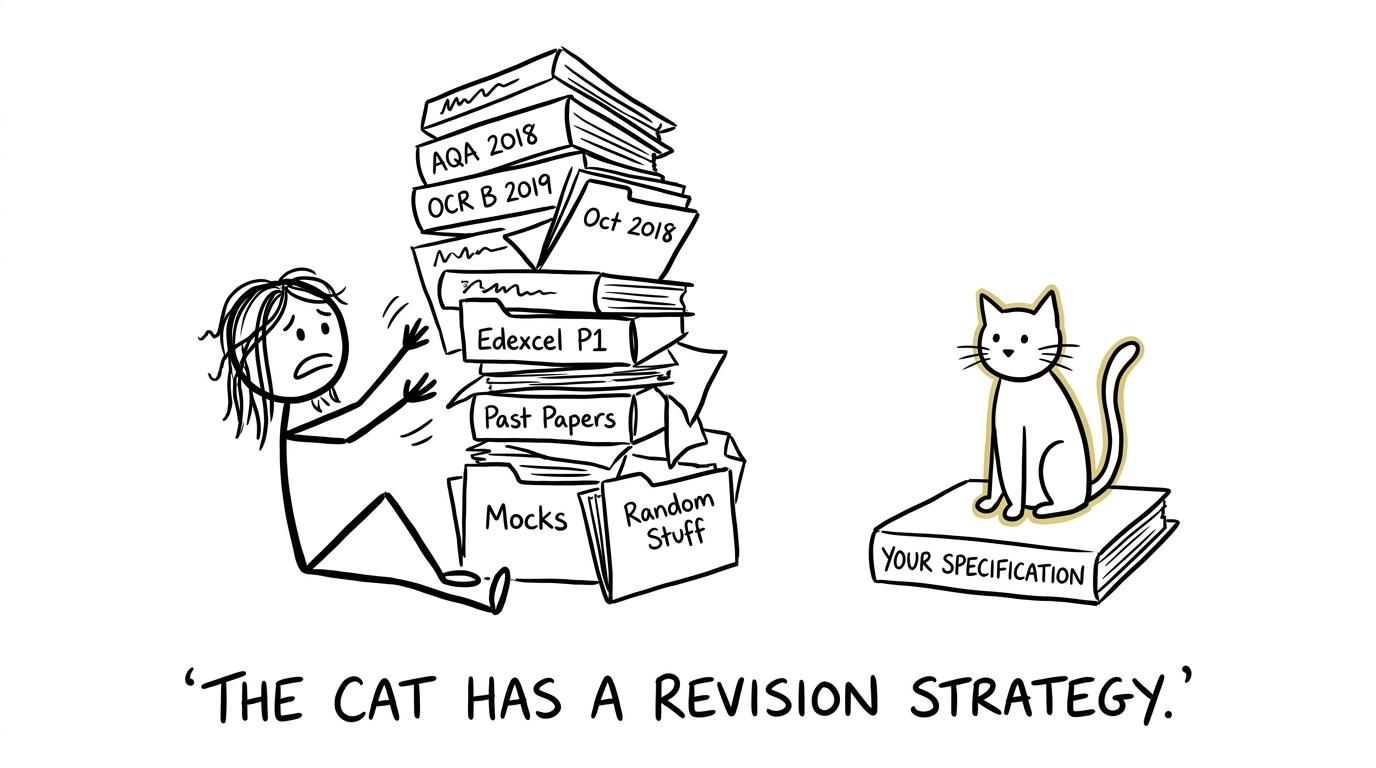 A calm cat selecting the correct specification from a chaotic pile of revision folders
Should you practise papers from another board?
Your own board should come first. Its papers reveal the language, structure, timing and level of detail you will meet in the real assessment.
Material from another board can still be useful when the topic genuinely overlaps. It may provide extra practice after you have exhausted your own questions. But check every question against your specification. Otherwise, you risk spending time on excluded content or learning terminology that your mark scheme does not expect.
For maths, the core knowledge across English exam boards overlaps substantially, so additional questions can often be useful when selected carefully. Even then, board-specific papers should remain central. MathsGenie supports this progression through GCSE exam paper practice, mark schemes and video solutions. Students moving beyond GCSE can follow the same principle with A Level maths revision resources and A Level past papers.
Common mistakes when comparing ICT exam boards
Comparing different qualifications
GCSE Computer Science, GCSE Digital Technology and vocational IT are not merely different versions of one course. Compare content and assessment first, not just names.
Assuming lower grade boundaries mean an easier board
Boundaries respond to the demand of a particular assessment series. A lower boundary can accompany a harder paper.
Revising from legacy papers without checking
Old ICT resources may assess discontinued content or use an obsolete assessment model. Check the specification code and year before committing time.
Ignoring non-exam assessment
Where a qualification includes non-exam assessment, it is a defined part of the final result. Follow your teacher's instructions and the board's rules carefully, particularly around permitted assistance and authentication.
Collecting papers instead of analysing errors
Completing ten papers without reviewing them is less valuable than completing fewer papers and identifying why marks were lost. Use mark schemes to separate missing knowledge from imprecise wording, weak timing and misread command words.
The exam board matters, but your response matters more
Your board determines the specification, paper structure and assessment rules. You must know those details. But the board's name does not decide that your exam will be easier or harder than everyone else's.
The controllable advantage is alignment: revise the right content, use the right papers, understand the mark scheme and practise under realistic conditions. That approach works for digital qualifications and for GCSE maths alike.
Start with MathsGenie's free GCSE maths revision, then move from revision lessons and practice questions to mini tests, past papers, mark schemes, video solutions and predicted papers. An exam-board rumour gives you something to worry about. A precise revision plan gives you something to do.