GCSE German Weekend Revision: A Two-Day Plan
GCSE German weekend revision made practical: plan Saturday and Sunday to improve vocabulary, listening, speaking and writing without exhausting yourself.

The hardest part of weekend revision is rarely a lack of material. It is deciding what to do first when German vocabulary, speaking practice and maths papers are all competing for your attention.
A useful GCSE German weekend revision routine solves that problem before Saturday begins. Give each language skill a clear session, practise under exam conditions, review mistakes and stop early enough to recover. You do not need two days of relentless work. You need a small number of focused sessions that turn uncertainty into evidence.
This plan is designed for the final weeks before the exam. It covers listening, speaking, reading, writing, vocabulary and grammar while leaving room for maths and your other GCSE subjects.
Your weekend revision checklist
Before starting, gather:
- your exam board specification and topic list
- one listening or dictation task
- one reading task
- speaking prompts or photo cards
- one writing question
- vocabulary cards or a vocabulary app
- the relevant mark schemes
- an error log, notebook or spreadsheet
- a timer and somewhere to leave your phone
GCSE German specifications vary between AQA, Edexcel, OCR and Eduqas, particularly in task format and timing. Current qualifications assess listening, speaking, reading and writing, with Foundation and Higher tier routes. Check the specification used by your school rather than relying on a revision routine made for another board.
If maths is also demanding attention, use the MathsGenie GCSE revision hub to choose your maths task before the weekend. One named topic or paper is easier to begin than the vague instruction to “revise maths”.
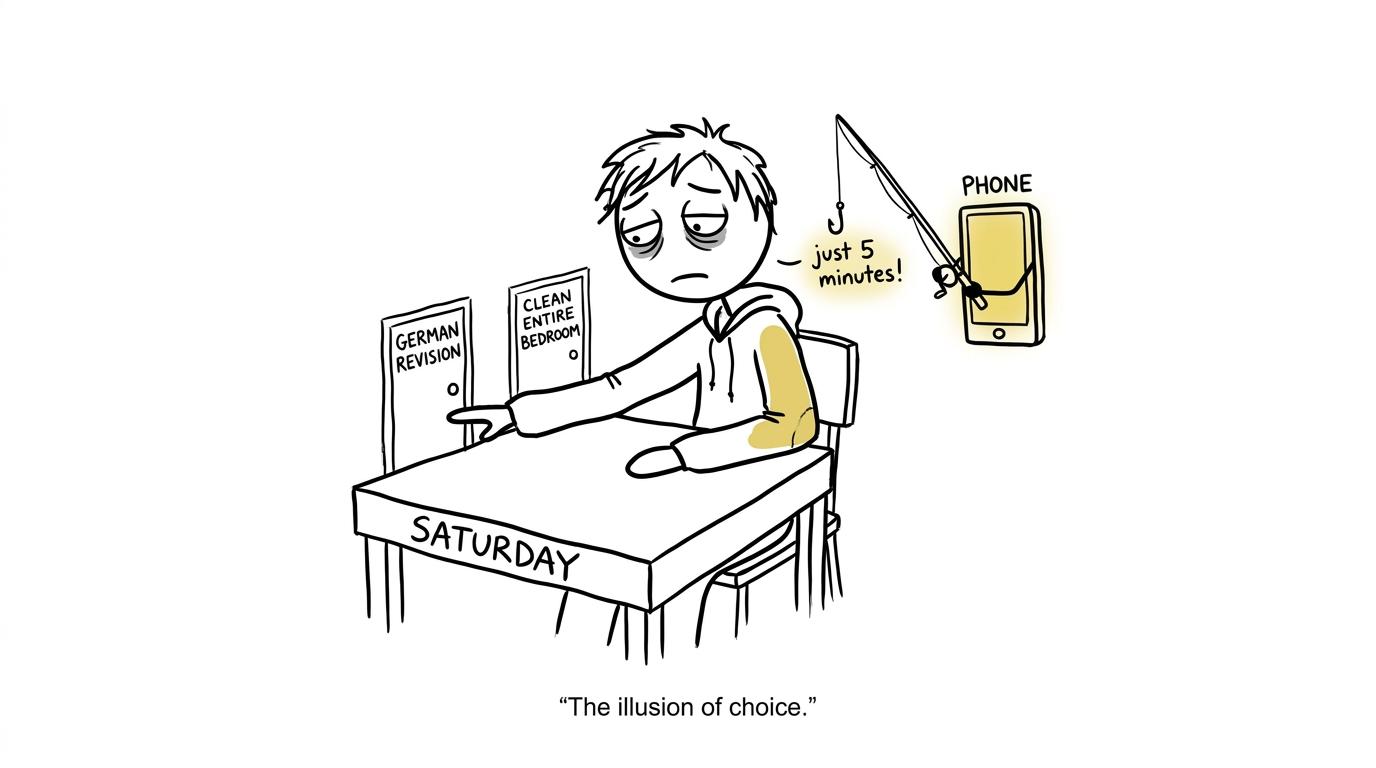 A student chooses German revision while a phone attempts a distraction
Prepare on Friday evening
A weekend often goes wrong before it starts. Saturday morning arrives, the student opens several tabs, searches for resources and spends the first hour arranging revision rather than doing it.
Avoid that trap with fifteen minutes of preparation on Friday.
Choose one weak German theme, one grammar weakness and one examination skill. For example, your priorities might be vocabulary about school, accurate past-tense verbs and listening for negative statements. These are targets, not a long wish list.
Then write down what “finished” will mean. It could be:
- complete and mark one listening task
- recall a selected vocabulary set without notes
- record two speaking responses
- complete one timed writing task
- correct every mistake and schedule a short retest
The final point matters. Completing a question reveals the problem; correcting it is where improvement begins.
Saturday morning: vocabulary and listening
Your first session should use the period when attention is usually strongest. Start with retrieval, then move into listening so that vocabulary is encountered in context.
Begin with active vocabulary recall
Spend around twenty-five minutes recalling words and phrases from memory. Translate in both directions because recognising a German word is not the same as producing it independently.
Separate vocabulary into three groups:
- secure words you recall quickly
- hesitant words you eventually remember
- missing words you cannot retrieve
Do not spend equal time on all three groups. Return mainly to the hesitant and missing words. Revision becomes efficient when confidence is tested rather than assumed.
Include small but influential words: negatives, time markers, intensifiers, connectives and opinion phrases. A student may understand the main noun in a sentence yet lose the meaning because they missed “never”, “although” or “next year”.
Complete one focused listening task
Now complete an exam-board listening task without pausing unless that matches the conditions of the paper. Before the recording begins, read the questions and predict what kind of information each answer requires: a place, opinion, reason, activity or time reference.
When marking, classify errors:
- vocabulary was unknown
- a known word was not recognised in speech
- a distractor was selected
- a negative or change of opinion was missed
- the answer was understood but expressed imprecisely
This diagnosis tells you what to practise next. If the problem was sound recognition, repeatedly reading the transcript will not be enough. Listen again, locate the exact phrase and say it aloud.
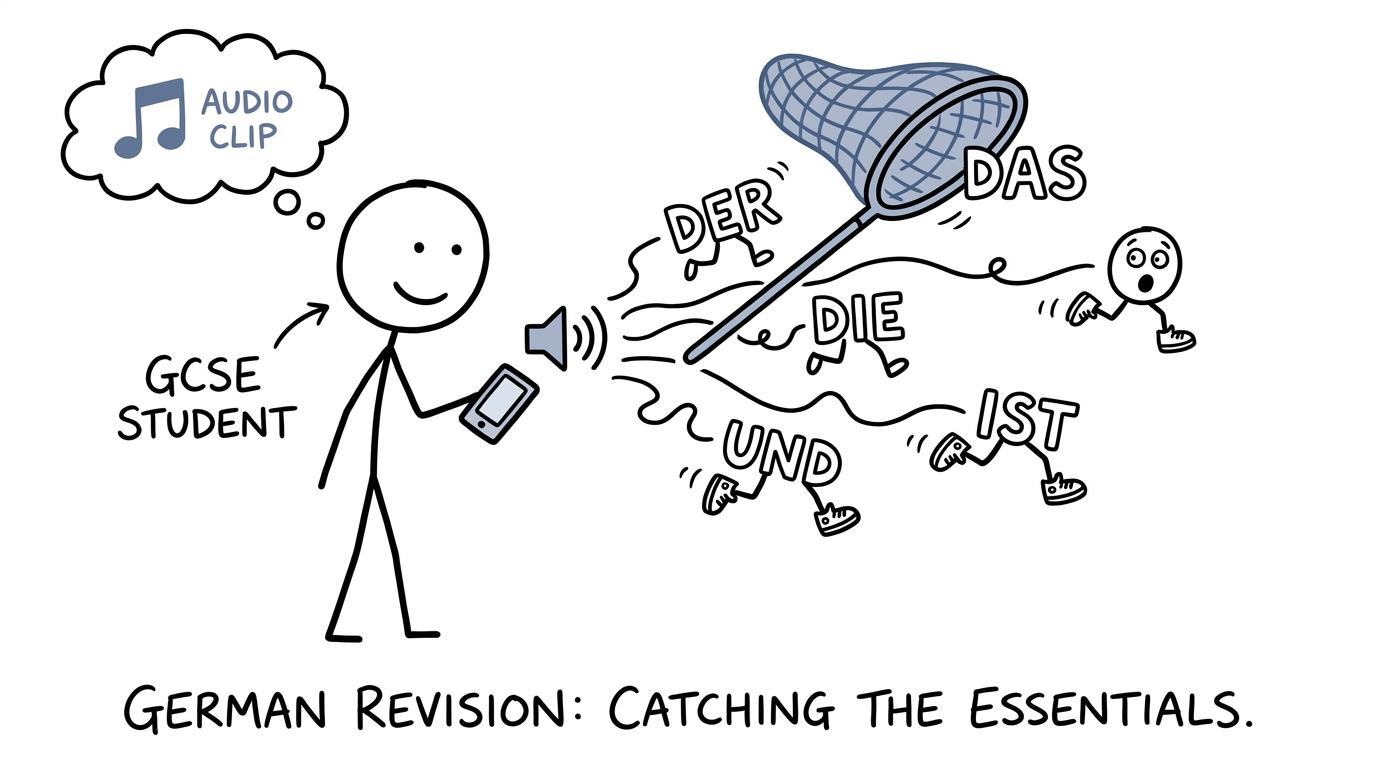 A student catches one fast-moving German word from an audio recording
Saturday afternoon: reading and grammar
After lunch and a proper break, move to reading. It demands concentration but gives you more control than listening because the text remains on the page.
Complete a short timed reading section. Underline time markers, opinions, negatives and evidence for each answer. Do not translate every word. Examination reading often depends on locating relevant meaning while tolerating unfamiliar vocabulary.
When you meet an unknown word, first ask whether its meaning is genuinely necessary. Context, cognates and surrounding grammar may provide enough information. Guessing wildly is unhelpful; making a cautious inference from evidence is a real reading skill.
Follow the task with a compact grammar session based on the errors you have actually made. Useful areas may include:
- verb position and word order
- present, past and future time frames
- adjective endings
- modal verbs
- cases and prepositions
- subject-verb agreement
- comparative and superlative forms
Avoid trying to “do German grammar” in one afternoon. Choose one pattern, review the rule, then retrieve and apply it without notes. Precision grows through repeated correction, not through reading the same explanation for longer.
Saturday evening: stop before revision becomes noise
The evening is not the time for another full paper. Use ten to twenty minutes to review the day’s error log and test the weakest vocabulary once more.
Then stop.
Rest is not a reward that must be earned after exhaustion. It protects the quality of Sunday’s work. Pack away the resources, note Sunday’s first task and do something unrelated to revision.
If you also have maths to cover, a short diagnostic is more useful than starting a random paper late at night. The MathsGenie guide to starting GCSE past papers explains how shorter tests and topic work can lead into timed papers as the exams approach.
Sunday morning: speaking while your mind is fresh
Speaking improves through speaking. Silent rehearsal can help organise an idea, but it cannot reveal hesitation, pronunciation problems or answers that collapse when said aloud.
Begin with common questions from your specification. Record your responses without reading a complete script. Aim to include:
- a direct answer
- a reason or justification
- an additional detail
- more than one time frame where appropriate
- accurate, understandable pronunciation
Listen back once. Note only the most important correction in each answer. Re-recording a response repeatedly in pursuit of perfection can create a polished script without building flexible speaking ability.
Next, ask a parent, friend or teacher to choose prompts unpredictably if someone is available. Otherwise, shuffle prompt cards and respond to the first one you turn over. The purpose is to practise retrieval under mild pressure.
For role-play and photo-based tasks, follow the exact format required by your exam board. Do not assume that timings, preparation rules or task structures are identical across specifications.
Sunday afternoon: timed writing and careful marking
Writing brings vocabulary, grammar and exam technique together. Choose one task at the correct tier and from the correct specification. Complete it under the official time guidance without using translation tools or prepared paragraphs.
Before writing, spend a short period identifying every bullet point. A sophisticated paragraph cannot recover marks lost by ignoring part of the task.
During the final check, look for a few specific features rather than vaguely rereading:
- every bullet point has been addressed
- verbs agree with their subjects
- time frames are clear and controlled
- nouns have appropriate capital letters
- word order works after connectives
- opinions are supported with reasons
- spellings and accents have been checked
Use the official mark scheme or criteria supplied by your teacher. Record patterns, not just individual slips. “Incorrect verb position after a connective” is more useful than copying one corrected sentence and forgetting why it changed.
Fit maths around German without losing focus
A final-weekend plan has to recognise reality: German is unlikely to be your only examination.
Use separate blocks for separate subjects. Switching from German vocabulary to algebra every few minutes creates the feeling of work without allowing either task to settle. A better approach is one clearly defined German block, a proper break, then one clearly defined maths block.
For maths, you could choose a topic lesson and related practice from the free MathsGenie GCSE resources, or complete a paper from the GCSE maths past papers collection. Mark it before deciding what to revise next.
In the final run-in, GCSE predicted papers can provide fresh exam-style maths practice. They work best as a diagnostic tool rather than a prediction to memorise: complete a paper, identify marks lost and return to the underlying topics.
The same principle applies to German. A practice paper is valuable because of what it reveals, not because it has been completed.
Common GCSE German weekend revision mistakes
Revising only comfortable topics
Familiar vocabulary feels fluent because recognition is easy. Test yourself without notes and let errors choose part of your plan.
Writing answers before speaking them
Complete scripts can become a support you cannot remove. Use brief prompts, then practise forming answers aloud.
Ignoring the mark scheme
An answer may sound impressive but miss a bullet point or task requirement. Marking criteria show what the assessment rewards.
Treating every mistake as a vocabulary problem
Listening errors may come from sound recognition, distractors or missed negatives. Writing errors may come from word order or agreement. Diagnose before revising.
Using resources from the wrong specification
The four broad language skills are shared, but task types and timings can differ by board and qualification version. Confirm your exam board, tier and specification year.
Attempting two full days without recovery
Long hours are not automatically productive hours. Use focused sessions, breaks, food, movement and a sensible stopping time.
Finish Sunday with a plan, not panic
Spend the final fifteen minutes reviewing your error log. Select three items to revisit during the week: perhaps one vocabulary group, one grammar pattern and one speaking response.
Prepare what you need for Monday, then close the books. The weekend has done its job if you now know more clearly what you can retrieve, what still breaks under pressure and what action comes next.
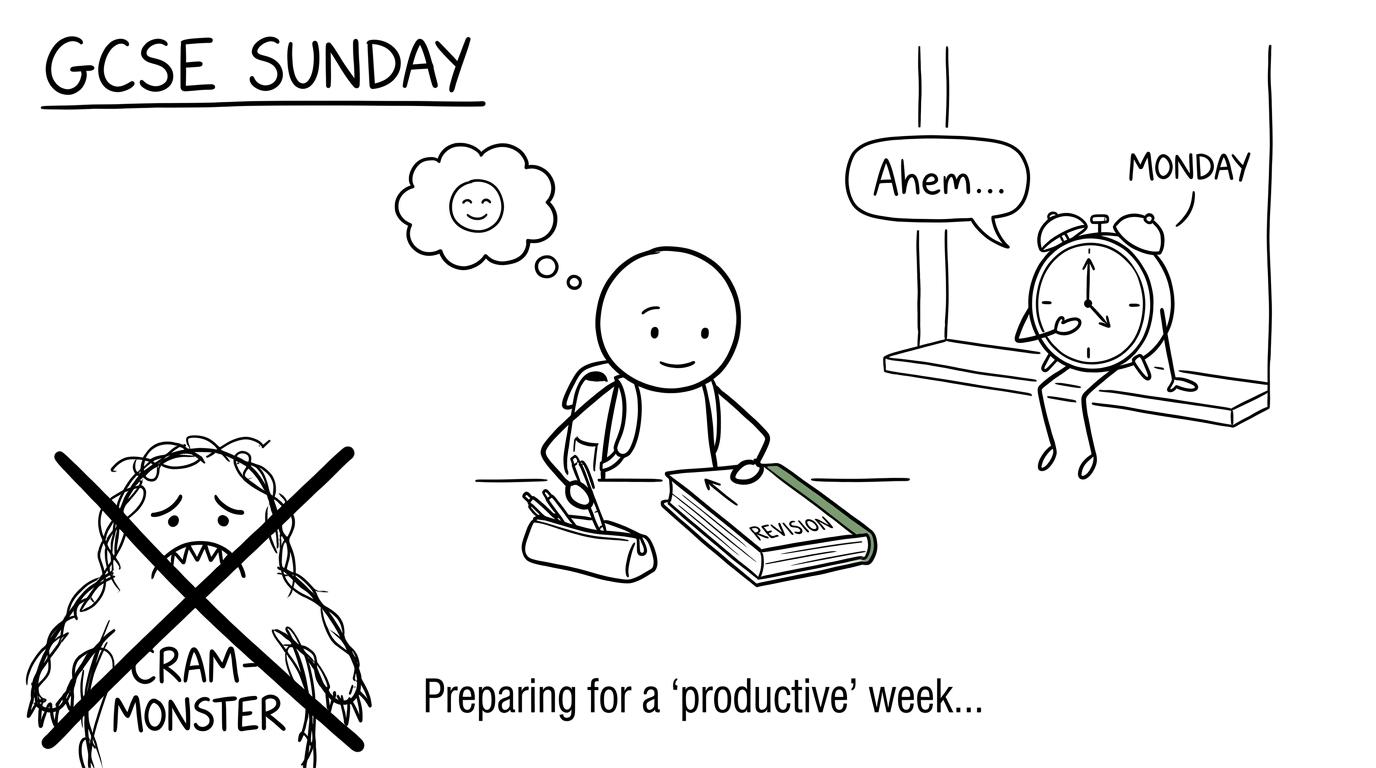 A calm student finishes revision while the cramming monster retreats
A strong GCSE German weekend revision routine is not built around heroic hours. It is a cycle of retrieval, examination practice, marking and focused repair. Saturday builds recognition and accuracy; Sunday develops spoken and written performance; the error log carries the useful lessons into the week.
For the maths part of your examination season, make MathsGenie your free revision base. Use revision lessons and practice questions to repair individual topics, mini tests to diagnose gaps, past papers and mark schemes to develop exam technique, and predicted papers and video solutions to sharpen your final preparation. Choose the next task now, place it in your weekend plan and begin with evidence rather than guesswork.