GCSE Geography Long Answer Questions: Top Marks
GCSE geography long answer questions explained: learn how examiners reward evidence, reasoning, resource use and clear, supported judgements in exams.
A long-answer question can feel strangely open-ended. You know the topic. You remember the case study. Yet the empty lines beneath the question create a harder problem: deciding what the examiner actually wants.
The short answer is that GCSE geography long answer questions reward a relevant, developed and evidence-based response that follows the command word. For evaluative questions, top answers also make a supported judgement. Length alone earns nothing. Examiners use levels-based mark schemes, so they consider the quality of the response as a whole rather than simply counting isolated facts.
That distinction separates many top-mark responses from average ones. An average answer often knows some geography. A top response uses that knowledge to answer the precise question.
The long-answer checklist
Before writing, identify these six things:
- Command word: Are you explaining, examining, assessing, evaluating or discussing?
- Topic boundary: Which exact part of the specification is being tested?
- Resource instruction: Must you use a figure, map, graph, photograph or table?
- Place requirement: Does the question request a named example or case study?
- Argument: What will your paragraphs collectively establish?
- Judgement: Does the command word require a decision about importance, success or extent?
Question styles and tariffs differ between AQA, Edexcel, OCR and Eduqas, so use resources written for your specification. The AQA GCSE Geography revision hub brings together topic revision, exam-style questions and past papers, while students following Pearson can begin with Edexcel B GCSE Geography revision.
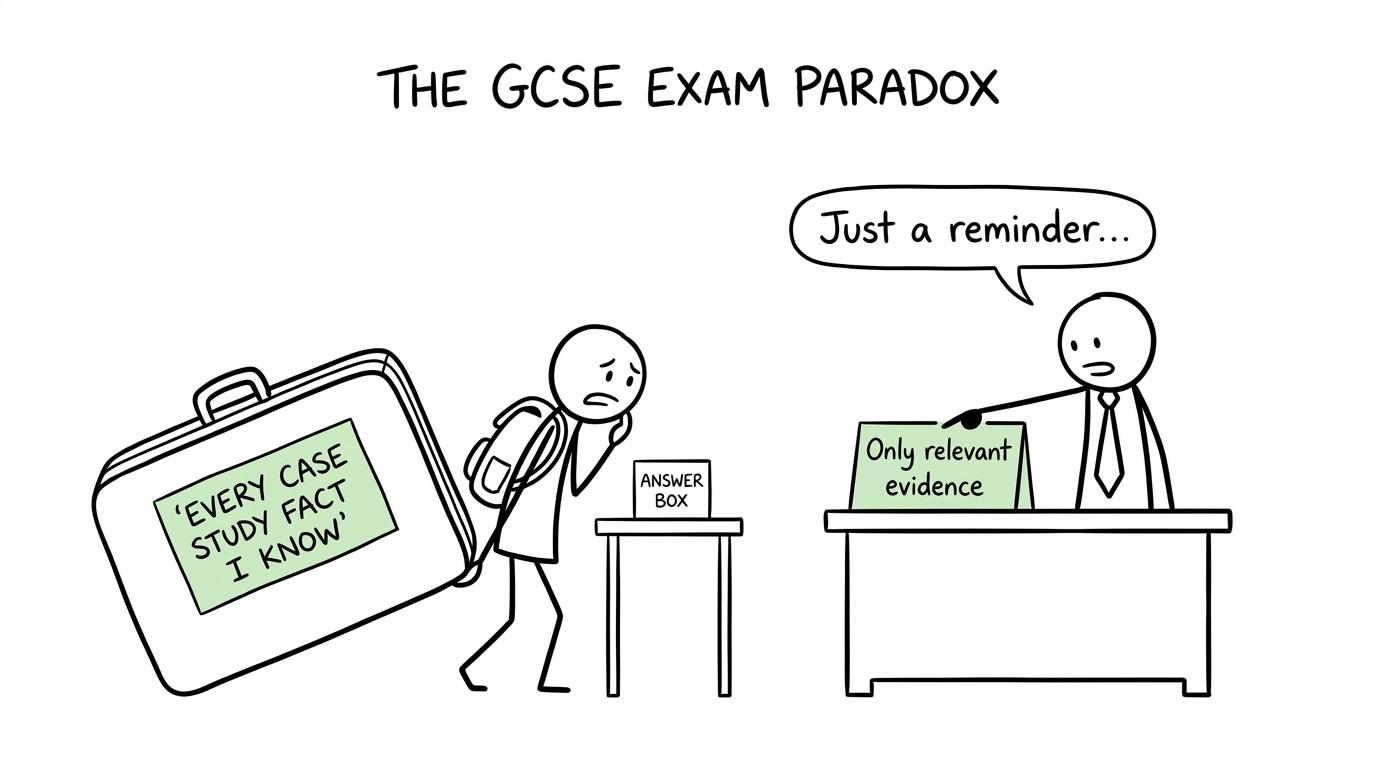 A student carrying too many case-study facts towards a tiny answer box
What examiners actually reward
Official specifications, mark schemes and examiner reports from the main UK exam boards use slightly different language, but several qualities appear repeatedly.
Accurate knowledge that stays relevant
Knowledge is the foundation. You may need accurate understanding of a process, place, strategy, issue or fieldwork method. Specialist geographical vocabulary can make that understanding more precise.
But relevance matters as much as recall. If a question asks whether hard engineering is effective, a page describing how groynes are constructed will not automatically become an evaluation. The material must be used to examine effectiveness, perhaps through cost, longevity, environmental consequences and effects on other stretches of coastline.
Think of case-study knowledge as a toolkit, not a speech memorised in advance. Select the facts that perform a job in your argument. Leave the rest in the toolkit.
Developed geographical reasoning
An undeveloped point states what happened. A developed point shows why it happened, how one factor caused another, or why the consequence matters to the question.
A useful paragraph often contains:
- a claim that addresses the wording of the question;
- precise evidence from knowledge, a named place or the supplied resource;
- geographical reasoning that explains the connection;
- a link back to the issue being assessed.
This is not a rigid writing formula. It is a test of whether each paragraph has intellectual movement. The reader should finish the paragraph understanding more than they did after its opening sentence.
Chains of reasoning are especially important in explanations. Connect cause and consequence clearly with language such as “because”, “therefore” and “this increases”. Do not merely add more examples when the missing ingredient is explanation.
Application rather than copied knowledge
Application means using what you know in the context set by the question. That context might be a named location, an unfamiliar place, a proposed development or a fieldwork enquiry.
This is why generic answers often settle in the middle levels. They may contain correct content but could have been written for several different questions. Strong responses repeatedly return to the specified place, group, scale, timescale or decision.
For fieldwork, application requires more than listing methods. You need to connect sampling, data collection, presentation and limitations to the enquiry being investigated. MathsGenie’s AQA Geography fieldwork guide explains how conclusions and evaluations should grow from evidence rather than vague comments.
Selective use of resources
When a question tells you to use a figure, using it is part of the task. A resource reference should be specific: identify a pattern, comparison, location, anomaly or value, then explain its significance.
Copying a figure’s title is not meaningful use. Nor is inserting one number and immediately abandoning it. The strongest responses combine resource evidence with geographical understanding.
Before writing, inspect:
- the title and geographical scale;
- labels, keys and units;
- broad patterns and contrasts;
- unusual values or anomalies;
- limitations in what the resource can establish.
Data skills matter here. The AQA statistical skills revision guide covers averages, spread, percentage change and graph interpretation, while the qualitative and quantitative data guide develops the distinction between describing, analysing and evaluating evidence.
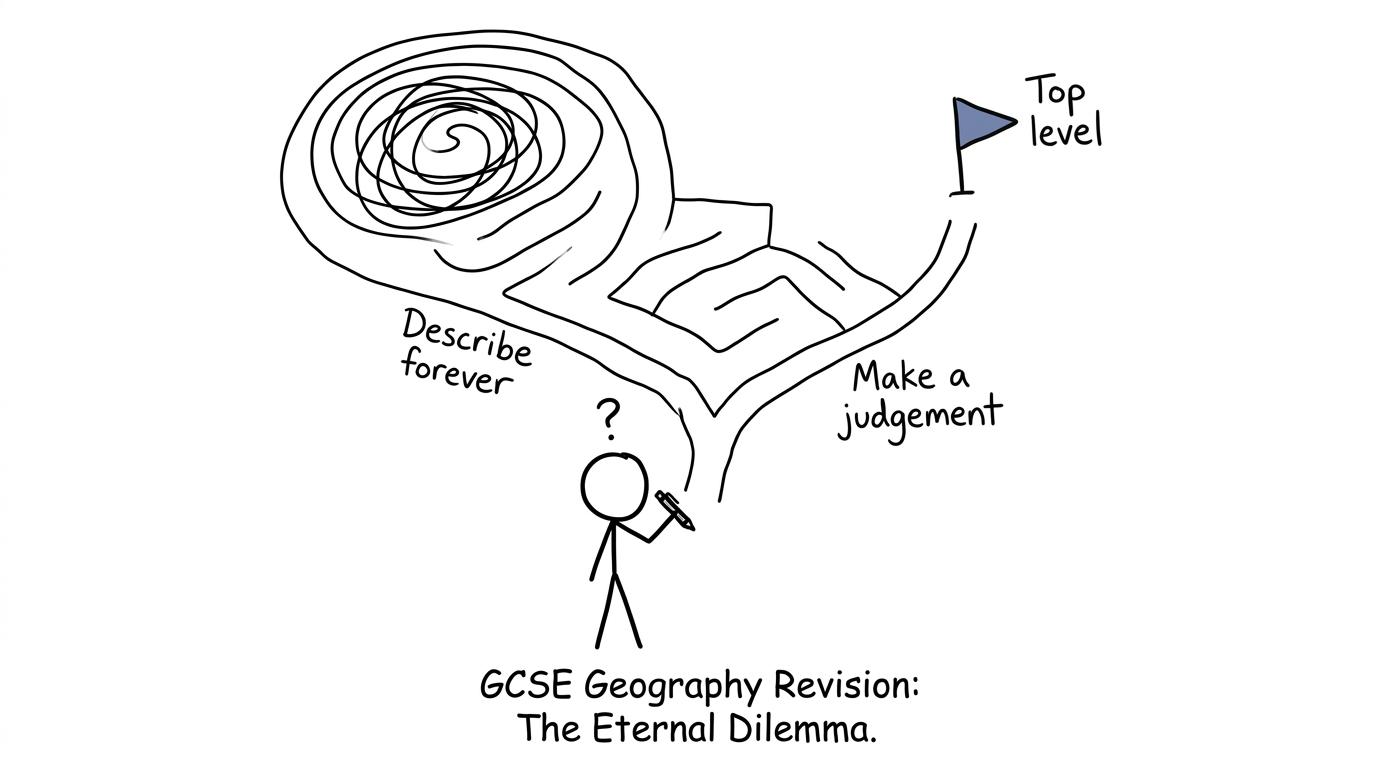 An exam maze where describing loops but making a judgement reaches the top level
Command words change the job
The same geographical knowledge can earn different marks depending on what the command word asks you to do.
Explain and examine
Explain requires reasons: how or why something happens. Make the causal sequence visible instead of assuming that the examiner will infer it.
Examine usually asks you to break an issue into components and explore how they contribute or connect. On Pearson Edexcel Geography A, for example, certain extended responses using “examine” are linked to unfamiliar resources. Always follow your own board’s definition and question format.
Assess, evaluate and discuss
Assess asks for an informed judgement, often about relative importance, significance or effectiveness. You must weigh evidence rather than producing two disconnected lists.
Evaluate asks you to judge worth, success or effectiveness by considering evidence, strengths, weaknesses or alternatives. The criteria for the judgement should be clear. A flood-management scheme might be effective economically but less convincing environmentally, or successful locally while transferring risk downstream.
Discuss requires an argument that considers relevant viewpoints or factors and reaches a conclusion. Balance does not mean giving every side exactly the same number of sentences. It means acknowledging meaningful alternatives before deciding what the evidence supports.
Exam boards do not all attach the same mark tariff to these commands. AQA commonly uses levels-based nine-mark questions, Pearson Edexcel uses extended responses worth eight or twelve marks, and OCR and Eduqas have their own structures. Check the paper and mark scheme rather than memorising a universal paragraph count.
What makes a judgement convincing
A conclusion does not become strong simply because it begins with “overall”. It needs to answer the question and explain why the chosen argument outweighs the alternatives.
A high-quality judgement usually does three things:
- states the decision clearly;
- identifies the evidence or criterion carrying the most weight;
- recognises a condition, scale or limitation where appropriate.
Useful conditions include short term against long term, local against national scale, social against economic impact, or effectiveness for different groups. These distinctions turn an opinion into geographical judgement.
Judgement can also appear throughout the response. Brief comparisons at the ends of paragraphs build a line of argument, leaving the conclusion to bring that reasoning together. This is more convincing than writing several descriptive paragraphs and attaching an unsupported decision at the end.
Structure without sounding mechanical
Planning should be brief but purposeful. Write down your overall position, choose two or three distinct reasons, attach evidence to each, and note a counterargument or limitation.
Then organise the response so that every paragraph advances the argument. One paragraph might establish the strongest factor, another might explore a contrasting factor, and a third might test whether the judgement changes by place or timescale.
Paragraph acronyms can help you remember evidence and explanation, but examiners do not award marks for following an acronym. They reward the geographical thinking it is meant to produce.
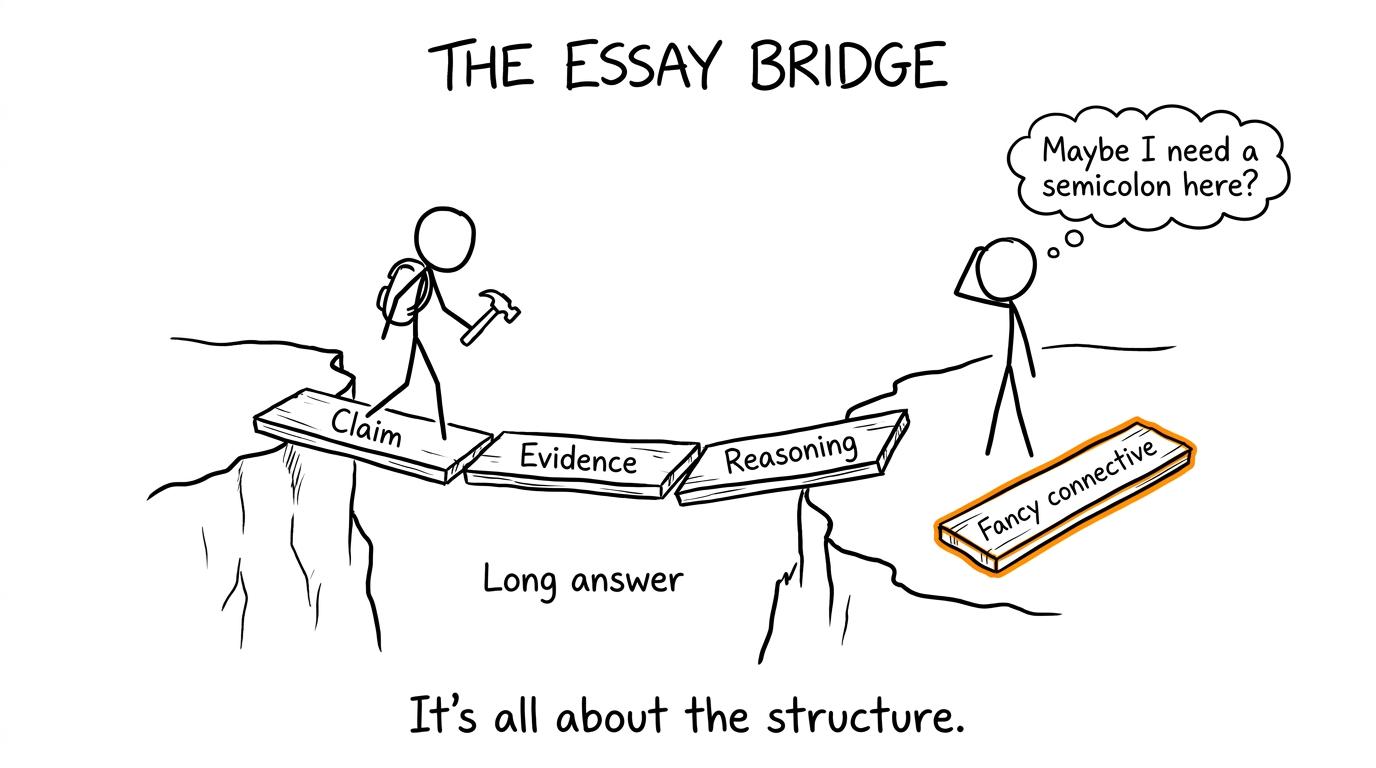 A student building a bridge from claim, evidence and reasoning
Common mistakes in geography long answers
Answering the topic instead of the question
Students sometimes recognise a familiar case study and write everything they remember. Circle the command word and underline the precise focus before planning. Ask whether every paragraph directly helps answer it.
Describing when analysis is required
Description identifies what can be seen or what happened. Analysis investigates patterns, relationships and implications. After using evidence, add the geographical meaning: why is the pattern present, what does it suggest, and how does it affect the argument?
Dropping in unsupported facts
A statistic or place name is not self-explanatory. Connect evidence to the claim it supports. Also avoid memorising excessive numerical detail that you cannot use accurately or relevantly.
Referring vaguely to a resource
Phrases such as “the figure shows this” are weak if “this” is unclear. Name the pattern or comparison and use units where relevant. Then combine it with your own understanding.
Giving a generic conclusion
“This depends on many factors” avoids the decision. Say which factor matters most, under what conditions, and why. Nuance strengthens a judgement only when a judgement is actually made.
Ignoring communication
On questions where spelling, punctuation, grammar or specialist terminology are explicitly assessed, those marks are shown on the paper. Even where separate marks are not offered, clear sentences and legible handwriting help the examiner follow your reasoning. Geography remains the priority; polished writing cannot rescue irrelevant content.
A revision method that improves long answers
Reading model answers can create familiarity, but improvement comes from producing and reviewing your own responses.
Choose one extended question from a board-specific paper. Spend a short period decoding and planning it, then write under timed conditions. Mark it using both the indicative content and the level descriptors. Those descriptors reveal whether the missing quality was knowledge, development, application, evidence or judgement.
Record one precise correction, such as “I described the resource but did not explain the pattern” or “my conclusion made no comparison”. Then answer a different question that tests the same skill. The OCR A numerical and statistical skills guide is useful when data handling is the weakness, while the GCSE Geography resit revision plan shows how to turn past-paper errors into a manageable schedule.
Turn knowledge into marks with MathsGenie
The gap between an average long answer and a top-level one is rarely filled by writing faster. It is filled by making better decisions: selecting relevant knowledge, developing the reasoning, using evidence deliberately and reaching the judgement requested.
Start with the MathsGenie GCSE Geography revision area, choose resources matching your exam board, and combine revision lessons with practice questions. Then use past papers, predicted papers, mini tests and mark schemes to see whether your reasoning survives exam conditions.
Practise one decision at a time. Eventually, the empty answer space stops feeling like an invitation to write everything. It becomes what it always was: a place to build one clear, supported geographical argument.