GCSE Further Maths Tutor: Do You Need One?
GCSE further maths tutor: learn when one is worthwhile, warning signs to notice, what to ask, and how free MathsGenie revision can fill your gaps.
A difficult Further Maths question can create a strange kind of doubt. You may understand everything in class, then meet an unfamiliar problem and suddenly wonder whether you need more help than school can provide.
The short answer is that a GCSE Further Maths tutor can help if you have persistent, identifiable gaps that are not improving through lessons, feedback and independent practice. But tutoring is not automatically necessary. If you mainly need more questions, clearer explanations or a better routine, free structured revision may solve the problem first.
The decision is less about whether Further Maths is difficult; it is supposed to be challenging, and more about whether personalised feedback would remove a specific barrier.
The quick decision checklist
A tutor may be worthwhile if:
- you repeatedly get stuck on the same concepts despite revising them;
- your algebraic foundations are preventing you from accessing Further Maths;
- you cannot tell why your solutions lose marks;
- lessons move too quickly for you to ask enough questions;
- you need an organised plan and regular accountability;
- your school offers limited teaching time for the qualification.
You may not need one yet if:
- you understand explanations but have not completed enough practice;
- your mistakes are mostly careless signs, arithmetic or incomplete working;
- you have not used mark schemes to diagnose lost marks;
- you are already making steady progress independently;
- the tutor would reduce revision time for your main GCSE subjects.
Before spending money, use the AQA GCSE Further Maths revision hub to test what you can learn, practise and correct independently.
Start by confirming which qualification you take
“GCSE Further Maths” is often used as an informal umbrella term, but schools do not all teach the same qualification. Ask your teacher for the exact awarding body, specification and entry code before choosing resources or contacting a tutor.
For example, the AQA Level 2 Certificate in Further Mathematics is an additional, untiered qualification designed to extend GCSE Maths rather than replace it. Its content includes number, algebra, coordinate geometry, calculus, matrix transformations and geometry. Students sit two papers: a non-calculator paper and a calculator paper, each lasting 111 hour 454545 minutes and carrying 808080 marks.
Other schools may offer Pearson Edexcel’s Level 2 Extended Mathematics Certificate or OCR’s Level 3 FSMQ in Additional Maths. These have different content and assessment structures. A tutor who teaches AQA Further Mathematics is not automatically the right person for an OCR FSMQ student.
This distinction matters. A capable maths tutor can still be a poor match if they teach interesting material that is not on your specification.
How to tell whether a tutor would actually help
The best evidence comes from your mistakes, not from how worried you feel after one hard lesson.
Your gaps remain after a complete revision cycle
Try a proper cycle before deciding:
- learn the idea from a lesson or revision guide;
- answer questions without copying the method;
- mark the work carefully;
- record the precise cause of each lost mark;
- revisit the topic on another day;
- attempt a fresh question under time pressure.
MathsGenie brings this process together through revision lessons, practice questions, mark schemes and video solutions. The broader GCSE Maths revision hub is particularly useful when the real weakness sits in Higher tier GCSE content rather than the extension material itself.
If you remain unable to begin questions or explain the method after several honest cycles, individual teaching may save time. A tutor can question your reasoning in real time and find the first missing step.
Your foundational algebra is fragile
Further Maths tends to expose small algebra gaps quickly. Manipulating expressions, factorising, solving equations, using functions and working exactly with surds are not isolated skills. They form the language in which later ideas are expressed.
For instance, a student may think calculus is the problem when the real obstacle is simplifying the resulting algebra. Another may understand function notation but reverse the order of composite functions.
Check core areas using MathsGenie’s quadratic formula lessons, inverse and composite functions videos and iteration revision resources. If several foundations are insecure, tutoring may help, but the tutor should repair those foundations rather than rushing into impressive-looking advanced content.
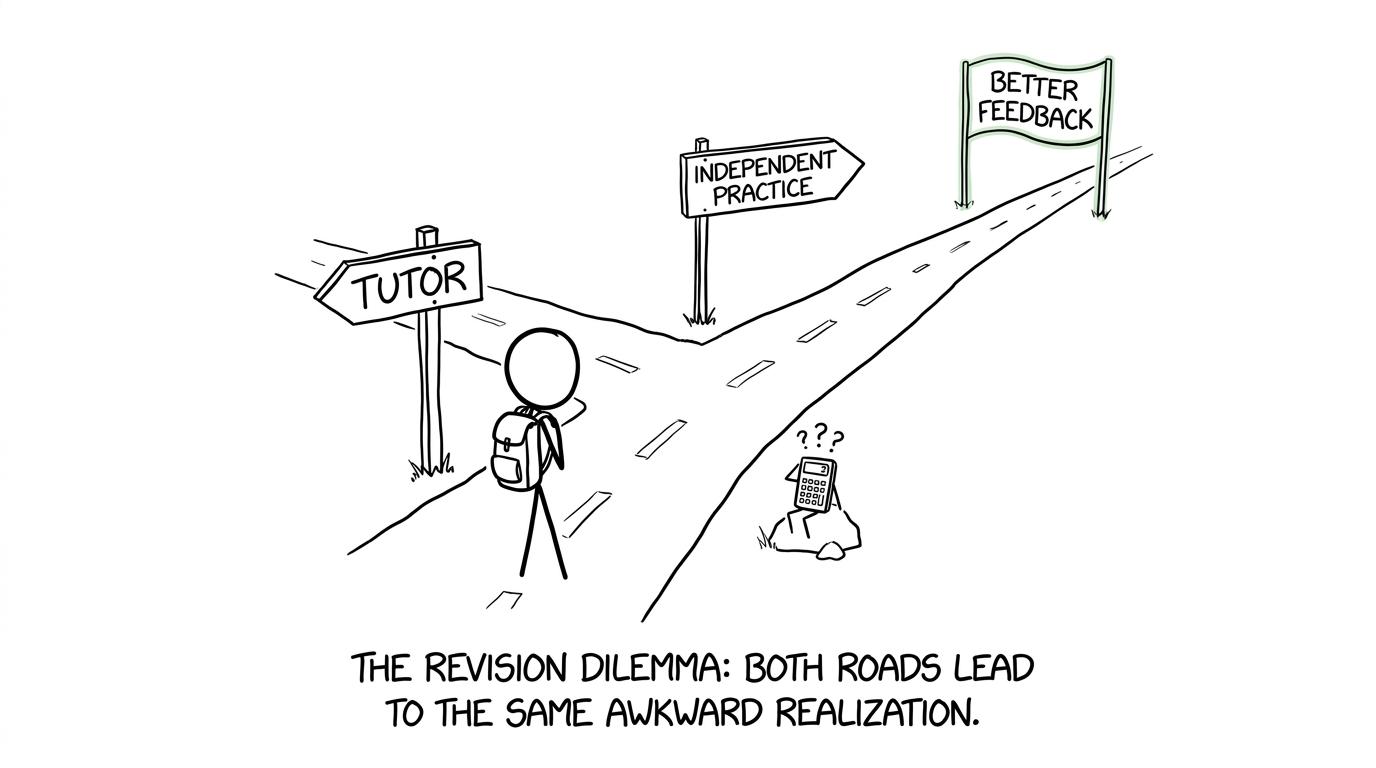 A student choosing between a tutor and independent practice, with both routes leading towards better feedback
You do not understand why marks are being lost
A low mark alone does not diagnose anything. Lost marks may come from four different sources:
| Type of problem | What it looks like |
|---|---|
| Knowledge gap | You do not recognise the relevant idea or notation. |
| Method gap | You know the topic but cannot organise the steps. |
| Accuracy gap | Your approach is sound, but signs or calculations go wrong. |
| Exam-performance gap | Timing, presentation or misreading damages an otherwise secure solution. |
A tutor is most valuable when they can identify the category accurately. More explanation will not fix poor timing. More timed papers will not fix a missing concept.
Use the AQA GCSE Maths past papers to create an error log. Record the topic, what happened and your next action. Patterns become visible after several sets of questions.
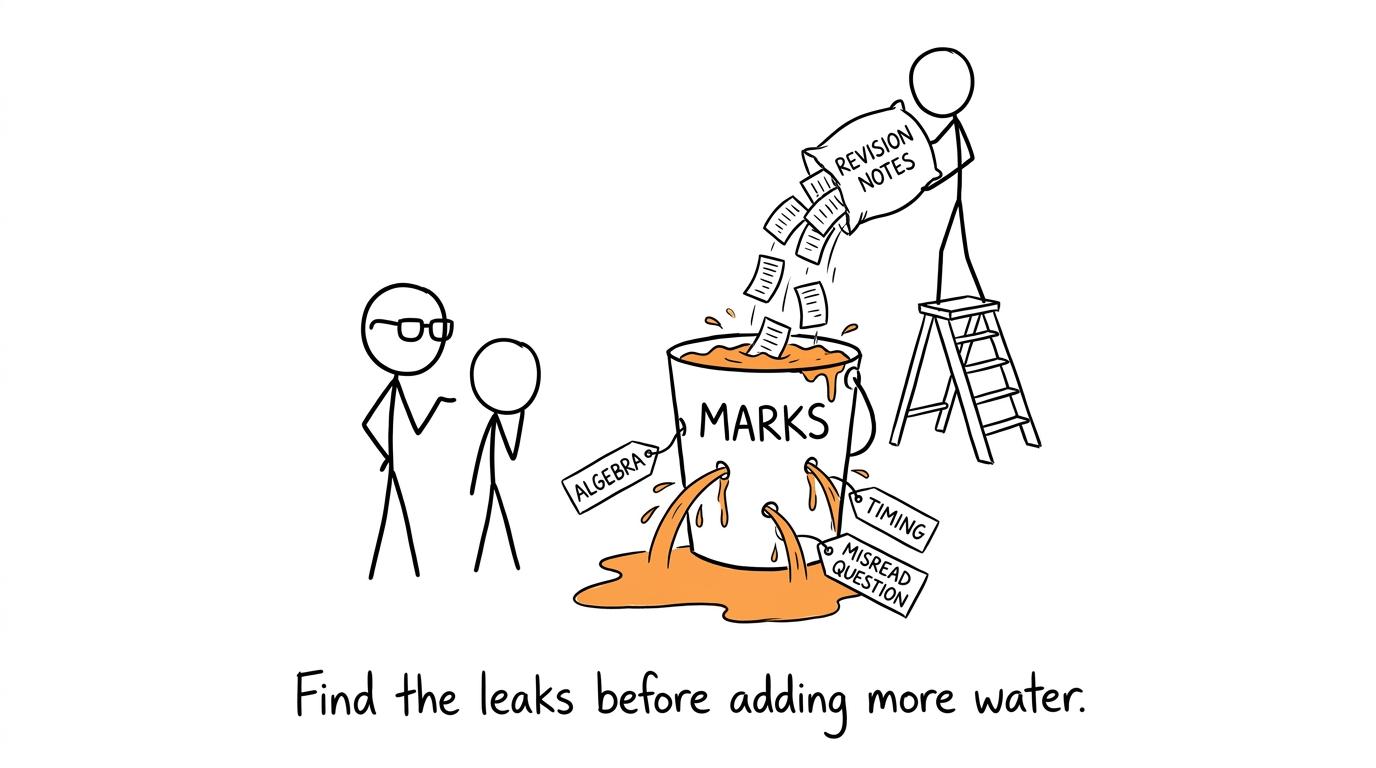 A tutor and student finding the algebra, timing and reading leaks in a bucket of marks
You need feedback that your current support cannot provide
Some students receive plenty of classroom support but need more independent practice. Others attend short Further Maths sessions in which there is little time to revisit misconceptions. Neither situation reflects ability; it reflects the type of feedback available.
Speak to your teacher before hiring anyone. Ask which topics need attention, whether extra school support exists and what qualification you are entered for. Your teacher may also be able to explain whether your difficulty is typical at this stage of the course.
What a good GCSE Further Maths tutor should offer
A tutor should do more than repeat a classroom explanation more slowly. Good tutoring is diagnostic: it changes according to what your written work reveals.
Look for someone who:
- knows your exact specification and current assessment format;
- can distinguish GCSE Higher content from extension content;
- asks you to explain your reasoning rather than only watching them work;
- uses exam-style questions and official-style mark schemes;
- gives focused practice based on errors;
- revisits previous weaknesses to check that learning has lasted;
- explains notation and mathematical communication precisely;
- is clear about safeguarding, lesson arrangements and costs.
Ask a potential tutor which qualification they teach most often and how they would assess your starting point. They should be able to describe a sensible process: inspect recent work, identify a small number of priorities, teach responsively and measure progress through fresh questions.
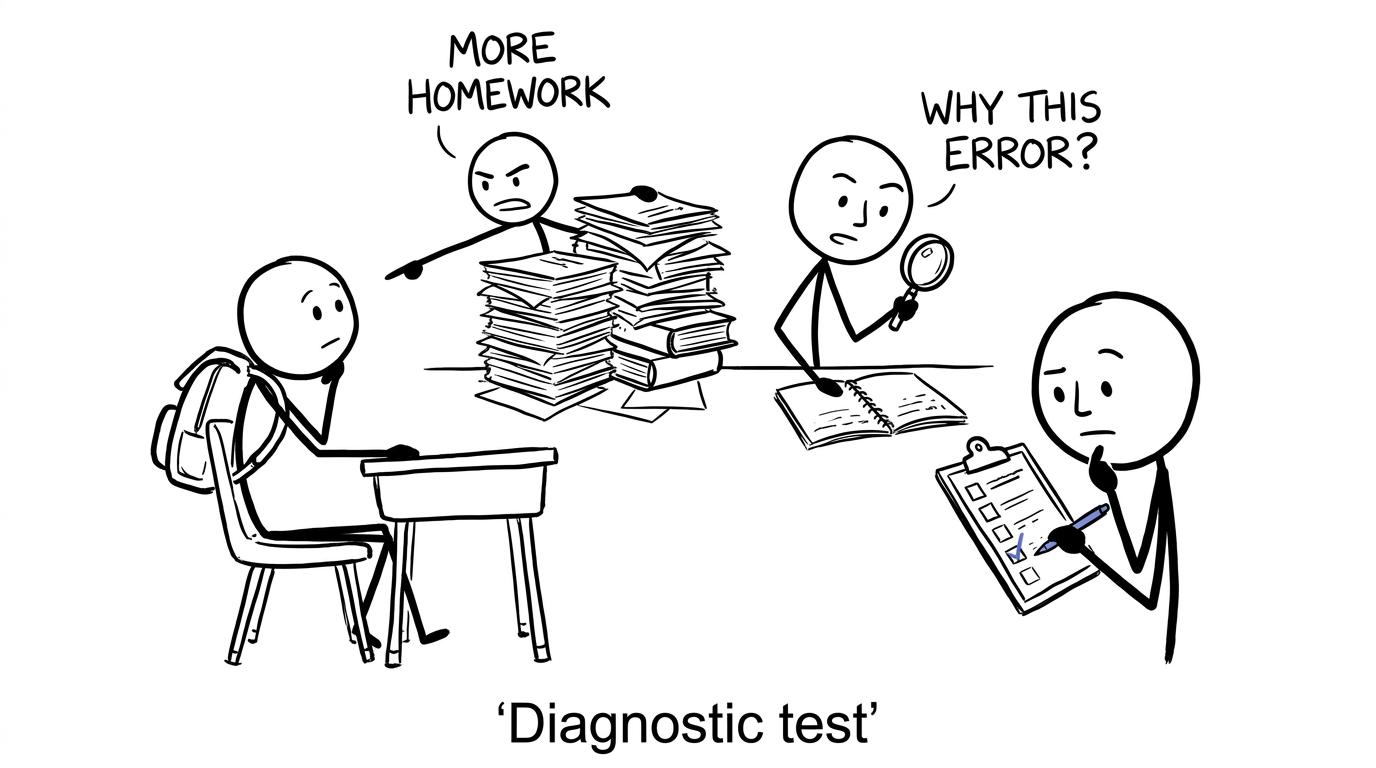 A student interviews one tutor offering more homework and another investigating the reason behind an error
Warning signs to notice
Be cautious if a tutor:
- guarantees a particular grade;
- cannot identify your specification;
- spends most of the lesson completing questions for you;
- introduces off-specification content without a clear reason;
- provides large quantities of work but little feedback;
- discourages you from asking your school teacher questions;
- measures progress only by whether the lesson felt easy.
The aim is not to become dependent on a weekly explanation. It is to become better at starting, checking and completing unfamiliar problems alone.
How to make tutoring worth the time and cost
Arrive with evidence. Bring marked questions, teacher feedback and a short list of points you cannot explain. “I am bad at algebra” is too broad; “I lose track of restrictions when manipulating algebraic fractions” gives the session somewhere useful to begin.
Between sessions, practise independently. A weekly conversation cannot replace retrieval, correction and repetition. Use a simple structure:
- one focused learning session;
- one independent question session;
- one short retest several days later;
- one mixed or timed set at the weekend.
MathsGenie’s guide to building a GCSE maths revision timetable can help you fit this around your other subjects. Near the exams, add GCSE predicted papers for fresh exam-style practice, but do not use predictions as a substitute for covering the specification.
After four to six sessions, review whether tutoring is producing a measurable change. Can you begin questions that previously stopped you? Are repeated errors becoming less common? Can you explain methods without prompts? If not, discuss changing the lesson approach before simply booking more sessions.
When independent revision may be the better choice
Further Maths often feels uncomfortable because it asks strong GCSE students to be beginners again. Difficulty is not proof that you need private tuition. Sometimes it is proof that you have reached material worthy of sustained thought.
Independent revision may be enough when you can understand a solution, identify your error and then answer a similar question correctly. In that situation, the missing ingredient is usually volume and spacing of practice, not another explanation.
It may also be the wiser choice if tutoring would crowd out your main GCSE Maths preparation. Further Maths is an additional qualification. Secure performance in your core subjects should remain the priority, especially if your school workload is already heavy.
Common mistakes when deciding about a tutor
Hiring someone before diagnosing the problem
A vague feeling of being behind can lead to vague lessons. Complete a diagnostic set and classify your errors first.
Choosing general reputation over specification knowledge
An excellent A Level tutor may not know how your Level 2 paper awards marks. Relevant experience matters more than impressive breadth.
Expecting tutoring to replace practice
Understanding something while a tutor prompts you is not the same as recalling it alone. Independent questions reveal whether the learning is secure.
Measuring progress by confidence alone
Confidence matters, but it fluctuates. Track accuracy, independence, timing and repeated error types alongside it.
Ignoring the free support already available
Revision lessons, practice questions, mini tests, past papers, mark schemes and video solutions can answer many needs without adding another weekly commitment.
Make the decision from evidence
A tutor can be a useful tool, but the tool should match the problem. Get one when personalised diagnosis, explanation and accountability would remove a barrier that independent work and school support have not shifted. Do not get one simply because Further Maths feels hard.
Start with MathsGenie’s free AQA GCSE Further Maths resources. Learn one weak topic, complete the questions, mark them carefully and retest yourself. Then move into past papers and predicted papers when your topic knowledge is ready.
That process will do one of two helpful things: it will show that you can progress independently, or it will give a future tutor the precise evidence needed to help. Either way, you stop guessing, and start making your revision count.