GCSE Further Maths Access Arrangements Guide
GCSE Further Maths access arrangements: request extra time, gather evidence, meet JCQ deadlines and prepare confidently for your exams at school.
The hardest part of an exam is not always the mathematics. Sometimes it is reading quickly enough, writing for a sustained period, managing a medical condition or keeping concentration steady while the clock continues moving.
GCSE Further Maths access arrangements are adjustments agreed before an examination so that an eligible student can demonstrate their knowledge without an unnecessary disadvantage. They may include extra time, supervised rest breaks, a word processor, modified papers, a computer reader or a scribe. Your school or exam centre normally requests them through its SENCo and exams officer; students do not usually apply directly to the exam board.
Start the conversation as early as possible. The centre may need to assess your needs, gather evidence from lessons and timed assessments, trial an arrangement in mock exams and meet a deadline that is earlier than the examination itself.
Access arrangements at a glance
Use this checklist as your starting point:
- Speak to your SENCo, learning support team or exams officer early.
- Explain the difficulty you experience, rather than simply requesting a particular arrangement.
- Ask what evidence and assessment may be required.
- Use the proposed arrangement during lessons, internal tests and mock exams where appropriate.
- Confirm which Further Maths qualification and awarding body you are taking.
- Check your centre's internal deadline, not just the final JCQ deadline.
- Practise under the exact conditions you expect on exam day.
- Tell the school immediately about a new injury or significant change in your condition.
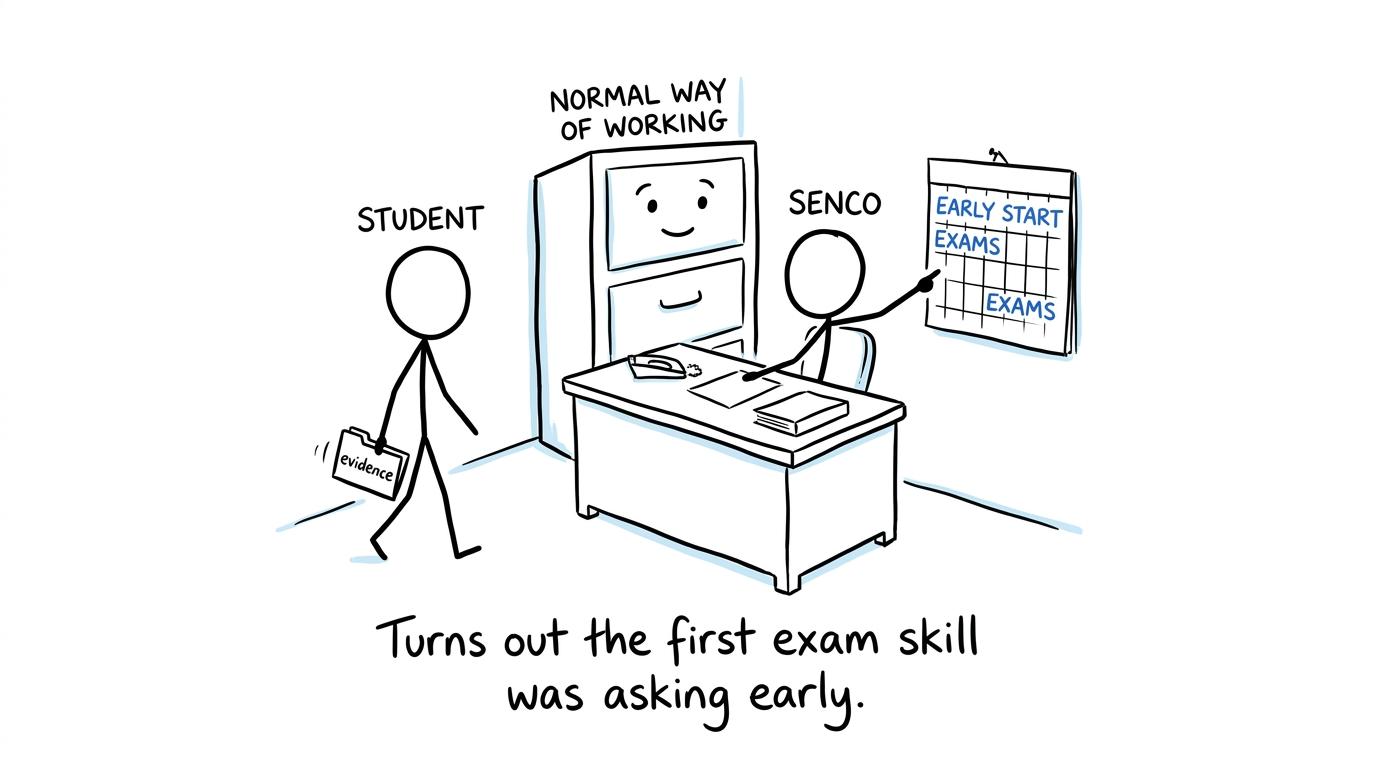 A student discovers that asking early is the first exam skill
What GCSE Further Maths access arrangements mean
An access arrangement changes how you access an assessment. It must not change the knowledge, understanding or skills being assessed, and it is not intended to make the mathematical content easier.
The precise qualification matters. What students informally call “GCSE Further Maths” may be the AQA Level 2 Certificate in Further Mathematics, CCEA GCSE Further Mathematics or another Level 2 mathematics qualification. The AQA Level 2 Certificate is explicitly covered by JCQ's Access Arrangements Online system, but you should ask your school to confirm the rules for your qualification and examination series.
MathsGenie has dedicated revision resources for both AQA GCSE Further Maths and CCEA GCSE Further Maths. Knowing the exact course helps you practise with the correct paper format as well as the correct access arrangement.
Who may be eligible?
Access arrangements can support students with learning difficulties, disabilities, medical conditions, sensory or physical needs, social, emotional or mental health needs, or temporary injuries. Eligibility depends on the individual barrier, the evidence available and the current regulations.
A diagnosis, Education, Health and Care Plan or previous arrangement may provide useful evidence, but none automatically guarantees a particular adjustment. Equally, not every route requires a formal diagnosis. The centre must establish why the arrangement is needed and, in most cases, show that it reflects your normal way of working.
That phrase matters. “Normal way of working” means the support is genuinely used because it addresses an established need, not introduced for the first time shortly before the final paper.
How extra time works in Further Maths exams
Extra time gives an approved candidate additional working time. A common arrangement is 25%25\%25% extra time, although approval depends on the applicable evidence criteria. Extra time above 25%25\%25% is a rare and exceptional arrangement with stricter requirements.
Where TTT is the standard duration of a paper, the duration with 25%25\%25% extra time is:
Ttotal=1.25TT_{\text{total}} = 1.25TTtotal=1.25TThe additional period is working time. You may continue reading, calculating, writing and checking your answers. Your centre will organise the timing and supervision, which may mean sitting in a different room from the main cohort. A separate room is not automatically part of an extra-time award; it must be justified and organised according to the relevant rules.
Extra time is most valuable when you have practised how to use it. During mock papers, notice whether it helps you complete unfinished questions, process wording, record full methods or check calculations. That evidence can also help teachers explain how the arrangement supports you.
Extra time is not a supervised rest break
These arrangements solve different problems.
During extra time, the examination clock continues and you can work. During a supervised rest break, your work is paused and you cannot access the question paper or answer booklet. The break is not additional thinking time.
A SENCo should consider which arrangement addresses the actual barrier. Current JCQ guidance emphasises professional judgement when considering supervised rest breaks before an application for 25%25\%25% extra time for an impairment other than a learning difficulty. A rest break may suit a student who needs to pause because of fatigue, pain, anxiety or attention difficulties; another student may need additional processing or writing time.
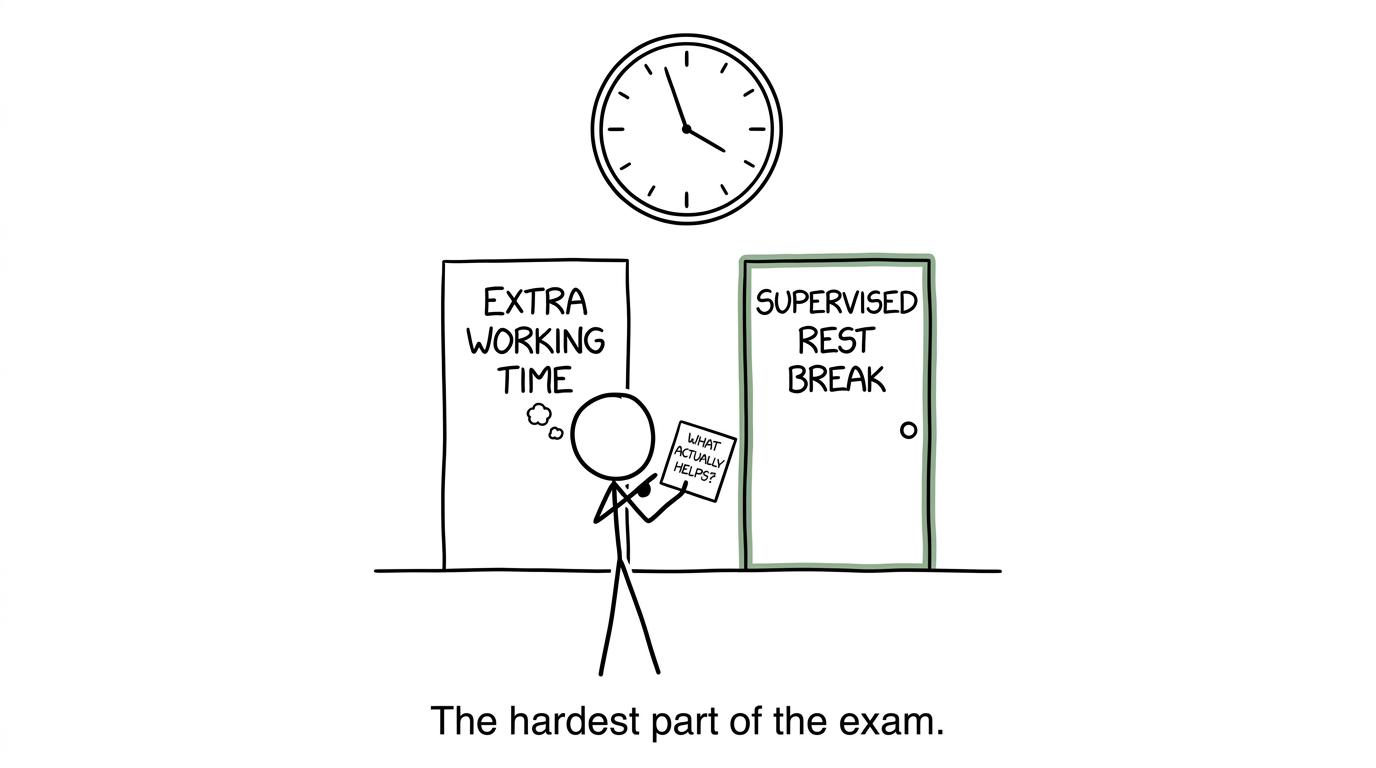 An exam clock asks whether extra time or a rest break actually helps
Other access arrangements you may discuss
The right adjustment is individual. Depending on need and the qualification rules, possibilities can include:
- supervised rest breaks;
- a word processor;
- a computer reader or human reader;
- a scribe or speech-recognition technology;
- modified enlarged, Braille or tactile papers;
- coloured overlays or other approved visual support;
- a prompter;
- a practical assistant;
- alternative accommodation or particular room arrangements.
Some arrangements require an application through Access Arrangements Online. Others may be delegated to the centre, meaning the school can approve them without an online application. Delegated does not mean informal: the centre may still need records showing the need, your normal way of working and compliance with examination rules.
Not every arrangement is permitted in every component. The SENCo and exams officer must check the current JCQ guidance, awarding-body instructions and specification rather than assuming that an arrangement used elsewhere will apply unchanged.
How to request access arrangements
Speak to the right person
Tell a teacher, form tutor or head of year if you do not know your SENCo. Be specific about what happens under timed conditions. For example, describe whether you struggle to process written instructions, sustain concentration, write continuously, see the paper clearly or manage pain and fatigue.
The useful question is not “Can I have extra time?” It is “What barrier am I experiencing, and what adjustment would allow me to show my mathematics fairly?”
Let the centre build evidence
The SENCo may collect teacher feedback, classroom observations, samples of work, records of support, screening information and evidence from internal tests or mock exams. Where specialist assessment is required, the centre must use an appropriately qualified assessor working within the JCQ framework.
Under the JCQ rules applying during the 2025/26 academic year, most new applications for 25%25\%25% extra time require evidence from internal tests or mock papers across relevant subjects, together with teacher comments explaining why the time is needed and how it is used. The exact documentary route depends on whether the need concerns a learning difficulty, disability, medical condition or another impairment.
Students should cooperate with assessments and mock-paper trials, but the SENCo and exams officer are responsible for the formal process.
Give consent and confirm the outcome
The centre will obtain the necessary candidate consent before processing and holding relevant information. If an online application is required, authorised centre staff submit it through the awarding bodies' shared system.
Ask for confirmation of what has been approved. Before the examination series, make sure you understand where you will sit, how the timing will work, when rest breaks can be taken and what equipment or assistance will be available.
The access-arrangements timeline
The safest timeline begins well before Year 11.
Year 9 or early Year 10
Raise persistent difficulties and use agreed classroom support consistently. Schools can begin establishing a picture of need and normal working practice. This is also a good time to build mathematical confidence through the GCSE maths revision hub.
During Year 10
The centre may arrange assessment, collect teacher observations and trial appropriate support in timed tasks. Keep explaining what helps and what does not. An arrangement should solve a real access problem, not merely exist on paper.
Autumn term of Year 11
Confirm that Further Maths is included in the centre's planning. Sit mocks using the proposed arrangements where appropriate. Practising this way builds realistic evidence and helps you develop a timing strategy.
MathsGenie's guide to building a GCSE maths revision timetable can help you schedule timed practice without turning every evening into a full mock.
Before the application deadline
Schools often set internal deadlines weeks or months before the final JCQ date because evidence must be checked and applications processed. Modified papers usually have an earlier ordering deadline than other arrangements.
JCQ deadlines change by examination series. For context, the published deadlines for the June 2026 series were 31 January 2026 for modified papers and 21 March 2026 for other access arrangements. Those dates have passed and must not be assumed to apply to a later series. Ask your exams officer for the current deadline and follow the school's earlier date.
After a late injury or change
Do not assume it is too late to ask. Contact the school immediately if you break an arm, develop a new medical need or experience a significant deterioration after the normal deadline. The centre will decide which application, temporary arrangement or other process is appropriate.
Private candidates should contact an accepting exam centre particularly early. The entering centre is responsible for access-arrangement applications and will need enough time to establish need, review evidence and organise the examination.
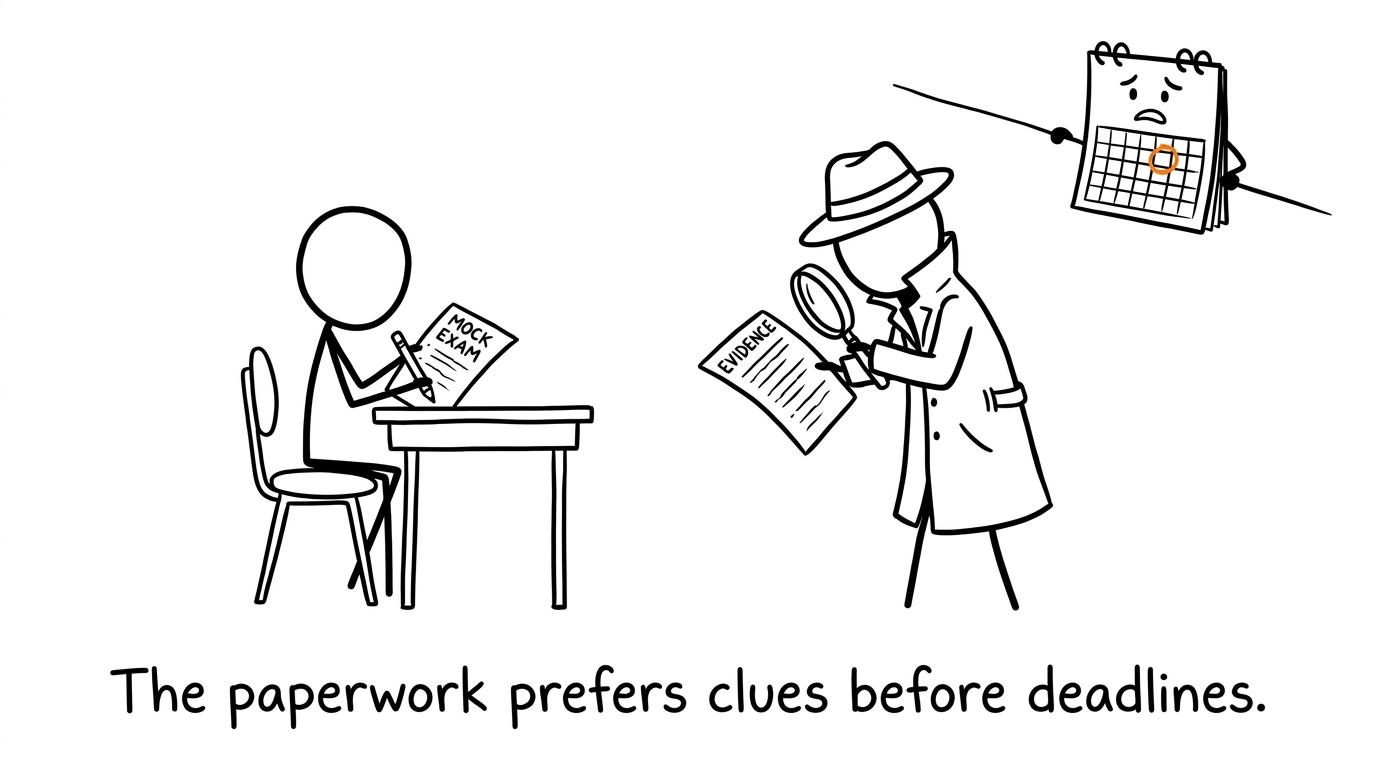 A teacher gathers mock-paper clues while the deadline calendar watches
Preparing once an arrangement is approved
An arrangement removes a barrier; practice turns that opportunity into performance.
Use a genuine Further Maths paper under your approved conditions. Mark it carefully, identify where time disappeared and return to the underlying topics. MathsGenie's AQA Further Maths page includes papers and mark schemes, while AQA GCSE Maths past papers can strengthen the algebra, graphs and geometry that Further Maths builds upon.
Do not make every revision session a full paper. Combine timed practice with revision lessons, targeted questions and mini tests. The guide to starting GCSE past papers explains how to increase exam practice gradually. Nearer the examination, use GCSE predicted papers for additional unfamiliar questions, while remembering that predicted papers cannot guarantee future content.
If the approved arrangement is missing or incorrect on exam day, tell an invigilator immediately. Do not wait until the paper has ended to mention a problem that the centre may be able to correct.
Common mistakes to avoid
- Waiting until the final term: evidence, assessment and mock trials take time.
- Assuming a diagnosis guarantees extra time: the centre must match the arrangement to evidence of need and current rules.
- Contacting the exam board yourself: students normally work through the SENCo and exams officer.
- Not using the arrangement in mocks: you lose both valuable practice and evidence of your normal way of working.
- Confusing extra time with rest breaks: one extends working time; the other pauses work under supervision.
- Ignoring the modified-paper deadline: enlarged, Braille and tactile papers may need to be ordered earlier.
- Assuming one approval covers everything forever: confirm the qualification types, academic years and examination series included.
- Using extra time without a plan: decide how you will complete, revisit and check questions before the real paper.
Your next step
Access arrangements are not a shortcut. They are a way of making sure the clock, the room or the format of a paper does not hide the mathematics you genuinely know.
Speak to your SENCo or exams officer now, confirm your qualification and ask what evidence or mock-paper trials are needed. Then make the arrangement familiar. Use MathsGenie's free Further Maths revision lessons, practice questions, past papers, mark schemes and video solutions alongside mini tests, predicted papers and the revision planner. The administrative process belongs to your centre, but the preparation remains yours, one calm, realistic session at a time.