

GCSE French Results Day Wrong Grade? What to Do
GCSE French results day wrong grade? Learn what to do in the first hour, how marking reviews work in 2026, and which costly mistakes to avoid.

A results slip can turn months of work into a single line. When that line is lower than your mock or predicted grade, the first reaction is often disbelief: That cannot be right.
If you are searching for GCSE French results day wrong grade advice, the immediate answer is simple: keep the result slip, speak to your French teacher or exams officer before leaving school, ask for your component marks and grade boundary, and find out whether your marked work can be accessed. Do not pay for a review until a teacher has considered the evidence.
An unexpected grade is worth investigating, but it is not automatically an incorrect grade. Predictions are estimates; final grades come from assessed work. The aim of the first hour is therefore not to prove that somebody is wrong. It is to replace shock with reliable information.
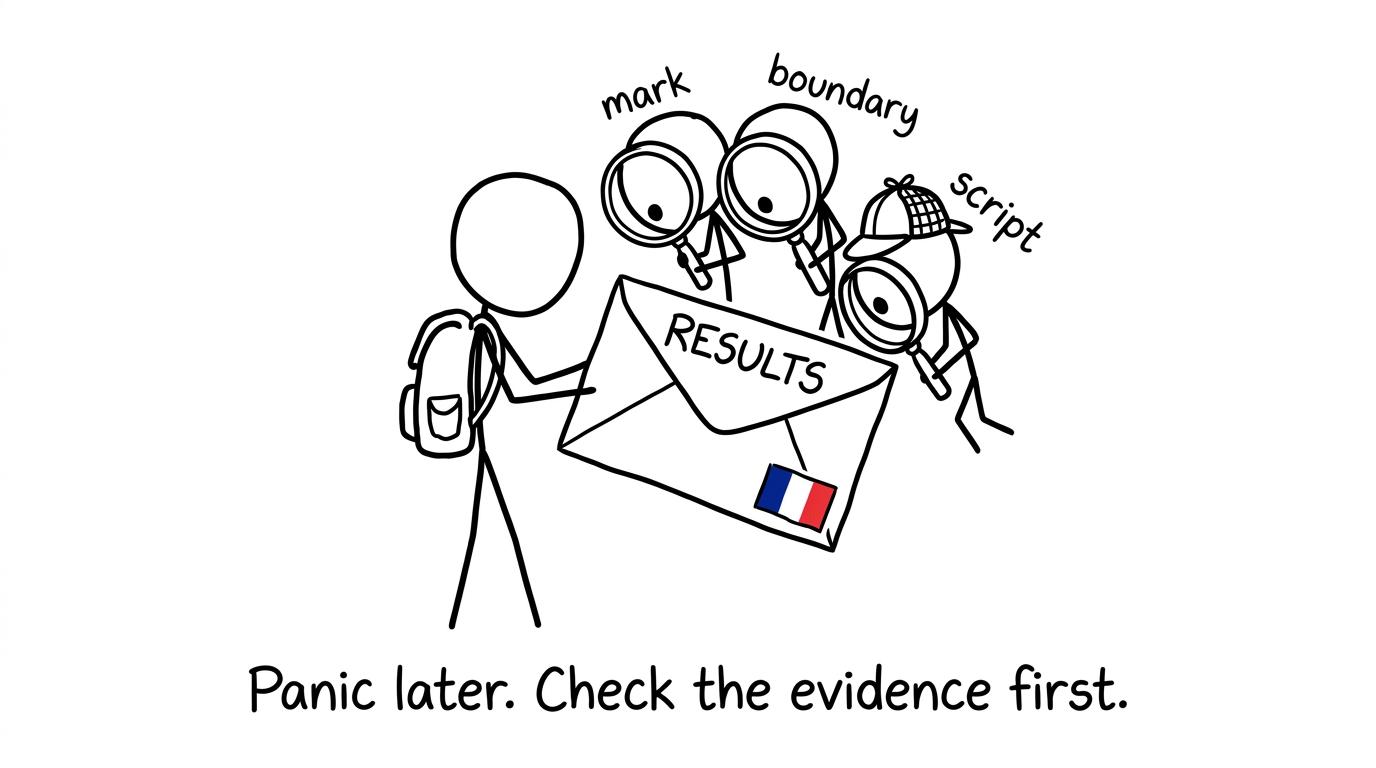 Student detectives inspect a results envelope before panicking
Your first-hour checklist
If your GCSE French result looks wrong, work through these actions while the appropriate staff are still available:
- Photograph or safely store your results slip.
- Confirm the subject, exam board and tier shown in your school records.
- Ask for your overall mark and available component marks.
- Check the official grade boundary for your exact board and specification.
- Tell your French teacher why the result seems unusual.
- Ask whether there is any missing, pending or incomplete result indicator.
- Ask whether your school can access the relevant scripts or assessed material.
- Get the school’s internal deadlines, fees and consent process in writing.
- Explain immediately if the grade affects sixth-form or college entry.
- Do not submit or agree to a review before understanding that the mark can fall, remain unchanged or rise.
For summer 2026, GCSE results are released to candidates on Thursday 20 August. The awarding-body deadline for standard reviews of results is 24 September 2026, but schools commonly set earlier internal deadlines so that staff can inspect work and complete applications. Treat the date given by your exams officer as the deadline that matters to you.
What to do during the first hour
Check that you are reading the result correctly
Results slips are compact and not always self-explanatory. Make sure you are looking at GCSE French rather than another language qualification, and distinguish the final grade from individual component marks or codes.
Ask the exams officer to confirm:
- your exam board, such as AQA, Pearson Edexcel, OCR or Eduqas;
- the specification and tier entered;
- the overall subject grade;
- your total mark and component marks, where available;
- whether every expected component has been included.
Current GCSE French specifications assess language through listening, speaking, reading and writing, although the precise structure, weighting and reporting depend on the exam board and specification. A surprisingly low total might reflect performance across several components rather than one obvious problem.
If the slip shows a missing, pending or incomplete result rather than an ordinary grade, point this out immediately. That may require an administrative investigation rather than a conventional review of marking.
Compare marks with the official boundary
Your predicted grade and mock results provide context, but neither determines your final grade. Grade boundaries are set after students have completed the assessments, and they can move between exam series because papers differ in difficulty.
Ask for the published boundary covering your exact board, tier and specification. Avoid screenshots, speculative boundaries and figures from a previous year. The same evidence-led habit matters in maths: MathsGenie’s guide to GCSE results day grading and appeals explains why a prediction or closeness to a boundary does not itself create an extra mark.
Being close to the next grade can make script inspection more consequential, but it does not prove an error. The stronger question is: Does the assessed work suggest that the mark scheme was applied incorrectly or that something was not counted?
Speak to the right people before leaving
Your French teacher can judge whether the component profile looks plausible. Your exams officer controls the centre’s formal post-results process. You usually need both perspectives.
Give them specific information rather than saying only that the grade feels unfair. For example, explain that the result is substantially different from several recent assessments, that one component mark appears unusual, or that you are concerned a response or recording may not have been included.
Most students cannot request a review directly from the exam board. The school or college submits it and must obtain your written consent after results have been released. Private candidates may have different arrangements and should contact their entering centre or follow the relevant awarding body’s instructions.
 A student calmly brings a checklist to the exams officer
Tell staff if progression depends on the grade
If a sixth form, college or course requires a particular French grade, tell both the institution and your school promptly. Ask whether your place can be held while the result is checked and what evidence they require.
Do not assume that the GCSE priority review service used for some urgent Level 3 progression cases is available. Under the standard 2026 JCQ arrangements, Priority Service 2 is for A Level, T Level and other eligible Level 3 qualifications, not an ordinary GCSE French result. Your exams officer can explain the fastest valid GCSE route for your board.
Is the grade wrong or simply unexpected?
A lower-than-predicted result can have several explanations:
- the live assessments tested different material or skills from the mock;
- performance varied between listening, speaking, reading and writing;
- the official boundary differed from the one used for school assessments;
- a teacher prediction was optimistic;
- exam-day timing, nerves or interpretation affected the responses;
- a clerical or marking error occurred.
Only the final possibility means the awarded mark was wrong. That is why checking evidence matters.
There is also a useful emotional distinction between unexpected and impossible. An unexpected result deserves questions. Calling it impossible before seeing the marks can push you towards an expensive decision without enough information.
Understanding the post-results options
Access to scripts or assessed material
Access to Scripts allows a centre to obtain marked material where the service is available. A teacher can then compare your response with the mark scheme and advise whether a review appears justified.
Written permission is required, and it can only be collected after results have been published. Availability differs by component and board, particularly where an assessment involves recordings or other non-written material, so ask precisely what your school can access.
For 2026, AQA lists 3 September as its deadline for a priority copy of a GCSE marked paper. Pearson and OCR also provide access services, but their arrangements and download deadlines differ. Your school may impose a much earlier cut-off.
Clerical re-check
A clerical re-check examines administrative matters such as whether all parts were marked, whether awarded marks were counted and whether the total was recorded correctly. It does not reconsider the academic judgement applied to an extended response.
This may suit a concern about missing pages, an incorrect total or a result that appears incomplete. Candidate consent is required because the mark and grade can move down as well as up.
Review of marking
A review of marking checks whether the original examiner applied the mark scheme correctly. It includes clerical checks, but it is not an instruction to award more marks and it is not simply a complete fresh mark by somebody looking for a more generous outcome.
The result can be:
- no mark change;
- a higher or lower mark with the same grade;
- a higher grade;
- a lower grade.
For June 2026 GCSEs, the awarding-body deadline is 24 September 2026. Standard reviews are normally completed within 20 calendar days of receipt. Charges vary by exam board and component, and schools may have their own policy on payment or administration fees. Ask for the current cost rather than relying on an older online post.
Review of moderation and appeals
A review of moderation concerns centre-assessed work whose marking was moderated by the exam board. It is requested for a cohort rather than one student in isolation, so it is not usually the relevant route for an individually examined French component.
An appeal normally comes after the appropriate review process. It needs valid grounds, such as a remaining marking error or a procedural concern; it cannot be used merely because you dislike the grade boundary. Your school must also provide a way to appeal internally if it decides not to request a review on your behalf.
Questions to ask your teacher or exams officer
Write these down before the conversation:
- What was my total mark?
- What were my marks for each reported component?
- How far was the total from the next grade boundary?
- Does any component look inconsistent with my previous assessed work?
- Can you access the marked script or relevant assessment material first?
- Which post-results service matches the concern?
- Could my mark or grade decrease?
- What will it cost, and when is the school’s internal deadline?
- What happens if the school recommends against a review?
- Who should I contact if the grade affects my next course?
A short written record helps because results day can blur together. Ask for copies of forms and keep emails concerning consent, deadlines and outcomes.
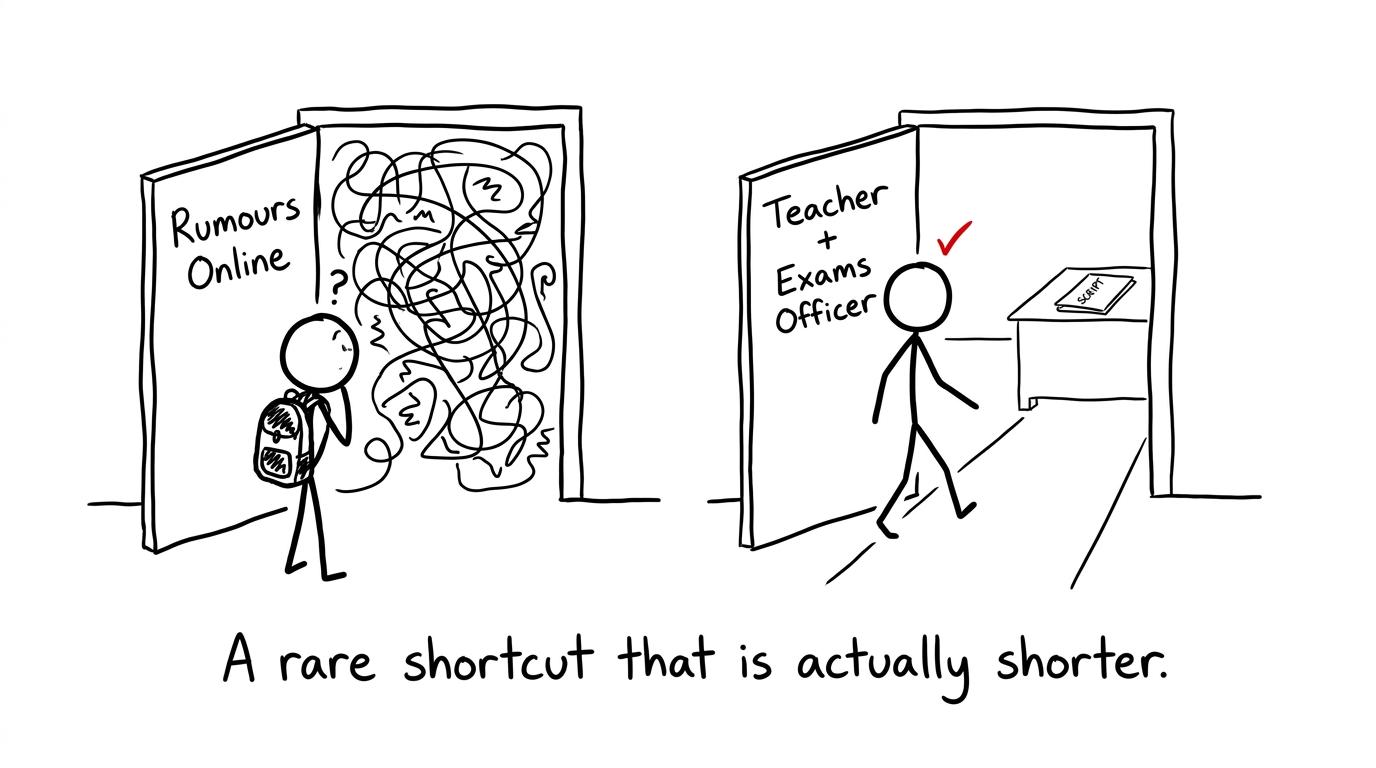 The sensible route through an exams officer beats the online rumour maze
Common mistakes when a GCSE French grade looks wrong
Treating a predicted grade as proof
A predicted grade is an informed estimate, not part of the exam board’s calculation. A discrepancy is a reason to investigate, not evidence that the examiner made an error.
Comparing with last year’s boundary
Grade boundaries can change between exam series. Use only the official boundary for your board, tier, specification and examination series.
Requesting a review without seeing the evidence
Where time and access arrangements permit, teacher inspection of marked work can reveal whether there is a credible marking concern. Closeness to a boundary alone is not enough.
Forgetting that marks can go down
There is no grade protection in an individual clerical re-check or review of marking. Your written consent confirms that you understand this risk.
Waiting for the published deadline
The exam board’s deadline is not necessarily your school’s deadline. Centres need time to obtain consent, review material and submit the correct service.
Asking a parent to contact the exam board directly
For most school candidates, the request must go through the centre. A parent can support you, but the exams officer is normally the practical starting point.
Letting one result stop every other plan
A disappointing grade deserves attention, but it should not freeze your next steps. Continue speaking to sixth forms or colleges and keep preparing for the subjects ahead.
Keep the rest of your results-day plan moving
French may be the immediate concern, but results day can also shape your maths route. If you need to strengthen or resit GCSE maths, begin with the free GCSE maths revision hub and the GCSE maths resit results-day plan.
Choose resources matching your board and tier. MathsGenie provides dedicated collections of Edexcel GCSE maths past papers, AQA GCSE maths past papers and OCR GCSE maths past papers, with official mark schemes and worked solutions where available.
When you are ready for fresh exam practice, use the GCSE predicted papers. Predicted papers should complement official past papers, while revision lessons, practice questions, mini tests and video solutions repair the specific skills that cost marks.
From uncertainty to a clear next step
An unexpected result feels personal because the work behind it was personal. The process for checking it, however, is deliberately evidence-based.
In the first hour, preserve the result, confirm the details, obtain the marks, speak to your teacher and exams officer, and record every deadline. Then decide between script access, a clerical re-check or a review of marking with a clear understanding of the possible outcomes.
Once those actions are in motion, return your attention to what you can still influence. Use MathsGenie’s free revision lessons, past papers, predicted papers, practice questions, mark schemes, mini tests and video solutions to prepare for your next maths milestone. Results day gives you information. What you do with it writes the next part.










