GCSE English Language and Literature Extracurricular Club
GCSE English language and literature extracurricular club: discover when joining may improve your grade and how to balance it with maths revision.

A club can sound like one more demand in a week already divided between homework, revision and the rest of life. Yet English is unusual: talking about a text can reveal ideas that remain invisible when you read alone. A well-run GCSE English language and literature extracurricular club can therefore help your grade, but attendance alone will not earn marks.
The benefit comes from what the club makes you do: read closely, explain interpretations, hear alternative viewpoints, write under guidance and respond to feedback. If it provides only relaxed conversation without connection to your exam board's assessment objectives, it may be enjoyable without being effective exam revision.
For students also preparing for maths exams, the decision is not simply whether the club is good. It is whether its likely value justifies the time it takes from deliberate practice elsewhere.
The short answer
Joining an English Language and Literature club may help if it gives you:
- regular opportunities to discuss unfamiliar texts;
- practice explaining how writers create meanings and effects;
- useful feedback on analytical and creative writing;
- structured revision linked to your specification;
- accountability without consuming your maths revision time.
It is less likely to improve your grade if meetings are unstructured, dominated by a few confident speakers or disconnected from exam questions and mark schemes.
Before joining, ask four questions:
- What does the group actually do each week?
- Is it linked to AQA, Edexcel, OCR or Eduqas requirements?
- Will you write and receive feedback, rather than only talk?
- Can it fit beside your GCSE maths revision and other subjects?
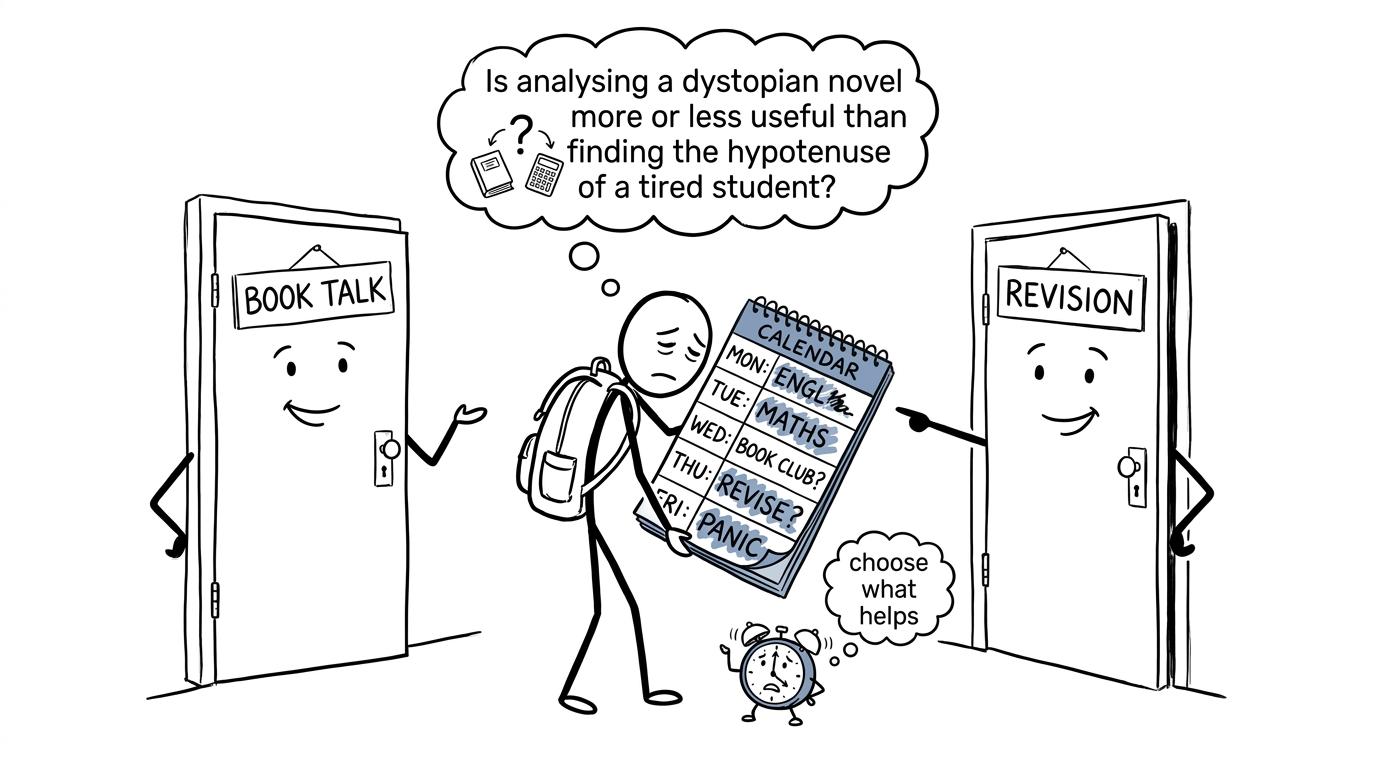 A GCSE student choosing between book club and revision while holding an overloaded calendar
How an English club can improve exam performance
English Language and English Literature reward several related abilities, including comprehension, analysis, comparison, evaluation and clear communication. The precise assessment objectives and paper structures differ by exam board, so students should always check their current specification and follow their teacher's guidance.
A productive club strengthens those abilities through purposeful activity rather than passive attendance.
Discussion makes interpretations more precise
It is easy to believe that you understand a passage until somebody asks, “What in the text supports that?” Discussion forces a vague impression to become an argued interpretation.
Listening to other students also demonstrates that a text can support more than one reasonable reading. That does not mean every interpretation is equally convincing. Strong interpretations remain rooted in relevant textual evidence and explain how language, form or structure contributes to meaning.
Evidence reviews in education generally find that purposeful classroom talk and collaborative learning can support attainment when discussion is carefully structured. The important phrase is carefully structured. A conversation with clear prompts, evidence and feedback is different from an informal chat about whether a character was likeable.
Speaking can expose gaps before the exam does
When an idea exists only in your head, its missing steps are easy to overlook. Saying it aloud makes those gaps audible.
You may notice that you have identified a technique but not explained its effect, or made a broad claim without selecting evidence. A good club leader can challenge that gap immediately. Over time, questions such as “Why this word?” and “How does this support your interpretation?” may become part of your own independent thinking.
This is metacognition in practical form: planning an approach, monitoring whether it works and adjusting it. It matters in maths too. The student who checks whether an English argument answers the question is using the same self-monitoring habit as the student who checks whether a calculated answer is sensible.
 Students dramatically examining a novel with magnifying glasses during a discussion club
Regular writing turns discussion into marks
Insight is valuable, but examiners can only reward what appears in the answer booklet. An effective club therefore moves between conversation and writing.
Useful activities may include planning a response, improving a paragraph, comparing interpretations, analysing an unseen passage or editing a piece of creative writing. Feedback should identify the next specific improvement, such as selecting more precise evidence or developing the link between method and meaning.
Be cautious if a club promises particular grades simply for attending. GCSE grades come from assessed performance under the relevant qualification rules. The club is preparation, not a source of additional marks.
Reading beyond lessons can build flexibility
Wider reading can increase familiarity with different voices, structures and viewpoints. This can be useful for English Language, where students may need to respond to material they have not seen before, and for Literature, where understanding context and genre can sharpen interpretation.
However, reading more is not automatically the same as revising well. The strongest club connects wider reading to an examinable skill: inference, comparison, evaluation, vocabulary, organisation or textual analysis.
What a useful GCSE English club should include
A club does not need to feel like another formal lesson, but it does need a purpose. Look for a balance of the following:
- Specification awareness: activities reflect the requirements of the exam board being taken.
- Inclusive discussion: every student has a meaningful opportunity to contribute.
- Evidence-led analysis: interpretations are tested against the text.
- Frequent writing: ideas are converted into timed or untimed responses.
- Actionable feedback: students leave knowing what to improve next.
- Varied practice: sessions cover reading, writing and the relevant Literature texts rather than repeating one comfortable task.
- Independent follow-up: students can revisit feedback between meetings.
Ask whether the club supports both Language and Literature. A Literature-heavy reading group may deepen discussion of set texts but offer little practice in transactional or creative writing. Conversely, a creative-writing club may build confidence and control without addressing Literature essays. Neither is necessarily poor; you simply need to know what problem it solves.
Balancing the club with GCSE maths revision
Time has an opportunity cost. An hour spent at a club cannot also be spent completing a maths mini test or checking a past paper. That does not mean you should avoid extracurricular activities. It means your timetable should respond to evidence rather than guilt.
Start by identifying your weakest examinable areas in each subject. For maths, use the MathsGenie GCSE revision resources to find topics by grade and watch the relevant video lesson before attempting the practice questions. Your errors should decide what comes next.
Then protect several short, focused maths sessions across the week. Retrieval and problem-solving are generally more useful when repeated over time than when compressed into one exhausting session. You can use GCSE maths past papers when you need mixed exam practice and mark your work carefully rather than simply counting a total.
The English club should occupy a defined place in this plan. If it replaces unfocused scrolling or passive rereading, the trade-off may be excellent. If it repeatedly replaces your only higher or foundation maths practice, it may create a new weakness while addressing another.
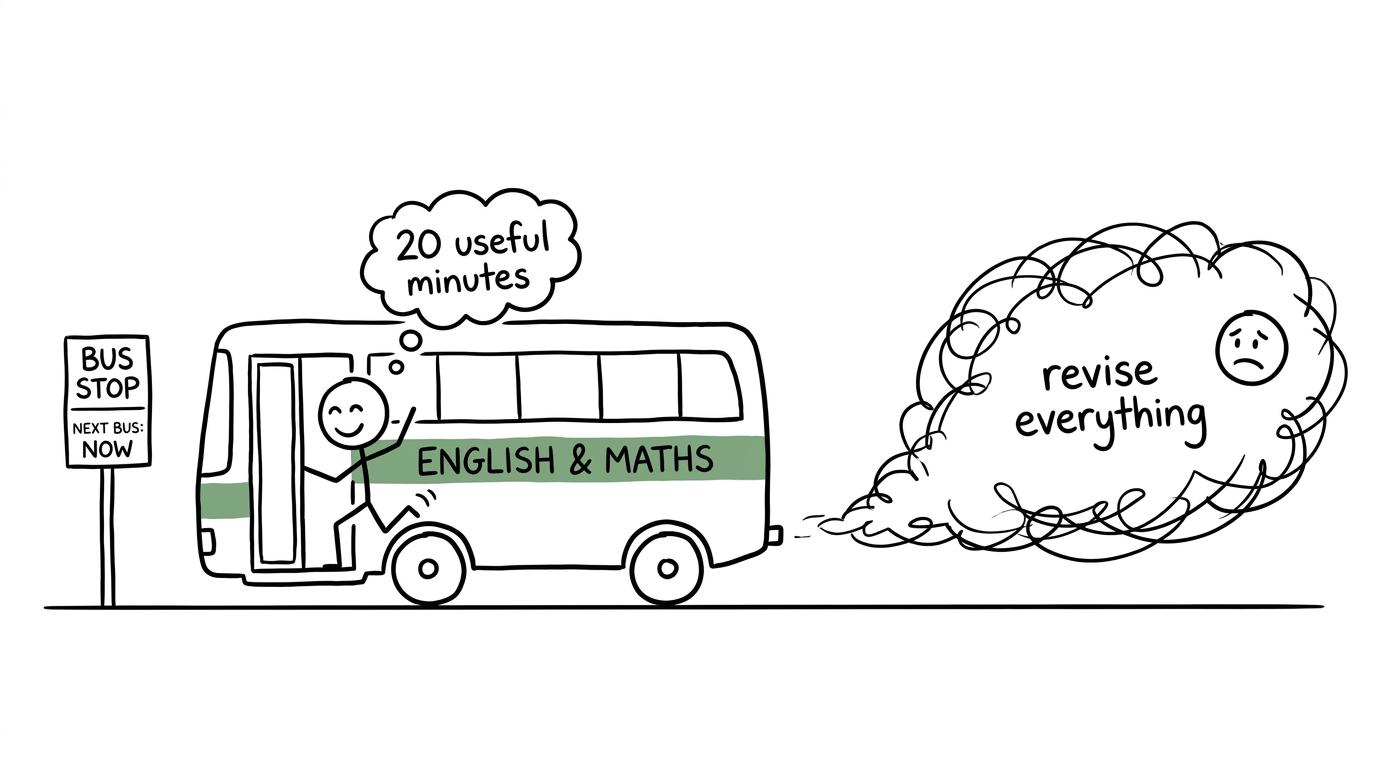 A focused revision task catches the bus while a vague revise-everything cloud misses it
How to test whether the club is working
Do not judge the club only by whether you enjoy it or feel busy. Review its effect after a few sessions.
Look for observable changes:
- Are your written interpretations more specific?
- Can you select evidence more efficiently?
- Do you explain effects instead of merely naming techniques?
- Are repeated weaknesses disappearing from teacher feedback?
- Can you complete tasks with less prompting?
- Is your maths revision still happening consistently?
Keep a short record of feedback and recurring errors. This is more useful than trying to predict progress from effort alone. If the same weakness remains, change what you do during or after the club: request targeted feedback, complete a short follow-up task or speak to your teacher about a better approach.
Use the same feedback loop in maths. Complete questions, mark them, classify the errors and return to the relevant lesson. MathsGenie's free maths revision platform brings together video solutions, practice resources and exam preparation so that revision leads to an identifiable next action.
As exams approach, predicted maths papers can add focused practice, but they should supplement rather than replace past papers and broad specification coverage. No predicted paper can guarantee which questions will appear.
When joining may not be the best choice
A club is optional support, not a requirement for success. It may be the wrong choice when:
- the sessions do not match your exam board or current needs;
- travel and meeting time disrupt essential revision disproportionately;
- you already receive effective discussion and feedback elsewhere;
- the environment makes it difficult for you to participate;
- you need individual support with a specific writing difficulty;
- your timetable is already unsustainable.
There are alternatives. You might arrange a small peer discussion, ask your teacher for a targeted task or use a short independent session to plan and write. The valuable element is deliberate practice with feedback, not membership itself.
Students moving towards post-161616 study should apply the same principle. MathsGenie's A Level maths revision resources support the next stage, but adding more commitments only helps when each has a clear purpose.
Common mistakes when choosing or using a club
Assuming attendance guarantees progress
Showing up creates an opportunity to practise. It does not guarantee that useful practice happens. Participate, write, seek feedback and complete any sensible follow-up.
Treating confident opinions as strong analysis
A forceful interpretation still needs textual support. Ask what evidence justifies the claim and whether the explanation addresses the question.
Memorising other people's interpretations
Borrowed ideas can sound impressive but become fragile when the wording of a question changes. Use discussion to understand how interpretations are built, not to collect paragraphs for reproduction.
Ignoring exam-board differences
AQA, Edexcel, OCR and Eduqas specifications are not interchangeable. Set texts, paper structures and assessment demands vary. Confirm what applies to your qualification rather than relying on generic advice.
Letting English consume the whole timetable
A productive English session can feel more satisfying than a difficult maths topic. That is exactly why balance must be planned. Continue to use topic practice, GCSE exam papers and mark schemes, and video solutions to keep maths weaknesses visible.
Counting hours instead of evaluating learning
Longer is not automatically better. Judge revision by what you can now retrieve, explain or apply without support. A focused meeting followed by a brief written response may achieve more than an evening of passive rereading.
Make the decision based on what you need
A GCSE English Language and Literature club can genuinely help your grade when it turns reading into discussion, discussion into writing and writing into better decisions. Its value does not come from the word club. It comes from structured practice, precise feedback and regular reflection.
Try it if the activities match your needs, then review the evidence. Stay if your analysis and writing are improving without destabilising the rest of your timetable. Change your approach if they are not.
Meanwhile, make maths revision equally deliberate. Start with MathsGenie's GCSE topic resources, complete practice questions, check your methods with video solutions and progress to past papers and predicted papers when appropriate. A balanced plan does not give every subject identical time. It gives each subject the right next task.