GCSE English Language and Literature Cross-Curricular Overlap
GCSE English language and literature cross-curricular overlap: learn which skills transfer to maths and other subjects, so you revise once and apply twice.
Revision can feel as if every subject lives in a separate folder. English has quotations. Science has practicals. History has evidence. Maths has equations. The folders look different, so it is natural to assume that every one demands a completely separate set of skills.
The honest answer to whether GCSE English language and literature cross-curricular overlap helps is yes, but only in particular ways. English will not teach you how to factorise a quadratic or calculate an angle. It can, however, make you better at reading questions precisely, organising multi-step reasoning, selecting evidence and explaining conclusions. Those abilities matter in maths and across the GCSE curriculum.
The goal is not to revise every subject at once. It is to identify transferable skills, practise them deliberately and avoid duplicating work that serves the same purpose.
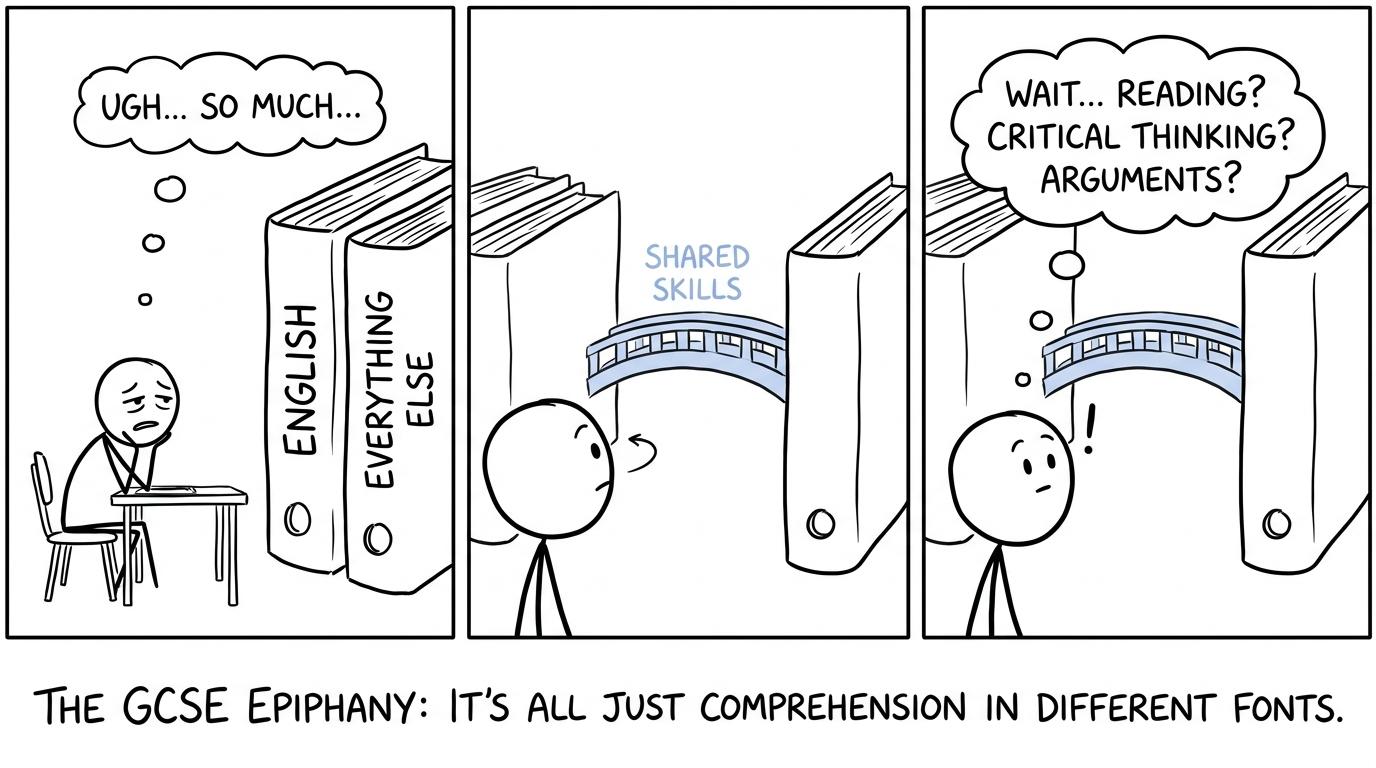 A student discovers a bridge of shared skills between revision folders
The quick overlap checklist
English revision is likely to support another subject when both tasks require you to:
- read unfamiliar material accurately;
- identify what a command word requires;
- distinguish relevant evidence from background detail;
- build a logical sequence;
- compare two sources, methods or results;
- explain rather than merely state;
- adapt an answer to its audience and purpose;
- check whether a conclusion is justified.
It does not replace subject knowledge. A beautifully structured maths answer with the wrong method remains wrong. A confident science explanation without accurate scientific ideas will not earn the available marks. Transferable skills strengthen knowledge; they do not substitute for it.
Where English Language genuinely overlaps
Official GCSE English Language subject content emphasises comprehension, critical reading, comparison, evaluation and clear communication. Those skills travel well because GCSE papers in many subjects ask students to process information before applying what they know.
Reading maths questions precisely
Maths is sometimes described as a subject without much reading. A modern GCSE paper quickly disproves that idea. Many questions include a context, conditions, data and a final instruction. The arithmetic may be manageable while the interpretation is not.
English Language reading habits can help you separate:
- the situation: what the question is about;
- the evidence: values, diagrams, tables or graphs;
- the constraint: words such as “integer”, “estimate” or “fully”;
- the task: what must actually be found, shown or compared.
This is particularly valuable in ratio, probability, statistics and multi-step problem solving. The topic knowledge still comes from focused maths revision, but careful reading helps you deploy it correctly. Use the GCSE maths revision hub to practise questions at the correct exam-board and tier level.
Understanding command words
English teaches you that “describe”, “explain”, “compare” and “evaluate” are not interchangeable. The same principle applies elsewhere, although each subject gives those words its own assessment meaning.
In maths, “show that” usually requires a convincing chain of working rather than an unsupported final value. “Estimate” signals that approximation is expected. “Give a reason” asks you to connect the result to a mathematical fact or property.
The useful transfer is the habit of pausing at the verb. The precise response must then come from the subject specification, classroom guidance and mark schemes for your board, whether that is Edexcel, AQA, OCR or Eduqas.
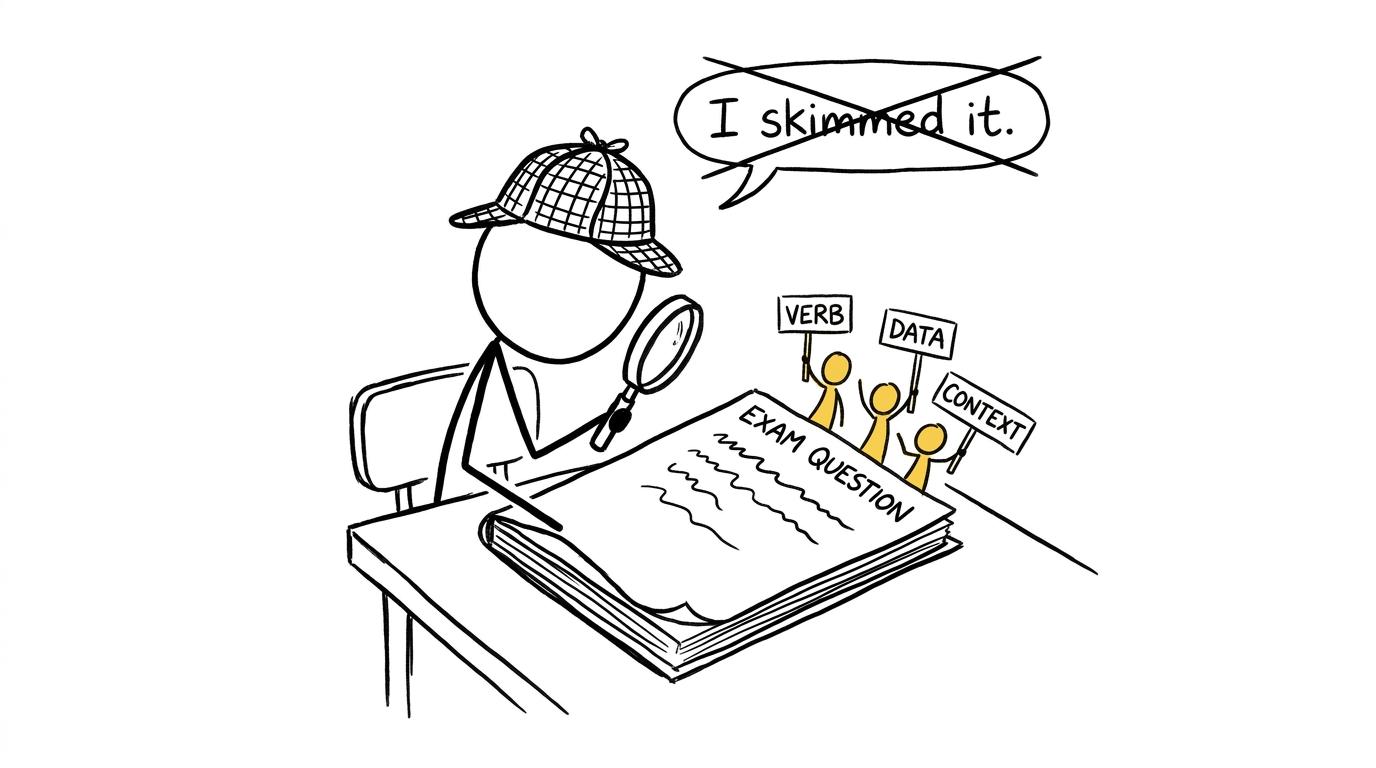 A student detective finds the verb, data and context hidden in an exam question
Building a clear argument
An English response often follows a simple intellectual pattern: make a point, support it with evidence and explain why the evidence matters. Mathematical reasoning has a related structure:
- state or imply the claim being established;
- show relevant calculations or deductions;
- connect each line logically;
- finish with a conclusion that answers the question.
This does not mean writing an essay in a maths exam. Concision matters. The overlap is structural: a reader should be able to follow why one step leads to the next.
Mark schemes reveal where method and accuracy are rewarded. MathsGenie’s past-paper platform places papers and mark schemes together, making it easier to compare your reasoning with what the examiner accepts.
Where English Literature overlaps
Literature has less direct content overlap with maths, but some of its thinking habits are surprisingly useful.
Evidence before assertion
In Literature, an interpretation becomes credible when it is supported by a relevant quotation or textual reference. In maths, a conclusion needs mathematical evidence: working, a construction, a graph, a calculation or a valid deduction.
Suppose a question asks whether a claim is correct. Writing “yes” is an assertion. Showing the reasoning turns it into an answer. Literature revision can reinforce the discipline of asking, “What evidence supports this?”
Following chains of cause and effect
Literary analysis examines how a writer’s choice creates an effect and contributes to a wider idea. Science, geography and history also rely on cause-and-effect chains. Maths uses them in a more formal way: if one relationship holds, what follows from it?
The transferable habit is refusing to jump from the opening statement to the conclusion. Every important link must be visible. That is especially helpful in proof, algebraic reasoning and longer geometry questions.
Considering alternative interpretations
Literature makes room for interpretations that are defensible rather than merely guessed. Maths normally aims at more tightly determined conclusions, but there are still moments when students must compare methods, challenge a statement or decide whether the available information is sufficient.
English Literature can develop intellectual caution: an answer should be supported, and a plausible idea is not automatically a proven one.
The strongest links with your other GCSE subjects
The overlap is not equally strong everywhere.
| Subject | Genuine English overlap | What still needs separate revision |
|---|---|---|
| Maths | Precise reading, logical sequencing, justification and concise conclusions | Formulae, techniques, fluency and subject-specific notation |
| Science | Interpreting unfamiliar information, explaining processes and evaluating evidence | Scientific knowledge, calculations and required practicals |
| History | Source analysis, argument, comparison and contextual judgement | Chronology, events, individuals and historical concepts |
| Geography | Extended responses, data interpretation and evaluation | Case studies, processes, fieldwork and geographical knowledge |
| Religious Studies | Structured argument, evidence and evaluation | Beliefs, teachings, practices and accurate references |
| Languages | Grammar awareness, audience, tone and editing | Vocabulary, pronunciation and language-specific grammar |
| Computer Science | Reading specifications, sequencing logic and explaining decisions | Programming, algorithms, systems and technical vocabulary |
The distinction matters. “I practised evaluation in English” may reduce the time needed to relearn the shape of an evaluative response in geography. It does not remove the need to know the relevant case study.
How to revise once and benefit twice
The best approach is to combine skills practice, not whole subjects.
Tag mistakes by topic and transferable skill
When marking a maths paper, record both what the question tested and why the mark disappeared. A useful error log might include:
- topic: probability;
- subject issue: did not know the method;
- transferable issue: overlooked a condition;
- next action: revise the method, then annotate the condition in similar questions.
This prevents every mistake being labelled “bad at maths”. Sometimes the missing piece is knowledge. Sometimes it is reading, organisation or checking.
You can find those patterns through GCSE past-paper practice or by following MathsGenie’s guide to finding your weakest GCSE topics.
Use one short routine across subjects
Before answering an extended or multi-step question:
- circle or underline the command word;
- identify the evidence or information provided;
- decide what form the response should take;
- complete the subject-specific thinking;
- check that the final line answers the original task.
That routine can support English, science, humanities and maths without pretending their content is identical. Repetition makes the process automatic, leaving more attention available for the difficult knowledge.
Build overlap into your revision timetable
Do not create two sessions called “reasoning skills”. Put the shared habit inside subject practice. During English revision, check that every interpretation has evidence. During maths revision, check that every conclusion has working.
A MathsGenie revision planner can help you protect separate time for mathematical content while avoiding a timetable full of vague, duplicated tasks. If you need a broader framework, use the GCSE maths revision timetable guide to balance topic learning with timed practice.
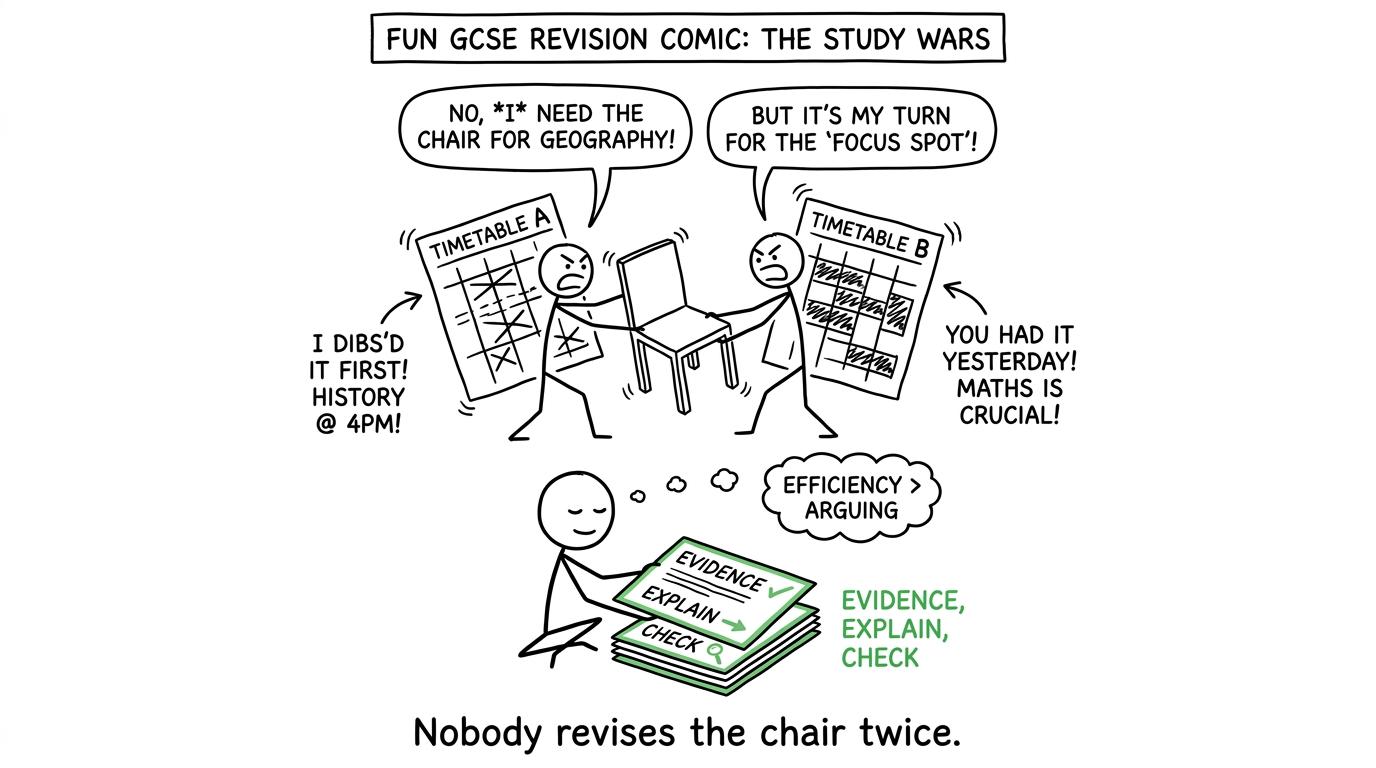 Revision timetables discover that nobody needs to revise the same chair twice
Common mistakes when using cross-curricular overlap
Treating transferable skills as transferable knowledge
Clear writing cannot replace a missing formula, quotation, scientific process or historical event. Use overlap to improve how you handle knowledge, not to avoid learning it.
Writing too much in maths
English encourages developed prose, but maths rewards relevant communication. Use correct notation, show sufficient working and write a brief conclusion where needed. Extra paragraphs can hide the method rather than clarify it.
Assuming command words mean exactly the same thing
“Evaluate” in English Language, science and geography may lead to different kinds of evidence and judgement. Learn how your exam board uses the term in each subject.
Re-reading instead of practising
Spotting overlap is useful only if it changes what you do. Complete questions, mark them and correct the precise weakness. For Edexcel students, GCSE maths past papers with mark schemes provide realistic practice; students on other boards can choose the relevant route from the main revision hub.
Duplicating generic revision sessions
A session called “improve analysis” is difficult to measure. Replace it with an observable action, such as selecting evidence in an English response or justifying each stage of a maths solution.
Make overlap serve the subject
Cross-curricular revision works best when it is modest. English Language can sharpen the way you read. Literature can strengthen your respect for evidence. Maths can improve logical precision, while science and humanities give those habits new settings in which to operate.
But the final step must always be subject-specific practice. Open the MathsGenie GCSE maths revision area, choose your board and foundation or higher tier, then move from revision lessons to practice questions. Use mini tests to check recall, past papers to build exam stamina and predicted papers for additional unseen practice. Mark every attempt with the mark scheme and use video solutions when the reasoning is unclear.
You do not need to revise the same skill twice. You need to recognise it once, then practise applying it wherever marks depend on it.