GCSE Engineering Weekend Revision Routine
GCSE engineering weekend revision plan for maths: build a focused Saturday and Sunday routine using timed papers, targeted practice and proper rest.
The final weekends before a GCSE maths exam can feel strangely unstructured. You know the exam is close. You know there is plenty you could revise. Yet deciding what to do first can consume the very time you meant to use.
A strong GCSE engineering weekend revision routine solves that problem by treating the weekend as a system. Here, engineering means designing a reliable process for GCSE maths: diagnose weaknesses, repair them with focused practice, test the repairs under pressure and leave enough time to recover.
You do not need to spend every waking hour at a desk. You need a weekend in which each session has a clear job.
Your weekend revision checklist
Before looking at the detailed timetable, make sure your plan contains these parts:
- One paper or substantial timed section matching your exam board and tier
- Honest marking with the official mark scheme
- A short list of the topics costing you marks
- Focused revision lessons and practice questions for those topics
- A second attempt that checks whether the repair worked
- Proper breaks, food, movement and sleep
- An equipment check before Sunday evening
Start from the GCSE Maths Revision Hub so that your lessons, questions, mini tests and papers remain connected. Random worksheets can make you busy. A connected revision loop makes you better.
Why engineering the weekend works
A weak revision plan measures effort by hours. A better one measures what changes.
Imagine finishing Sunday with three completed papers but no idea why marks were lost. That feels productive because a lot of pages have been filled. Yet the same misunderstandings may simply travel from one paper to the next.
The useful loop is:
attempt→mark→diagnose→repair→retest\text{attempt} \rightarrow \text{mark} \rightarrow \text{diagnose} \rightarrow \text{repair} \rightarrow \text{retest}attempt→mark→diagnose→repair→retestEach stage produces the information needed for the next. The timed attempt reveals what happens without support. The mark scheme identifies the gap. Topic practice strengthens the method. Retesting tells you whether the improvement is real.
MathsGenie's guide to using GCSE mark schemes to improve is particularly useful if you tend to check only the final answers. GCSE mark schemes may reward correct intermediate methods, so showing clear working can matter even when an arithmetic slip affects the final result.
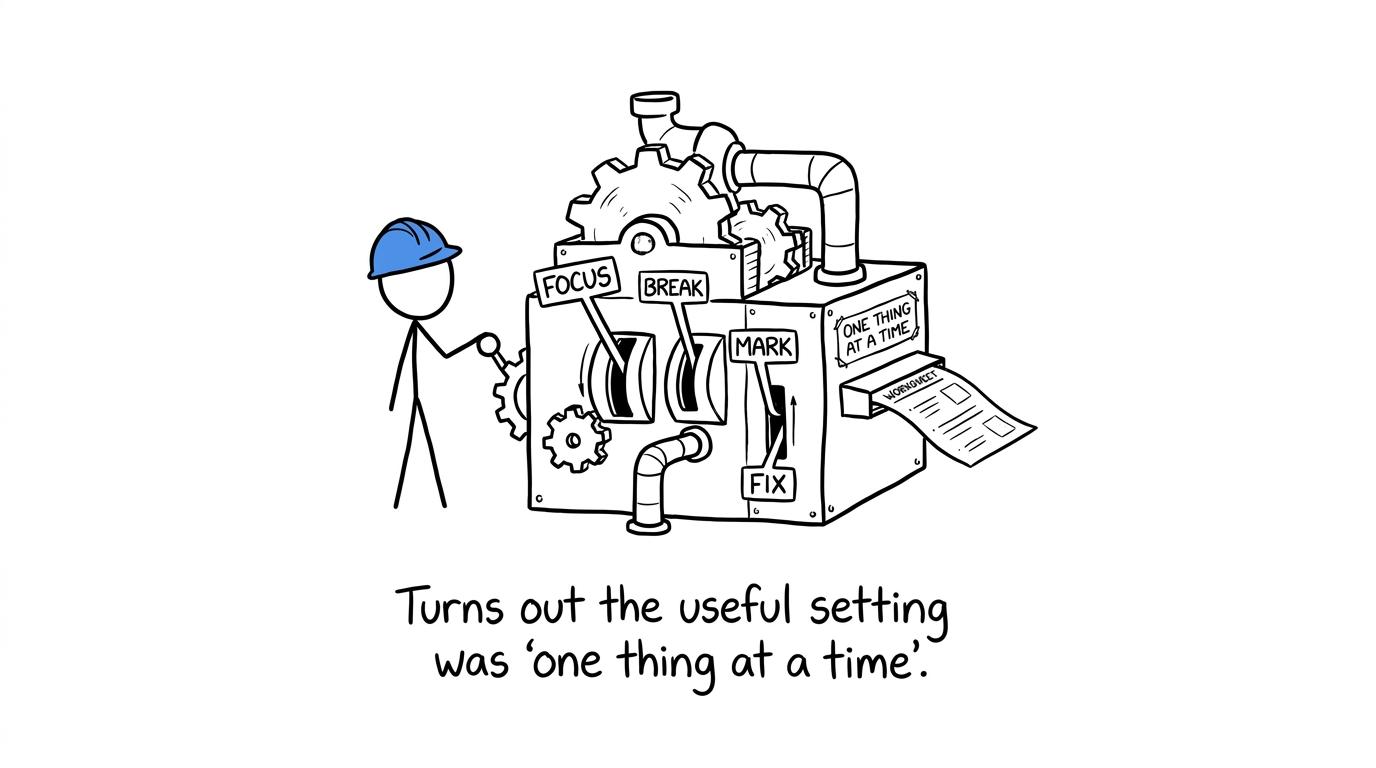 A student discovers that the best revision machine does one useful task at a time
Saturday morning: build an honest diagnosis
Begin when you are reasonably alert. Do not spend the first hour making an elaborate timetable or rewriting notes. Sit a timed paper, a half-paper or a mixed mini test.
Choose material that matches:
- Your exam board: Edexcel, AQA, OCR or Eduqas
- Your confirmed foundation or higher tier entry
- The calculator conditions of the paper you are practising
- The time you can realistically protect that morning
MathsGenie organises Edexcel GCSE Maths past papers, AQA GCSE Maths past papers and OCR GCSE Maths past papers by series. If a full paper would leave no time for review, use a shorter section or an Edexcel GCSE Maths mini test.
Recreate useful exam conditions
Work somewhere quiet. Put away notes and pause notifications. Follow the calculator instruction printed on the paper, and use the formula sheet that applies to your exam series where appropriate.
For GCSE Mathematics exams in 202620262026, official exam-board guidance confirms that formula sheets are supplied with the papers, with separate foundation and higher versions. That does not remove the need to recognise which formula applies, substitute accurately or show a valid method. Check the latest arrangements for your own series with your school and exam board rather than assuming that a previous paper has identical materials.
Do not stop whenever a question becomes uncomfortable. Practising how to move on and return later is part of exam preparation.
Saturday afternoon: turn lost marks into a repair list
After a proper break, mark the work carefully. Use a different-coloured pen and award marks according to the scheme rather than according to what you intended to write.
For every lost mark, assign one cause:
- Knowledge: you did not know the relevant fact or method
- Method: you chose an unsuitable process or could not complete it
- Accuracy: the approach was sound, but arithmetic, signs or rounding failed
- Interpretation: you misunderstood the wording, diagram or required form
- Timing: you could probably answer it, but did not reach or finish it
- Communication: your reasoning was not shown clearly enough
Now create a marks-leak list. Use precise descriptions such as “rearranging formulae when the unknown appears in a denominator” rather than writing “algebra”. Precision makes the next action obvious.
Choose at most three priorities. The full GCSE maths topic list by board and tier can help you name each weakness accurately and avoid revising higher-only content if you are taking foundation tier.
Repair one topic at a time
For each priority:
- Use a short MathsGenie revision lesson to recover the method
- Write a compact method checklist in your own words
- Complete focused practice questions without copying solutions
- Mark the questions immediately
- Correct the first point at which your reasoning went wrong
The goal is not to become perfect at every topic in one afternoon. It is to make a small number of weaknesses less likely to cost you marks in the next paper.
A practical Saturday timetable
Adapt the start time, but preserve the order.
| Time | Session | Purpose |
|---|---|---|
| 09:3009{:}3009:30-09:4509{:}4509:45 | Set up | Select the correct board, tier and paper conditions |
| 09:4509{:}4509:45-11:1511{:}1511:15 | Timed practice | Build stamina and expose genuine gaps |
| 11:1511{:}1511:15-11:4511{:}4511:45 | Break | Eat, move and step away from the paper |
| 11:4511{:}4511:45-12:3012{:}3012:30 | Marking | Score strictly and classify lost marks |
| 14:0014{:}0014:00-14:4514{:}4514:45 | Repair block | Relearn the highest-priority topic |
| 15:0015{:}0015:00-15:4515{:}4515:45 | Practice block | Answer targeted exam questions |
| 16:0016{:}0016:00-16:2016{:}2016:20 | Review | Record corrections and choose Sunday’s retest |
A student with less time could use a 454545-minute paper section and one repair block. Quality matters more than making the schedule look impressive.
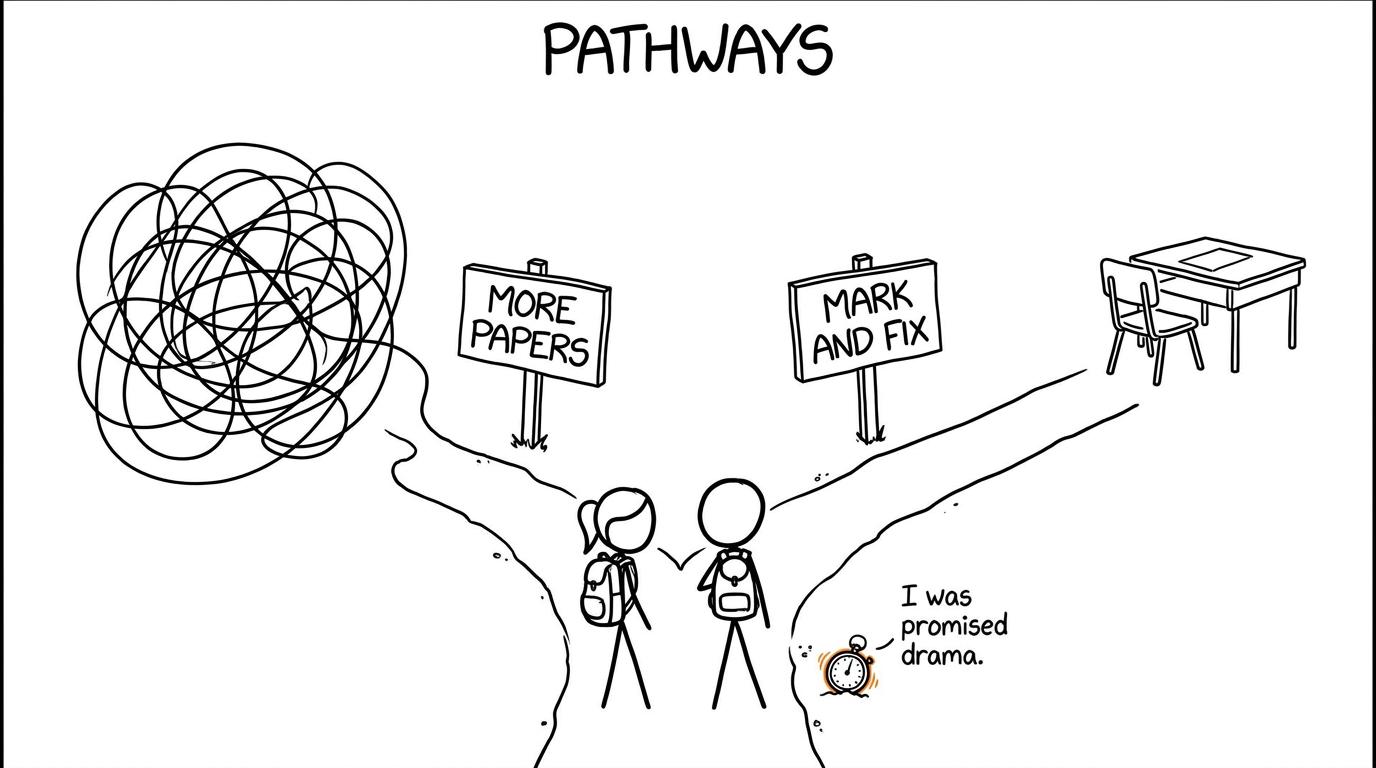 Two revision routes show that marking and fixing beats endlessly collecting papers
Sunday morning: retest instead of rereading
Sunday should answer a simple question: did Saturday's repair hold?
Begin with a closed-book retrieval session. Write down key steps, facts or formula choices connected to Saturday's priorities. Then complete fresh questions on the same skills. Avoid repeating an answer you can remember line by line; you need to recognise the method in a new setting.
If the same error returns, compare your new attempt with the corrected one and locate the first mismatch. That first mismatch is often more useful than staring at the final answer.
Once the targeted retest is complete, add a short mixed set. Mixing topics forces you to decide which technique applies, which is closer to the experience of a real GCSE paper.
Sunday afternoon: sharpen exam decisions
Use the final substantial session for exam technique rather than another exhausting full paper.
Practise these decisions:
- Which questions should you answer first?
- When should you leave a difficult question and return?
- Have you written enough working to make the method visible?
- Does the answer have the correct units and degree of accuracy?
- Is the result reasonable in the context?
- Have you checked both possible solutions where the question requires them?
Predicted papers can provide fresh exam-style practice in the final weeks, but they should supplement past papers rather than replace them. MathsGenie's Edexcel GCSE Maths predicted papers include mark schemes and worked solutions where available. Use them as a pressure test, not as a promise about the exact questions that will appear.
Finish by planning your next weekday session from the remaining marks-leak list. This gives Monday a starting point and prevents the weekend's learning from fading into a pile of corrected paper.
Protect energy as carefully as revision time
A weekend plan should include stopping points. Attention usually declines before students admit it, and tired marking becomes generous, rushed or careless.
Use breaks away from the screen and desk. Eat normally. Keep the evening lighter than the main daytime sessions. A late-night paper that damages sleep may leave you less capable of recalling and applying what you revised.
The principle is simple:
useful revision=focused practice+honest feedback+recovery\text{useful revision} = \text{focused practice} + \text{honest feedback} + \text{recovery}useful revision=focused practice+honest feedback+recoveryRecovery is not time stolen from revision. It is part of the system that makes the next session possible.
Check your exam equipment on Sunday
Remove avoidable uncertainty before the week begins. Check the instructions provided by your school and the front of the relevant paper.
Your preparation may include black pens, pencils, a ruler, protractor, compasses, eraser and a compliant calculator when one is permitted. Current JCQ rules state that the question paper tells candidates whether calculators are allowed. Where one is allowed, it must not provide prohibited facilities such as symbolic algebra manipulation or communication with other devices or the internet. Stored information must be cleared, and covers containing printed formulae or instructions must be removed.
Phones, watches and earbuds are not revision equipment for the exam room. Follow your centre's instructions about where personal devices must be left.
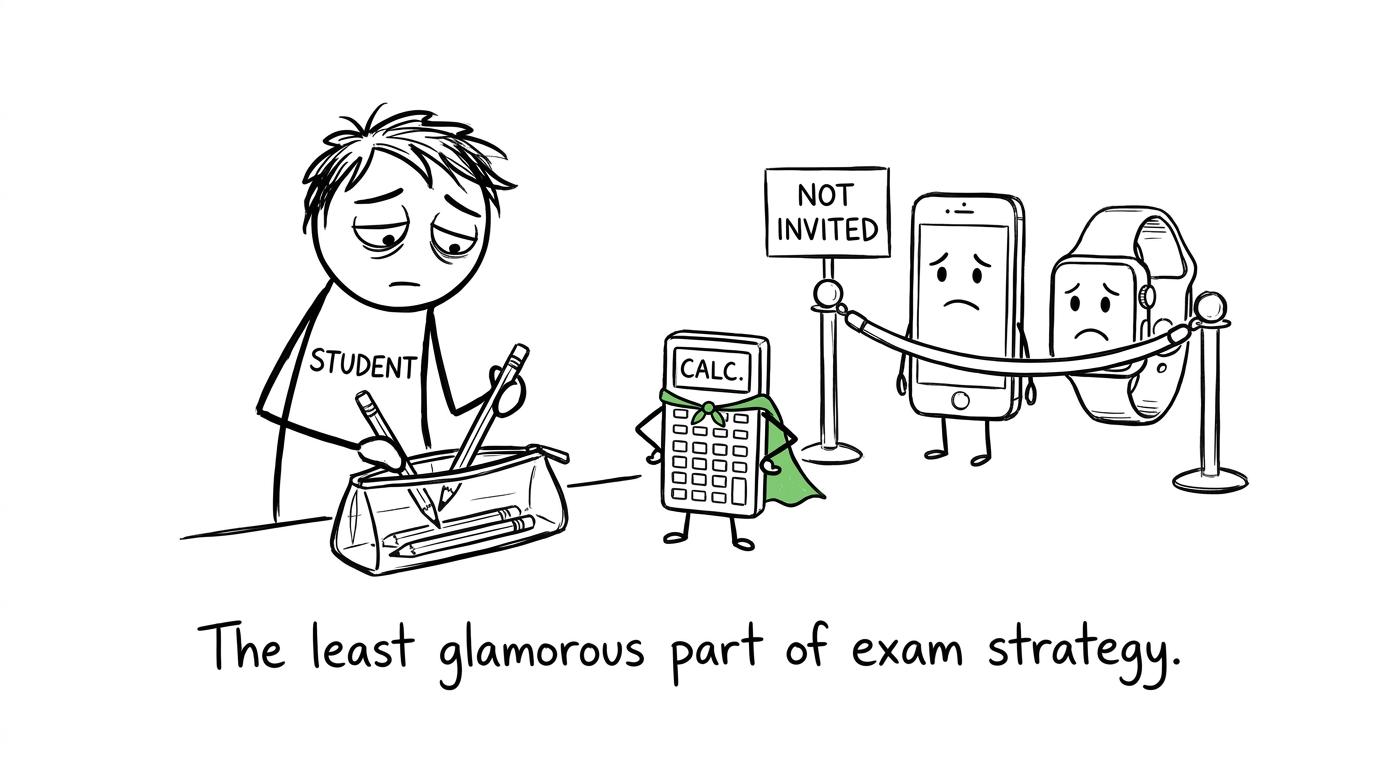 A calculator joins the exam team while a phone and smartwatch remain behind the rope
Common weekend revision mistakes
Starting with favourite topics
Comfortable questions create confidence but reveal little. Begin with timed mixed work, then let lost marks determine the topics you revise.
Completing papers without reviewing them
The review is where a paper becomes useful. Reserve at least a substantial separate block for marking, diagnosis and correction.
Revising every weakness at once
A long list creates shallow attention. Choose the few weaknesses responsible for repeated losses and repair them properly.
Watching solutions before attempting questions
A solution can feel familiar without becoming retrievable. Commit to an answer first, then use the mark scheme or video solution to locate the gap.
Treating predicted papers as forecasts
Predicted papers are useful sources of fresh, specification-informed practice. They cannot guarantee what will appear. Maintain broad coverage across number, algebra, ratio and proportion, geometry and measures, probability and statistics.
Ignoring the correct tier or paper conditions
Foundation and higher papers target different grade ranges and demands. A calculator paper also trains different habits from a non-calculator paper. Confirm your entry rather than guessing.
Revising until sleep is sacrificed
More time is not automatically more learning. Set a finishing time, pack your equipment and let the weekend end.
Build a weekend you can repeat
The best GCSE engineering weekend revision routine is not heroic. It is repeatable. Saturday reveals the weaknesses. Saturday afternoon repairs them. Sunday tests the repair and sharpens exam decisions. Then you stop, recover and carry the remaining priorities into the week.
MathsGenie gives you the whole loop in one free place: revision lessons for understanding, practice questions for accuracy, mini tests for retrieval, past papers for timing, and predicted papers for fresh exam-style practice. Mark schemes and video solutions help you see not only whether an answer is wrong, but where the method changed direction.
Open the MathsGenie GCSE Maths Revision Hub, choose your exam board and tier, and select one timed task for Saturday morning. Do not try to conquer the entire specification this weekend. Engineer one honest attempt, one careful repair and one meaningful retest.