GCSE Engineering Group Chat Study Tips That Work
GCSE engineering group chat study tips that turn messages into focused maths revision through clear roles, short sessions, checking and safe boundaries.
A class chat can become busy precisely when revision needs to become calm. One person asks about density, three memes arrive, somebody posts an unexplained answer, and the original question disappears up the screen.
Effective GCSE engineering group chat study works differently. Give each session one mathematical focus, attempt questions independently, share methods rather than answers, check units and use mistakes to choose the next task. Keep the chat small, timed and tied to reliable resources.
That matters because GCSE Engineering draws on mathematical skills including ratio, percentages, standard form, trigonometry, Pythagoras, formula rearrangement, graphs, area, volume and unit conversion. These skills also strengthen your GCSE Maths preparation. The chat should not replace individual practice. It should make that practice more focused.
The quick group chat revision checklist
Before the first session, agree that your chat will have:
- one topic and one finish time for each session
- a short independent attempt before discussion
- working and reasoning, not answer-only messages
- named roles such as organiser, explainer and checker
- one shared error log
- links to trusted revision material rather than random screenshots
- clear rules about privacy, respect and notification times
- a final mini test or individual question set
The principle is simple: the chat creates feedback, but each student still does the thinking.
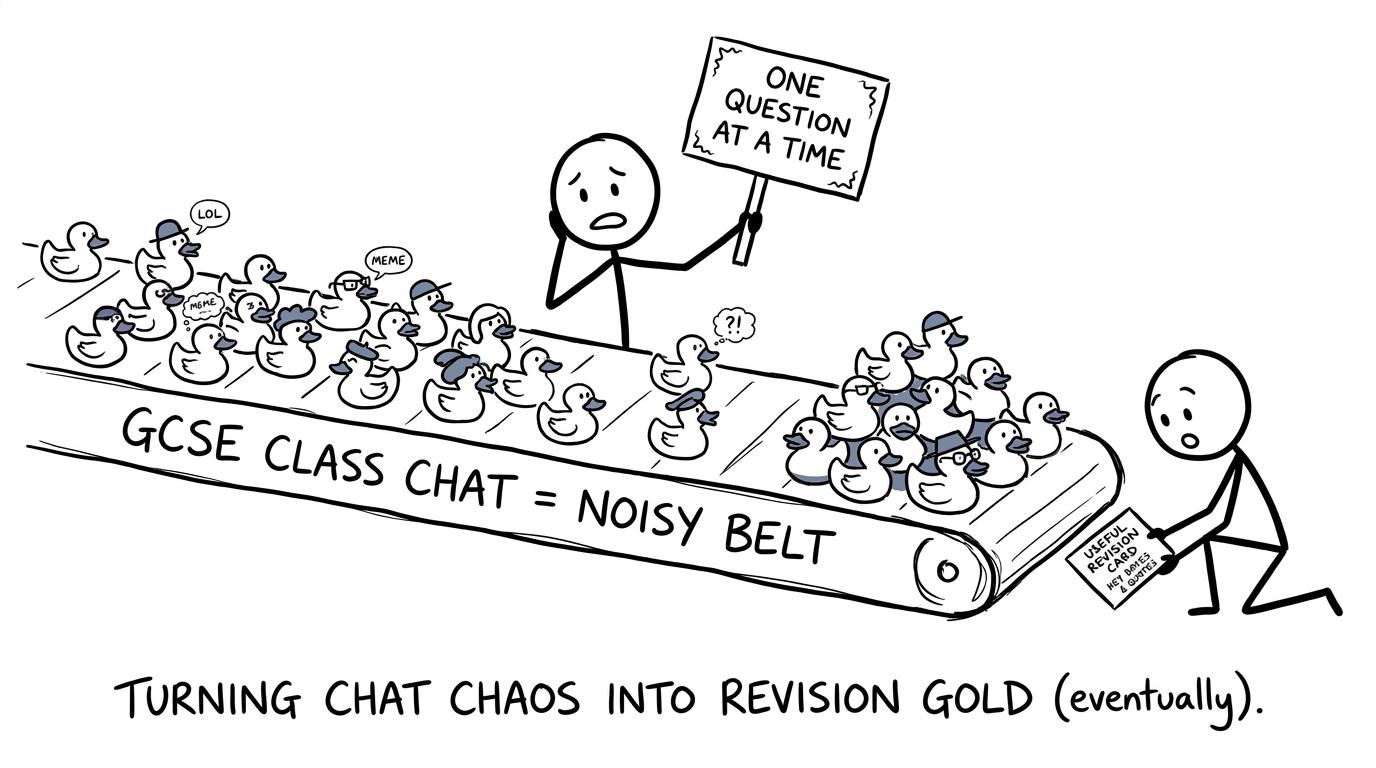 A chaotic meme conveyor belt being turned into focused revision
Begin with one engineering maths target
A vague message such as Shall we revise engineering? creates vague activity. Choose a target that can be completed and checked, such as:
- converting engineering units accurately
- substituting into density and pressure formulae
- calculating area and volume
- rearranging equations
- interpreting experimental graphs
- using ratio, percentages or standard form
- checking significant figures
These are not decorative bits of arithmetic added to engineering. They are part of the mathematical understanding expected in GCSE Engineering and frequently overlap with GCSE Maths.
If units are causing trouble, begin with MathsGenie’s Conversions and Units revision resources. For engineering relationships involving density, MathsGenie’s Speed and Density revision guide reinforces the underlying structure:
density=massvolume.\text{density}=\frac{\text{mass}}{\text{volume}}.density=volumemass.The group’s target should describe an action. Understand density is difficult to measure. Complete six density questions, explain one method and record every unit error is visible and useful.
Use a message format that makes thinking visible
Fast chats encourage fast answers. Unfortunately, an answer without a method tells the group almost nothing. It could be correct reasoning, a calculator slip or a copied result.
Agree on a simple format for mathematical posts:
- Given: the values and units supplied
- Need: the quantity the question asks for
- Method: the formula or mathematical idea
- Check: units, rounding and whether the result is sensible
For example, a useful method post might identify that pressure is calculated using
P=FA,P=\frac{F}{A},P=AF,then explain which quantities must use compatible units. It does not need to complete somebody else’s question. The aim is to expose the decision behind the calculation.
This also improves communication in a maths exam. Clear substitutions and intermediate steps can make your reasoning easier to follow and may provide access to method marks where the mark scheme allows them.
Attempt first, discuss second
The most important group-chat rule is also the easiest to break: everyone attempts the task before opening the discussion.
Without that pause, the quickest student becomes the group’s answer service. Everyone else experiences recognition rather than recall. A solution may look obvious once it is visible, but that feeling is not evidence that you could produce it in an exam.
Use this routine:
- Post the topic and resource.
- Mute the chat for 101010 to 151515 minutes.
- Complete the same short set independently.
- Reopen the chat and compare methods.
- Identify disagreements before looking at solutions.
- Check against the mark scheme or video solution.
- Retest individually on a fresh question.
MathsGenie’s Edexcel GCSE Maths mini tests are useful when the group needs a short, bounded task. Students following another board should still use resources that match their own Edexcel, AQA, OCR or Eduqas specification and tier.
Give people roles instead of letting volume win
In an unstructured chat, the most frequent poster can accidentally control the session. Roles distribute the work more intelligently.
The organiser
The organiser chooses one topic, posts the correct resource and states when the discussion ends. This role prevents a session on formulae from drifting into simultaneous conversations about vectors, homework and lunch.
The explainer
The explainer describes why a method works without simply dropping the final answer. This role should rotate. Explaining an idea can reveal gaps that silent reading hides.
The checker
The checker looks for unit mismatches, premature rounding, incorrect substitutions and missing working. For a volume calculation, for example, the checker should notice that a length conversion affects three dimensions. A linear conversion factor of kkk produces a volume factor of k3k^3k3.
MathsGenie’s Similar Shapes: Area and Volume guide can help when scale factors are part of the confusion.
The sceptic
The sceptic asks calm questions: Why that formula? Are the units compatible? Should the answer be larger or smaller? This is not about catching people out. Engineering depends on checking assumptions, and good maths revision does too.
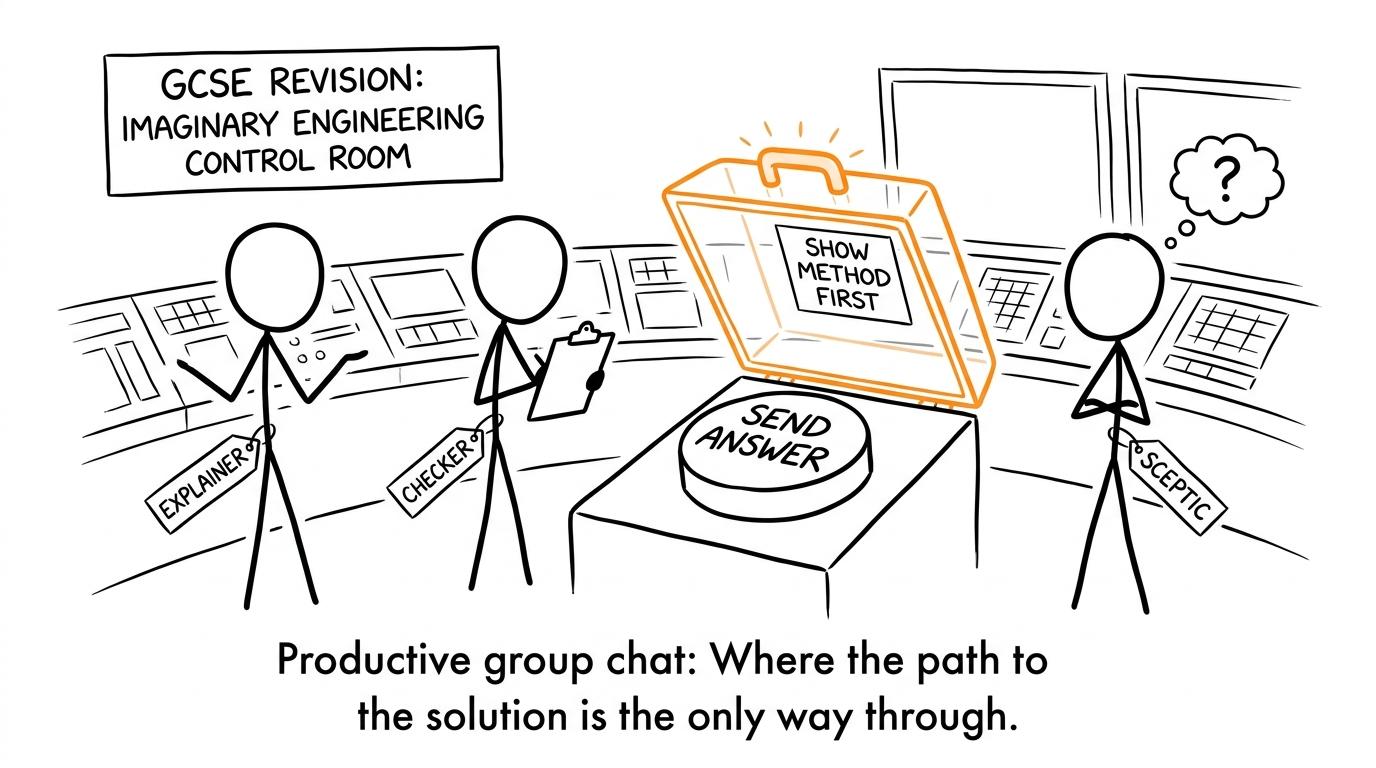 The explainer, checker and sceptic protect the send-answer button
Build a shared formula and error system
A giant folder of screenshots soon becomes another thing nobody uses. Keep two small shared documents instead.
The first is a formula sheet organised by purpose. It might include relationships such as
A=πr2,A=\pi r^2,A=πr2, V=cross-sectional area×length,V=\text{cross-sectional area}\times\text{length},V=cross-sectional area×length,and
ρ=mV.\rho=\frac{m}{V}.ρ=Vm.For every formula, record the meaning of each symbol and the expected units. Check the required formulae against your teacher’s guidance and current exam-board specification rather than assuming every online list applies to your course.
The second document is an error log. Use four headings:
| Question or topic | What went wrong | Correct rule | Retest date |
|---|---|---|---|
| Unit conversion | Mixed incompatible units | Convert before substitution | Next session |
| Formula rearrangement | Changed only one side | Apply the same operation to both sides | Next session |
Keep entries specific. Bad at algebra is not actionable. I do not isolate the squared variable before taking the square root tells you exactly what to practise.
When rearrangement is the issue, use MathsGenie’s Rearranging Harder Formulae guide. Then return to the engineering context and test whether the algebra survives when symbols represent physical quantities.
Turn chat discussions into exam practice
Conversation can clarify an idea, but marks come from answering questions independently under the conditions of your paper. Every group session therefore needs an exit task.
A strong sequence is:
- learn or recall one method
- attempt questions alone
- discuss differences
- check using a mark scheme
- record precise mistakes
- complete a fresh question without chat support
As exams approach, move from topic sets to timed paper sections and then complete papers. MathsGenie explains this process in How to Use GCSE Past Papers Properly. The valuable part is not merely finishing a paper. It is marking, diagnosing, repairing and retesting.
You can also use GCSE Maths predicted papers as additional exam-style practice where they match your board and tier. Predicted papers should complement official past papers, not replace them.
When the group disagrees about how marks are awarded, consult the scheme rather than holding a vote. The MathsGenie guide to using GCSE mark schemes explains how to turn lost marks into specific revision tasks.
Set boundaries that protect attention and people
A revision chat should have opening hours. Constant notifications fragment attention and can make an optional revision tool feel compulsory. Agree that messages stop at a sensible time and that nobody is expected to reply immediately.
Keep the group to classmates you know, follow your school’s rules, and avoid sharing personal information, live locations, passwords or private images. Ask before adding anyone or reposting their work. If messages become threatening, discriminatory, sexual, harassing or otherwise unsafe, do not handle the problem as a revision dispute. Save relevant evidence, use the platform’s reporting tools and speak promptly to a trusted adult or your school’s safeguarding staff.
Academic boundaries matter too. Do not circulate leaked assessment material, submit somebody else’s work or use the group to complete controlled or non-exam assessment dishonestly. Collaboration should help everyone understand their own work.
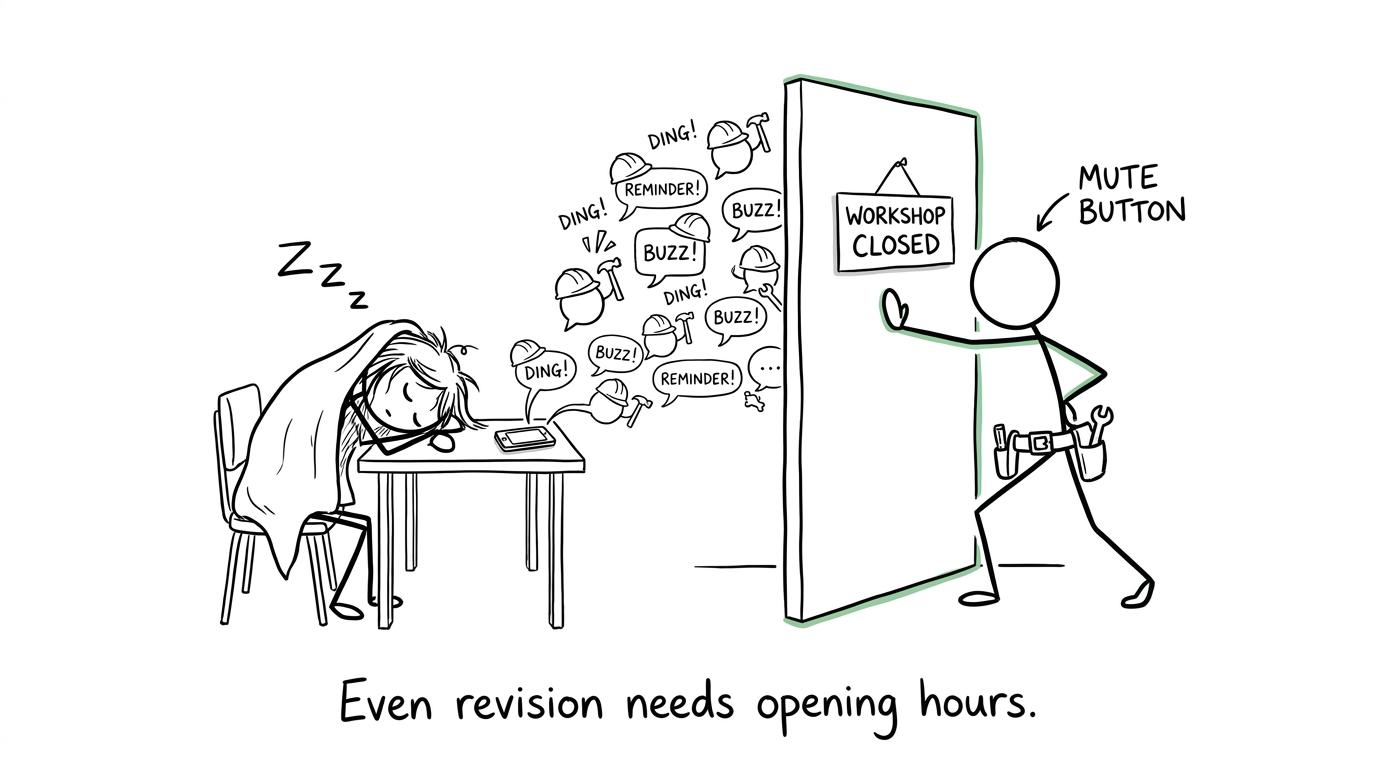 A heroic mute button protects a sleeping student from late notifications
Common group chat revision mistakes
Posting only final answers
This creates speed without understanding. Require a formula, method or explanation before comparing final results.
Discussing before attempting
Once the method appears on screen, independent recall becomes impossible. Use a silent attempt period first.
Revising too many topics at once
A chat containing density, trigonometry and graph interpretation becomes difficult to follow. Keep one thread or session for one target.
Trusting the most confident message
Confidence is not verification. Check solutions against an appropriate mark scheme, teacher guidance or a reliable revision resource.
Ignoring units and rounding
Engineering calculations depend on quantities as well as numbers. Convert units before substitution, retain sufficient calculator accuracy and round only as the question requires.
Letting chat replace written practice
Reading explanations is not the same as producing a solution. Finish every session with independent written questions.
Leaving mistakes in the message history
Useful corrections vanish quickly in a busy thread. Transfer each recurring mistake into the shared error log and schedule a retest.
Make the chat a workshop, not a waiting room
The best group chat does not make revision effortless. It makes effort better directed. It gives uncertainty somewhere to go, makes methods visible and turns mistakes into the next practical task.
Start with one session this week: choose one engineering-related maths skill, work independently for a fixed period, compare reasoning, check the result and finish with an individual retest. Then build the next session from the errors you found.
Use MathsGenie’s free GCSE and A Level maths revision resources as your shared base. Revision lessons can rebuild a weak method; practice questions and mini tests can test it; mark schemes and video solutions can settle uncertainty; and past papers and predicted papers can prepare you for exam conditions. Let the chat organise the conversation. Let MathsGenie organise the revision.