

GCSE Design and Technology Christmas Revision Plan
GCSE design and technology Christmas holiday revision: build a realistic plan, protect your break, and keep maths skills sharp for the written exam too.
Christmas revision has a habit of expanding. A short list becomes a timetable; the timetable fills every morning; suddenly the holiday feels like another term with better food.
A reasonable amount of GCSE design and technology Christmas holiday revision is usually around 444 to 666 focused hours across the whole break. That might mean 666 to 888 sessions lasting 353535 to 454545 minutes, with several complete days off. This is not an official requirement. It is a practical starting point that should be adjusted for your mock results, school deadlines and teacher guidance.
The aim is not to finish the course by January. It is to return knowing your weakest areas, remembering the important technical principles and feeling more comfortable with the calculations that can appear in the written paper.
A reasonable Christmas revision checklist
A balanced plan should include:
- one short audit of your current strengths and weaknesses;
- two or three sessions on technical knowledge;
- one session on designing and making principles;
- one session on applied maths and science;
- one timed set of exam questions;
- time to mark, correct and revisit mistakes;
- several days containing no formal revision at all.
If your school has set specific Design and Technology work, place that into the plan first. Do not add 666 extra hours on top simply because a generic timetable says you should.
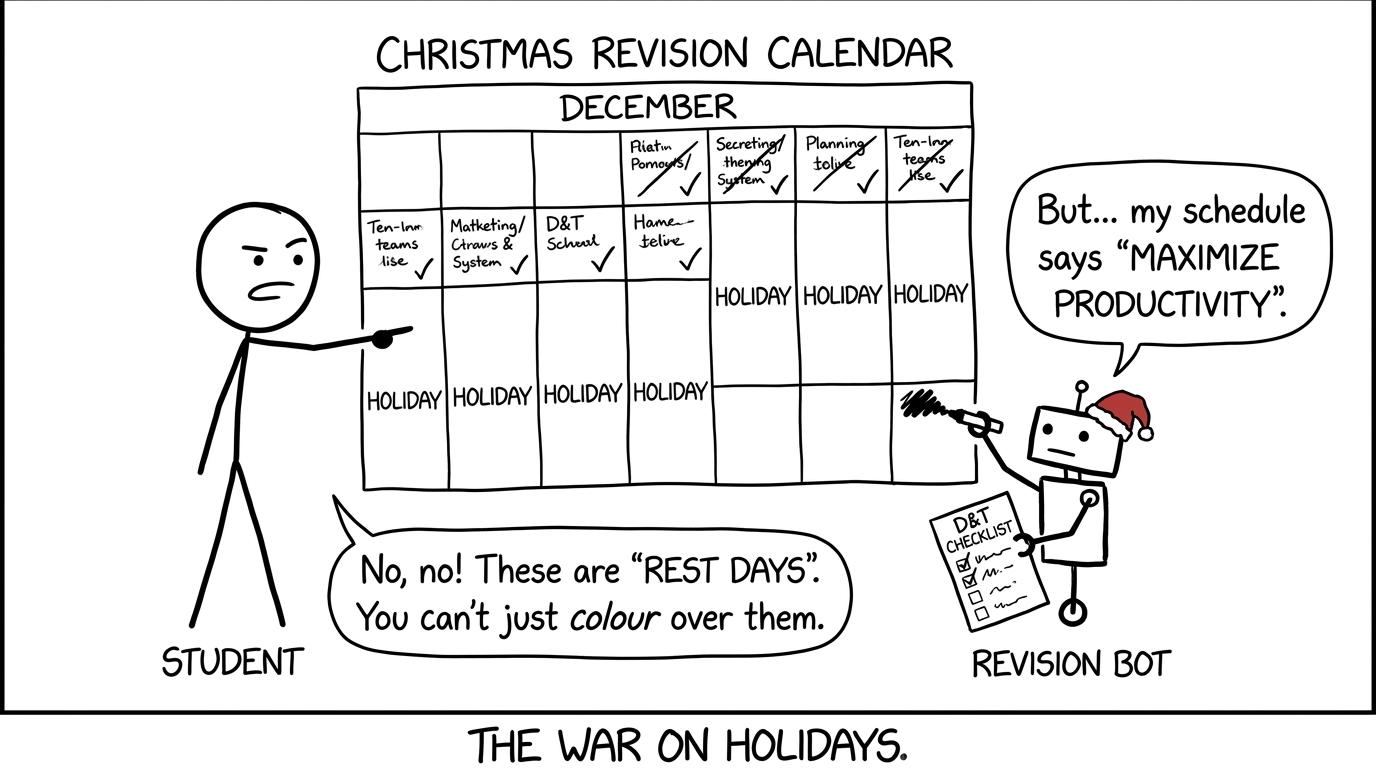 A student protects rest days from an overenthusiastic revision robot
Why a small, focused plan is enough
Christmas sits at an awkward point in Year 111111. You know enough to recognise how much remains, but the final exams are still months away. This can make every subject feel urgent.
Urgency is not the same as priority.
For the main AQA, Pearson Edexcel, OCR and Eduqas GCSE Design and Technology specifications, the written examination contributes 50%50\%50% of the qualification and non-exam assessment contributes the other 50%50\%50%. The exact paper structure and timing vary, so check your own exam board specification rather than borrowing a friend's revision list.
The written assessment covers technical principles and designing and making principles. It can also ask you to analyse products, justify decisions, consider wider issues and apply mathematical or scientific knowledge. Across these specifications, at least 15%15\%15% of the written examination assesses mathematical skills in a Design and Technology context.
That is why focused preparation beats hours of copying. You need to retrieve knowledge, apply it and explain decisions clearly. A beautiful page of notes may feel productive while revealing very little about what you can recall without help.
How to build your holiday plan
Begin with a twenty-minute audit
Divide a page into three columns:
- Secure: topics you can explain and apply without notes;
- Uncertain: topics you partly recognise but cannot use confidently;
- Weak: topics you avoid or regularly answer incorrectly.
Use your latest assessment, class feedback and specification checklist. Keep the categories specific. “Materials” is too broad; “properties and uses of thermosetting polymers” gives you something you can actually revise.
Choose no more than four priorities. The purpose of an audit is to reduce the plan, not produce an inventory of the entire course.
Use short sessions with one outcome
A session should have a visible finish line. For example, you might aim to recall the properties of a material group, compare production methods or complete and mark a small set of calculation questions.
A workable session could contain:
- 555 minutes of retrieval from memory;
- 202020 to 252525 minutes of focused revision;
- 101010 minutes of exam questions;
- 555 minutes of marking and recording errors.
The structure matters more than the precise duration. Stop when the planned task is complete. Revision becomes exhausting when every session quietly turns into “continue until I feel clever enough”.
Spread the work across the break
If you plan 888 sessions of 404040 minutes, your total is:
8×40=320 minutes8 \times 40 = 320\text{ minutes}8×40=320 minutesThat is 555 hours and 202020 minutes across the holiday. Spread over roughly two weeks, it leaves plenty of room for family plans, sleep, exercise and genuinely unstructured time.
Try alternating subjects rather than giving an entire day to Design and Technology. A short D&T session followed later by a different subject usually feels more manageable than a three-hour block.
What should GCSE D&T revision cover?
Core technical knowledge
Prioritise the content named by your exam board. Depending on the specification, this may include material properties, energy, systems, new and emerging technologies, sustainability, manufacturing methods and the impact of design decisions.
Use active recall. Close the book and explain a process, compare two materials or list the factors that influence selection. Then check what was missing.
Your specialist material area also needs attention. Pearson Edexcel, for example, assesses core content alongside a chosen material category, while other boards organise specialist knowledge differently. Your teacher's specification checklist should therefore decide the detail of your plan.
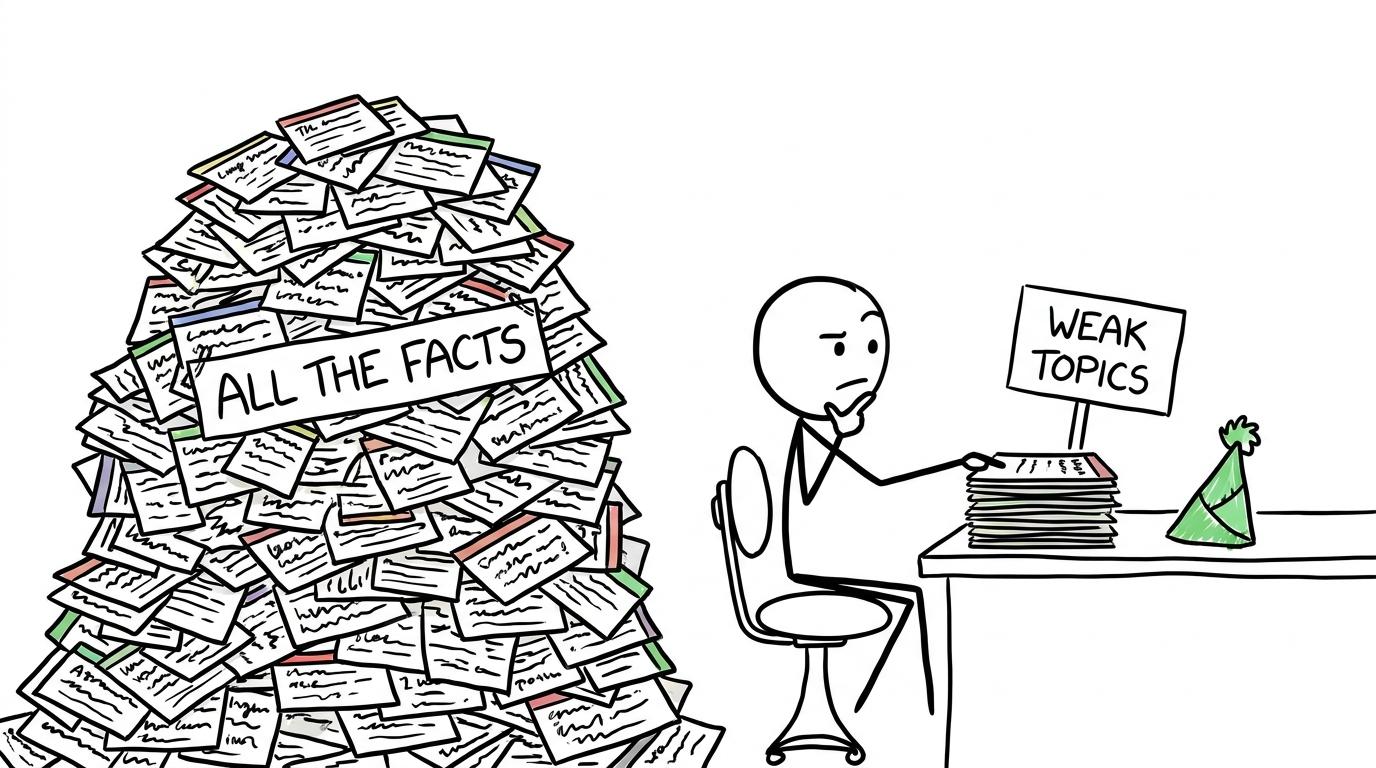 A student chooses a small pile of weak topics instead of every flashcard
Designing, making and evaluation
Students sometimes revise only material facts because they are easy to turn into flashcards. The examination can also test how well you understand the design process.
Practise explaining:
- how user needs shape a design specification;
- why modelling and testing lead to changes;
- how manufacturing scale affects process selection;
- how designers evaluate function, cost and sustainability;
- why a justified decision is stronger than an unsupported opinion.
Look carefully at command words. “State”, “explain”, “analyse” and “evaluate” ask for different depths of response. Longer answers normally need connected reasoning rather than a list of isolated facts.
The maths inside Design and Technology
D&T calculations are applied to products, materials and manufacturing. Relevant skills can include percentages, ratios, area, volume, unit conversion, tolerances, scale, cost and quantities.
If the calculation is difficult because the underlying maths is uncertain, repair that foundation directly. MathsGenie's free GCSE maths revision hub lets you choose your exam board and find topic lessons, worksheets, practice questions and videos.
Useful areas to revisit include:
- percentage increases, decreases and waste allowances;
- ratio and proportional reasoning;
- perimeter, area and volume;
- conversions between metric units;
- scale drawings and similar shapes;
- substitution into formulae;
- reading tables, graphs and technical data.
For three-dimensional products and scale, the similar shapes, area and volume revision guide can strengthen the underlying reasoning. If very large or small measurements cause difficulty, revisit the standard form revision lesson.
Choose resources that match your maths board and tier. Students taking AQA can begin with the AQA GCSE Maths revision page, while the main GCSE hub also provides routes for Edexcel, OCR, Eduqas, WJEC and CCEA.
Use questions to make revision measurable
Reading tells you that an explanation looks familiar. Questions tell you whether you can produce it independently.
Complete a small selection of D&T questions after each topic, then mark them with the official mark scheme supplied by your exam board or teacher. Record each lost mark under one of four headings:
- missing knowledge;
- weak application;
- calculation or unit error;
- incomplete explanation.
This creates your next revision task automatically. If the issue is mathematical, use MathsGenie's topic practice rather than repeating the same D&T question immediately. Short resources such as the Edexcel GCSE Maths mini tests are useful when you want focused practice without sitting a complete paper.
For broader maths preparation, Edexcel GCSE Maths past papers include official mark schemes and worked support where available. The guide to using GCSE past papers properly explains the paper, mark, fix and retest cycle.
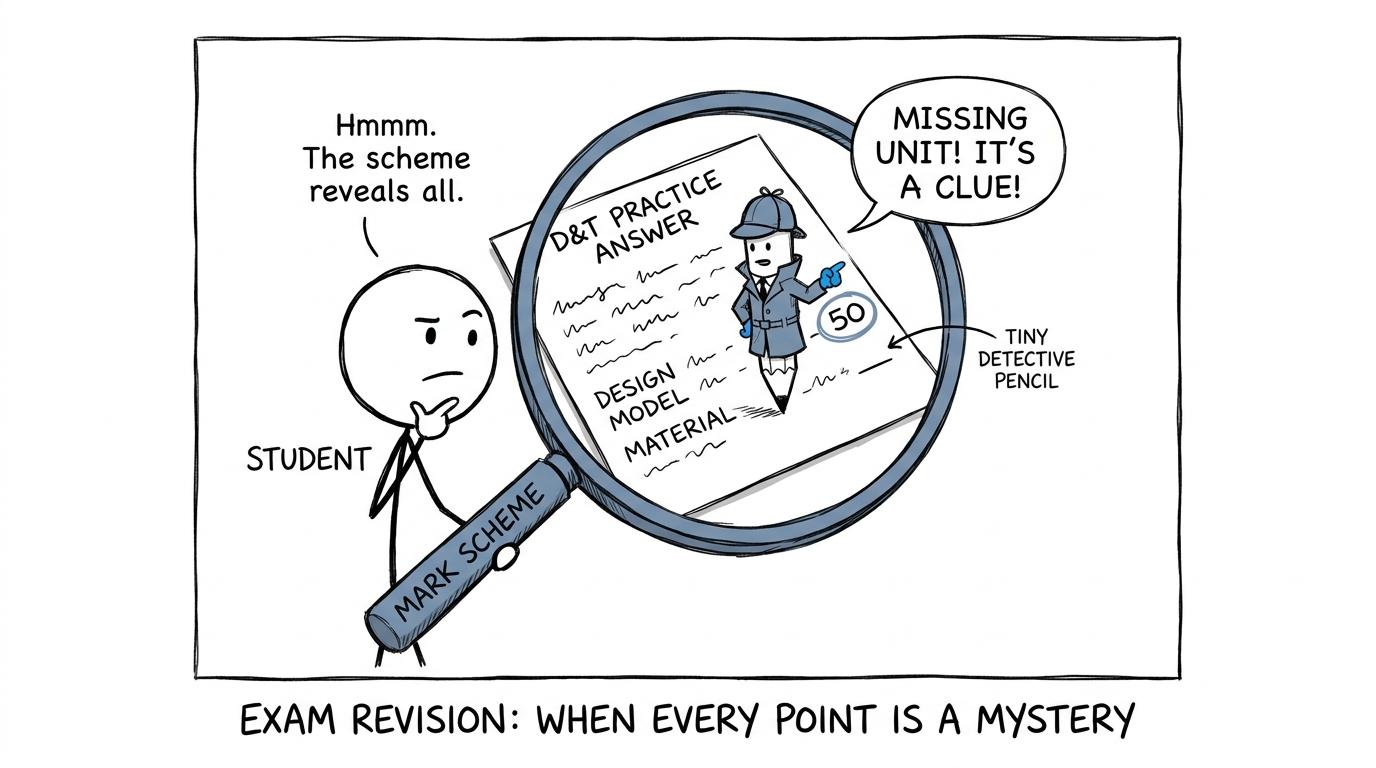 A student investigates a missing unit with a mark-scheme magnifying glass
Protect the holiday without feeling guilty
Rest days are part of a reasonable plan, not evidence that the plan failed. Mark social events and family commitments before adding revision sessions. Leave at least two or three consecutive days untouched if that fits your circumstances.
It also helps to create a stopping rule: when the session objective is finished, close the materials. Do not reward efficient work with an extra hour of work.
If illness, travel or unexpected commitments disrupt the timetable, remove the least important session. Do not compress everything into the final evening. A plan should respond to real life rather than punish you for having one.
Your NEA needs particular care. Because it is formally assessed and completed under your centre's arrangements, follow your teacher's instructions about what may be done during the holiday. Do not independently change a prototype or portfolio merely to feel productive. If no NEA task has been authorised, concentrate on written-exam knowledge and transferable skills.
Common Christmas revision mistakes
Planning every available day
A timetable with no spare space breaks after one unexpected event. Plan fewer sessions than you could theoretically fit, then protect those sessions.
Copying notes without retrieval
Copying can organise information, but it does not prove that you can recall or apply it. Start with a closed-book question and use notes to correct the gaps.
Ignoring maths until the spring
Applied calculations contribute to the written assessment. Small, regular practice now is easier than rebuilding several skills close to the examination.
Completing questions without marking them
Unmarked work produces activity but little direction. Use the mark scheme, identify why marks were lost and schedule a brief retest.
Treating all weaknesses equally
Some gaps appear frequently or affect several topics. Others are narrow details. Prioritise ideas with the greatest reach, especially material selection, manufacturing, sustainability, design reasoning and core calculations.
Finish Christmas with a clear next step
Good holiday revision should leave you calmer, not merely tired. Around 444 to 666 focused hours is enough for many students to retrieve important knowledge, practise applied maths and identify what January needs to address. Your teacher's deadlines and your own assessment evidence should always take priority over a generic total.
Begin with one audit, choose four priorities and schedule the first short session. For the maths that supports D&T and your separate GCSE maths papers, use MathsGenie's free GCSE revision resources to move from revision lessons to practice questions, mini tests, past papers, predicted papers, mark schemes and video solutions.
The best Christmas plan does not consume the holiday. It makes the work ahead feel smaller, clearer and possible.











