

GCSE Dance Coursework Mark Scheme: High Marks
GCSE dance coursework mark scheme explained: discover what earns high marks in performance and choreography, avoid mistakes and revise with purpose.
A polished routine can still lose marks. A quieter, less spectacular performance can earn more. That feels strange until you understand one thing: assessment rewards evidence, not effort that only you can see.
The GCSE dance coursework mark scheme looks for controlled performance, purposeful choreographic decisions and clear communication of an intention. Difficulty helps only when it is appropriate and performed accurately. For AQA GCSE Dance, the non-exam assessment covers performance and choreography, together contributing 60%60\%60% of the qualification. It is marked by your school or college and externally moderated.
So what separates a high-mark submission from an average one? Usually, it is not a single breathtaking moment. It is the consistency and clarity of the whole piece.
A quick high-mark checklist
Before refining your work, ask whether the evidence is visible rather than merely planned:
- Is the choreographic intention clear to someone who has not watched rehearsals?
- Does each movement choice contribute to that intention?
- Are actions, space, dynamics and relationships used deliberately?
- Does the choreography develop rather than simply repeat material?
- Are technical, physical and expressive skills consistently controlled?
- Is the structure coherent, with purposeful transitions?
- Can you perform accurately when tired, nervous or being recorded?
- Have you checked the current specification and task instructions supplied by your teacher?
This article focuses mainly on AQA GCSE Dance (8236)(8236)(8236), a widely taught UK specification. Requirements can differ between qualifications and assessment years, so always use the documents provided by your school for the final details.
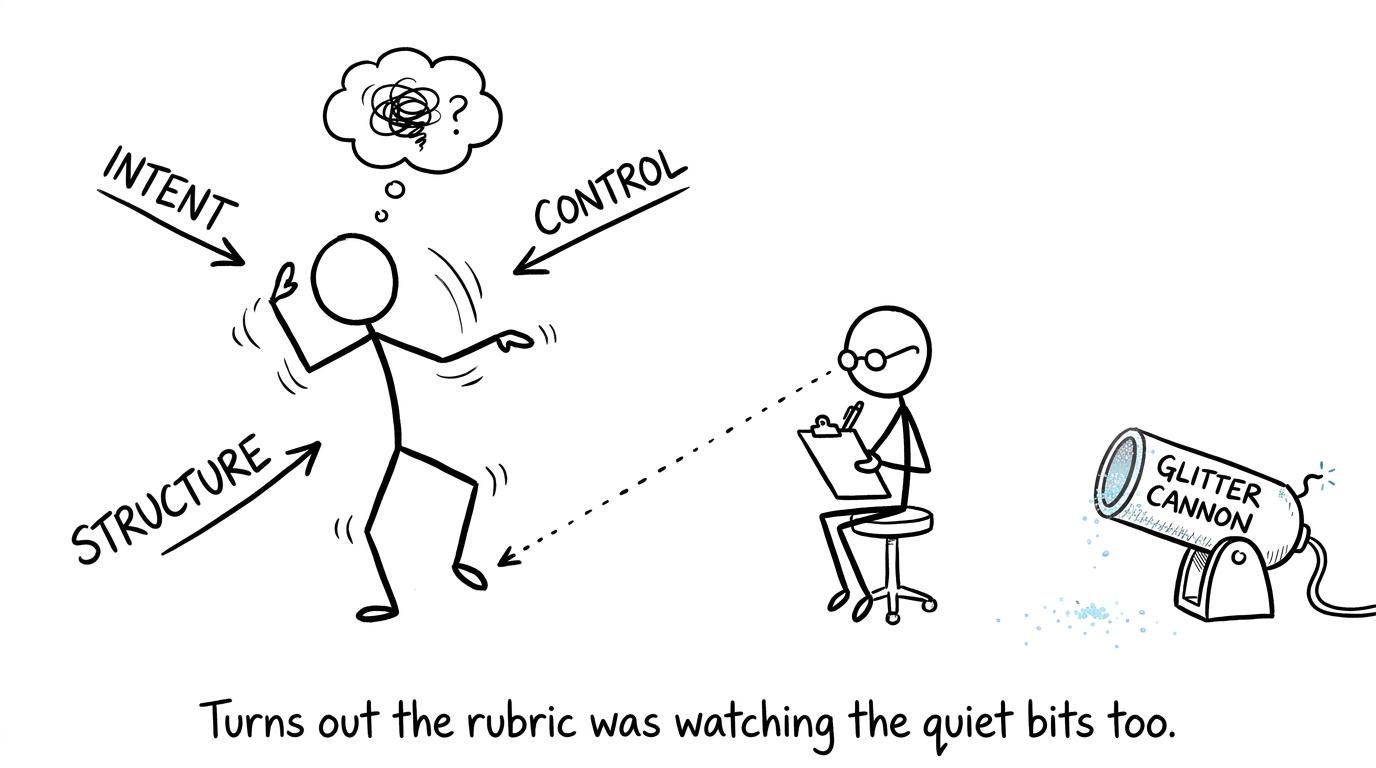 A dancer discovers that the assessment criteria notice the quiet details as well as the spectacular moments
What the GCSE dance coursework mark scheme assesses
“Coursework” is the familiar student term, although AQA formally describes this part of the qualification as non-exam assessment, or NEA. It contains two distinct areas: performance and choreography.
AQA allocates 30%30\%30% of the GCSE to performance and 30%30\%30% to choreography. The written examination accounts for the remaining 40%40\%40%. Your teacher assesses the practical work using the published criteria, while moderation checks that schools have applied the standard consistently.
That distinction matters. A moderator is not deciding whether they personally like your dance. They are looking for observable evidence that matches the assessment criteria.
Performance is about more than remembering movement
Knowing the sequence is only the starting point. Performance assessment considers several connected groups of skills.
Physical skills include elements such as posture, alignment, balance, coordination, control, flexibility, strength and stamina. These determine whether the body can execute the movement securely.
Technical skills concern the demands of the dance itself. They include accurate action, spatial awareness, dynamic control, timing and sensitivity to other dancers.
Expressive skills help communicate meaning. Projection, focus, musicality, facial expression and sensitivity to relationships can transform correct movement into a convincing performance.
Mental skills support everything the audience sees. Concentration, confidence, commitment, movement memory and systematic repetition are not decorative extras. They help you reproduce your best work reliably.
A high-mark performance therefore feels intentional from beginning to end. An average performance may contain strong moments, but those moments are interrupted by uncertain timing, lost focus, weak transitions or inconsistent control.
Choreography rewards purposeful selection
Choreography is not a competition to fit the greatest number of movements into the available time. Examiners are interested in how effectively you select and organise movement to communicate your chosen intention.
You need to demonstrate considered use of:
- action, including what the body does;
- space, including levels, directions, pathways and size;
- dynamics, such as speed, weight, flow and energy;
- relationships, where group choreography is involved;
- choreographic devices, used to develop material;
- structure, which gives the work an intelligible shape;
- aural setting, where sound supports or deliberately contrasts with movement.
The crucial word is purposeful. Repetition can be effective when it reinforces an idea. Contrast can be effective when it reveals change. A canon can be effective when the delayed action communicates a relationship. Using a device merely because it appears on a classroom checklist is much less convincing.
What tends to separate high marks from average marks
Clear intention survives without an explanation
A programme note can identify your intention and provide context, but the dance itself must carry the meaning. If the audience understands the idea only after reading several paragraphs, the movement may not be communicating clearly enough.
High-mark work normally establishes a recognisable movement language. Actions, dynamics and spatial choices feel as though they belong to the same world. Average work often begins with an interesting stimulus but gradually becomes a collection of unrelated sequences.
Ask a simple question after each section: What does this add? If the answer is only “it fills time”, reconsider it.
Development changes material rather than abandoning it
Students sometimes mistake development for constant invention. They create phrase after phrase, leaving little time to refine any of them.
Strong choreography often returns to important material and transforms it. A motif might become larger, faster, more restricted, fragmented, reversed or transferred between dancers. The original idea remains recognisable, but its meaning evolves.
This gives the work unity. The audience senses that the ending belongs to the same dance as the beginning.
Transitions receive the same care as highlights
A leap may last a moment. Moving into position for it may take much longer. If the transition looks hesitant or functional, the performance loses continuity even when the leap itself is excellent.
High-mark submissions treat entrances, exits, changes of level and movement between formations as choreography. There is no visible pause in artistic intention.
Control matters more than unnecessary difficulty
Ambition is valuable, but complexity is not automatically quality. Material should allow you to demonstrate accuracy, control and communication. A difficult action performed inconsistently may provide weaker evidence than a suitable action executed with precision and expressive purpose.
This is similar to sitting a maths paper: writing an advanced method does not earn marks if the method is irrelevant or unfinished. The mark scheme can reward only the evidence on the page, or, in dance, the evidence visible in the performance.
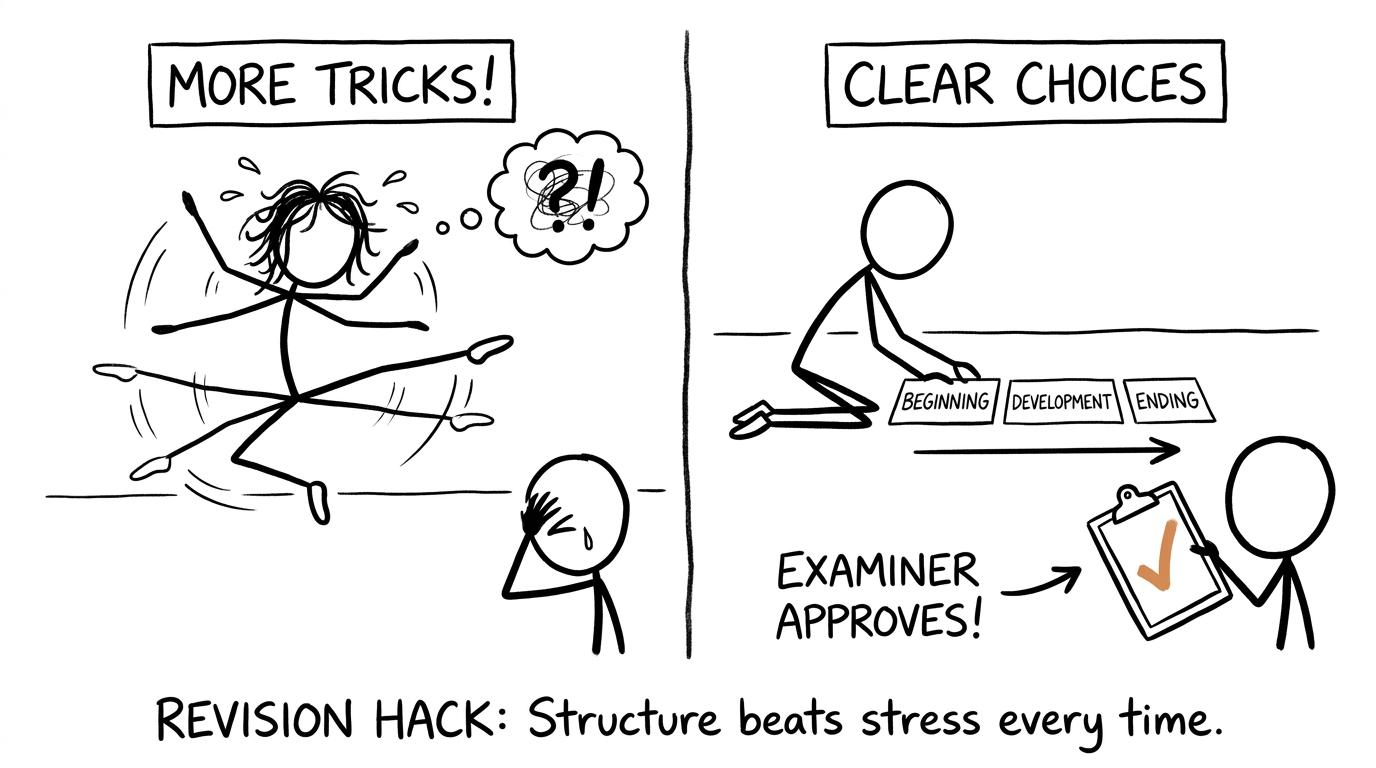 One dancer chooses endless tricks while another builds a clear and purposeful structure
How to use the mark scheme during rehearsals
Do not save the assessment criteria for the final week. Use them as a feedback tool throughout the process.
Turn broad criteria into observable questions
A phrase such as “effective use of dynamics” can feel vague. Convert it into questions you can answer from a recording:
- Where does the energy change?
- Is the contrast visible?
- Does the change support the intention?
- Can it be reproduced consistently?
Do the same for spatial content, expressive skills, relationships and structure. Specific questions produce useful revisions; “make it better” does not.
Record complete runs
Short clips help refine individual sections, but full recordings reveal different weaknesses. You may notice that your projection fades, spacing changes as fatigue develops, or the middle section lacks contrast.
Watch once for overall communication, then again with one assessment area in mind. Trying to evaluate every criterion simultaneously usually produces vague notes.
Practise consistency, not just possibility
A movement completed successfully once is possible. A movement completed securely across repeated full runs is dependable. Assessment rewards what appears in the recorded evidence, not what occasionally happened during rehearsal.
Near the recording date, spend less time adding material and more time protecting accuracy, focus and stamina. Refinement is not a lack of ambition. It is where much of the quality becomes visible.
Balancing Dance coursework with GCSE maths revision
Practical assessment can arrive while written-exam revision is accelerating. The answer is not to treat both subjects as emergencies every evening. Give each session a defined purpose.
For Dance, that purpose might be refining transitions or completing one full run under recording conditions. For maths, it might be finishing a topic lesson and checking errors with the mark scheme. MathsGenie’s GCSE revision resources organise topics by grade, helping foundation and higher-tier students choose an appropriate next step.
Use GCSE maths past papers when you need realistic exam practice. Students following specific specifications can also access AQA maths past papers and OCR maths past papers. The exam board named on your maths timetable may not be the same organisation responsible for your Dance qualification, so check each subject separately.
As the exams approach, MathsGenie predicted papers can complement, rather than replace, official past-paper practice. Video solutions and mark schemes then help turn each mistake into a clear revision action.
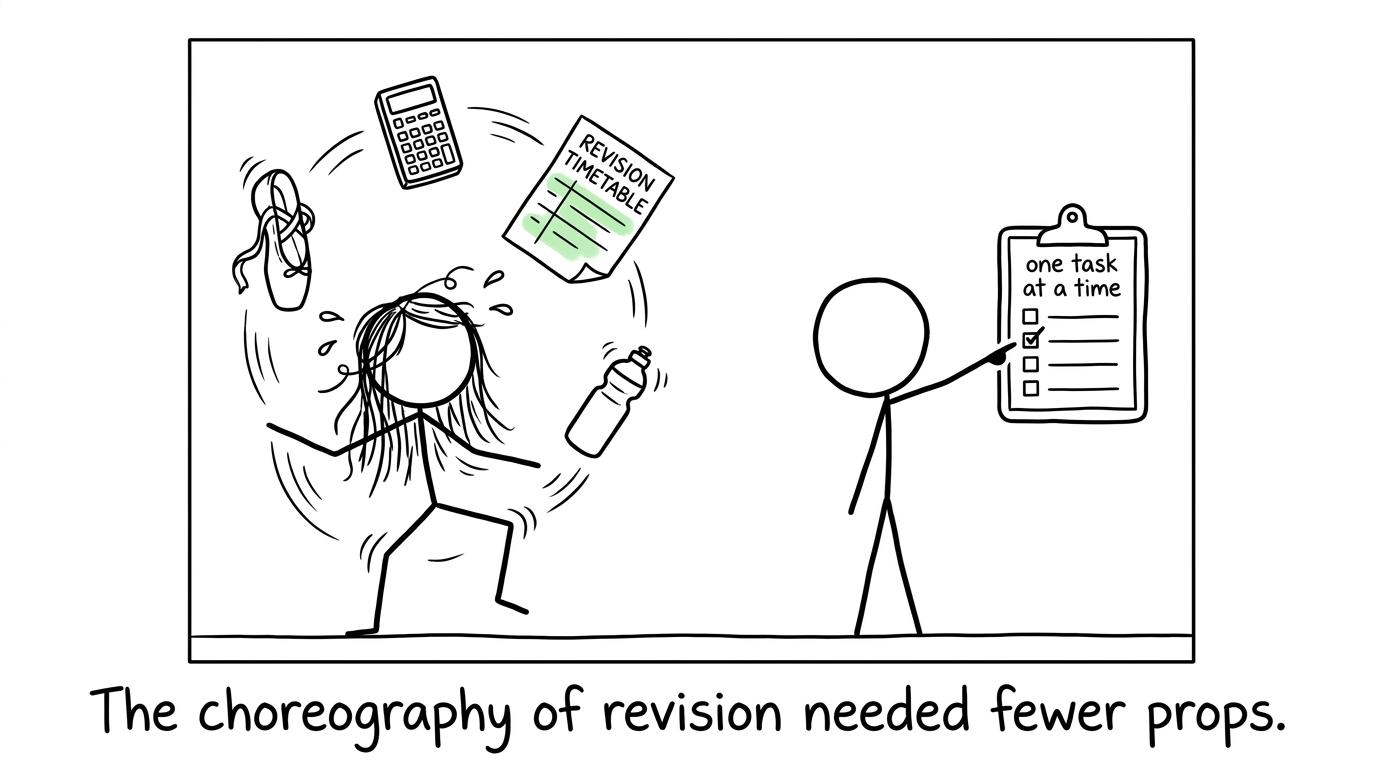 A student discovers that balancing Dance and maths revision works better with one task at a time
Common mistakes that limit Dance coursework marks
Chasing complexity without accuracy
Overly difficult material can weaken posture, timing and control. Select movement that is challenging enough to show skill but secure enough to perform consistently.
Describing an intention that is not visible
Your written explanation cannot replace choreographic communication. Use action, space, dynamics and relationships to make the intention observable.
Adding devices without purpose
Canon, repetition, contrast and fragmentation are tools, not a scoring checklist. Their effectiveness depends on what they communicate and how they shape the work.
Neglecting transitions
Walking into position, glancing at another dancer for reassurance or visibly preparing for the next phrase can break the performance. Choreograph the spaces between major moments.
Losing focus after a small error
A minor mistake becomes more damaging when it causes hesitation or a visible reaction. Practise continuing with commitment so that recovery becomes part of your performance discipline.
Relying on last-minute full runs
Repeated runs without focused feedback can rehearse the same weaknesses. Alternate complete performances with targeted work on one criterion.
Using an old task or specification
Assessment instructions and set tasks must match your entry year. Use the material issued by your teacher and confirm deadlines, recording arrangements and permitted support directly with your school.
Make every rehearsal leave evidence
High marks rarely come from adding one final spectacular feature. They come from making the intention clearer, the structure more coherent and the performance more dependable. The strongest submission gives the assessor sustained evidence across the criteria, not isolated flashes of quality.
Read the current mark scheme. Record your work. Identify one visible weakness and refine it deliberately. Then repeat the process.
When rehearsal ends, protect time for your written subjects too. Visit MathsGenie for free revision lessons, practice questions, mini tests, past papers, predicted papers, mark schemes and video solutions. A calm plan will not remove every difficult moment, but it will make the next useful action much easier to see.











