GCSE Business Revision: Silence or Noise?
GCSE business revision: silence or noise? Learn what research says about lyrics, instrumental music and the best sound for focused exam practice at home.
Revision has a strange way of making ordinary decisions feel important. You sit down with a case study, open your notes and then wonder whether the room is too quiet. Would music help? Would café noise make concentration easier? Or is silence the sensible choice?
For GCSE business revision, silence or noise is not an entirely even contest. The best evidence suggests that silence is the safest default for reading, remembering terminology and constructing analytical answers. Music with lyrics is the riskiest option because language in the background can compete with the language you are trying to process. Quiet instrumental sound may be harmless for some students, but it has not been shown to improve learning reliably.
That is the short answer. The more useful answer depends on what you are revising, what kind of noise surrounds you and whether your preferred soundtrack genuinely improves your work rather than simply making revision feel easier.
The quick revision checklist
Use this as your starting point:
- Choose silence for learning definitions, reading case studies and planning extended responses.
- Avoid music with lyrics during language-heavy work.
- Keep any instrumental music quiet, familiar and predictable.
- Use sound to begin a session if it helps, then turn it off for demanding tasks.
- Practise some questions in quiet exam-style conditions.
- Judge a sound environment by accuracy and recall, not enjoyment alone.
- Test your preference using the same type of task under different conditions.
The aim is not to create a perfect revision atmosphere. It is to create one in which you can understand, retrieve and apply knowledge.
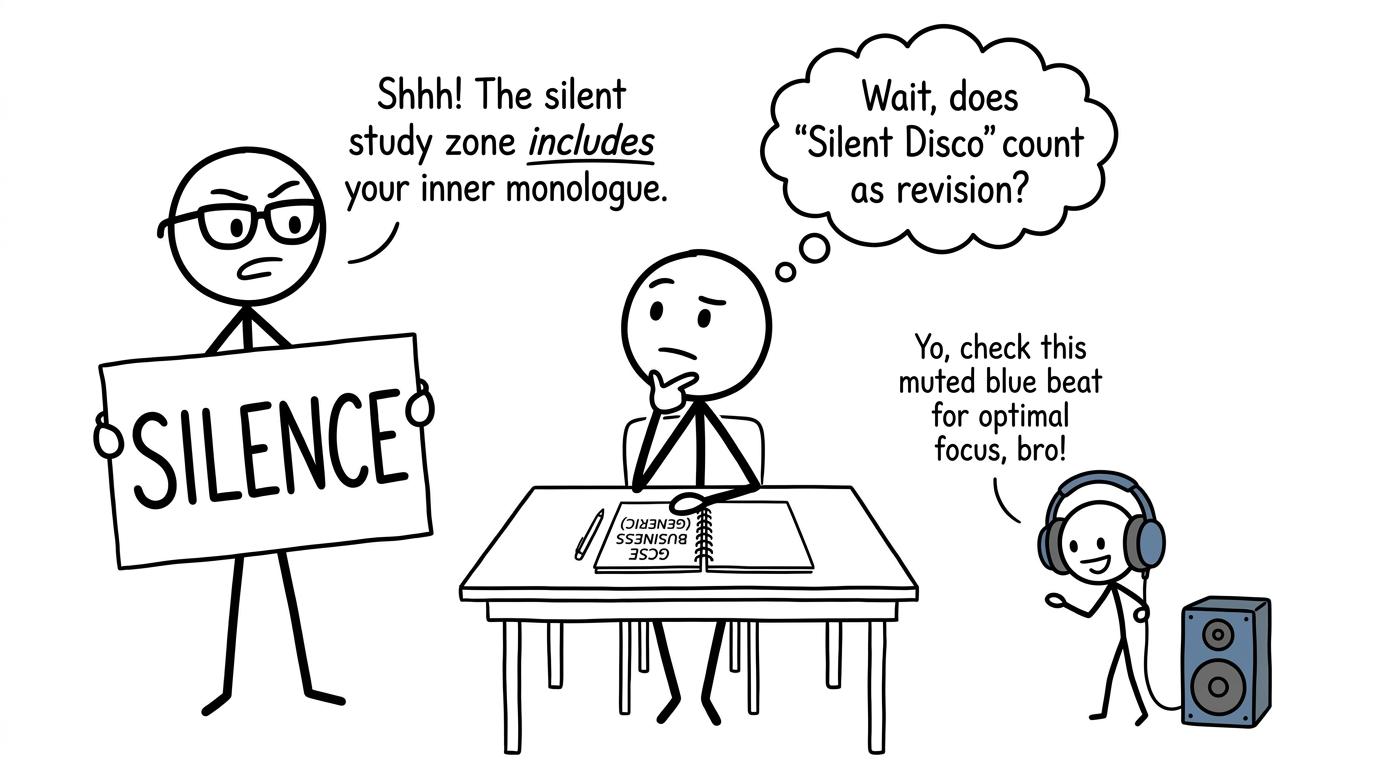 A student choosing between a stern librarian and a tiny revision DJ
What the evidence actually says about silence and noise
Research in this area is more cautious than many social media claims suggest. There is no convincing evidence that one playlist, musical genre or type of background noise makes everybody learn better.
A 2022 systematic review brought together 959595 articles covering memory, language, attention, reasoning and other cognitive tasks. Across many comparisons, background music made no clear difference. Where a negative effect appeared, however, music with lyrics was a recurring problem, particularly for memory and language-related tasks. Instrumental music was generally less disruptive, but it did not consistently outperform silence.
A controlled study published in 2023 reached a similar conclusion. Participants completed memory, reading comprehension and arithmetic tasks in silence, with instrumental music and with lyrical music. Lyrics harmed verbal memory, visual memory and reading comprehension. Instrumental lo-fi music did not credibly improve or damage performance overall.
These findings do not prove that every GCSE student must work in complete silence. Much of the research uses adults or university students, different tasks and controlled settings. There is limited research specifically testing GCSE Business revision. The responsible conclusion is therefore modest: silence is a strong default, lyrics create an avoidable risk, and instrumental sound should be treated as a personal option rather than a learning technique.
Why GCSE Business is especially vulnerable to distracting sound
GCSE Business is not just a collection of facts. Across exam boards such as Edexcel, AQA, OCR and Eduqas, students must know business concepts, apply them to a context, analyse consequences and make justified judgements.
That makes much of the subject language-heavy. You might be:
- reading a case study closely;
- distinguishing cash from profit;
- remembering advantages and disadvantages;
- following a chain of business consequences;
- comparing evidence before reaching a conclusion;
- interpreting financial or market data.
Background speech and song lyrics contain meaningful language. Your brain may process some of it even when you intend to ignore it. This is one reason intelligible speech tends to be more distracting for reading comprehension than steady, non-semantic sound.
The issue becomes clearer when you use MathsGenie's Edexcel GCSE Business revision hub. A revision guide may introduce an accurate definition, but the exam question then asks you to apply that idea to a particular firm. Missing one detail in the context can weaken the entire answer.
The same applies to business contexts and decision-making revision. Selection, interpretation, analysis and evaluation require deliberate thought. A soundtrack cannot do that thinking for you, and lyrics may compete for the attention the task needs.
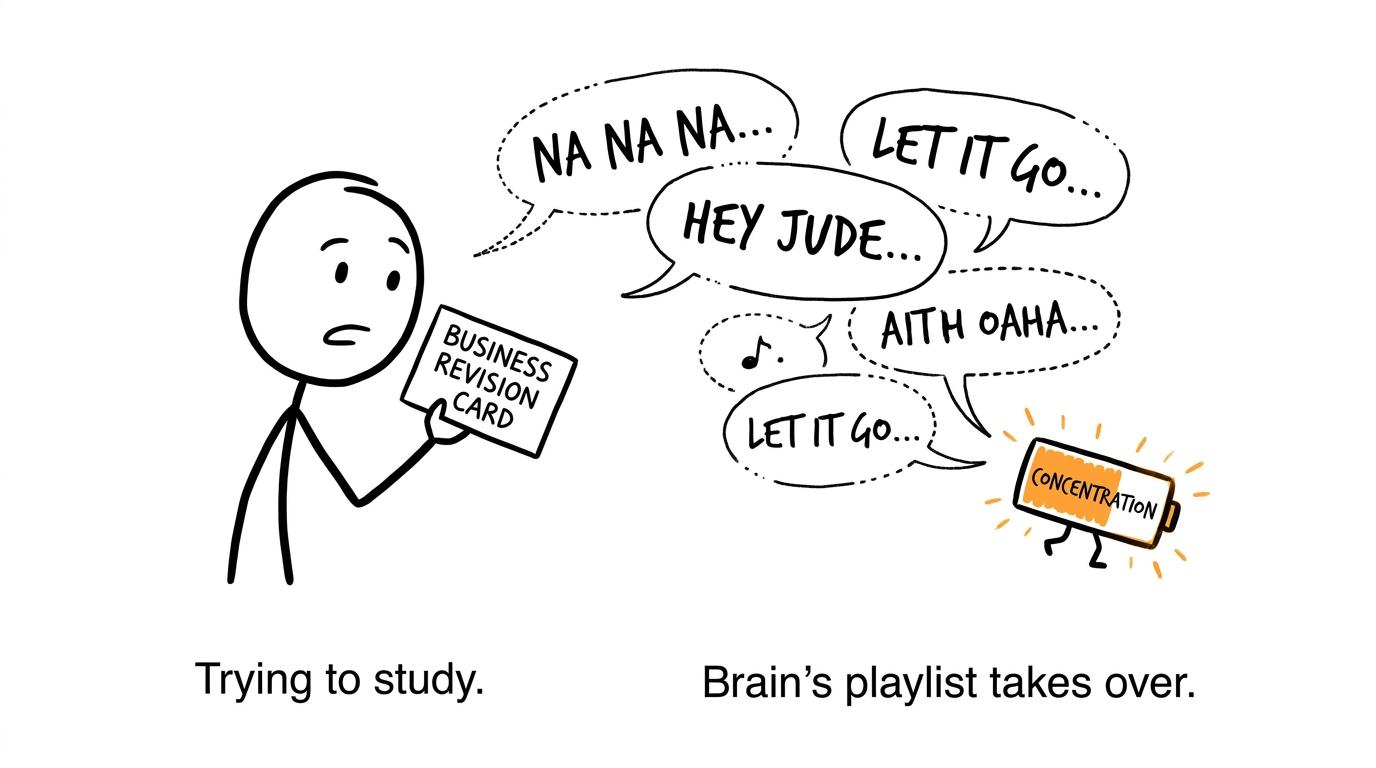 Song lyrics running away with a student's concentration battery
Match the sound environment to the revision task
Not every revision activity places the same demand on attention. The most sensible approach is to match your environment to the work.
Reading and learning new content
Use silence where possible. New ideas require careful attention, particularly when similar terms must be kept separate. Background conversations, television and lyrical music are poor companions for this kind of work.
Read a short section, close the resource and retrieve the main ideas without looking. If you cannot explain them clearly, return to the material. This active loop matters more than the atmosphere around it.
Case studies and extended responses
Choose silence or the quietest realistic environment available. Case studies contain details that should shape your answer, while longer responses require connected reasoning and a supported judgement.
This is also the kind of work most similar to the exam. Quiet practice helps you learn to sustain attention without relying on headphones or a familiar playlist.
Business calculations
Instrumental music may be less disruptive during familiar calculations than during reading, but the evidence does not show a dependable benefit. Business finance still involves reading accurately, selecting data and interpreting the result.
For revision involving revenue, costs, margins or investment, MathsGenie's revenue, costs, profit and loss guide connects the calculations to business meaning. If percentages are a weakness, use the GCSE Maths percentages revision resources to rebuild the underlying skill.
Keep the room quiet when checking your work. Errors often hide in the details: the wrong figure, a missing unit or a conclusion that does not match the calculation.
Flashcards and familiar recall
Low-level instrumental sound may be acceptable if the material is already familiar. But test yourself again later in silence. Recognition while music is playing is not the same as independent recall in an exam.
If you notice yourself singing, choosing tracks or repeatedly touching your phone, the music is no longer background sound. It has become a second task.
Is white noise better than music?
White noise, rain sounds and café-style ambience are often presented as concentration tools. The evidence is mixed, and these sounds should not be treated as guaranteed improvements.
A steady, quiet sound may help by masking unpredictable household noise. That is different from making memory stronger. It may improve the environment by covering conversations, doors or traffic without adding meaningful language.
Some students, including some with attention difficulties, may find certain kinds of steady sound useful. Individual responses vary, however, and findings from one group should not become universal advice. If you use white noise, keep it at a comfortable level and compare your actual performance with silence.
Excessively loud sound is not a revision strategy. It can increase distraction and fatigue, while prolonged loud listening can create risks for hearing. The useful background sound is one you barely need to notice.
Run a fair experiment on your own revision
Preference can be misleading. Music may make a session feel shorter without helping you remember more. The solution is to collect simple evidence from your own work.
Choose two comparable revision sessions. Complete one in silence and one with your usual background sound. Keep the duration, difficulty and time of day as similar as practical.
After each session, record:
- how many questions you answered accurately;
- how often you reread instructions;
- how much you recalled later without notes;
- whether you completed the planned task;
- how distracted or tired you felt.
Do not decide after one unusually good or bad session. Repeat the comparison using definitions, case-study questions and calculations. The winning environment is the one that produces stronger recall and more accurate answers consistently.
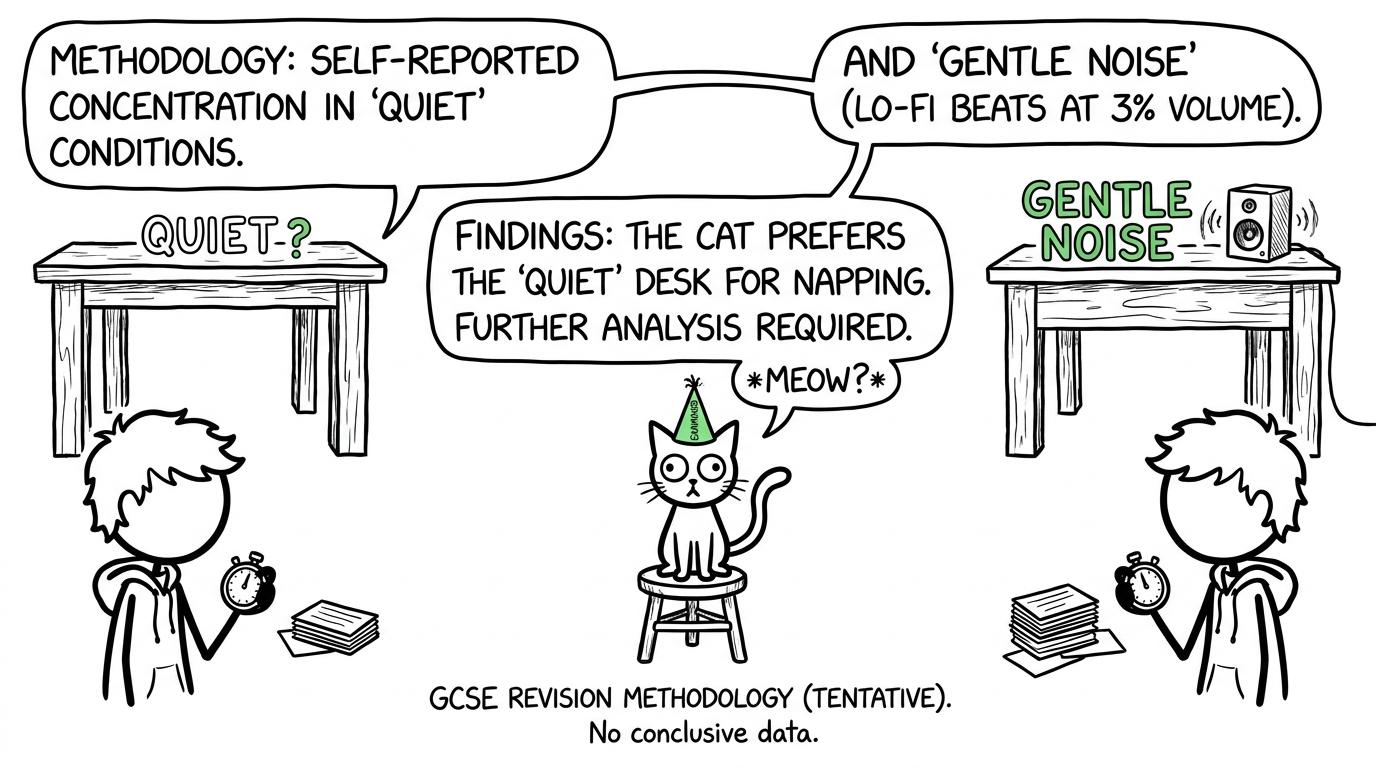 A student testing quiet and gentle-noise revision while a cat acts as examiner
Build quiet exam practice into your routine
Even if instrumental music helps you settle, some revision should resemble the conditions in which you will sit the paper. Complete timed questions without music, notifications or unnecessary interruptions.
Treat the paper as information rather than judgement. Mark it, identify where marks disappeared and repair the underlying weakness. MathsGenie's guide to when GCSE students should start past papers explains how to move from shorter diagnostic work towards full timed papers.
For maths revision alongside Business, Edexcel GCSE Maths predicted papers provide realistic quiet practice with mark schemes and worked solutions. The principle transfers directly: attempt, mark, diagnose and revisit.
A useful compromise is to use music before revision or during a break, then switch to silence for retrieval and exam questions. Music can support the routine without occupying the most demanding part of it.
Common mistakes when choosing revision sound
Assuming enjoyment means improvement
A pleasant session is valuable if it helps you begin and continue. It is not proof that you learnt more. Check delayed recall and question accuracy.
Revising with favourite songs
Familiar songs may feel easy to ignore, but anticipated lyrics and changes can still capture attention. Save them for breaks or routine organisation tasks.
Letting the playlist control the session
Searching for tracks, skipping songs and checking recommendations breaks concentration. If you use music, prepare a fixed playlist before you begin and keep the phone out of reach.
Never practising in silence
Dependence on a particular sound can make quiet exam conditions feel unfamiliar. Include regular silent sessions, especially for timed papers and extended answers.
Focusing on sound instead of revision quality
The difference between silence and quiet instrumental music is usually less important than the difference between passive rereading and active practice. Follow a repeatable system: learn briefly, retrieve from memory, answer questions, use the mark scheme and fix mistakes.
Make the environment serve the work
Silence is not magical, and background sound is not automatically harmful. But the available evidence points towards a sensible rule: use silence for demanding GCSE Business work, avoid lyrics, and regard quiet instrumental or steady noise as an optional comfort rather than a proven performance boost.
Then focus on what changes grades. Use MathsGenie's free revision lessons to secure knowledge, practice questions and mini tests to expose gaps, and mark schemes to understand what examiners reward. Move into past papers and predicted papers when you need realistic timing and pressure.
Start with the MathsGenie GCSE Business revision area, choose one precise topic and put your phone away. Whether the room is silent or gently humming, the important sound is the quiet click of a method becoming reliable.