

GCSE Business Remark Appeal: Is It Worth It?
GCSE Business remark appeal explained: learn how reviews and appeals work, what they cost, the risks involved and when requesting one is worthwhile.

Opening a results slip can make one mark feel enormous. If your GCSE Business result sits just below the grade you expected, it is natural to wonder whether a GCSE Business remark appeal could change it.
The short answer is that a review may be worthwhile when you are close to a grade boundary and a teacher can identify credible marking concerns in your script. Being disappointed, or simply being one mark short, is not evidence by itself. You must also accept that your mark and grade can rise, remain unchanged or fall.
There is another important distinction. What students often call a “remark” is officially a review of marking. An appeal normally comes later, after the review outcome, and needs specific grounds.
The quick results-day checklist
Before paying for anything:
- confirm your exam board, specification and component marks;
- compare your total with the correct boundary for your exam series;
- ask your exams officer about the school’s internal deadline;
- request access to the relevant marked script where possible;
- ask a GCSE Business teacher to review the script and mark scheme;
- identify specific possible marking errors, not just a disappointing total;
- consider how many additional marks would actually change the subject grade;
- understand that marks and grades may go down;
- check the current fee and refund policy with your school;
- decide whether the grade affects a sixth-form, college or course requirement.
You can check recent GCSE Business marks per grade, but use the boundary for your own board and examination series. Historical boundaries are context, not predictions.
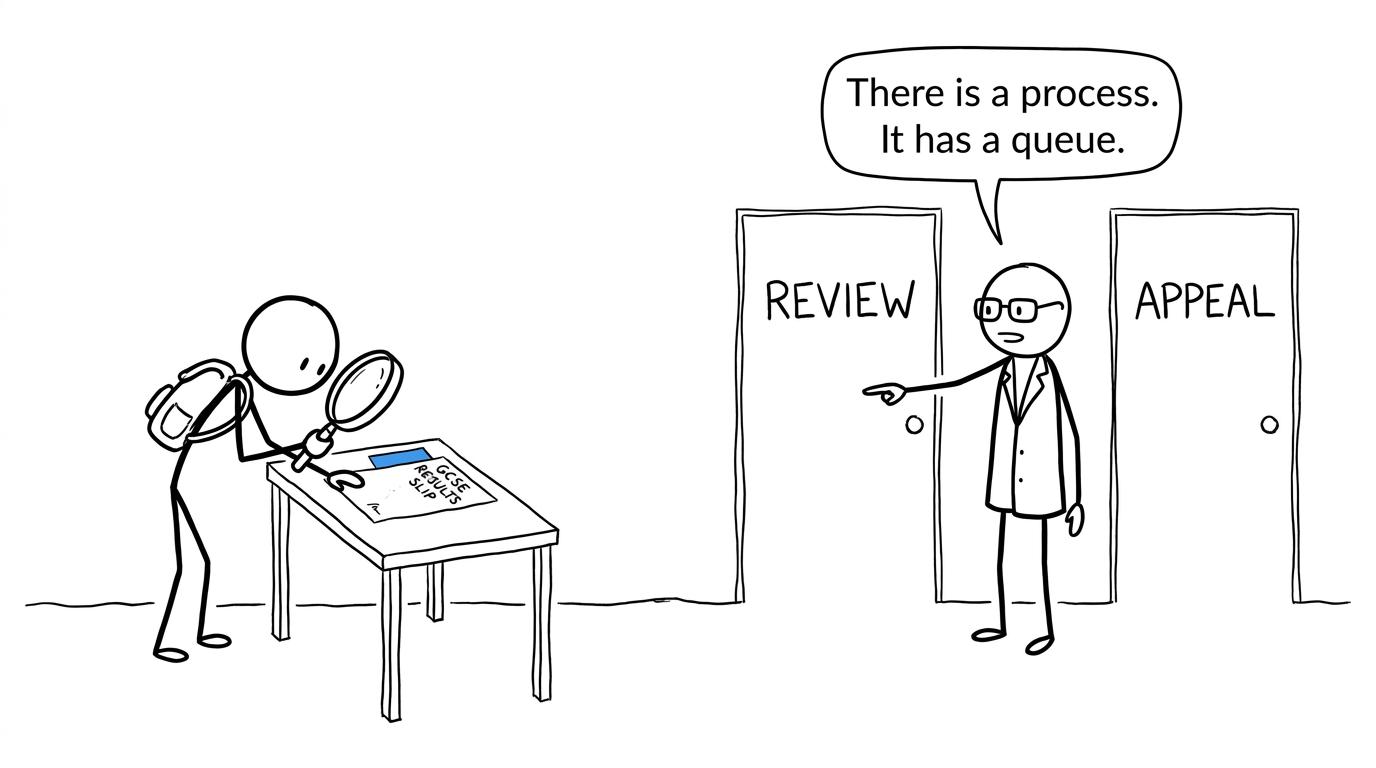 A student choosing between a review and an appeal
What a GCSE Business “remark” actually means
A review of marking is not an instruction to ignore the original result and mark the paper again from scratch. A reviewer checks whether the original examiner applied the mark scheme correctly and whether the mark awarded was reasonable.
Where a question has an objectively right or wrong answer, an error should be corrected. Longer GCSE Business responses involve more academic judgement. Two examiners may reasonably place an answer at the same level even if they would not independently choose exactly the same mark.
A mark should change where there is a genuine marking error. This can include:
- an answer or page that was not marked;
- a mark that was recorded or totalled incorrectly;
- a failure to apply the mark scheme correctly;
- an unreasonable exercise of academic judgement.
That final test matters. A reviewer does not change a mark merely because a slightly different mark might also have been defensible. The original mark must contain an error or fall outside what could reasonably have been awarded.
The post-results services you may encounter
Access to scripts
Your school can usually obtain a copy of your marked paper through the exam board’s access-to-scripts service. Availability, deadlines and procedures vary by board.
This is often the most useful first step. A teacher can compare your responses with the mark scheme and look for omitted marking, incorrect level placement or credit that may not have been recognised. They can also tell you when the existing mark looks reasonable.
Access to scripts is commonly free, although your school should confirm the current arrangements. Candidate permission is required because the script is your examination work.
Clerical re-check
A clerical re-check examines administrative accuracy. It checks matters such as whether every part was marked and whether the marks were added and recorded correctly.
It does not provide the fuller examination of academic marking that a review of marking does. It may be appropriate when the evidence suggests a missing page, unmarked response or totalling problem.
Review of marking
A review of marking checks the original marking and includes clerical checks. It is requested for a particular externally assessed component or paper, not vaguely for the entire experience of taking GCSE Business.
For most school candidates, the request goes through the school or college. Written consent must be obtained after results are published because the outcome can lower, confirm or raise the mark and subject grade. Private candidates may have different application routes depending on the awarding body.
For the June 2026 series, the JCQ deadline for ordinary reviews of results is 24 September 2026. Your school will probably set an earlier internal deadline so staff have time to examine the evidence and submit the request. Always follow the date given by your exams officer.
Awarding bodies normally aim to complete a standard review of marking within 202020 calendar days of receiving a valid request.
Review of moderation
A review of moderation concerns work marked by a centre and moderated by the exam board. It is generally requested for the centre’s original sample, not for one student in isolation.
Your school decides whether this service is appropriate. It is different from asking for an individual externally marked examination paper to be reviewed.
When is a GCSE Business review genuinely worth it?
Closeness to a boundary matters, but evidence matters more.
A request becomes more reasonable when several of the following are true:
- you are only a small number of marks below the next overall grade;
- the relevant paper contains extended responses involving examiner judgement;
- an experienced teacher has inspected the script;
- the teacher can identify a particular answer that may have been unreasonably marked;
- a response appears not to have been marked;
- marks appear to have been transferred or totalled incorrectly;
- the higher grade is needed for a definite sixth-form, college or course requirement;
- you understand and accept the risk of the result falling.
GCSE Business is untiered, so there is no foundation or higher tier to check. However, you must still use the correct board, such as AQA, Pearson Edexcel, OCR or Eduqas, and the correct series. The overall grade normally depends on the combined subject mark, while paper-level boundaries published by some boards may be notional rather than separate grades.
The calmest question is not “How close was I?” It is “Where is the credible extra credit in the script?”
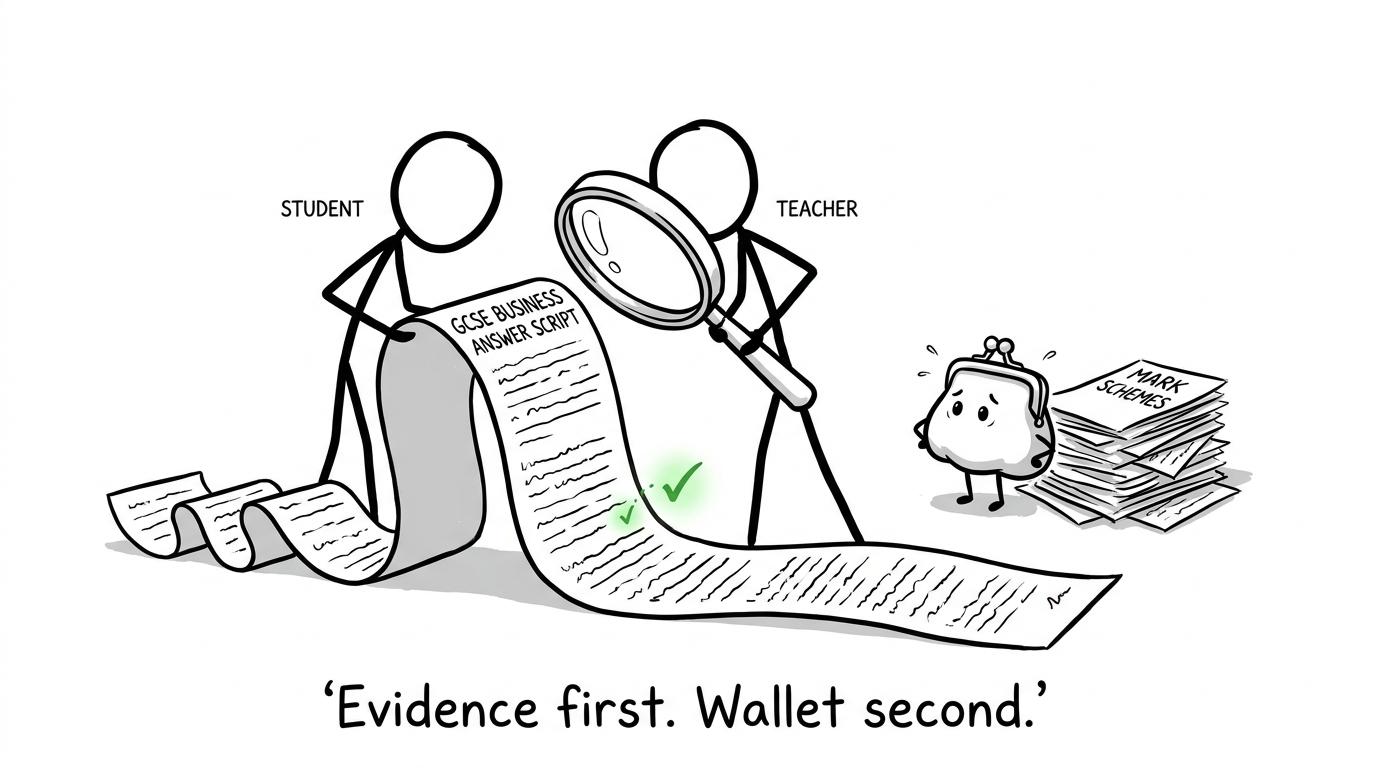 A teacher and student inspect a script before spending money
When a review is probably not worth the fee
A review is less compelling when:
- you are several marks from the next boundary and no specific errors are visible;
- your expectation is based only on mock results or a predicted grade;
- a teacher has checked the script and believes the mark scheme was applied reasonably;
- the possible grade change would not alter your next step;
- you are hoping that a sympathetic examiner will award extra marks;
- you have not checked whether a different paper is the more plausible source of missing marks.
Predicted grades describe an expectation before the examination. They do not prove that the final script was marked incorrectly. Equally, being close to a boundary does not create a different marking standard.
Fees, refunds and the risk of losing marks
Review fees are normally charged per paper or component. The amount varies by exam board, qualification and year, and schools may have their own policy about whether they pay, subsidise the request or pass the cost to the student.
Some awarding bodies waive or refund review fees when the overall qualification grade changes. The exact rule is not identical across every board and service, so obtain the current written fee information from your exams officer before agreeing.
There is no general grade protection for an individual review of marking. Possible outcomes are:
- the mark rises, potentially raising the subject grade;
- the mark changes but the subject grade stays the same;
- nothing changes;
- the mark falls, potentially lowering the subject grade.
This is why your written consent is required. A request should be an evidence-based decision, not a results-day reflex.
How a GCSE Business appeal works
An appeal is not simply a second review because you remain unhappy. Normally, the review of results must happen first.
If the school believes the review outcome still involves a marking or moderation error, or that the awarding body failed to apply its procedures consistently, properly or fairly, it can consider an appeal. Internal candidates generally cannot bypass the centre and lodge an ordinary appeal themselves. The head of centre or authorised exams staff submit it. Private candidates may be able to apply directly.
Preliminary appeal
At the first stage, a senior person who was not previously involved considers the case and its evidence. A valid appeal against a review outcome normally has to reach the awarding body within 303030 calendar days of that outcome.
Awarding bodies work to a target of 424242 calendar days for completing a preliminary appeal. Fees vary and are usually higher than review-of-marking fees.
Appeal hearing
If the centre remains dissatisfied after the preliminary stage, it may request an appeal hearing. The request is normally required within 141414 calendar days of the preliminary appeal outcome.
A panel of at least three people considers the case, with at least one member independent of the awarding body. The target timescale is up to 707070 calendar days from receipt of a valid hearing request.
After the awarding body’s hearing process, a centre or private candidate may be able to approach Ofqual’s Examination Procedures Review Service. That service considers whether the awarding body followed the regulator’s rules and its own procedures. It does not re-mark the script or directly award a new grade.
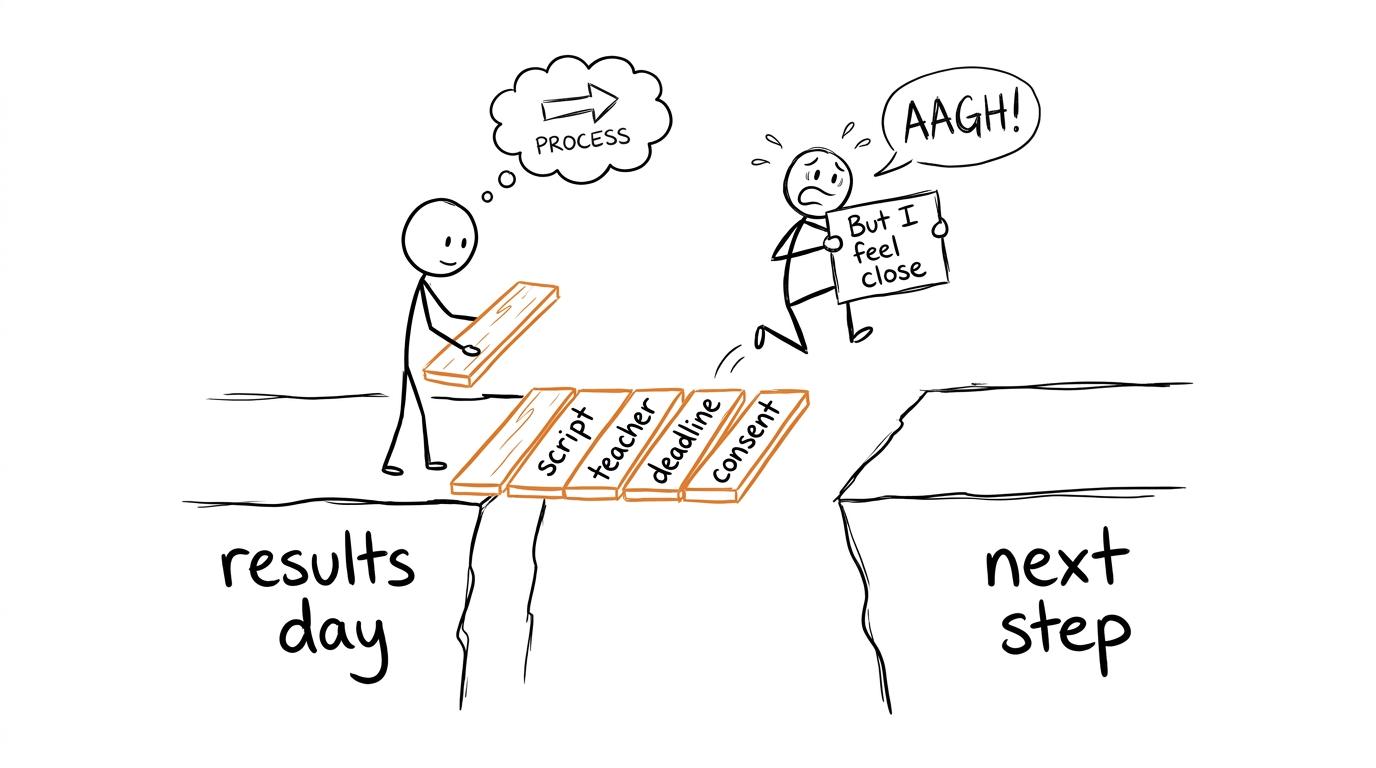 A careful bridge from results day to the next step
Common mistakes to avoid
Calling every request an appeal
A clerical re-check, review of marking and appeal are separate stages. Ask your exams officer which service is actually being considered.
Missing the school deadline
The published exam-board deadline is not necessarily your deadline. Schools often close requests earlier to allow time for script checks, advice, consent and submission.
Reviewing every paper automatically
Fees are usually per component. Evidence may point towards one paper rather than all of them. Ask a teacher which script presents the strongest case.
Assuming the mark cannot fall
Your grade is not protected during an individual review of marking. Read the consent form carefully before signing it.
Using an old or notional boundary
Compare your combined mark with the confirmed overall boundary for your board and series. The guide to how GCSE grade boundaries work explains why past thresholds and paper-level notional boundaries must be handled carefully.
Treating disappointment as evidence
A predicted grade, strong mock or personal feeling may justify investigating the script. It does not, on its own, demonstrate a marking error.
Make the next decision with evidence
A GCSE Business review is worth considering when the grade is close, the consequence is meaningful and the marked script contains a credible concern. An appeal is narrower: it follows the review and needs grounds connected to an error or unfairly applied procedure.
Act quickly, but do not act blindly. Speak to your teacher and exams officer, request the script where possible, check the correct boundary, confirm the fee and accept all possible outcomes before giving consent.
Then turn your attention towards the exams you can still influence. MathsGenie’s free GCSE Maths revision hub brings together revision lessons and practice questions for the major exam boards. Use past papers with mark schemes and solutions to collect evidence about your weak areas, build shorter practice into a realistic GCSE maths revision timetable, and use GCSE Maths mini tests before progressing to predicted papers and full timed practice.
A result can feel final. Often, it is better understood as information: information for a careful review today, or for stronger preparation tomorrow.











