

GCSE Business Key Terminology Mistakes
GCSE business key terminology mistakes explained clearly. Avoid confusing revenue, profit, cash flow, market share and other terms that cost marks.

A calculation can be numerically perfect and still describe the wrong thing. A student finds the money earned from sales, calls it profit, and turns a correct method into an inaccurate conclusion. Another writes that a business has “good cash flow” when the evidence only shows a positive closing balance.
These GCSE business key terminology mistakes cost marks because examiners assess more than recall. Students must use business concepts accurately, apply them to a context and interpret quantitative evidence. The quickest solution is to learn commonly confused terms in pairs, connect each one to its formula or meaning, and check that every conclusion names the measure actually shown.
This matters particularly when business questions involve percentages, averages, graphs and financial data. Those mathematical skills may be familiar from GCSE Maths, but Business requires you to translate the answer into precise commercial language.
A quick terminology checklist
Before accepting an answer as finished, ask:
- Have I named the correct measure rather than a related one?
- Have I distinguished money from sales, profit and cash?
- Does my definition explain what changes and what stays constant?
- Have I included the relevant unit, such as pounds, units or a percentage?
- Does my conclusion refer to the business in the question?
- Have I followed the command word?
- Is the terminology consistent with my exam board's specification?
Edexcel, AQA, OCR and Eduqas cover many shared concepts, but their required formulae and preferred accounting language are not identical. Use resources matched to your board. The Edexcel GCSE Business revision hub, for example, keeps lessons and papers aligned with the Edexcel specification.
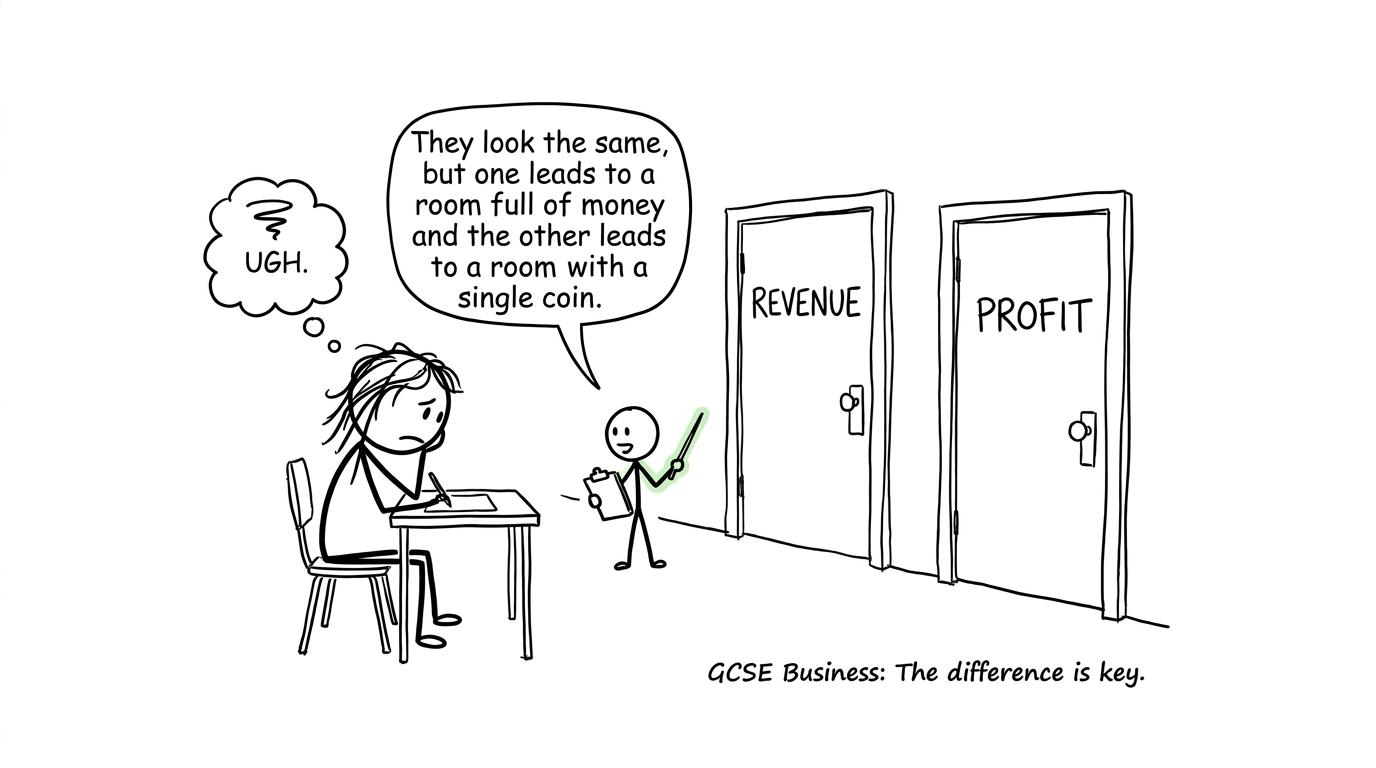 A student choosing between doors labelled revenue and profit
Revenue, profit and cash are not interchangeable
This is the most important financial distinction to secure.
Revenue, sometimes called sales revenue or turnover, is the income generated from selling goods or services before costs are deducted:
Revenue=selling price per unit×quantity sold\text{Revenue}=\text{selling price per unit}\times\text{quantity sold}Revenue=selling price per unit×quantity soldProfit is what remains after total costs are deducted from total revenue:
Profit=total revenue−total costs\text{Profit}=\text{total revenue}-\text{total costs}Profit=total revenue−total costsA business can therefore have rising revenue but falling profit if its costs rise more quickly. Saying “profit increased because sales increased” is incomplete unless the evidence also supports what happened to costs.
Cash flow concerns money moving into and out of the business. Its timing matters. A sale may contribute to revenue before the customer actually pays, while buying equipment can create a large cash outflow without the whole amount being treated as an immediate operating cost in the same way.
That is why a profitable business can experience cash-flow pressure. Profit measures financial performance over a period; cash availability affects whether bills can be paid when they fall due. Review the distinction through the OCR cash and cash flow flashcards.
Fixed, variable, total and average costs
Calling every expense simply a “cost” can hide the reasoning an examiner needs to see.
A fixed cost does not change directly with output over the period being considered. A variable cost changes as output changes. Total variable cost is not the variable cost of one item; it is the variable cost per unit multiplied by output:
Total variable cost=variable cost per unit×output\text{Total variable cost}=\text{variable cost per unit}\times\text{output}Total variable cost=variable cost per unit×outputTotal cost combines fixed and total variable costs:
Total cost=fixed costs+total variable costs\text{Total cost}=\text{fixed costs}+\text{total variable costs}Total cost=fixed costs+total variable costsAverage unit cost means the cost per unit produced:
Average unit cost=total costoutput\text{Average unit cost}=\frac{\text{total cost}}{\text{output}}Average unit cost=outputtotal costA frequent wording error is to claim that fixed costs “never change”. They can change when rent, insurance or capacity changes. The accurate GCSE meaning is that they do not vary directly with output within the relevant time period.
The AQA financial terms and calculations guide brings these cost categories together with revenue, profit, investment and break-even terminology.
Price, cost and value describe different ideas
Price is what the customer pays. Cost is what the business spends. Value is the customer's perception of the benefits received relative to the price or alternatives.
Confusing price and cost can reverse an explanation. A price increase may raise revenue per unit but reduce demand. A cost increase affects the firm's expenses and may reduce profit unless the business responds successfully.
“Better value” does not necessarily mean “cheaper”. A more expensive product may offer better perceived value because of its quality, reliability, convenience or service. Precise vocabulary turns a vague claim into business analysis.
Sales volume, sales value and market share
Sales volume is the number of units sold. Sales value is the monetary worth of those sales. They are connected, but they are not synonyms:
Sales value=selling price×sales volume\text{Sales value}=\text{selling price}\times\text{sales volume}Sales value=selling price×sales volumeSales value can rise even when sales volume falls if the price rises sufficiently. Conversely, a business might sell more units while receiving less revenue if prices fall sharply.
Market share is the proportion of total market sales held by one business or product. Depending on the data supplied, it may be measured using sales value or sales volume:
Market share=business salestotal market sales×100\text{Market share}=\frac{\text{business sales}}{\text{total market sales}}\times 100Market share=total market salesbusiness sales×100Market share is not the same as market size. Market size describes the whole market; market share describes one firm's slice of it. A firm's sales may rise while its market share falls if the overall market grows faster.
Students who need more confidence with the underlying calculation can use percentage change revision before returning to Business interpretation.
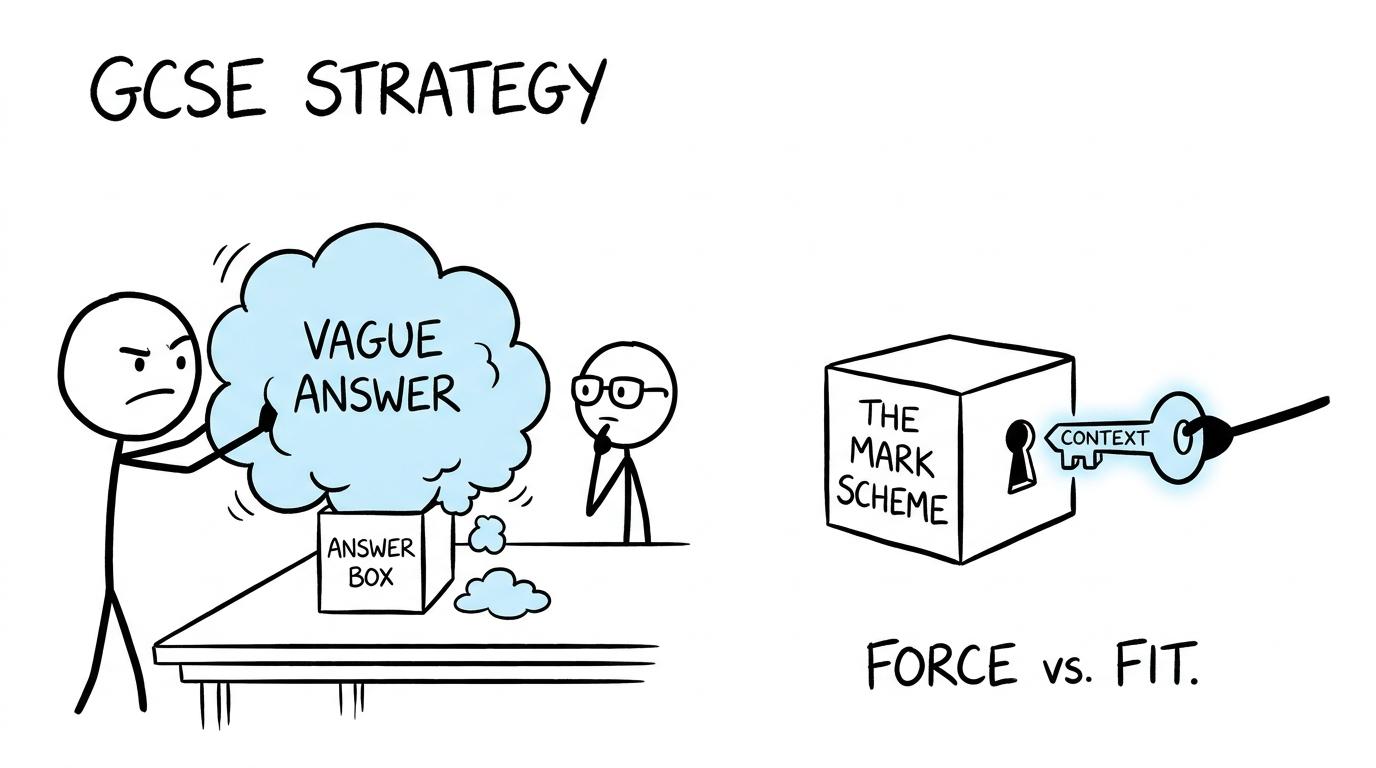 A vague answer being forced into an exam box while context fits the lock
Profit margin and markup use different starting amounts
Both are percentages involving profit, but their denominators are different.
A profit margin compares profit with revenue:
Profit margin=profitrevenue×100\text{Profit margin}=\frac{\text{profit}}{\text{revenue}}\times 100Profit margin=revenueprofit×100Markup compares profit per item with its cost:
Markup=profit per itemcost per item×100\text{Markup}=\frac{\text{profit per item}}{\text{cost per item}}\times 100Markup=cost per itemprofit per item×100Using “margin” and “markup” interchangeably can produce the wrong calculation and interpretation. It is also important to name the exact profit measure requested. Gross profit, operating profit and net profit do not automatically mean the same thing, and terminology varies between specifications.
Check your own board's formula sheet and specification rather than borrowing language from another course. MathsGenie's profit, margin and average rate of return resources help Edexcel students keep each measure separate.
Break-even is not the same as making a profit
At the break-even point, total revenue equals total costs. The business makes neither a profit nor a loss:
Total revenue=total costs\text{Total revenue}=\text{total costs}Total revenue=total costsContribution per unit is the selling price per unit minus the variable cost per unit. It contributes first towards fixed costs and then towards profit:
Contribution per unit=selling price per unit−variable cost per unit\text{Contribution per unit}=\text{selling price per unit}-\text{variable cost per unit}Contribution per unit=selling price per unit−variable cost per unitThe margin of safety is the amount by which actual or budgeted sales exceed break-even sales:
Margin of safety=actual or budgeted sales−break-even sales\text{Margin of safety}=\text{actual or budgeted sales}-\text{break-even sales}Margin of safety=actual or budgeted sales−break-even salesIt is not profit and it is not a percentage unless the question or specification explicitly expresses it that way. It measures how far sales could fall before the business reaches break-even. The costs, revenue and break-even revision guide explains the connected terms in one place.
Net cash flow and closing balance are different
Cash inflows are amounts entering the business. Cash outflows are amounts leaving it. Net cash flow compares the two during a period:
Net cash flow=cash inflows−cash outflows\text{Net cash flow}=\text{cash inflows}-\text{cash outflows}Net cash flow=cash inflows−cash outflowsThe closing balance also includes the opening balance:
Closing balance=opening balance+net cash flow\text{Closing balance}=\text{opening balance}+\text{net cash flow}Closing balance=opening balance+net cash flowA business may have negative net cash flow for a month but retain a positive closing balance because it began with enough cash. Calling the closing balance “net cash flow” ignores the opening amount and can lead to a faulty judgement about liquidity.
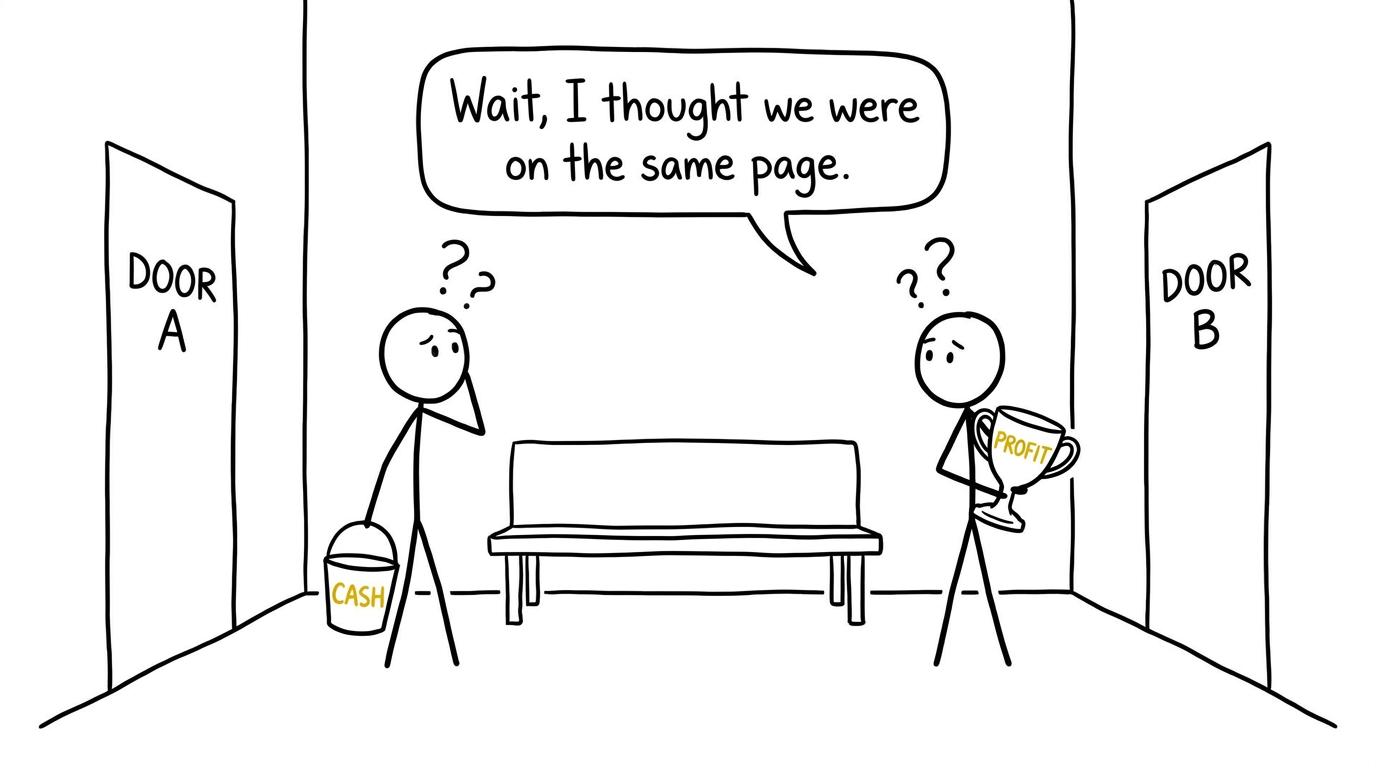 Cash and profit arriving through different doors
Non-financial terms that are easily blurred
Aim and objective
An aim is a broad, long-term intention. An objective is a more specific target that helps a business pursue an aim. Writing that both are simply “things a business wants” misses the distinction. Use the business aims and objectives guide to connect objectives with context.
Stakeholder and shareholder
A shareholder owns shares in a company. A stakeholder is any individual or group with an interest in, or affected by, the business. Shareholders are stakeholders, but employees, customers, suppliers and local communities may be stakeholders without owning shares.
Productivity and production
Production is the creation of goods or services, often discussed as total output. Productivity measures output relative to an input, such as output per worker:
Labour productivity=outputnumber of employees\text{Labour productivity}=\frac{\text{output}}{\text{number of employees}}Labour productivity=number of employeesoutputProduction can rise without productivity rising if the business uses proportionally more resources.
Promotion and marketing
Promotion is communication intended to inform or persuade customers. Marketing is broader: it includes understanding customer needs and making decisions about product, price, place and promotion. Calling advertising “the marketing mix” reduces four connected decisions to one component. Revisit the distinction in the OCR marketing mix lesson.
Span of control and chain of command
Span of control is the number of subordinates directly managed by one manager. The chain of command is the route through which authority and communication pass. One describes how many direct reports there are; the other describes the line of authority. The organisational structures revision guide makes this distinction visible.
Command words are part of business terminology
Knowing the content is not enough if the response performs the wrong task. Although exact expectations vary by exam board, the broad distinctions are consistent:
- Define gives the precise meaning of a term.
- Identify selects the relevant item, often from data or context.
- Explain develops a reason or consequence.
- Analyse explores connected effects in context.
- Justify supports a choice using relevant evidence.
- Evaluate weighs evidence and reaches a supported judgement.
- Calculate uses the data mathematically and should show working and units.
A definition does not become analysis merely because it is long. Analysis needs a chain: business factor, immediate effect and developed consequence, all tied to the case. The Edexcel interpretation lessons help students move from selecting evidence to explaining why it matters.
Common GCSE Business terminology mistakes
These errors are especially worth checking in practice papers:
- Calling all sales income profit rather than revenue.
- Treating profit and cash as the same measure.
- Saying fixed costs can never change.
- confusing variable cost per unit with total variable cost.
- Using sales volume when the data shows sales value.
- Describing market size as market share.
- Using margin and markup as synonyms.
- Calling a positive closing balance positive net cash flow.
- Saying break-even means the business has made a profit.
- Treating every stakeholder as a shareholder.
- Using production and productivity interchangeably.
- Giving a generic advantage without applying it to the named business.
- Writing an explanation when the command word requires a judgement.
One inaccurate word does not automatically lose a mark in every question; mark schemes reward the meaning communicated. But when the wrong term changes that meaning, it can weaken knowledge, application, analysis or the interpretation of a calculation.
Turn precise vocabulary into reliable marks
Terminology improves through retrieval and correction, not rereading alone. Create pairs of terms you confuse, cover the definitions, recall them, then use each in a sentence based on a business context. When marking a paper, record the exact language error rather than writing only “definition wrong”.
Then connect vocabulary to the wider revision cycle. Use MathsGenie's revision lessons and flashcards to learn the distinction, practice questions and mini tests to retrieve it, and past papers to use it under time pressure. Check every response against the mark scheme and video solution. Nearer the exam, predicted papers can reveal whether the terminology still holds when topics are mixed.
The goal is not to sound complicated. It is to make each word carry the correct meaning. Start with the financial pairs that cause you most trouble, practise them on MathsGenie, and turn vague knowledge into answers an examiner can reward.











