

GCSE Biology Paper 1: What to Actually Expect
GCSE Biology Paper 1 explained: compare exam-board topics, timings and question styles, then revise practicals, data skills and calculations confidently.

The unsettling thing about a science exam is not always the content. It is the uncertainty. You may know what mitochondria do, yet still wonder whether the paper will ask for a definition, a calculation or an evaluation of an unfamiliar experiment.
GCSE Biology Paper 1 normally assesses the first group of topics listed in your exam board's specification. Expect a mixture of knowledge recall, practical understanding, data interpretation, calculations and longer explanations. The exact topics, duration and marks depend on whether you take AQA, Edexcel, OCR or Eduqas and whether you study separate Biology or Combined Science.
That distinction matters. Paper 111 is not one universal exam with the same structure everywhere.
GCSE Biology Paper 1 at a glance
Before revising, confirm these details with your teacher or the front cover of an official paper:
- your exam board;
- separate Biology or Combined Science;
- foundation or higher tier, where applicable;
- the topics assigned to the relevant component;
- the duration and total marks;
- which required or core practicals can be assessed;
- whether you may use a calculator.
For example, the current AQA separate Biology specification gives Paper 111 a duration of 111 hour 454545 minutes, with 100100100 marks. It assesses Cell Biology, Organisation, Infection and Response, and Bioenergetics. AQA Combined Science: Trilogy uses a shorter Biology Paper 111, so do not borrow timing advice from a separate-science student without checking your own course.
Edexcel's separate Biology Paper 111 is also 111 hour 454545 minutes and worth 100100100 marks, but its topic organisation is different. It covers Key Concepts in Biology alongside Cells and Control, Genetics, Natural Selection and Genetic Modification, and Health, Disease and the Development of Medicines.
OCR divides its Gateway Biology content and components differently, while Eduqas uses its own component titles and assessment pattern. In OCR Gateway Biology, even the component number depends on tier. The safe principle is simple: revise from your specification, not from somebody else's Paper 111 checklist.
 A tiny mitochondrion acts as an unexpectedly demanding revision assistant
What is actually different about Paper 1?
Paper 111 is different mainly because of content allocation, not because it uses a completely different species of question.
Your specification places particular topics on the first paper. Later content is generally assessed on another paper or component, although some exam boards identify ideas that underpin both. Edexcel, for instance, includes Key Concepts in Biology across its Biology papers. That is why treating the course as two sealed boxes can be risky.
The first paper often feels foundational because it includes ideas such as cells, enzymes, transport, organisation and biological processes. Those ideas can then appear inside unfamiliar contexts. A question about osmosis may be presented through plant tissue data rather than a familiar diagram. A question about enzymes may ask you to interpret an investigation rather than recite the definition of an active site.
Paper 111 therefore does not merely ask, “Can you remember the first half of the course?” It asks, “Can you use that knowledge when the presentation changes?”
The question types you should expect
Across the main exam boards, GCSE Biology assessments use a broad combination of question styles. Exact wording varies, but the following demands are common.
Short recall questions
These assess accurate biological knowledge: naming a structure, stating a function or identifying a process. They may carry relatively few marks, but vague language can still lose them.
A cell membrane and a cell wall are not interchangeable. Respiration and breathing are not synonyms. Precision is part of the science.
Application questions
An application question places familiar biology in an unfamiliar setting. The organism, treatment or apparatus may look new, but the underlying principle comes from your specification.
Do not assume that unfamiliar context means unfamiliar content. Strip the question back and ask which topic it is testing: diffusion, enzymes, pathogens, photosynthesis, respiration or something else from your course.
Practical and investigative questions
Required or core practicals are not assessed only through requests to describe a memorised method. You may need to:
- identify variables;
- suggest a control variable;
- explain why a method improves validity;
- discuss repeat measurements;
- identify hazards and suitable precautions;
- interpret anomalous results;
- evaluate limitations;
- suggest a realistic improvement.
Learn what each stage of a practical achieves. A memorised list of instructions is fragile; understanding the reason for each instruction is much easier to adapt.
Data, graph and calculation questions
Biology contains more mathematical reasoning than many students expect. Questions may involve percentages, ratios, means, rates, magnification, standard form, scales and graph interpretation.
Useful relationships include:
magnification=image sizeactual size\text{magnification}=\frac{\text{image size}}{\text{actual size}}magnification=actual sizeimage sizeand
rate=change in quantitytime\text{rate}=\frac{\text{change in quantity}}{\text{time}}rate=timechange in quantityThese are not worked examples to memorise. They are relationships you must be able to select, rearrange and use with consistent units.
AQA's Biology assessment includes a minimum mathematical-skills weighting across the qualification. Other boards also assess quantitative skills through their specifications. In practical terms, calculations are not optional extras. They are part of knowing biology.
If percentages or standard form slow you down, use the free GCSE Maths revision hub to strengthen the underlying skill. Students taking GCSE Statistics can also revisit Edexcel GCSE Statistics revision for structured work on data and graphs.
Extended-response questions
Longer questions reward connected reasoning. The command word may ask you to explain, compare, evaluate or discuss. A list of isolated facts is rarely enough when the question asks for a chain of biological reasoning.
A useful internal structure is:
- make a relevant scientific point;
- explain why it happens;
- connect it directly to the context or evidence;
- continue the chain where the number of marks suggests more development is needed.
Do not measure an answer by its physical length alone. A page of repetition is weaker than a short, accurate sequence of linked ideas.
How command words change the answer
The same topic can produce very different answers depending on the command word.
- State requires a concise fact.
- Describe requires the relevant features, pattern or sequence.
- Explain requires scientific reasons or linked causes.
- Compare requires similarities and/or differences, ideally using paired statements.
- Calculate requires a valid method, substitution and answer with appropriate units.
- Evaluate requires evidence-based strengths, limitations and a justified judgement.
- Suggest asks you to apply your knowledge to information that may be unfamiliar.
Circle or underline the command word when reading the question. It is the shortest instruction on the page, but often the most important.
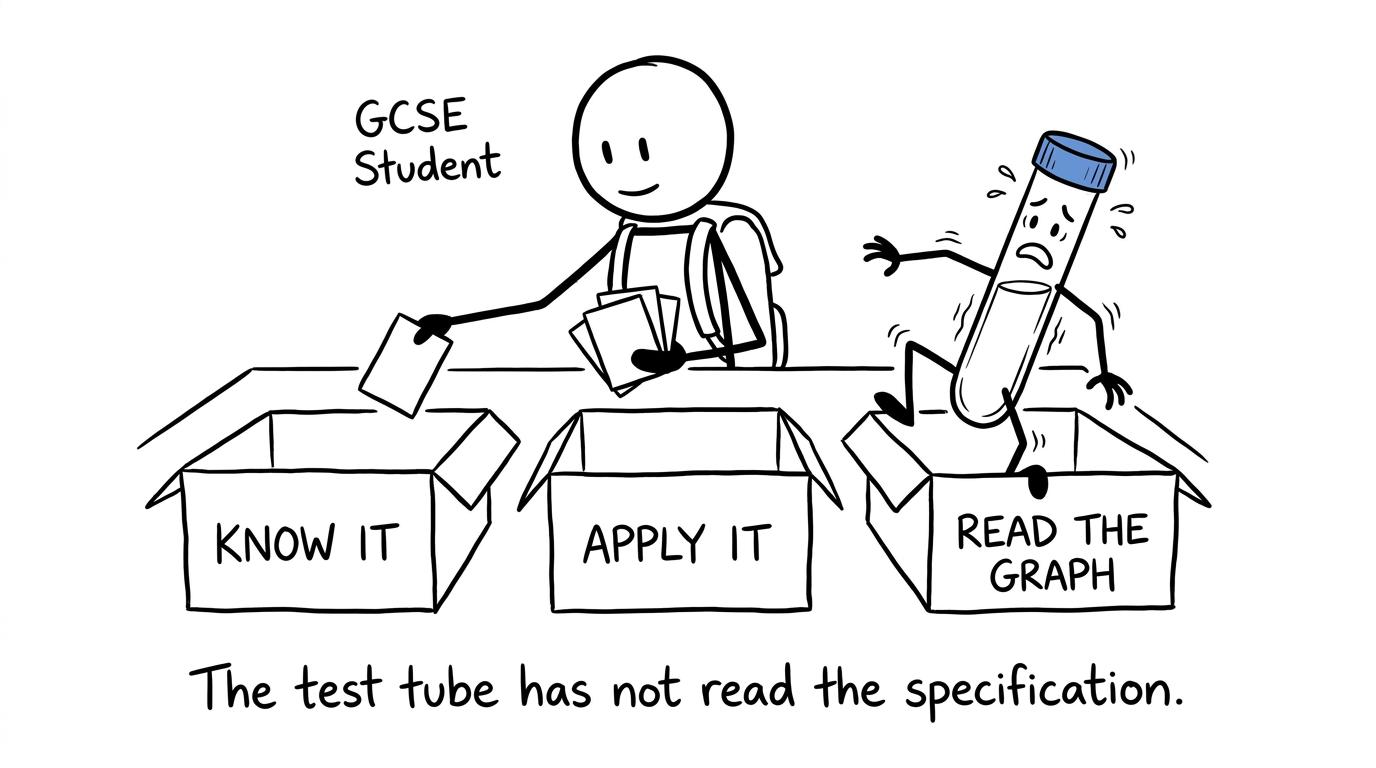 A revision-card sorting system is disrupted by an overenthusiastic test tube
A practical revision plan for Paper 1
A calm plan separates knowledge, application and exam technique rather than trying to improve all three through rereading.
Build a specification checklist
Copy the Paper 111 headings from your own exam board's current specification. Break broad areas into small, testable statements. “Cell Biology” is too large for one revision box; “compare eukaryotic and prokaryotic cells” is usable.
Mark each statement as secure, uncertain or weak. This turns anxiety into a list of decisions.
Retrieve before you reread
Close your notes and write what you can remember. Draw and label a structure from memory. Explain a process aloud. Then check what was missing.
Recognition can be misleading: a page may feel familiar because you have seen it often. Retrieval shows whether the knowledge is available without the page.
Pair each topic with questions
After revising a topic, answer exam-style questions immediately. Mark them carefully and record the cause of every lost mark:
- missing knowledge;
- imprecise terminology;
- misread command word;
- weak practical reasoning;
- calculation or unit error;
- incomplete explanation.
This approach mirrors the diagnostic method in MathsGenie's one-week GCSE revision plan: identify a small number of specific weaknesses, correct them and test them again. With more time available, the one-month GCSE revision plan provides a useful rhythm of retrieval, focused practice and timed papers.
Practise under the correct timing
Use papers for your board, qualification and tier. AQA separate Biology students can estimate an average of just over one minute per mark from a 105105105-minute, 100100100-mark paper, but that is only a pacing guide. Some short questions should take less time so that extended responses and data analysis can take more.
Complete some practice without pausing. Then mark it using the official mark scheme. The score matters, but the pattern behind it matters more.
Common mistakes on GCSE Biology Paper 1
Revising the wrong topic list
A checklist labelled “GCSE Biology” may belong to another board or to Combined Science. Confirm every topic against your own specification.
Memorising practical methods without understanding them
The apparatus can change. Learn the independent, dependent and control variables, the purpose of repeats, relevant safety measures and how the results should be processed.
Ignoring units and scale conversions
Write units during the calculation, not as a last-second decoration. Check whether measurements use millimetres, micrometres, seconds or minutes before substituting values.
Describing when asked to explain
“The rate increases” describes a pattern. An explanation must give the biological reason for that pattern. Use the command word to decide how far the answer must go.
Forcing remembered answers onto new contexts
Read the information supplied. Examiners may deliberately alter an organism, variable or treatment to test application. Answer the question on the page, not the one you hoped would appear.
Treating maths as separate from science
A correct formula can still lead to a lost mark through poor rearrangement, inconsistent units or an unreasonable answer. MathsGenie's guide to GCSE Maths topics that recur frequently can help you identify transferable skills such as percentages, ratio, standard form and graphs.
Make the exam feel less unfamiliar
Paper 111 becomes manageable when you stop treating it as a mystery. Its content is defined by your exam board. Its questions repeatedly test four broad things: what you know, whether you can apply it, whether you understand investigations and whether you can reason with evidence and numbers.
Start with the correct Biology specification and official papers. For the mathematical skills inside science, calculations, ratios, percentages, graphs and standard form, use MathsGenie's free GCSE Maths resources. Revision lessons rebuild the method, practice questions expose weak spots, and mini tests develop speed. Past papers, mark schemes, video solutions and predicted papers can then strengthen your GCSE Maths preparation alongside your science revision.
The goal is not to predict every Biology question. It is to become difficult to surprise.











