

GCSE Biblical Hebrew Weekend Revision Routine
GCSE Biblical Hebrew weekend revision made simple: plan two focused days for vocabulary, grammar, set texts, timed practice and calmer exam preparation.
The final weeks before an exam create a strange kind of pressure. You have enough time to improve, but not enough time to revise everything again from the beginning. That is why a GCSE Biblical Hebrew weekend revision routine should not be a heroic attempt to cover the whole course. It should be a controlled cycle of recall, timed practice, marking and repair.
For students balancing Biblical Hebrew with GCSE maths, the challenge is even sharper. Both subjects reward accurate thinking, but they demand different kinds of recall. The practical answer is to give Biblical Hebrew several focused blocks across Saturday and Sunday while keeping maths alive with one short, targeted session each day.
This routine is designed around the Pearson Edexcel GCSE Biblical Hebrew qualification. It is untiered, unlike foundation and higher tier maths, and contains two equally weighted components: Language and Literature. Always check your current specification, set texts and examination timetable with your school before planning the final weeks.
Your weekend revision checklist
By Sunday evening, aim to have completed:
- one closed-book vocabulary recall session
- one grammar and morphology session
- one unseen comprehension or translation task
- one focused review of each set text
- one timed literature response or question set
- one error log containing precise next actions
- two short GCSE maths maintenance sessions
- a planned stopping time and proper night of sleep
The order matters. Begin with retrieval, move into application, mark the work, then repair what the evidence reveals. Research on learning consistently supports retrieval practice and spaced review over passive rereading. In simpler terms, trying to remember is usually more useful than repeatedly looking.
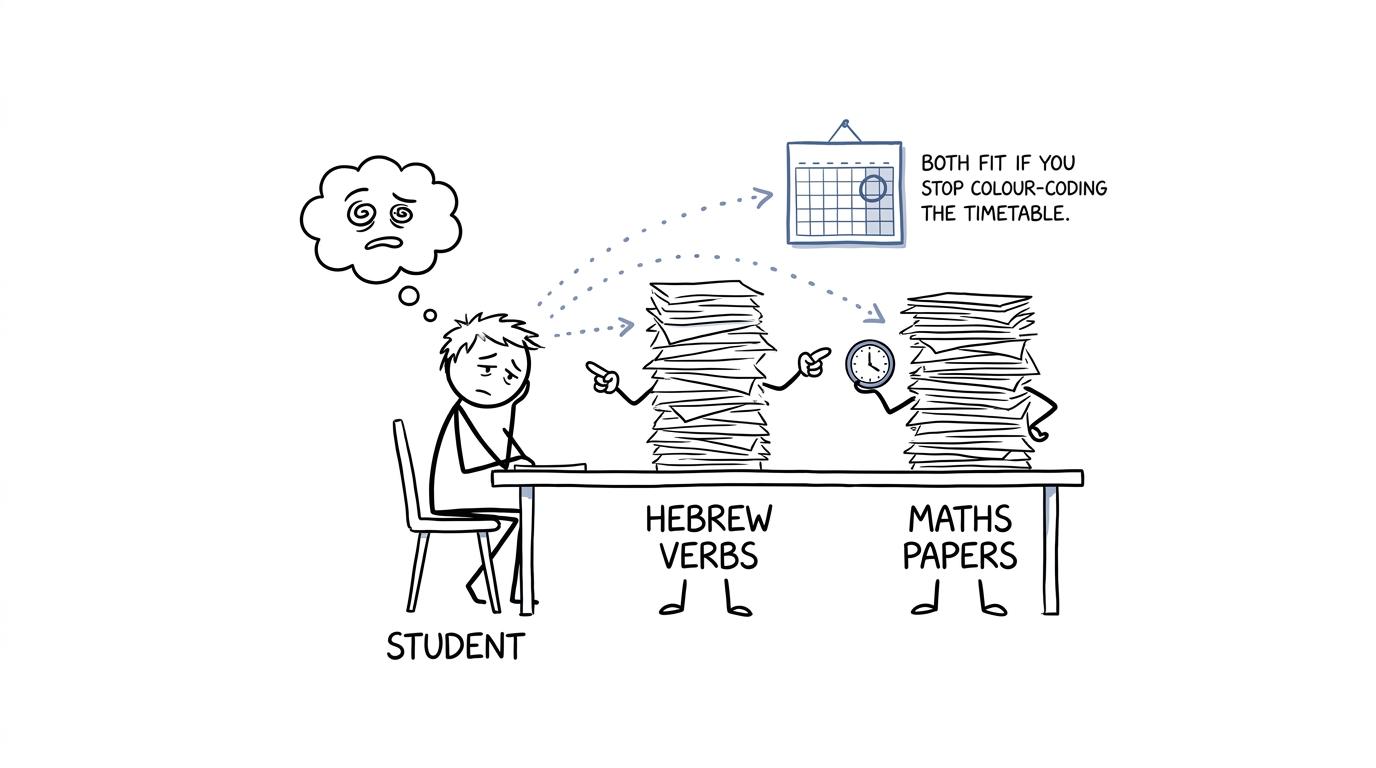 A student balancing Hebrew verbs and maths papers on a weekend timetable
Know what the Biblical Hebrew exams require
The current Pearson Edexcel GCSE has two externally examined components, each lasting 222 hours and contributing 50%50\%50% of the qualification.
Component 1: Language assesses comprehension and translation of unseen Biblical Hebrew passages. Students also choose between answering questions on grammatical structures or translating short English sentences into pointed Biblical Hebrew. Your revision should follow the option your teacher has prepared you for.
Component 2: Literature assesses knowledge, translation and analysis of two prescribed set texts. It includes short responses, translation, extended responses and a synoptic question requiring connections across the texts.
For examinations from 202620262026 to 202820282028, Pearson identifies the prescribed material as Joseph’s rise to power from Genesis and the miracles of Elisha from Kings. Check the exact chapters in the current specification rather than relying on an old revision folder. Set texts change between examination cycles.
Biblical Hebrew is not GCSE Modern Hebrew. It is also not divided into foundation and higher tiers. AQA, OCR and Eduqas are familiar names to maths students, but you should not use a Modern Hebrew specification or a legacy Biblical Hebrew document as the basis of your weekend plan.
Saturday morning: diagnose before revising
A common instinct is to begin with the most comfortable activity: reading vocabulary lists, highlighting notes or copying paradigms. That creates movement, but it does not tell you what you can retrieve under examination pressure.
Start with a short diagnostic covering four areas:
- vocabulary from the prescribed list
- recognition of roots, prefixes, suffixes and verb forms
- unseen comprehension or translation
- factual and literary knowledge of the set texts
Work without notes. If you cannot recall something, leave a gap rather than guessing and immediately checking. The gap is useful information.
When marking, label each error as one of the following:
- recall: you did not know the word, form or textual detail
- recognition: you knew it after seeing the answer but did not identify it independently
- analysis: you understood the passage but did not explain its significance
- English expression: your translation or response was unclear
- timing: you spent too long and rushed later work
This is the same diagnostic principle used in effective maths revision. MathsGenie’s guide to finding your weakest GCSE topics explains why evidence from attempted questions is more reliable than choosing a topic by feeling.
Saturday afternoon: repair language weaknesses
Your first major revision block should target the weaknesses exposed by the diagnostic. Divide it into three distinct activities.
Retrieve vocabulary actively
Cover the meanings and recall them from the Biblical Hebrew forms. Then reverse the direction where your course requires productive knowledge. Separate secure cards from uncertain cards and revisit the uncertain group later in the weekend.
Do not revise words only in the printed order of the specification. A fixed sequence can become an accidental clue. Shuffle cards and mix verbs, nouns, particles, prepositions and numbers so that retrieval resembles the unpredictability of an unseen passage.
Review morphology in context
Isolated paradigms are useful only if they help you read a passage. Practise identifying the root and explaining what prefixes, suffixes, person, number, gender, stem or aspect contribute to meaning, where relevant to your specification.
Keep a one-page confusion list. It should contain pairs or patterns you repeatedly mix up, not every grammatical rule you have ever learnt. The final weeks are about reducing recurring errors.
Attempt unseen material under time pressure
Choose an unseen passage or a section from an appropriate past or specimen paper. Work without vocabulary notes beyond anything the paper itself provides. Aim for accurate English that conveys the meaning of the original rather than an awkward word-for-word sequence.
Mark the attempt on the same day. A paper completed but never reviewed is only a record of what went wrong.
Maths students can use the same feedback loop with GCSE maths past papers for all boards. If you take Edexcel maths, the Edexcel GCSE maths past papers include mark schemes and solutions for checking exactly where marks were lost.
Saturday evening: keep the session light
Saturday evening should consolidate rather than introduce a large new topic. Spend a short block recalling vocabulary missed earlier, rereading your corrected translation and testing yourself on a small selection of set-text details.
Then stop.
A late-night session often feels serious because it is tiring. Tiredness, however, is not evidence of learning. Leave difficult literature analysis for Sunday morning, when attention is fresher.
If maths also needs attention, use a mini test or a small group of questions rather than beginning a full paper. The MathsGenie revision resources bring together mini tests, predicted papers, practice papers and other focused materials.
Sunday morning: turn set-text knowledge into answers
Literature revision can become passive very quickly. Reading a familiar chapter creates recognition, but the examination requires you to retrieve details, translate extracts and construct evidence-based responses.
For each prescribed text, close the book and write a brief map containing:
- the sequence of key events
- important characters and motivations
- major ideas, values and social practices
- significant literary features
- passages you can translate less confidently
- links and contrasts with the other set text
Only then reopen your notes and correct the map. Add missing information in another colour, but do not rewrite the entire page.
Next, plan or complete a timed literature task. Pay attention to the command word and the number of marks available. A response should answer the exact question, select relevant evidence and explain how that evidence supports the conclusion. Retelling the narrative is not the same as analysing it.
For the synoptic element, practise making explicit comparisons. Do not prepare one paragraph about the first text and another unrelated paragraph about the second. Build connections around a shared idea, contrast or social practice.
Sunday afternoon: practise the exam process
The afternoon is the right moment for a longer timed section because you have already refreshed language and literature knowledge. Choose the component closest to your next examination or the area that lost the most marks in Saturday’s diagnostic.
Before starting:
- remove your phone from reach
- use only the materials permitted for that task
- set a visible timer
- read the instructions and choices carefully
- reserve time for checking translations and unanswered questions
Afterwards, mark the work and record no more than five priority fixes. A short list creates action. A list of twenty vague weaknesses creates dread.
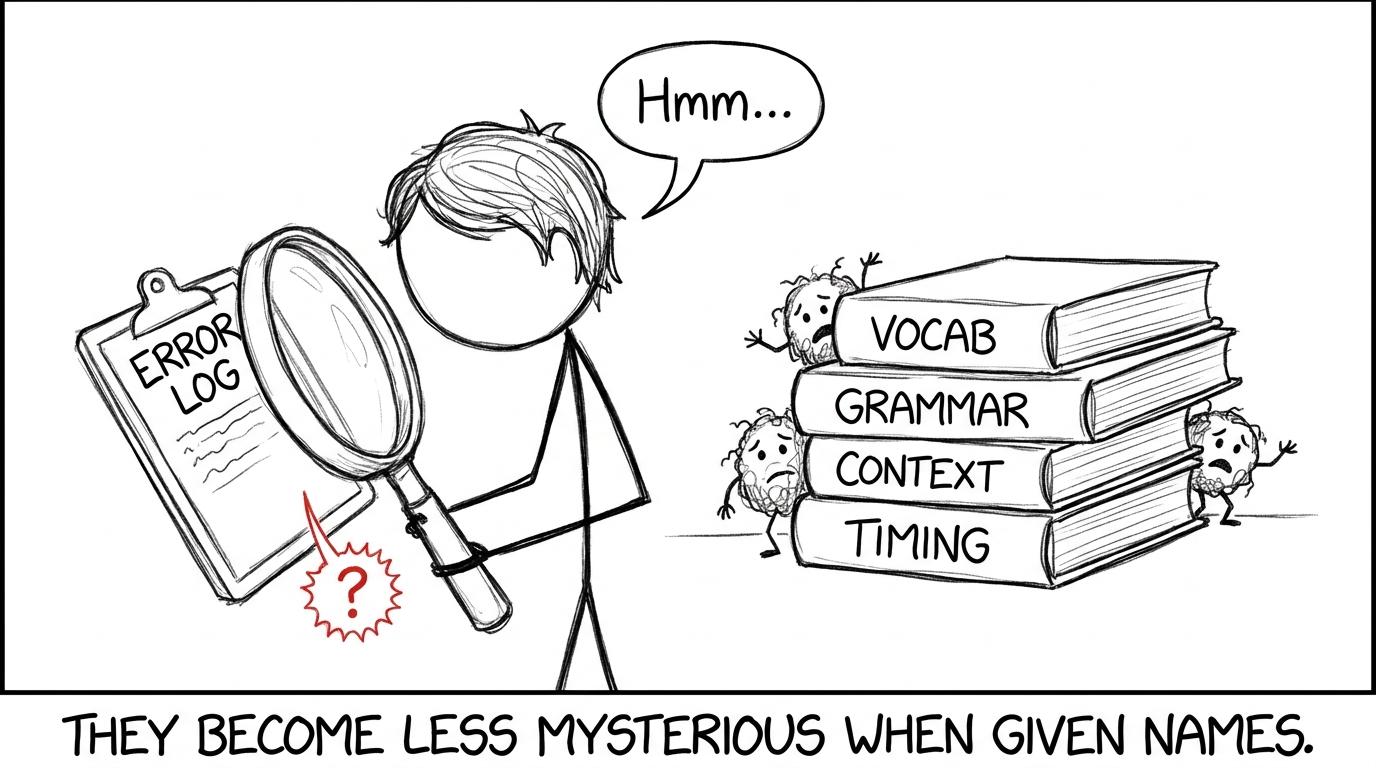 A student searching for named mistakes hiding behind revision books
Your error log should state what happened and what you will do next. “Grammar bad” is not useful. “I missed attached pronoun suffixes in two sentences; review the relevant forms and retest on Tuesday” is useful.
This approach transfers directly to maths. The MathsGenie guide to using past papers properly shows how to turn each lost mark into targeted practice rather than simply recording a score.
Fit maths around Biblical Hebrew without losing momentum
A Biblical Hebrew weekend does not need to become a zero-maths weekend. In the final exam period, continuity matters. One focused maths block on each day can preserve methods and expose anything that needs attention next week.
On Saturday, complete a short topic session or mini test. On Sunday, attempt a timed mixed section and mark it. Choose resources for your actual exam board and tier:
If the maths exam is very close, prioritise exam-style questions, mark schemes and video solutions. Predicted papers can provide useful additional practice, but they should complement official past papers and targeted revision rather than replace them.
Common weekend revision mistakes
Revising what feels familiar
Familiar chapters and vocabulary are comforting. Begin with the weakest evidence from your diagnostic instead. Confidence should follow accurate performance, not replace it.
Reading instead of retrieving
Rereading has a place after an unsuccessful attempt. It should not be the whole session. Close the book, recall first, check second and retest later.
Ignoring the choice in the Language paper
Prepare for the grammar or English-to-Biblical-Hebrew route taught by your school. Do not divide the final weekend between two options if you will answer only one in the examination.
Treating translation as word substitution
A successful translation must communicate the passage accurately in clear English. Check relationships between words and clauses before committing to a final meaning.
Using outdated set texts
Past papers may contain texts from an earlier examination cycle. They can still support technique, but they are not a substitute for revising the currently prescribed literature.
Completing work without marking it
Improvement happens during correction. Use mark schemes, teacher guidance and model responses to identify why marks were lost, then reattempt the weak skill.
Letting revision consume the whole weekend
A sustainable plan includes food, movement, breaks and sleep. Decide your finishing time before the evening arrives.
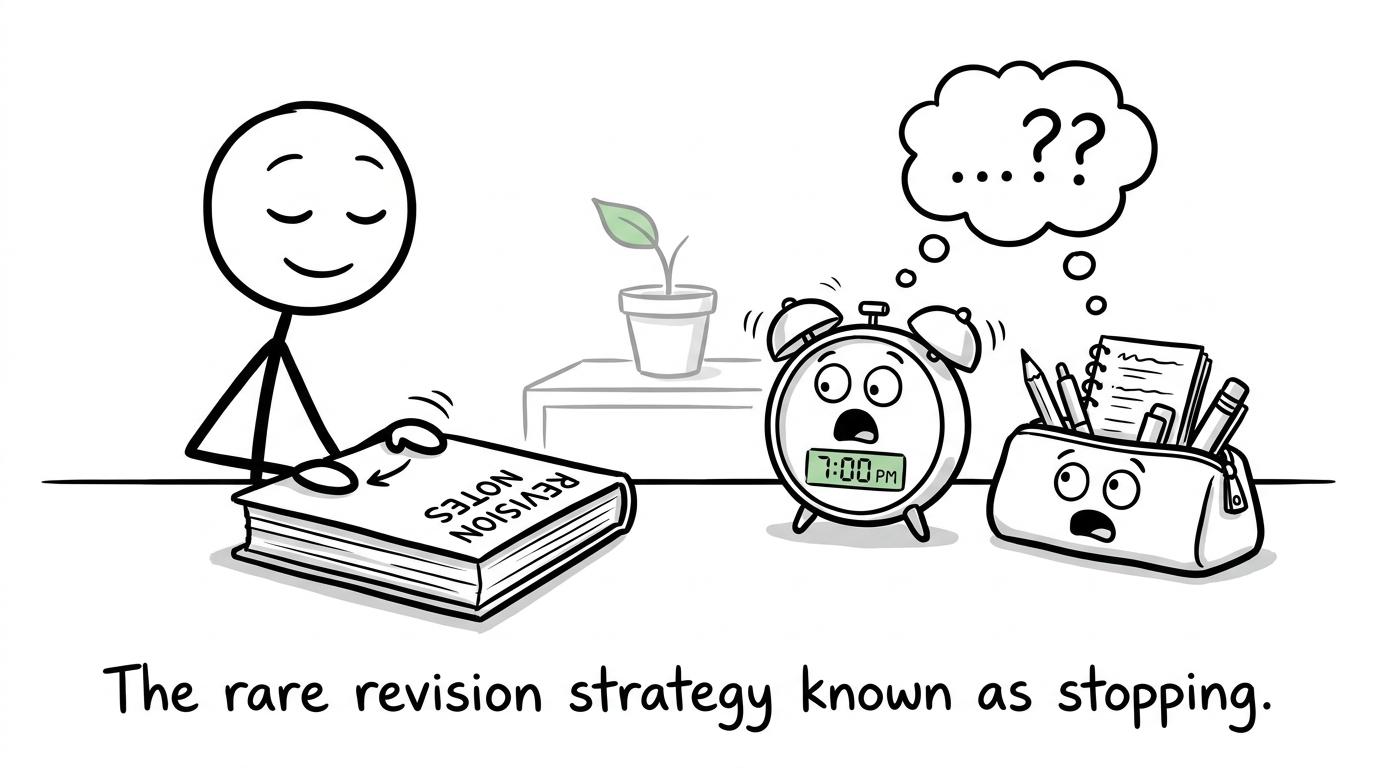 A calm student closes the books while a surprised alarm clock watches
Finish Sunday with a plan for the week
Spend the final few minutes scheduling brief returns to the material. Vocabulary missed on Saturday should reappear during the week. A weak translation feature should be retested with a new passage. A literature paragraph should be improved while the feedback is still clear.
The most valuable outcome of the weekend is not a large pile of completed pages. It is a smaller collection of weaknesses that you now understand and know how to repair.
For maths, let MathsGenie provide the same structure. Use free revision lessons to rebuild a method, practice questions and mini tests to retrieve it, then past papers and predicted papers to apply it under time pressure. Mark with the schemes, use video solutions when a method remains unclear, and add the next task to your revision planner.
Start with one honest diagnostic this Saturday. By Sunday evening, you should not merely have revised more. You should know more precisely what to do next.










