GCSE Biblical Hebrew Exam Start Time Explained
GCSE Biblical Hebrew exam start time explained, including 2027 sessions, permitted school variations, arrival advice and when writing begins.
The timetable may say “Morning” or “Afternoon”, but that does not quite answer the question circling in your head: When do I actually start writing? The short answer is that the published GCSE Biblical Hebrew exam start time is 9.00 am for a morning paper and 1.30 pm for an afternoon paper. However, UK centres may start a session up to 30 minutes earlier or later, so your school's candidate timetable and reporting instructions are the ones you must follow.
For summer 2027, Pearson Edexcel's provisional timetable places Component 1 in the morning and Component 2 in the afternoon. Because that timetable remains provisional at the time of writing, check the final version and your personal timetable before the examination series.
GCSE Biblical Hebrew exam timing at a glance
Here is the practical checklist:
- GCSE Biblical Hebrew is currently offered by Pearson Edexcel under specification code 1BH0.
- Component 1: Language is provisionally scheduled for Monday 10 May 2027, in the morning.
- Component 2: Literature is provisionally scheduled for Wednesday 19 May 2027, in the afternoon.
- The published UK session times are 9.00 am for morning examinations and 1.30 pm for afternoon examinations.
- A centre may normally start within 8.30 am to 9.30 am for a morning session or 1.00 pm to 2.00 pm for an afternoon session.
- Both Biblical Hebrew components last 222 hours.
- Your full examination time begins when the invigilator formally starts your paper, not when you enter the room.
- Your school may give you an earlier reporting time for registration, seating and instructions.
The distinction between arrival time, published session time and actual writing time is the key. Three times can appear to describe one event, but they serve different purposes.
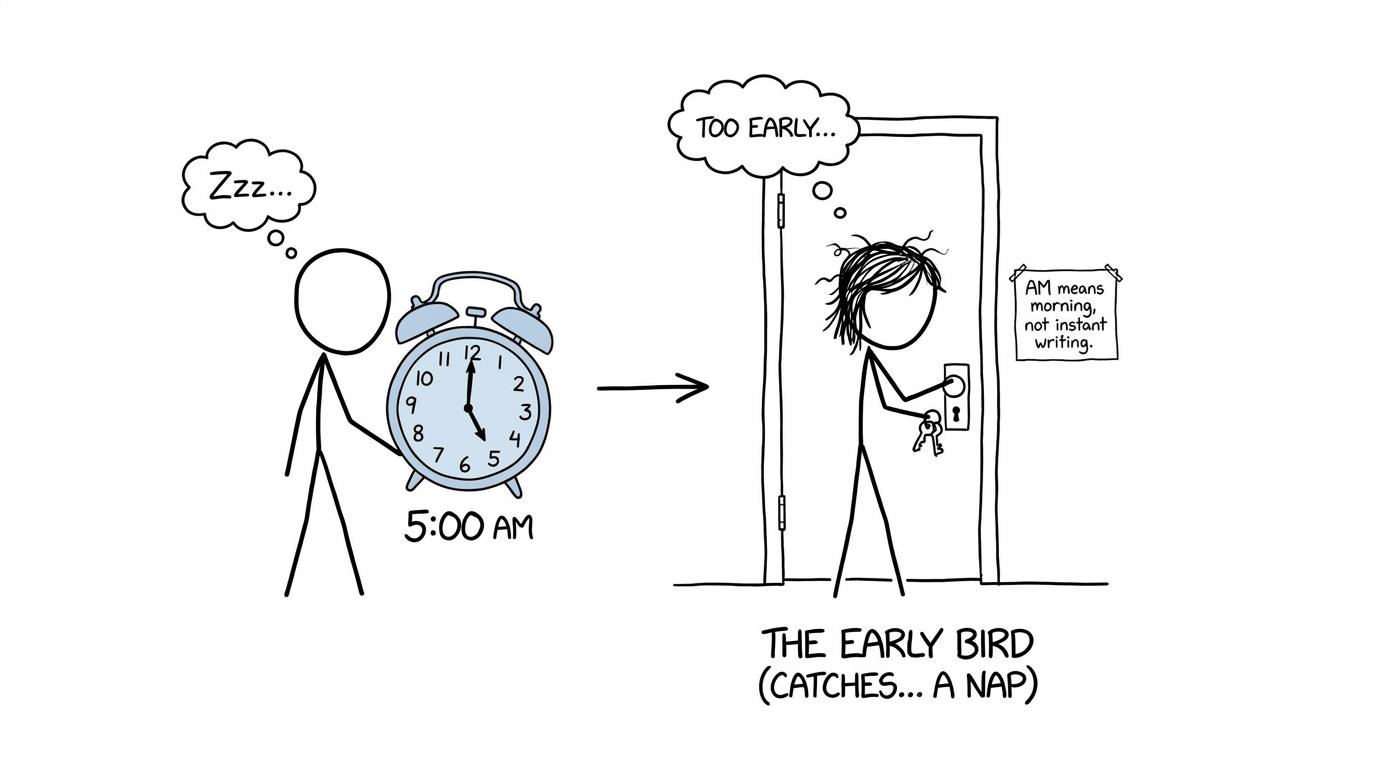 A student arriving extremely early for a morning examination
The official GCSE Biblical Hebrew exam start time
Pearson's published starting times for UK centres are 9.00 am and 1.30 pm. These are national session times used to coordinate examinations securely across the country.
They do not guarantee that every candidate begins at precisely the same minute. Under current Joint Council for Qualifications guidance, a UK centre can move the start by up to 30 minutes without requesting prior permission from the awarding body. That produces these ordinary starting windows:
| Timetabled session | Published start | Normal permitted window |
|---|---|---|
| Morning | 9.00 am | 8.30 am to 9.30 am |
| Afternoon | 1.30 pm | 1.00 pm to 2.00 pm |
This flexibility allows a school to organise several rooms, invigilators and groups of candidates without weakening paper security. It is also why advice found online cannot replace your own candidate timetable.
If your school tells you to report at 8.30 am for a 9.00 am session, that does not necessarily mean writing begins at 8.30 am. It may simply be the time by which you must register or wait outside the examination room. Equally, do not assume that a paper labelled “Morning” can be taken at any convenient point before lunch.
The confirmed and provisional dates you need to distinguish
The summer 2026 final timetable scheduled Component 1: Language for the morning of Thursday 7 May 2026 and Component 2: Literature for the afternoon of Tuesday 19 May 2026. Those dates have now passed.
For summer 2027, Pearson's latest published timetable is provisional:
| Component | Provisional date | Session | Duration |
|---|---|---|---|
| Component 1: Language, 1BH0/01 | Monday 10 May 2027 | Morning | 222 hours |
| Component 2: Literature, 1BH0/02 | Wednesday 19 May 2027 | Afternoon | 222 hours |
Provisional means exactly that: it is a planning timetable, not yet the final instruction for your journey to the examination hall. Save the dates, but check again when Pearson publishes the final timetable. Your school or examination centre should then issue a personal timetable showing your paper, room and reporting arrangements.
Do not confuse Biblical Hebrew with Modern Hebrew or with an OCR Religious Studies paper on Judaism. Similar words in a crowded timetable can hide entirely different specifications. Confirm the board, subject, component code and date together.
What happens from arrival to writing
The calmest examination mornings are often built the evening before. Not because everything has been memorised, but because the small decisions have already been made.
Before leaving home
Read your centre's candidate instructions and pack only permitted equipment. Biblical Hebrew candidates should follow the paper instructions and their centre's rules rather than assuming that materials used in lessons will be allowed in the examination.
If you also have maths examinations approaching, use the GCSE maths revision hub to check your board and tier, then keep the final evening measured. A short review is usually more useful than an exhausted attempt to cover an entire specification.
Set an alarm with enough margin for ordinary delays. The goal is not to arrive hours early. It is to remove the risk that one late bus becomes the defining event of the day.
Arriving at the centre
Follow the reporting time printed by your school. If no clear reporting time has been supplied, ask the examinations officer in advance rather than guessing from the national session time. Arriving roughly 20 to 30 minutes before the centre's stated start is sensible general planning, but your centre may require something different.
You may be asked to wait in a designated area, check a seating list or place belongings elsewhere. These local steps are not part of your 222 hours.
If you are delayed, contact the centre as soon as it is safe to do so and report directly to the examinations team when you arrive. Do not decide for yourself that being late means you should go home. The centre must apply the relevant late-arrival rules.
Entering the examination room
Formal examination conditions begin when you enter the room. From that point, you must not communicate with or disturb other candidates. Find your allocated seat and listen carefully, even if you have heard similar instructions in mocks.
A visible board should show information including the subject, paper number and actual starting and finishing times. Check that the paper is GCSE Biblical Hebrew and that the component code is correct. Component 1 is 1BH0/01; Component 2 is 1BH0/02.
This is a small check with a large purpose. Examination systems are designed around checks because humans become less observant when nervous.
Before the clock starts
The invigilator will explain the regulations and tell candidates when to complete the required details on the front of the question paper or answer booklet. Follow the instruction given in the room.
Do not open the question paper or begin answering until the invigilator announces that the examination has started. Sitting at your desk at 8.55 am does not mean five minutes of useful reading time. The sealed paper is still sealed time.
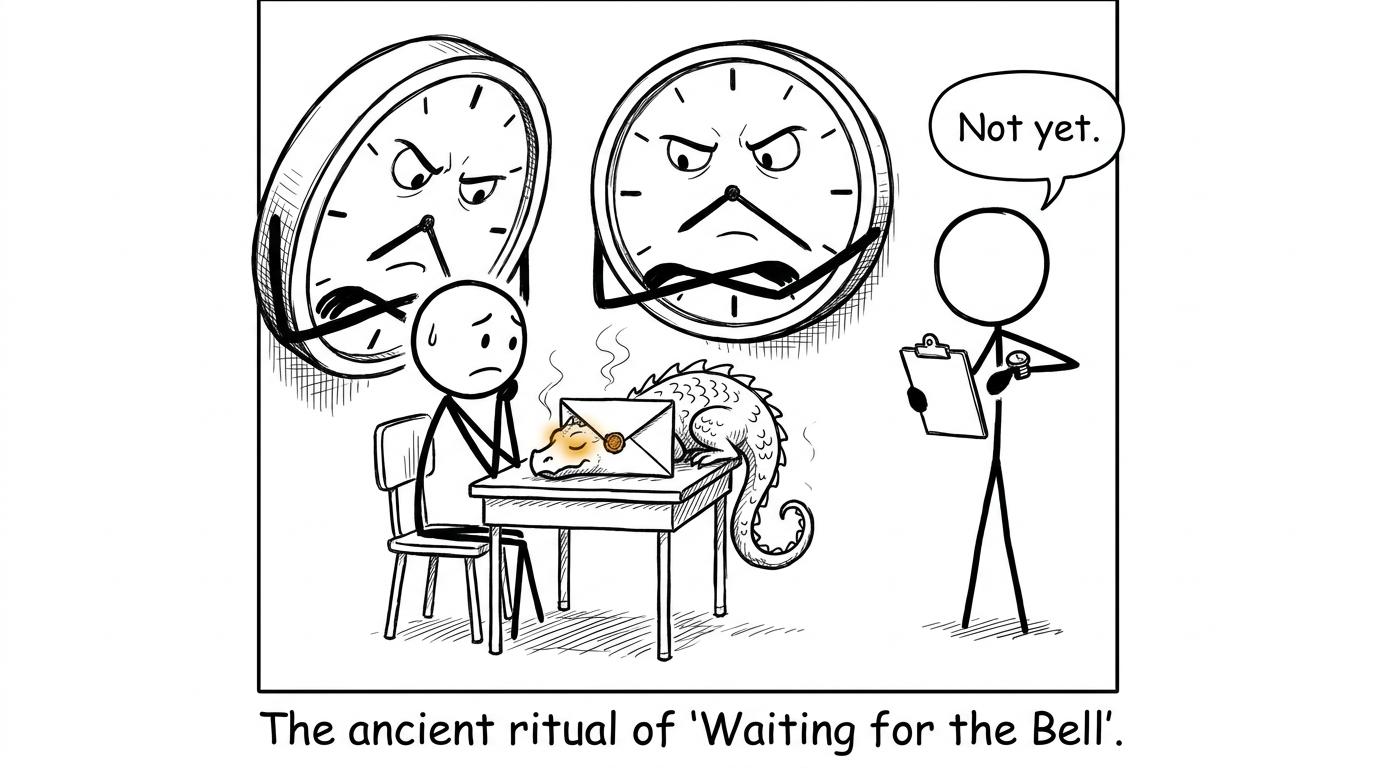 A candidate waiting for permission to open the question paper
When you actually start writing
Your writing time begins at the actual start announced by the invigilator. You must receive the full published duration of 222 hours.
If a morning paper begins at 9.00 am, the ordinary scheduled finish is 11.00 am. If the afternoon paper begins at 1.30 pm, the ordinary finish is 3.30 pm. A centre beginning at a different permitted time adjusts the finish accordingly.
Candidates with approved access arrangements may have a different finishing time. Rest breaks can also affect the clock differently from extra time, so rely on the arrangements confirmed for you rather than calculating them from somebody else's timetable.
Why this matters for maths revision too
Biblical Hebrew and maths test different knowledge, but examination-day timing is a transferable skill. A student who has practised starting a paper calmly, reading instructions and working for the full duration is building useful habits for every GCSE.
Timed practice should therefore rehearse the routine, not just the questions. Choose the correct board and tier, remove your notes, start a visible timer and continue without pausing. Afterwards, use the mark scheme to identify where marks disappeared.
MathsGenie makes that process straightforward through Edexcel GCSE Maths past papers, AQA GCSE Maths past papers and the OCR GCSE Maths revision hub. Shorter GCSE maths mini tests are useful when a full paper will not fit into your day.
The aim is familiarity. On the real day, the clock should feel like information rather than a threat.
Planning the day around two different sessions
A morning examination changes breakfast and travel. An afternoon examination changes lunch and the temptation to revise all morning. Neither needs an elaborate ritual.
For the morning Language paper, prepare your belongings the night before and protect your travel margin. For the afternoon Literature paper, eat normally and stop intensive revision with enough time to reach the centre without rushing. Avoid turning the hours before an afternoon paper into one continuous test of memory.
The same principle supports a busy maths timetable. A one-month GCSE maths revision plan can help you distribute practice before exam week, while the GCSE maths night-before plan keeps the final evening focused on preparation rather than panic.
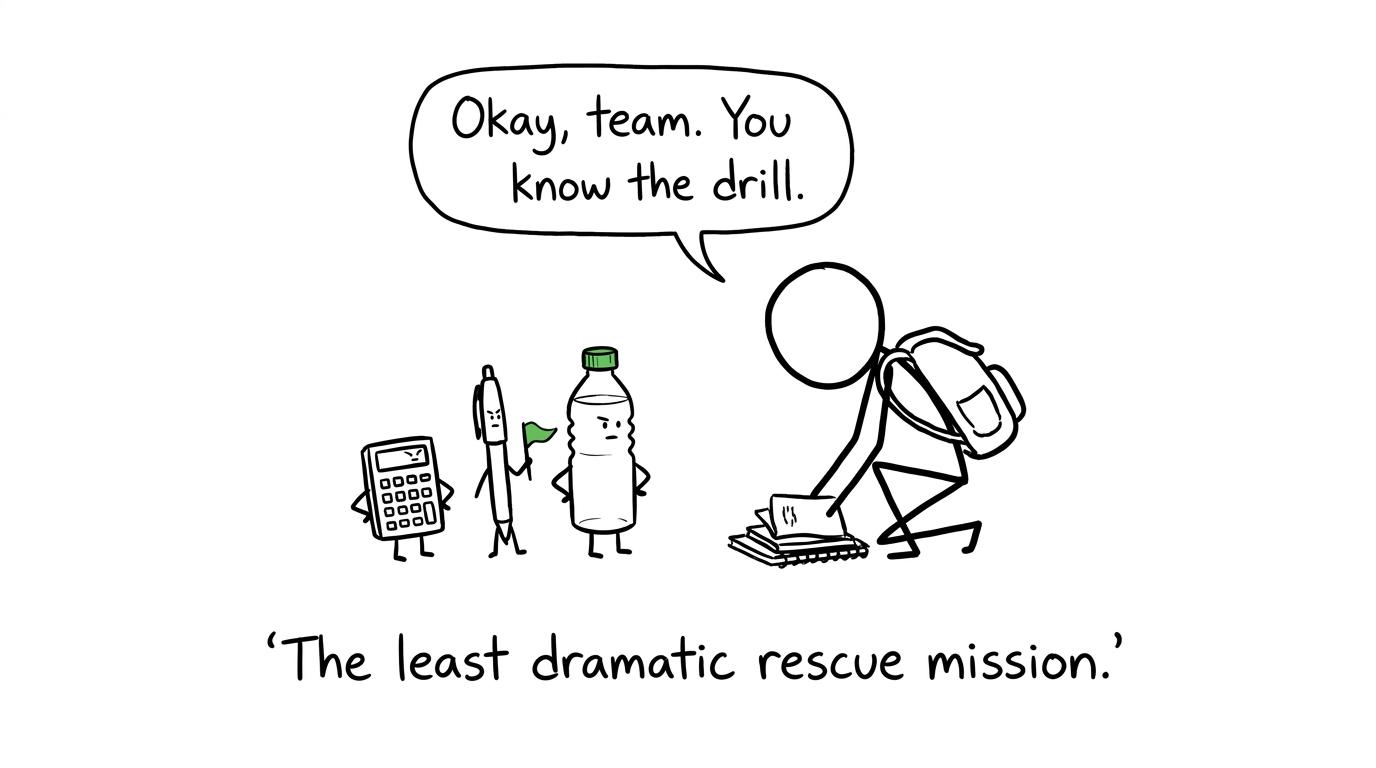 An exam kit preparing for a remarkably undramatic mission
Timetable clashes and unusual arrangements
If another examination appears in the same session, tell your examinations officer immediately. Do not choose which paper to attend or arrange an informal change with a teacher.
Centres manage timetable clashes under JCQ rules. Depending on the number and total duration of the papers, examinations may be taken consecutively, with formal supervision and a controlled break where permitted. Candidates can also have different arrangements because of approved access needs or exceptional circumstances.
These cases explain why one classmate may begin or finish at a different time. Their arrangement does not change yours.
Common mistakes to avoid
Treating “Morning” as an exact personal instruction
The national published time is 9.00 am, but your school can use the permitted window. Read your personal timetable.
Arriving at the published start time
If your centre says the paper starts at 9.00 am, walking through the gate at 9.00 am is late for the preparation process. Follow the earlier reporting time provided.
Using an old timetable
Search results can preserve past examination dates. Check the year, whether the timetable is provisional or final, and whether you are looking at Pearson Edexcel GCSE Biblical Hebrew.
Confusing reporting time with writing time
Registration, seating and instructions happen before the examination starts. Your 222 hours begin only when the invigilator starts the paper.
Opening the paper early
Do not open the question paper until instructed. Use the waiting time to listen, check the visible paper details and settle your breathing.
Assuming another candidate's arrangement applies to you
A timetable clash, access arrangement or separate room can change an individual's schedule. Confirm your own arrangements with the examinations officer.
Turn uncertainty into a simple plan
The answer is reassuringly small: morning papers have a published start of 9.00 am, afternoon papers have a published start of 1.30 pm, and your centre may operate within the permitted 30-minute window. For 2027, Language is provisionally a morning paper and Literature an afternoon paper. Your school's final candidate timetable tells you when and where to report.
Once that is written into your calendar, return your attention to what you can improve. Use MathsGenie's free revision lessons and practice questions to repair weak maths topics, then build confidence with past papers, Edexcel predicted papers, mini tests, mark schemes and video solutions. Good revision does not remove every nervous thought. It makes the next action obvious.