GCSE Biblical Hebrew: Go From Grade 4 to 7
GCSE Biblical Hebrew 4 to 7 guidance: improve translation, grammar, set-text analysis and exam technique with a focused, evidence-led revision plan.
A grade 4 can feel confusing. You know enough Biblical Hebrew to understand parts of a passage, yet unfamiliar forms, missed details and vague literature answers keep pulling your mark down. The route from GCSE Biblical Hebrew 4 to 7 is not simply to revise for longer. It is to become more accurate in language, more selective with evidence and more analytical when discussing the set texts.
The practical answer is this: strengthen vocabulary and morphology, translate by clauses rather than isolated words, learn the set texts as literature rather than scripts, and use marked exam practice to identify exactly where marks disappear.
That matters particularly when Biblical Hebrew sits beside GCSE maths and other demanding subjects. Your plan must improve performance without consuming every available evening.
The grade 4 to grade 7 checklist
A student moving towards grade 7 will usually need to:
- recognise prescribed vocabulary quickly and in context
- identify verb forms, suffixes and grammatical relationships accurately
- produce coherent English translations without adding unsupported meaning
- retrieve precise details from both set texts
- explain how literary features create effects
- compare the texts directly, using relevant evidence
- adapt answers to the command word and number of marks
- review mistakes systematically rather than merely completing more papers
The current Pearson Edexcel specification gives language and literature equal weight. Paper 1 assesses language, while Paper 2 assesses knowledge, analysis and response to literature. A weakness in either half can therefore limit the final grade.
What separates a grade 4 from a grade 7?
There is no permanent number of marks separating the two grades. Grade boundaries are set for each examination series, so an old boundary should be treated as context, not a prediction. The GCSE Biblical Hebrew grade boundaries show this movement clearly.
The more useful distinction is qualitative.
| Grade 4 performance often looks like | Grade 7 performance more often looks like |
|---|---|
| Recognises common words but loses meaning when forms change | Uses roots, morphology and syntax together to infer meaning |
| Translates word by word | Reconstructs each clause as accurate, natural English |
| Understands the broad narrative | Recalls precise events, speakers, motives and consequences |
| Names a literary feature | Explains the feature, its effect and its importance in context |
| Makes separate comments about two texts | Builds direct, supported comparisons between them |
| Finishes practice and records a score | Diagnoses lost marks, repairs the weakness and retests it |
A grade 4 answer often contains real understanding, but that understanding is uneven. Grade 7 performance is more dependable. The student makes fewer avoidable errors and develops ideas far enough to meet the assessment objective.
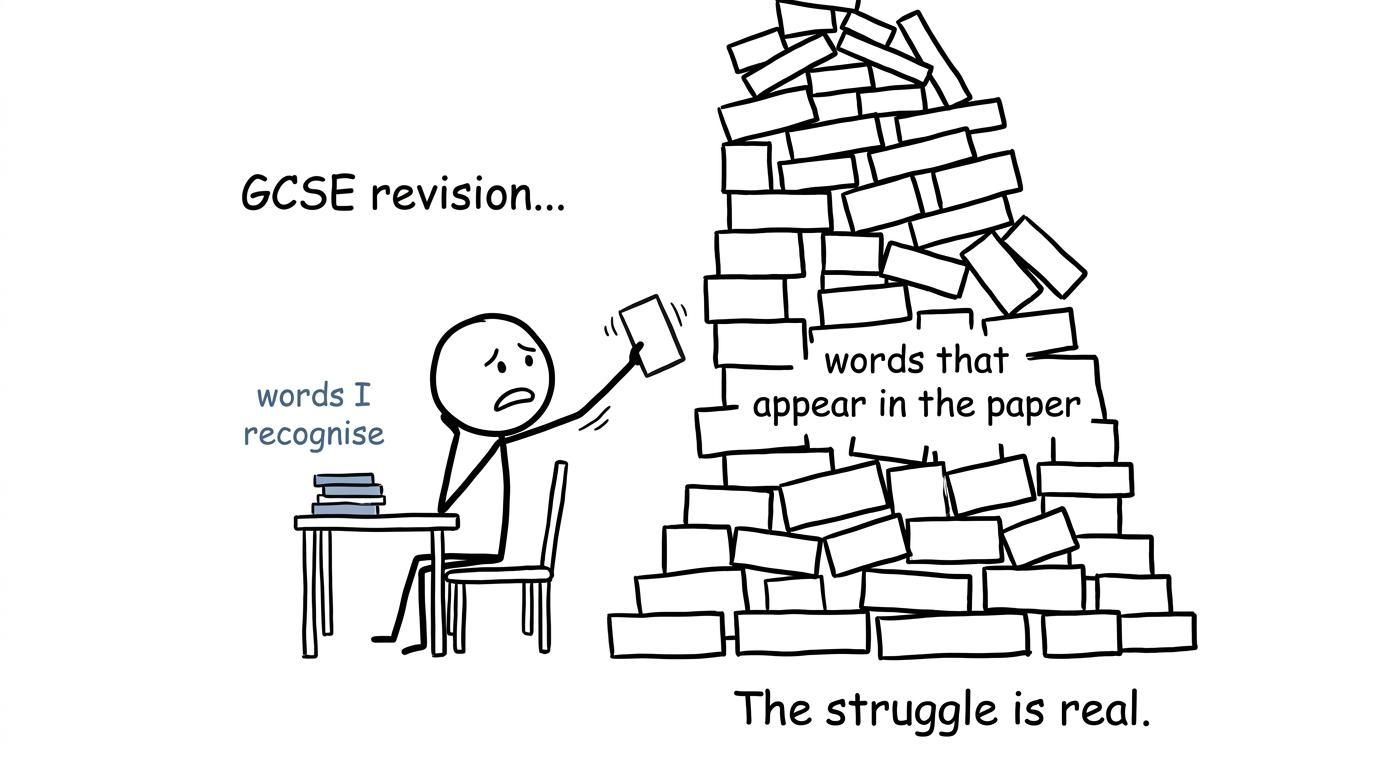 A student defending themselves from an enormous vocabulary pile with one flashcard
Build language accuracy before chasing speed
Paper 1 is a two-hour language examination worth half of the qualification. It includes comprehension and translation from unseen passages. Students also follow their centre's chosen option involving grammatical understanding or translation of simple English sentences into pointed Biblical Hebrew.
Learn vocabulary through retrieval
Rereading a vocabulary list creates familiarity, but the examination requires recall. Cover the answer, retrieve it and then check it. Practise in both directions where appropriate, while giving priority to recognition from Biblical Hebrew into English.
Keep difficult vocabulary in small groups:
- words with similar appearances
- words with several possible meanings
- common particles and prepositions
- verbs whose roots are harder to recognise
- words repeatedly missed in unseen passages
Revisit errors after a short delay. A word recognised immediately after correction has not necessarily entered long-term memory.
Read forms, not just roots
Recognising a root is only the beginning. Ask what the form tells you about person, number, gender, stem and aspect where relevant. Then look for attached prefixes, conjunctions, prepositions and pronominal suffixes.
This is one of the clearest changes between grade bands. A developing student sees a familiar root and guesses. A stronger student tests that root against the complete form and the surrounding syntax.
Create a morphology log with three entries for each error: the form you saw, the feature you missed and the clue that should have revealed it. This turns grammar from a large abstract subject into a collection of repairable patterns.
Translate clauses, not a line of dictionary entries
For each clause, establish:
- who performs the action
- what the action is
- who or what receives it
- how the clauses are connected
- whether any detail changes time, emphasis or possession
Then write natural English that preserves the original meaning. Avoid embellishment. A plausible sentence can still lose marks if it inserts information that the Hebrew does not support.
The specification's translation marking rewards communicated meaning as well as accuracy. That makes disciplined reconstruction more valuable than a polished guess.
Turn set-text knowledge into analysis
For examinations from 2026 to 2028, the prescribed selections are Genesis chapters 41 to 43, covering Joseph's rise to power, and Kings chapters 4 to 7, covering the miracles of Elisha. Confirm the precise prescribed material with your teacher and the current Pearson Edexcel specification.
Paper 2 lasts two hours and contains sections on both set texts, followed by a synoptic comparison. It includes short responses, set-text translation, extended responses and a comparison drawing on both texts.
Knowing the narrative is necessary. It is not sufficient.
Build a map of each text
For every episode, record:
- its position in the wider narrative
- the principal speakers and actions
- motives, values and social practices shown
- significant repetitions, contrasts or changes
- literary features and their effects
- links to another episode or the second set text
This structure prevents two common problems: remembering an event but placing it incorrectly, and identifying a feature without explaining why it matters.
Move from feature spotting to interpretation
If a question asks about literary style, naming repetition, direct speech or irony is only the opening step. A developed answer explains what the choice emphasises, how it shapes the reader's understanding and why it is significant at that moment.
A useful internal sequence is:
evidence, feature, effect, significance.
Your final response should read as connected prose, not as four mechanical labels. The sequence is a thinking tool that keeps analysis from stopping too early.
Compare directly
The synoptic task requires familiarity with both complete set texts. Do not write one miniature essay on Genesis and another on Kings before adding a final sentence saying they are different.
Organise the answer around comparison points. For each point, make a claim about both texts, provide accurate support and explain the significance of the similarity or difference. Strong comparison is woven through the response.
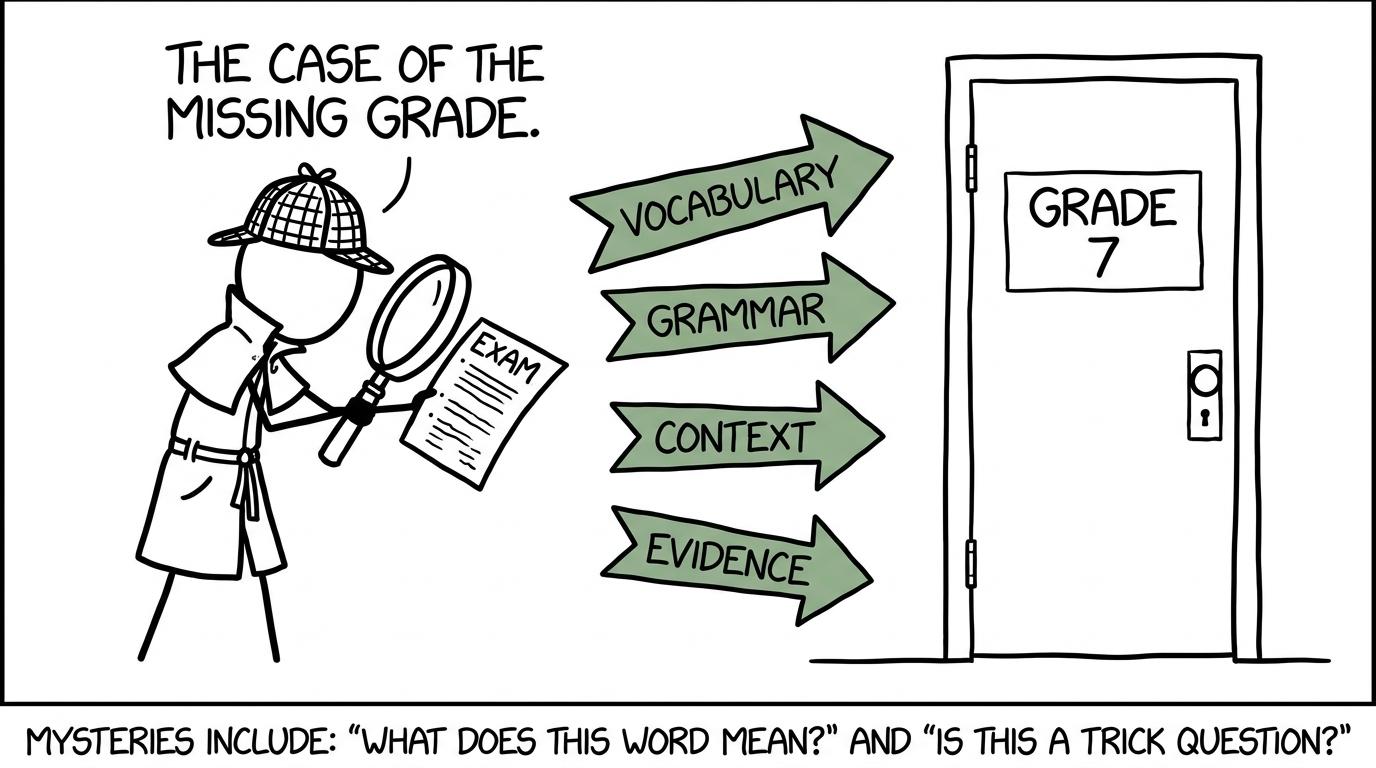 A student detective follows vocabulary, grammar, context and evidence clues towards grade 7
Use mark schemes as revision documents
A completed paper tells you what happened. A marked and analysed paper tells you what to do next.
After every timed section, classify each lost mark:
- vocabulary gap
- morphology or syntax error
- mistranslation or omission
- set-text knowledge gap
- unsupported analysis
- incomplete comparison
- command-word mistake
- timing or checking failure
This resembles the method in MathsGenie's guide to finding your weakest GCSE topics. The subject differs, but the principle survives: marks are evidence.
Choose the two largest recurring problems. Repair them with focused practice, then attempt a fresh question testing the same skill. Merely reading the correct answer can create an illusion of progress.
A revision routine that protects your maths preparation
Students taking Biblical Hebrew are rarely revising it in isolation. If maths also needs attention, use short, repeatable sessions rather than allowing one subject to take over the week.
A balanced Biblical Hebrew session could contain:
- brief vocabulary retrieval
- one morphology or grammar focus
- one unseen clause or short passage
- one set-text recall or analysis task
- immediate marking and one written correction
Across the week, include one longer timed section. As the examination approaches, build towards complete papers under the correct conditions.
For maths, keep the same learn-practise-test cycle. The GCSE maths revision hub brings together board-specific revision for Edexcel, AQA, OCR and Eduqas. Use GCSE maths mini tests when time is limited, then move to Edexcel GCSE maths past papers for full-paper practice if that is your board.
The aim is not to pretend that maths resources teach Biblical Hebrew. They do not. The value is organisational: revision lessons, practice questions, video solutions, mini tests and mark schemes give your maths work a clear home, leaving you more time to follow your school's Biblical Hebrew materials.
If the examinations are close, the one-month GCSE revision plan offers a useful model for spacing diagnosis, targeted practice and timed papers across a crowded timetable.
Common mistakes that keep students near grade 4
Memorising translations without understanding the language
A familiar set-text translation can conceal weak parsing. When the examination isolates an extract or asks about a form, memorised English is not enough. Link every translation to vocabulary, morphology and syntax.
Guessing from one familiar word
One recognised root can pull an entire sentence in the wrong direction. Parse the complete form and confirm that your interpretation fits the clause.
Giving narrative summary instead of analysis
Retelling what happened demonstrates some knowledge, but analytical questions require effects, significance and supported judgement. Check the command word before writing.
Making assertions without textual support
A sensible idea is not automatically a rewarded idea. Select a precise detail from the prescribed text and explain how it supports the claim.
Treating comparison as two separate responses
Make both texts visible within each main comparison point. Use similarities and differences to reach a reasoned conclusion rather than attaching a brief comparison at the end.
Counting completed papers instead of corrected errors
Volume can feel productive because it is measurable. Improvement happens after marking, when a recurring weakness is isolated and fixed.
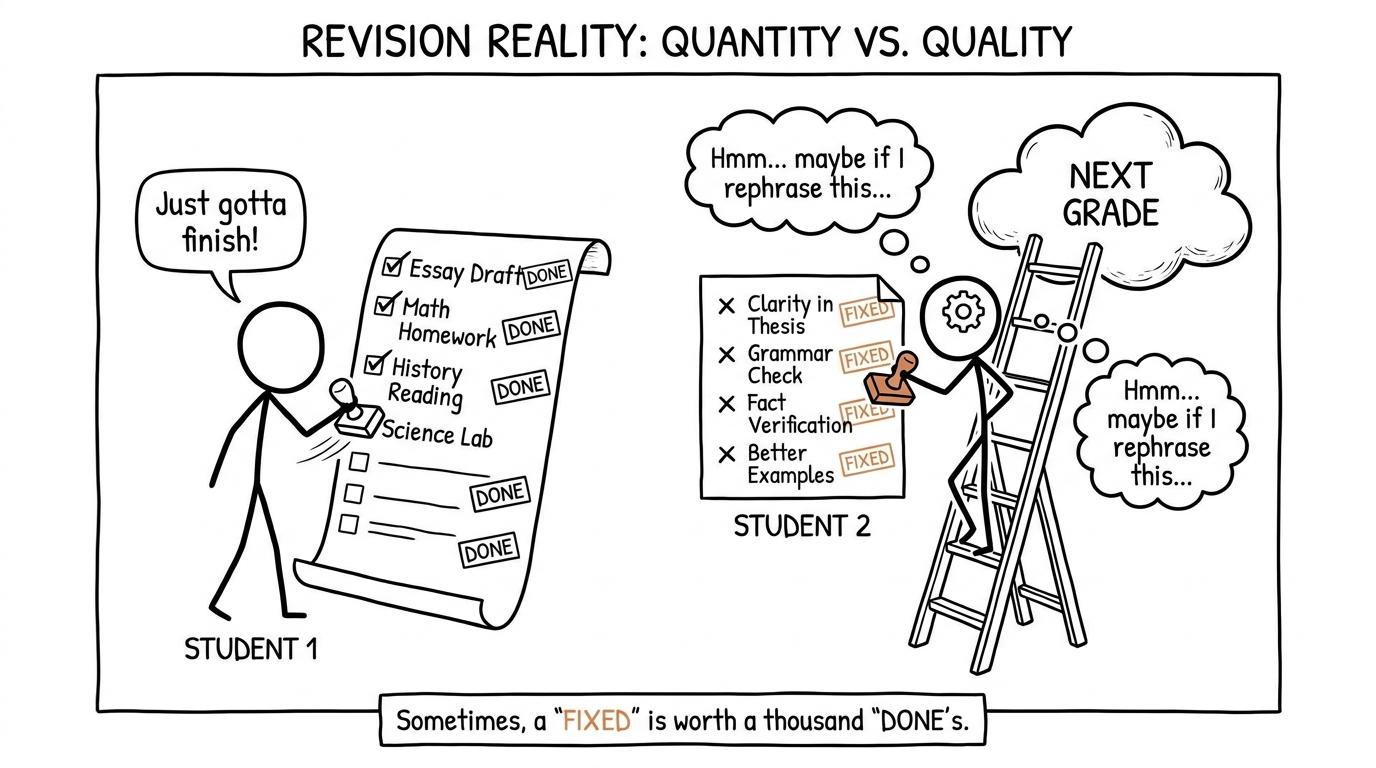 One student stamps revision tasks done while another builds a ladder by fixing mistakes
Make grade 7 the result of a better process
The move from grade 4 to grade 7 in GCSE Biblical Hebrew is not one dramatic leap. It is a collection of smaller changes: retrieving rather than rereading, parsing rather than guessing, analysing rather than retelling, and correcting rather than simply counting papers.
Begin with one timed diagnostic. Separate language losses from literature losses, identify the two patterns costing the most marks and repair those first. Then retest them. That is how an ambitious grade becomes a practical sequence of decisions.
Keep your wider GCSE revision equally deliberate. Use MathsGenie's free revision lessons and practice questions to strengthen individual maths topics, mark your work carefully, and move on to mini tests, past papers and predicted papers when you need exam-condition practice. Open the GCSE Maths revision resources, choose the next useful task and let evidence, not panic, decide what you revise tomorrow.