GCSE Bengali Revision Drop-In Sessions: Worth It?
GCSE Bengali revision drop in sessions can sharpen speaking and feedback. Learn when school sessions beat solo revision and how to combine both for exams.

The hardest revision decision is not always what to learn. Sometimes it is where to spend the next hour. A teacher is running a Bengali session after school, but you could go home, work independently and still leave time for maths. So, are GCSE Bengali revision drop in sessions worth attending?
Usually, yes, provided the session gives you something that solo revision cannot easily provide. Immediate feedback, speaking practice and help with specific misunderstandings are valuable. But a vague session where you passively reread notes is unlikely to beat focused independent practice. The strongest approach is normally a combination: use drop-ins for interaction and expert feedback, then revise alone for repetition, recall and timed work.
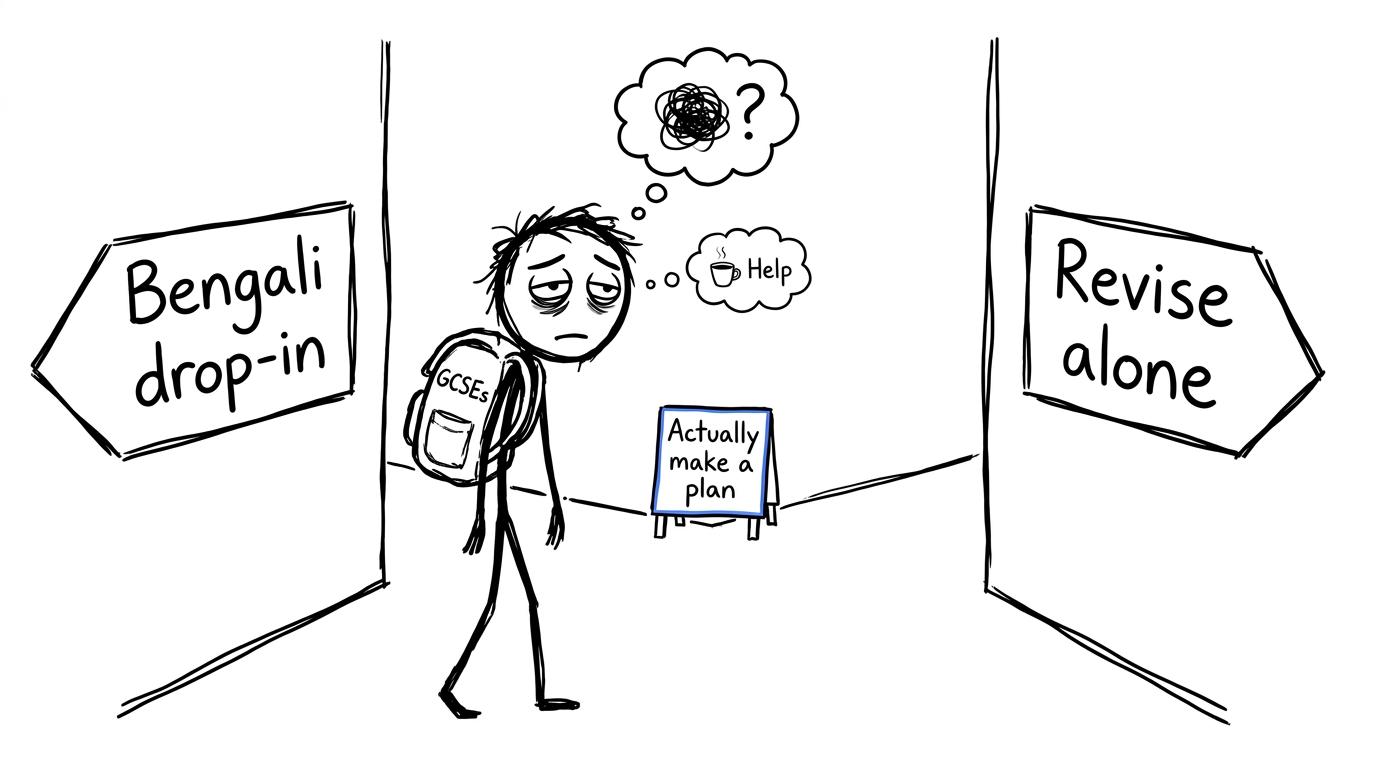 A student choosing between a Bengali drop-in and revising alone while a third sign recommends making a plan
The quick decision checklist
A Bengali drop-in is probably worth attending when:
- you can bring a precise question or piece of work;
- the teacher can correct speaking, pronunciation or writing;
- you need a partner for spontaneous conversation;
- you are unsure how the mark scheme rewards an answer;
- the session is focused on the qualification and tier you are taking;
- attending will not replace an urgent revision task in another subject.
Independent revision may be better when:
- you already know exactly what needs practising;
- you need quiet, repeated vocabulary retrieval;
- the drop-in has no clear structure;
- travel or waiting would consume most of the available time;
- you have imminent maths work requiring timed practice.
The question is not whether group revision is universally better than solo revision. It is whether the session offers a better use of this particular hour.
What a useful GCSE Bengali drop-in should cover
For AQA GCSE Bengali, the assessment covers listening, speaking, reading and writing. Each skill contributes 25%25\%25% of the qualification, and students take all components at the same tier. That balance matters. Revising only vocabulary lists or prepared paragraphs can create confidence in one narrow area while leaving other parts exposed.
Check your own specification before planning. A Pearson International GCSE Bangla course, for example, is not structured in exactly the same way as AQA GCSE Bengali. Your teacher should be able to confirm your awarding body, specification and assessment format.
Speaking that cannot be recreated easily alone
Speaking is where school sessions often have their clearest advantage. A teacher or partner can ask an unexpected follow-up question, notice unclear pronunciation and tell you when an answer sounds memorised rather than responsive.
You can rehearse independently, record yourself and listen back. That is useful. Yet it is difficult to surprise yourself with a question you did not expect. A good drop-in creates the mild pressure of having to understand, think and respond in real time.
Ask to practise the forms of interaction required by your specification rather than simply holding a comfortable conversation about familiar topics. The aim is not to sound perfect. It is to discover where communication breaks down while there is still time to repair it.
Feedback on writing and translation
Independent writing practice becomes much more valuable when someone identifies the pattern behind your errors. Perhaps tense control is inconsistent, key Bengali spellings are uncertain, or an answer communicates the basic message but lacks range and accuracy.
Bring one completed response rather than arriving with an empty page. Ask the teacher to identify the two changes most likely to improve it. Then rewrite the response independently after the session. Feedback only becomes revision when you act on it.
Listening diagnosis
Listening difficulties are not all the same. One student may lack vocabulary. Another may know the words but process them too slowly. A third may lose the thread after one unfamiliar phrase.
At a drop-in, ask the teacher to help classify the problem. The correct remedy depends on the cause: vocabulary retrieval, repeated listening, prediction from context or practice recovering after a missed phrase. “I am bad at listening” is too broad to produce a useful plan.
When revising alone is the better choice
Solo revision has one enormous advantage: control. You choose the skill, difficulty, pace and length. You can repeat one troublesome set of spellings several times without waiting for the rest of a group, or complete a timed response in genuine silence.
Research on retrieval practice suggests that attempting to recall material is generally more productive than merely rereading it, although classroom evidence varies and the quality of implementation matters. For Bengali, that means closing the vocabulary list and producing the words, translating without looking, or answering a prompt before checking. Feedback remains important because repeated errors can otherwise become familiar.
Independent work is especially effective for:
- recalling vocabulary from memory;
- learning and checking spellings;
- repeated reading and listening practice;
- timed writing;
- completing past-paper tasks;
- correcting work after teacher feedback.
A quiet hour with a clear task can be more productive than a busy room with no personal target. Attendance is not evidence of learning. The work completed, checked and revisited is what matters.
The best approach combines drop-ins and solo revision
Think of a drop-in as a diagnostic and coaching session, not as your entire revision plan. It helps you see the problem clearly. Independent practice then supplies the repetition needed to fix it.
A practical cycle looks like this:
- Before the session: attempt a speaking, listening, reading or writing task without help.
- At the session: ask for feedback on the precise point where you struggled.
- Immediately afterwards: write down the correction and the action it requires.
- Within a few days: attempt a fresh task testing the same skill.
- Later: return to it again without notes to check whether the improvement lasted.
This resembles the paper-to-feedback cycle that works well in maths. MathsGenie’s guide to finding your weakest GCSE topics explains why diagnosis should lead to targeted practice and a later retest. The subject changes, but the principle survives: a weakness is useful information only when it changes what you do next.
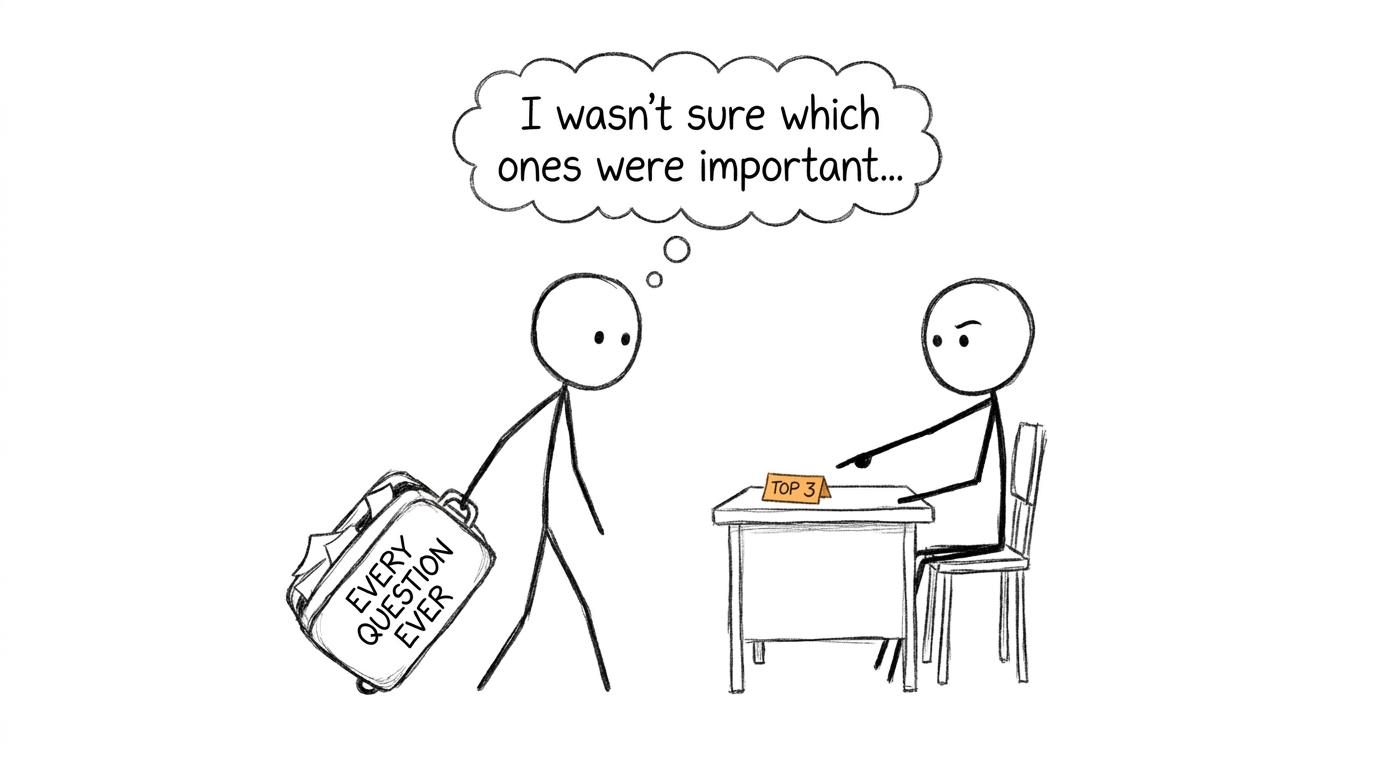 A student arriving at a drop-in with every question ever while a teacher recommends choosing the top three
How to make a school drop-in worth your time
Arrive with evidence, not a general worry
“I need help with Bengali” gives the teacher little to work with. Bring an attempted answer, a marked task, a short recording or a list of phrases you could not understand. Evidence makes feedback faster and more specific.
Prepare no more than three priority questions. A short list forces you to decide what matters most and reduces the chance of spending the session discussing whichever topic happens to come up first.
Ask questions that produce an action
Useful questions include:
- Which repeated error is costing me the most marks?
- What should I practise before the next session?
- Does this answer communicate every required point?
- Which part of my speaking becomes unclear?
- Am I practising the correct task for my specification and tier?
Finish by writing one next action. “Improve writing” is not an action. “Rewrite this response while checking tense consistency” is.
Avoid turning the session into passive reassurance
It is comforting to hear a teacher explain something clearly. But recognition is not the same as recall. After an explanation, close the notes and try the task yourself. Ask the teacher to check your attempt rather than demonstrate the same point repeatedly.
That active approach is useful across your timetable. Maths students can build it through GCSE maths revision lessons and questions, where learning a method is followed by practice rather than left as passive viewing.
Protecting maths revision during Bengali preparation
GCSE revision is a timetable problem as much as a subject problem. Bengali may need more school-based interaction because speaking feedback is difficult to reproduce alone. Maths, by contrast, has abundant independent resources and can often fit around the school session.
On a Bengali drop-in day, keep maths moving with one small, closed task. An Edexcel GCSE maths mini test can provide focused timed practice without demanding an entire evening. Students following another board can begin at the main GCSE maths revision hub or use the OCR GCSE maths revision area.
On a day without the drop-in, allow more time for a paper or deeper topic repair. MathsGenie’s Edexcel GCSE maths past papers include mark schemes and solutions for checking how marks are awarded. Nearer the exam, GCSE predicted papers can add unseen exam-style practice, but they should supplement rather than replace topic work and official past papers.
The goal is not to give every subject identical time. It is to give each subject the kind of time it needs.
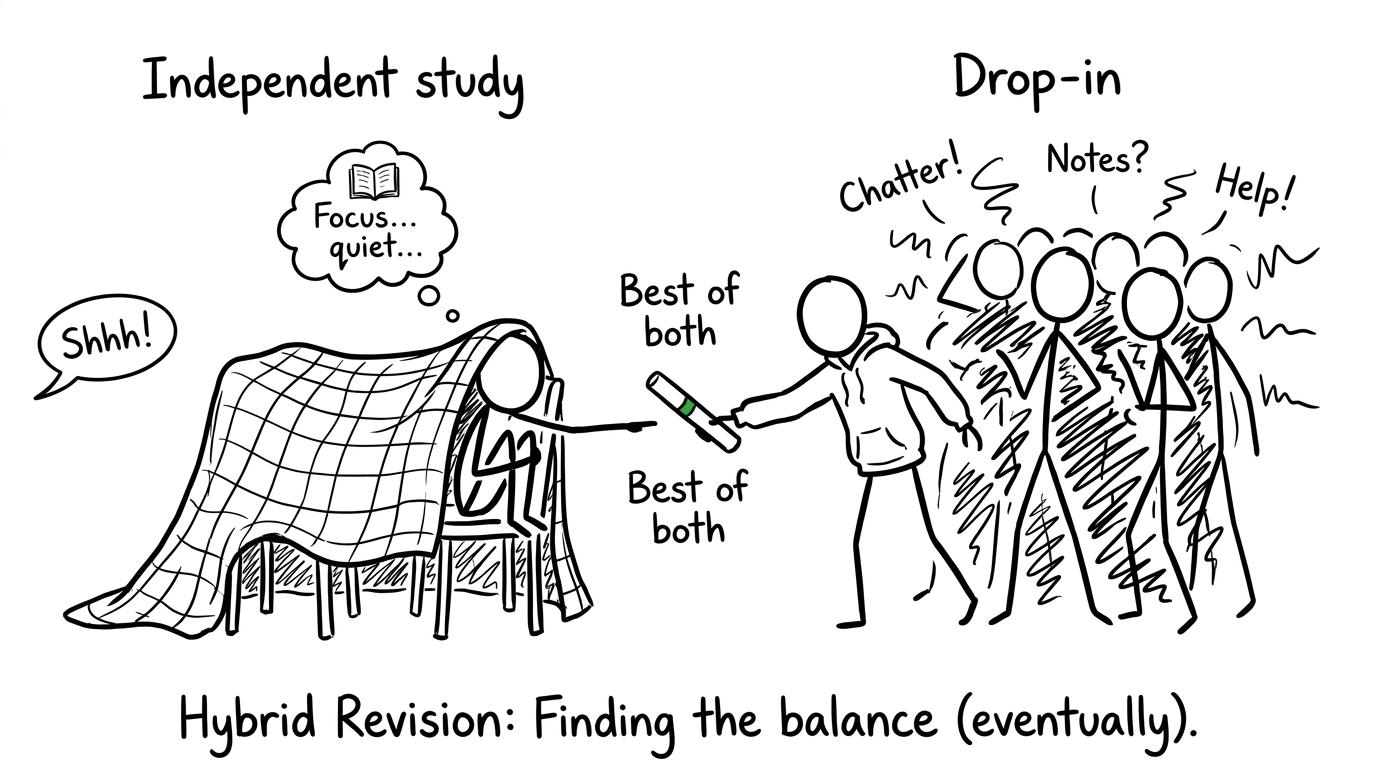 Independent revision and a busy drop-in passing a best-of-both baton
Common mistakes when using revision drop-ins
Attending without attempting anything first
Without a prior attempt, you do not know what you can do independently. Complete a task before the session so the teacher can see the real gap.
Treating attendance as completed revision
A session may feel productive because you stayed after school. Test that feeling. Can you now answer a fresh question, correct the sentence or explain the mistake without support?
Letting confident students control the session
Drop-ins can drift towards whoever speaks first. Keep your prepared questions visible and ask for time on at least one priority. You are not being difficult; you are using the session for its intended purpose.
Collecting corrections without revisiting them
A page covered in teacher comments is not the finished product. Rewrite, retest and return after a gap. The correction must eventually be produced from memory.
Sacrificing every other subject
One useful Bengali session should not quietly erase a week of maths revision. Use a realistic planner and preserve a small maths minimum. The GCSE one-month maths revision plan offers a practical structure using targeted practice, mini tests and papers.
The verdict: attend selectively and arrive prepared
School drop-in sessions for GCSE Bengali are worth attending when they provide interaction, diagnosis and expert feedback. They are particularly valuable for speaking and for understanding why a written response is losing marks. They are less valuable when the session is unstructured, passive or duplicates work you could complete more efficiently at home.
Do not choose permanently between school support and independent revision. Use each for what it does best. Attend with an attempted task and focused questions, leave with a specific action, then practise alone until you can perform the skill without help.
And while Bengali benefits from real conversation, keep maths moving with MathsGenie. Use free revision lessons to repair weak topics, practice questions and mini tests to build fluency, past papers and mark schemes to understand the exam, and predicted papers with video solutions to sharpen your final preparation. Start with the MathsGenie GCSE revision area, choose your board and turn the next available hour into work you can measure.