GCSE Bengali Cross Curricular Overlap: Does It Help?
GCSE Bengali cross curricular overlap can save revision time. Discover genuine links with maths and other subjects without revising content twice.
Revision can feel as if every subject has built its own private mountain. Bengali vocabulary sits in one pile, maths questions in another, while English, geography and science wait nearby. The useful truth is that GCSE Bengali cross curricular overlap does exist. Shared skills such as interpreting information, comparing evidence, describing trends and communicating precisely can support several subjects at once.
But overlap does not mean that one revision session magically covers two specifications. Bengali still requires Bengali vocabulary, grammar, listening, speaking, reading and writing. Maths still requires accurate methods and mathematical reasoning. The sensible aim is to reuse the thinking process while practising the subject-specific form separately.
The quick overlap checklist
Use cross-curricular revision when you can answer yes to these questions:
- Does the Bengali theme connect naturally to content in another subject?
- Are you practising a transferable skill such as retrieval, comparison or interpretation?
- Are you still producing an answer in the form required by each exam?
- Can you identify the separate knowledge that must be learnt for each subject?
- Will combining the work save time without making either task vague?
The strongest links tend to involve Bengali and English communication, environmental and social themes from geography or citizenship, health and technology topics from science, and data interpretation from maths.
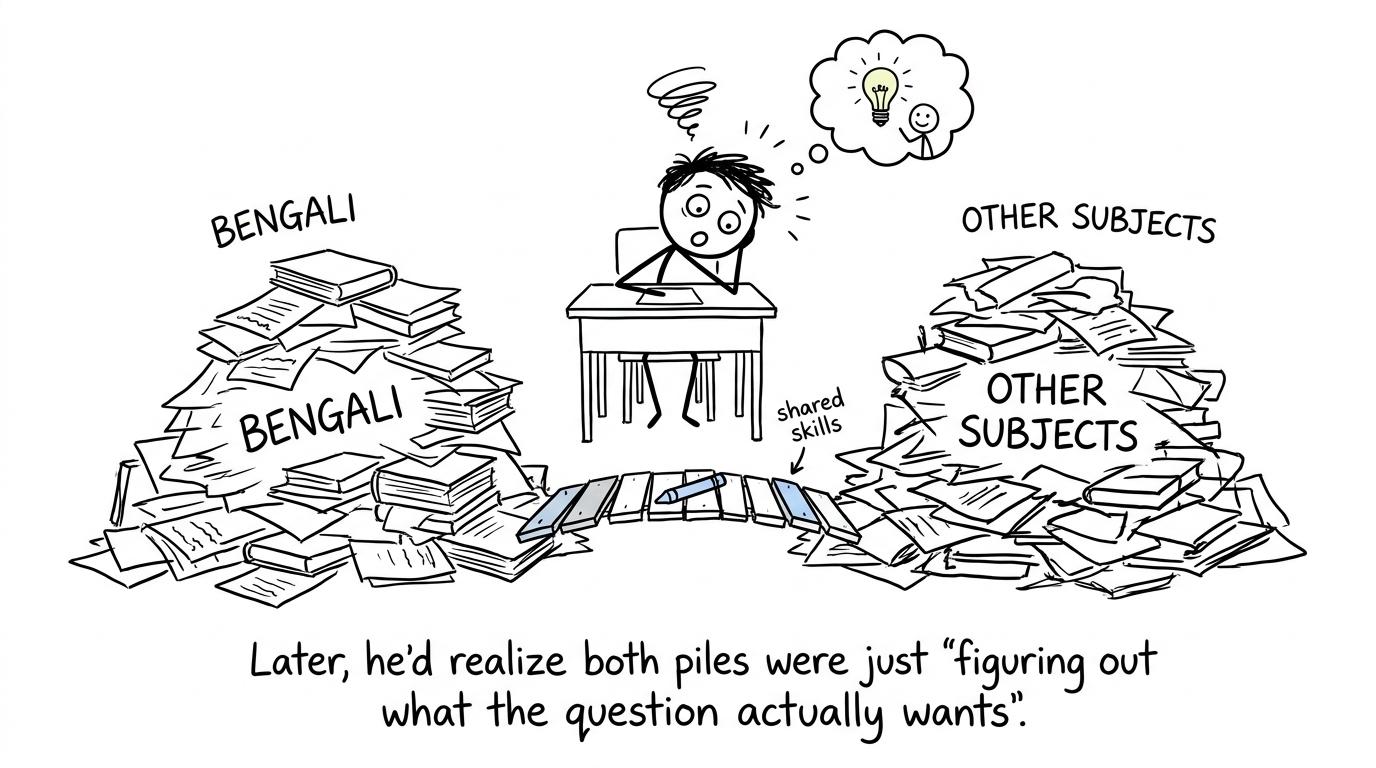 A student discovers a shared-skills bridge between two revision piles
What the GCSE Bengali specification actually covers
The current AQA GCSE Bengali specification is organised around three broad themes: identity and culture; local, national, international and global areas of interest; and current and future study and employment. These themes apply across its listening, speaking, reading and writing papers.
That creates genuine contact with other subjects. Technology, healthy living, the environment, poverty, travel, education and careers are not isolated language topics. You may encounter related ideas in geography, science, citizenship, English or PSHE.
However, the assessment remains linguistic. The four Bengali skills are equally weighted at 25%25\%25% each. Knowing the science behind healthy living cannot replace the Bengali language needed to discuss it. Understanding climate change in geography does not automatically provide accurate Bengali grammar.
AQA GCSE Bengali is also tiered. Foundation tier covers grades 111 to 555, while higher tier covers grades 444 to 999, and all four papers must be taken at the same tier. Check your own entry and specification rather than assuming that arrangements from another language or qualification apply.
Where Bengali overlaps with maths
The overlap with maths is less about shared syllabus content and more about reading, structure and information. That still matters. GCSE maths specifications require students to interpret and communicate mathematical information, reason from evidence and solve problems in context.
Reading information before calculating
A Bengali reading task may ask you to identify a detail, distinguish fact from opinion or infer an attitude. A contextual maths question also rewards disciplined reading. You need to identify what is known, what is required, which units matter and which information is irrelevant.
The transferable routine is:
- identify the task before acting;
- underline decisive words;
- separate facts from surrounding context;
- check the required form of the response;
- reread the answer against the original question.
This does not teach a mathematical method, but it reduces the risk of applying the right method to the wrong quantity. Use the GCSE Maths revision hub to practise that routine on authentic exam-style questions from your board and tier.
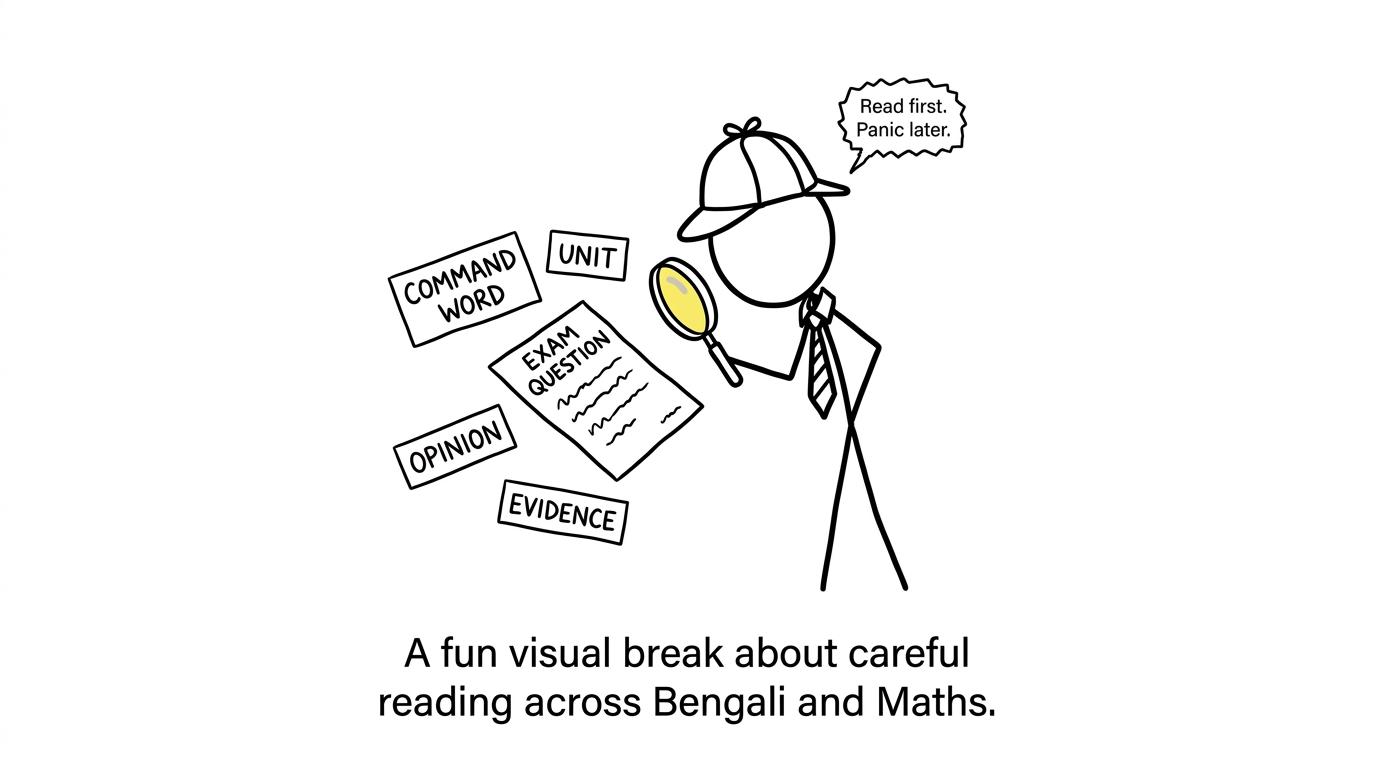 An exam detective searches for command words, units and evidence
Quantities, comparisons and proportions
Bengali topics such as health, travel, technology and social issues can involve frequencies, costs, distances, survey results and comparisons. These contexts reinforce the language of quantity: more than, fewer than, most, least, approximately and in comparison with.
In maths, those relationships may become fractions, ratios or percentages. The underlying structures include:
percentage=partwhole×100\text{percentage} = \frac{\text{part}}{\text{whole}} \times 100percentage=wholepart×100and
mean=sum of valuesnumber of values.\text{mean} = \frac{\text{sum of values}}{\text{number of values}}.mean=number of valuessum of values.You should not turn every Bengali task into a calculation. Instead, notice when both subjects are asking the same conceptual question: what is being compared, what counts as the whole, and what conclusion is justified?
If that language exposes a weakness, revise the method through the Maths Genie ratio revision guide. The guide is labelled for OCR, so students taking Edexcel, AQA or Eduqas should also check the organisation and wording used by their own board.
Data interpretation and cautious conclusions
Environmental or social themes can involve charts, tables and numerical claims. Here Bengali, geography and maths meet around interpretation. A strong response distinguishes between what the data shows and what someone merely assumes.
In maths, that might mean recognising that correlation does not by itself establish causation, checking whether a graph uses a misleading scale, or deciding whether an average represents the data well. In Bengali, it might mean accurately reporting a comparison or expressing a justified opinion about an issue.
MathsGenie's numerical and statistical skills guide for GCSE Geography shows how ratios, averages, percentages and spread appear beyond the maths classroom. Its GCSE Psychology data analysis guide provides another useful view of how evidence is summarised and interpreted.
Overlap with English and humanities
The closest cross-curricular connection is often with English. Translation is not simply word replacement. It requires attention to meaning, tense, register, audience and natural expression. Those habits support precise writing elsewhere.
Planning also transfers well. Before a longer Bengali response, you may organise ideas around the task's bullet points and decide which opinions, reasons and time frames to include. In English or humanities, you similarly need to select relevant material and arrange it logically. The language changes, but the planning discipline remains.
Geography and citizenship provide the clearest thematic links. Bengali themes include the environment, poverty, homelessness, voluntary work, travel and local areas. You can reuse your understanding of these issues, provided you do not import subject-specific claims carelessly. A geography case study needs accurate place detail and evidence; a Bengali answer is assessed for communication in Bengali within the task set.
History overlap is more selective. Cultural identity, migration, community and social change may provide helpful background, but the current AQA Bengali themes do not turn the qualification into a history course. Only combine revision where the connection is explicit.
A revision system that avoids doing everything twice
The efficient approach is to build shared theme packs rather than duplicate notebooks.
Create one theme map
Choose a theme such as environment, education, technology or healthy living. In the centre, record the shared concept. Around it, create separate branches:
- Bengali: vocabulary, opinions, reasons, tense control and likely speaking prompts;
- maths: percentages, graphs, averages or proportional reasoning connected to the context;
- geography or science: required facts, processes and evidence;
- English or citizenship: argument, audience and evaluation.
The centre prevents repeated background revision. The branches protect subject accuracy.
Pair retrieval without merging the exams
A short revision block can contain two linked activities. Retrieve Bengali vocabulary for a theme, then complete a maths data question using a related context. Later, return to the vocabulary without notes and mark the maths using its mark scheme.
This is more useful than passively rereading the same topic twice. It also keeps feedback separate: Bengali errors go on a language list, while mathematical errors go on a method list.
For a sustainable weekly structure, adapt the GCSE maths revision timetable. If exams are close, the one-month GCSE maths revision plan offers a tighter cycle of diagnosis, topic practice and timed papers.
Let papers decide what needs separate attention
Cross-curricular planning should save time, not hide weaknesses. Complete a Bengali task and a maths paper independently. Then classify each mistake:
- shared reading or interpretation problem;
- Bengali vocabulary or grammar gap;
- missing maths knowledge;
- inaccurate calculation;
- weak exam timing;
- failure to answer the command word.
Only the first category should be repaired jointly. Everything else needs subject-specific practice. If you take Edexcel maths, the Edexcel GCSE Maths past papers include mark schemes and solutions for checking exactly how marks are awarded.
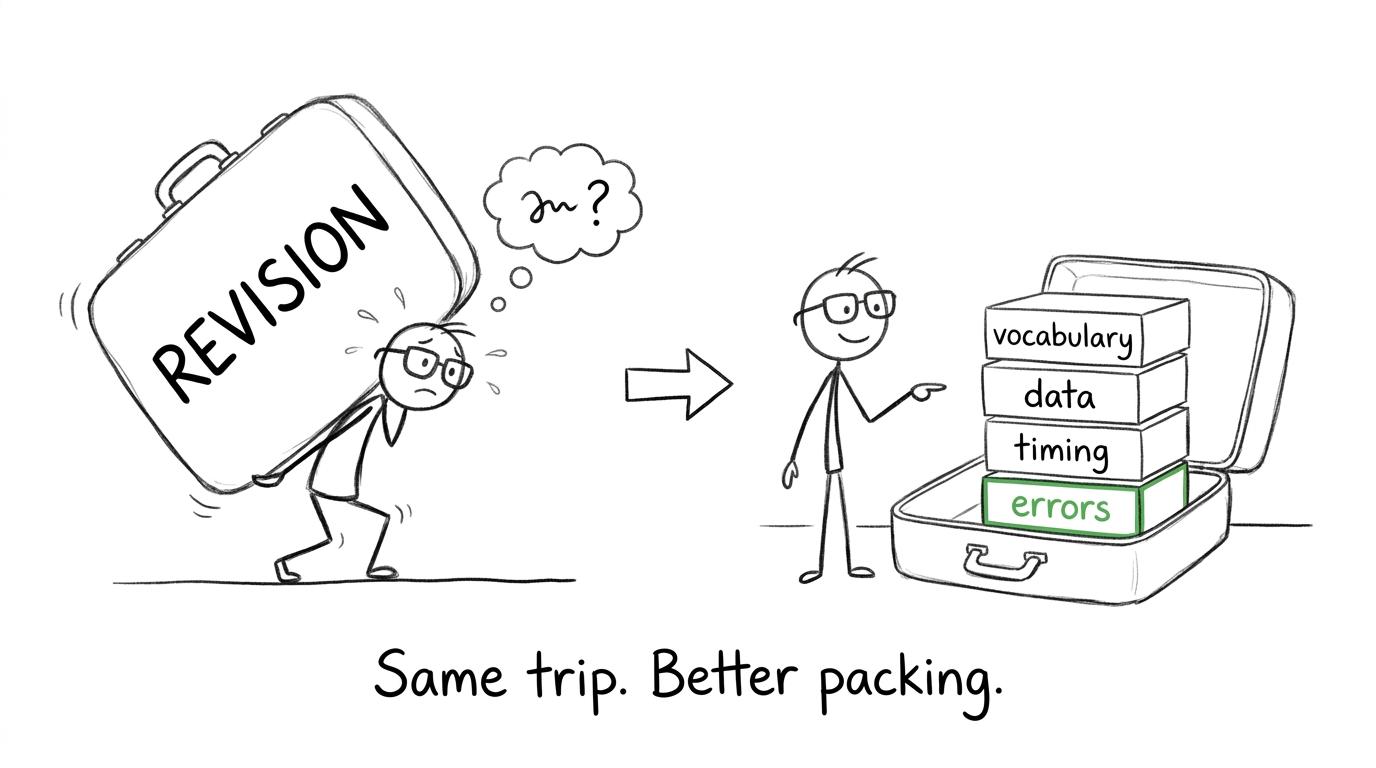 A student packs one large revision suitcase into organised skill boxes
Common mistakes with cross-curricular revision
Assuming shared themes mean shared marks
Knowledge of environmental issues may help you generate ideas, but Bengali marks depend on what the paper assesses. Maths marks depend on correct methods, reasoning and communication. Always return to the relevant specification and mark scheme.
Revising context instead of language
It is easy to spend too long reading about technology or health in English. That may feel productive while avoiding Bengali retrieval. Convert the idea into Bengali vocabulary, sentences, listening practice or speaking responses.
Treating maths as vocabulary alone
Recognising words such as ratio, average or increase does not prove that you can calculate or interpret them. Use a revision lesson, then answer practice questions without support. The overview of GCSE maths topics that commonly recur can help you prioritise broad areas before diagnosing your personal gaps.
Combining unrelated topics to save time
A forced connection creates extra mental work. Bengali festivals and quadratic equations, for instance, do not form a useful shared revision task simply because both are on your timetable. Keep them separate unless a genuine skill or context connects them.
Using the wrong board or tier
Maths resources must match your Edexcel, AQA, OCR or Eduqas course and your foundation or higher entry. Bengali students should likewise confirm their exact qualification. Similar subject names do not guarantee identical paper structures.
Make overlap serve the exam, not the timetable
Cross-curricular overlap helps when it removes duplicated background work, strengthens careful reading and lets you practise transferable habits in more than one setting. It stops helping when it blurs assessment requirements or replaces active practice.
Keep one map of shared themes. Keep separate lists for Bengali language gaps and maths method gaps. Then test both subjects in their real exam form.
MathsGenie can be the maths side of that system. Start with the free GCSE Maths revision hub, learn weak methods through revision lessons, practise with topic questions, and check your work using mark schemes and video solutions. As your confidence grows, move into mini tests, past papers and predicted papers. The goal is not to revise everything twice. It is to make every useful connection once, then practise each exam properly.