GCSE Astronomy Revision Timetable: Worth It?
GCSE astronomy revision timetable worth it? Learn when a written plan helps, when flexible revision works, and how to balance astronomy with GCSE maths.
Revision timetables can create a strange kind of comfort. You colour the boxes, assign every topic a slot and briefly feel as though the work has already been done. Then Tuesday changes, one session is missed and the whole plan begins to look like evidence against you.
So, is a GCSE astronomy revision timetable worth it? Usually, yes, but only when it is a flexible decision-making tool rather than a rigid calendar. A written plan can help you space revision, balance Astronomy with GCSE Maths and return to weak areas. It cannot improve your grade simply by existing. Flexible revision can work equally well if it still includes clear priorities, regular retrieval and honest feedback from questions.
The useful question is not, “Do I have a timetable?” It is, “Does my system make effective revision more likely?”
The short answer: use structure without building a cage
A worthwhile Astronomy revision plan should:
- cover both examination papers rather than following your favourite topics;
- revisit content across several weeks;
- include recall, calculations, graphical work and extended responses;
- leave space for schoolwork, GCSE Maths and other subjects;
- change when practice reveals a new weakness;
- specify an action, not merely a subject name;
- remain usable after a missed day.
If your timetable does those things, keep it. If it takes longer to maintain than to follow, simplify it.
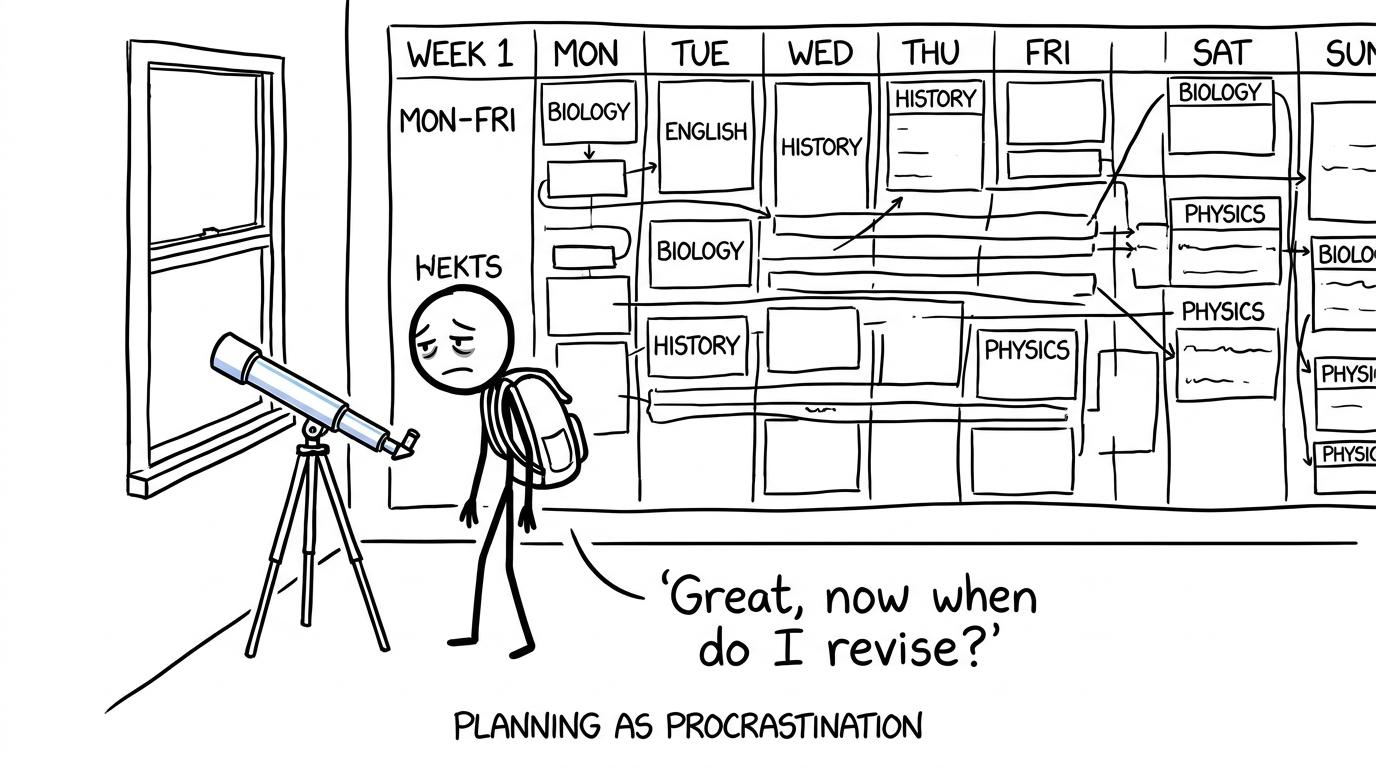 A student discovers that creating the perfect revision timetable has left no time for revision
Why a timetable can help GCSE Astronomy revision
Current Pearson Edexcel GCSE Astronomy, specification 1AS01\mathrm{AS}01AS0, is an untiered qualification. Unlike GCSE Maths, there is no foundation or higher paper. Every student prepares for the same specification and sits two externally examined papers.
Paper 111, Naked-eye Astronomy, covers Topics 111 to 888. Paper 222, Telescopic Astronomy, covers Topics 999 to 161616. Each paper lasts 111 hour 454545 minutes, carries 100100100 marks and contributes 50%50\%50% of the qualification. The papers can include multiple-choice, short-answer, calculation, graphical and extended-open-response questions. Calculators are permitted.
That breadth is the strongest argument for planning. Without a system, revision often follows interest. Cosmology receives another evening because it is fascinating, while time calculations or observational methods remain untouched because they feel awkward.
A timetable places boundaries around that instinct. It says that interesting topics matter, but neglected topics also need an appointment.
Planning is also useful because effective revision needs spacing. Guidance on self-regulated learning from the Education Endowment Foundation emphasises planning, monitoring and evaluating learning. Research strongly supports retrieval practice and revisiting material after gaps. However, this does not prove that a beautifully written weekly grid directly causes higher grades. The learning comes from what happens inside each session.
Written timetable or flexible revision?
Both can work. The difference is whether important tasks reliably happen.
A written timetable is useful when
Choose a visible weekly plan if you:
- regularly postpone Astronomy because another subject feels more urgent;
- forget which topics you have already covered;
- need to coordinate revision around clubs, homework or family commitments;
- tend to revise only the subjects you enjoy;
- want to balance Astronomy calculations with GCSE Maths preparation.
Writing down a session reduces the number of decisions you must make after a tiring school day. Instead of choosing from the entire specification, you begin with one defined task.
Flexible revision is useful when
A looser system may suit you if your week changes frequently or rigid schedules make you abandon the plan after one disruption. You could keep a prioritised task list and choose the next suitable task when a revision window opens.
The flexibility must be controlled. “I will revise Astronomy when I have time” is not a system. “Complete the next highest-priority task during one of three available windows” is.
A flexible plan still needs:
- a minimum number of weekly sessions;
- a list of specific next actions;
- coverage of both papers;
- a record of mistakes and completed topics;
- regular timed practice.
The calendar is optional. Those commitments are not.
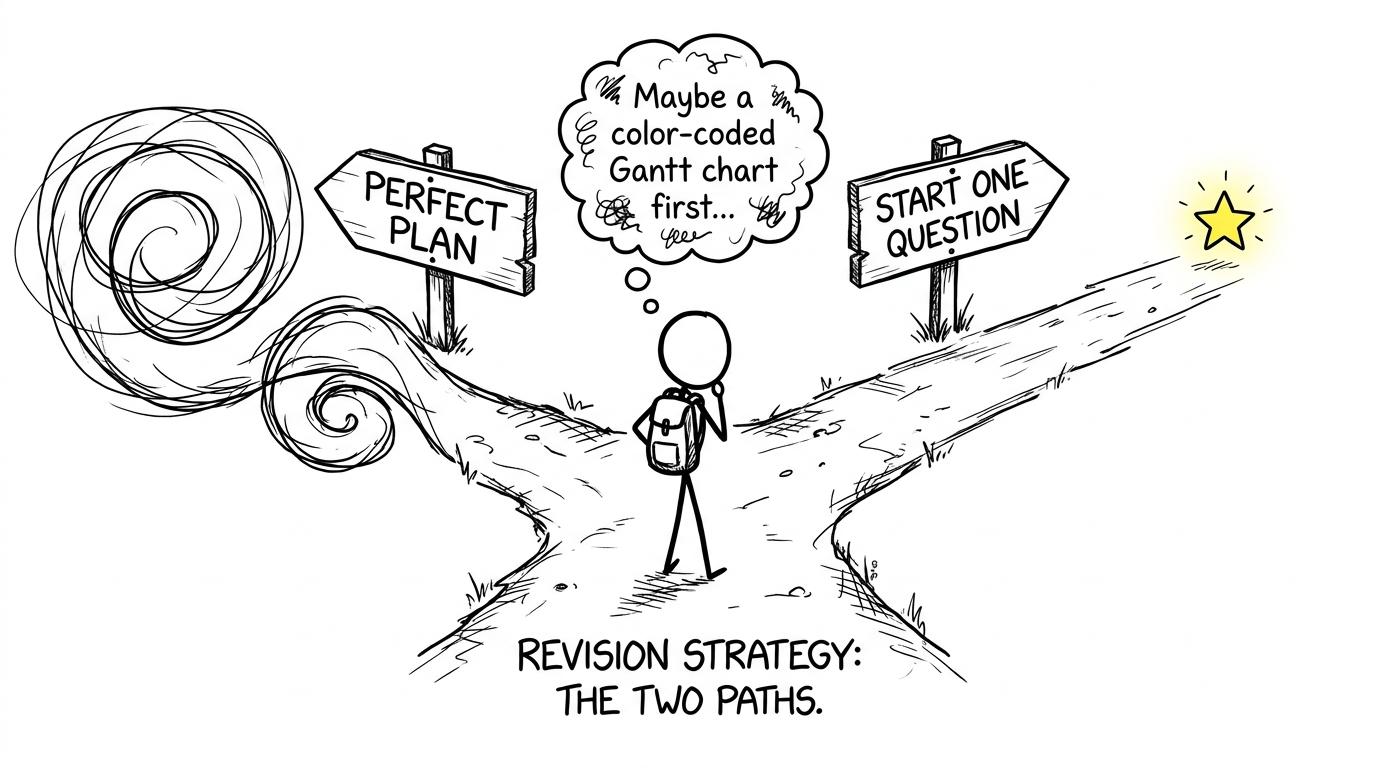 A revision path labelled Perfect Plan loops around while one small action leads towards a star
Build a minimum viable Astronomy timetable
A timetable should be small enough to survive a difficult week. Start with recurring session types rather than assigning all 161616 topics months in advance.
| Session | Purpose | Flexible version |
|---|---|---|
| Recall | Retrieve definitions, processes and key facts without notes | Choose the weakest topic for 202020 to 303030 minutes |
| Maths and data | Practise calculations, graphs, units and interpreting information | Complete one focused question set |
| Explanation | Practise longer responses and observational reasoning | Answer one or two questions, then compare with the mark scheme |
| Mixed review | Combine material from both papers | Use a mini test or selected paper questions |
| Feedback | Correct errors and choose the next priorities | Update an error log immediately after marking |
Three focused sessions and one mixed review each week may be more sustainable than promising Astronomy every evening. Your appropriate workload depends on how close the examinations are, your current understanding and the demands of your other GCSEs.
Do not write “Astronomy” in a box. Write the outcome: “Retrieve lunar feature definitions, answer questions and mark them.” A vague label invites passive reading. A concrete task tells you when the session is finished.
Review the plan weekly. Move a topic forward when it remains weak; reduce its frequency when repeated testing shows secure understanding. A timetable should respond to evidence rather than protect decisions made several weeks ago.
Connect Astronomy revision with GCSE Maths
Astronomy and maths should not become two entirely separate worlds. Astronomy papers include calculations and graphical interpretation, while the scale of astronomical quantities makes numerical fluency especially valuable.
Useful transferable skills include:
- writing and calculating with standard form;
- substituting into and rearranging formulae;
- working accurately with units and scale;
- interpreting tables and graphs;
- handling angles and geometrical relationships;
- checking whether an answer is reasonable.
If large and small quantities cause trouble, use MathsGenie’s Standard Form revision resources. If angular geometry is a wider weakness, revisit SOHCAHTOA and trigonometry.
This is where a combined plan becomes efficient. One session can strengthen a GCSE Maths method, followed later by Astronomy questions that require you to recognise when that method is relevant. MathsGenie’s GCSE Maths revision hub lets you choose resources for Edexcel, AQA, OCR, Eduqas and other boards. Remember that these board and tier choices apply to your Maths qualification; GCSE Astronomy itself follows the Pearson Edexcel Astronomy specification and is untiered.
If Maths also needs a clearer weekly structure, adapt the ideas in the GCSE Maths revision timetable guide rather than maintaining two complicated plans.
Measure work completed, not hours promised
A timetable records intention. Questions reveal performance.
At the end of each Astronomy session, record something observable:
- questions attempted;
- marks earned;
- definitions recalled correctly;
- errors corrected;
- topics requiring another visit;
- whether time pressure affected the result.
This turns planning into a feedback loop. A low mark is not a verdict; it is information that changes the next session.
The same method supports Maths revision. Use GCSE Maths past papers to reveal broader weaknesses, then repair individual skills with lessons and practice questions. Shorter Edexcel GCSE Maths mini tests can fit into busy weeks when a full paper would be unrealistic.
Past papers should not be saved until every topic feels perfect. Start with selected questions, then timed sections and eventually complete papers. The guide to starting GCSE past papers explains how to build that progression without using up every paper too early.
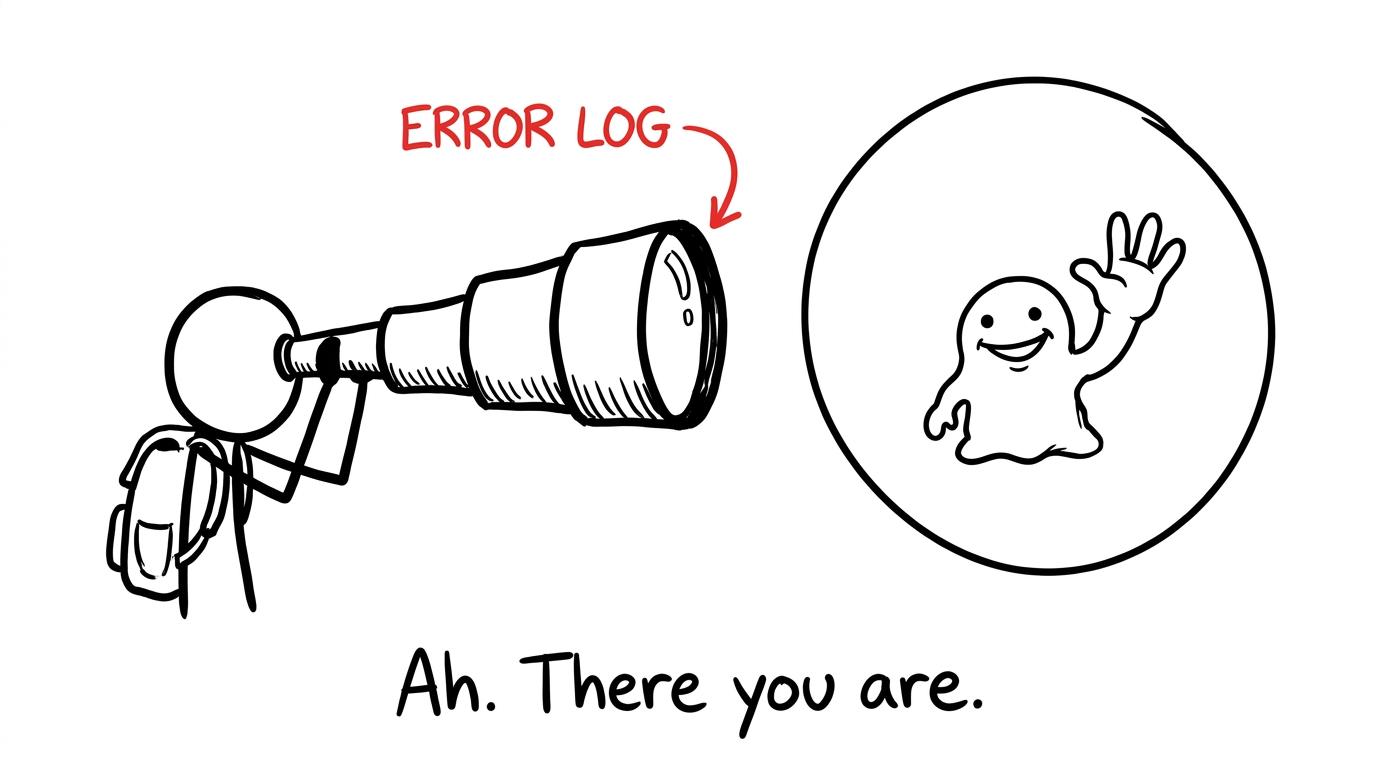 A student uses an error log as a telescope and finally spots a friendly mistake monster
Common revision timetable mistakes
Spending too long designing it
Colour can improve clarity, but design is not revision. Set a short planning limit, choose the next tasks and begin.
Scheduling every free hour
A plan without spare capacity collapses when homework grows or life changes. Leave open sessions that can absorb missed work.
Treating all topics equally
Equal time is not always fair time. Use question results to give weak, important areas more attention while revisiting secure topics often enough to retain them.
Revising passively
Reading notes can refresh understanding, but it gives little evidence that you can retrieve or apply knowledge. Close the notes, answer questions, draw information from memory and check the result.
Ignoring the mark scheme
Marking only right or wrong wastes feedback. Look at how marks are awarded, especially for explanations, observational reasoning, units and stages of calculation.
Keeping a timetable that has stopped working
Missing one session is normal. Repeatedly missing the same session is data. Change its time, length or task. The purpose is progress, not loyalty to an old plan.
A timetable is valuable when it leads to action
The best revision system is rarely the most impressive one. It is the one you can still follow on an ordinary Wednesday when motivation is quiet and other subjects are competing for attention.
Use a written GCSE Astronomy timetable if it helps you cover both papers, space retrieval and protect time for calculations. Use a flexible priority list if your week is unpredictable. Either way, make questions, marking and adjustment the centre of the system.
Then let MathsGenie support the mathematical side of the journey. Begin with free GCSE Maths revision lessons and practice, test yourself with mini tests and past papers, and use mark schemes and video solutions to understand every lost mark. Nearer your Maths examinations, predicted papers can add fresh exam-style practice, but always use them as feedback, not fortune-telling.
Make the plan small. Start the next task. Let the evidence decide what comes after that.