

GCSE Astronomy Results Day: Wrong Grade?
GCSE astronomy results day wrong grade? Follow a calm first-hour checklist, check your marks and ask your school about a review of marking promptly.
Results day compresses months of work into one line on a sheet. If that line looks completely different from your mock results, predicted grade or how the exams felt, shock can quickly become certainty: something must be wrong.
If you are searching for GCSE astronomy results day wrong grade advice, the immediate answer is simple: keep the result slip, speak to your teacher or exams officer before leaving school, ask for your component marks and grade boundary, and find out how quickly your script can be checked. A surprising result is worth investigating, but a predicted grade alone does not prove that an error occurred.
Your first task is not to demand a remark. It is to collect evidence while the right people are available.
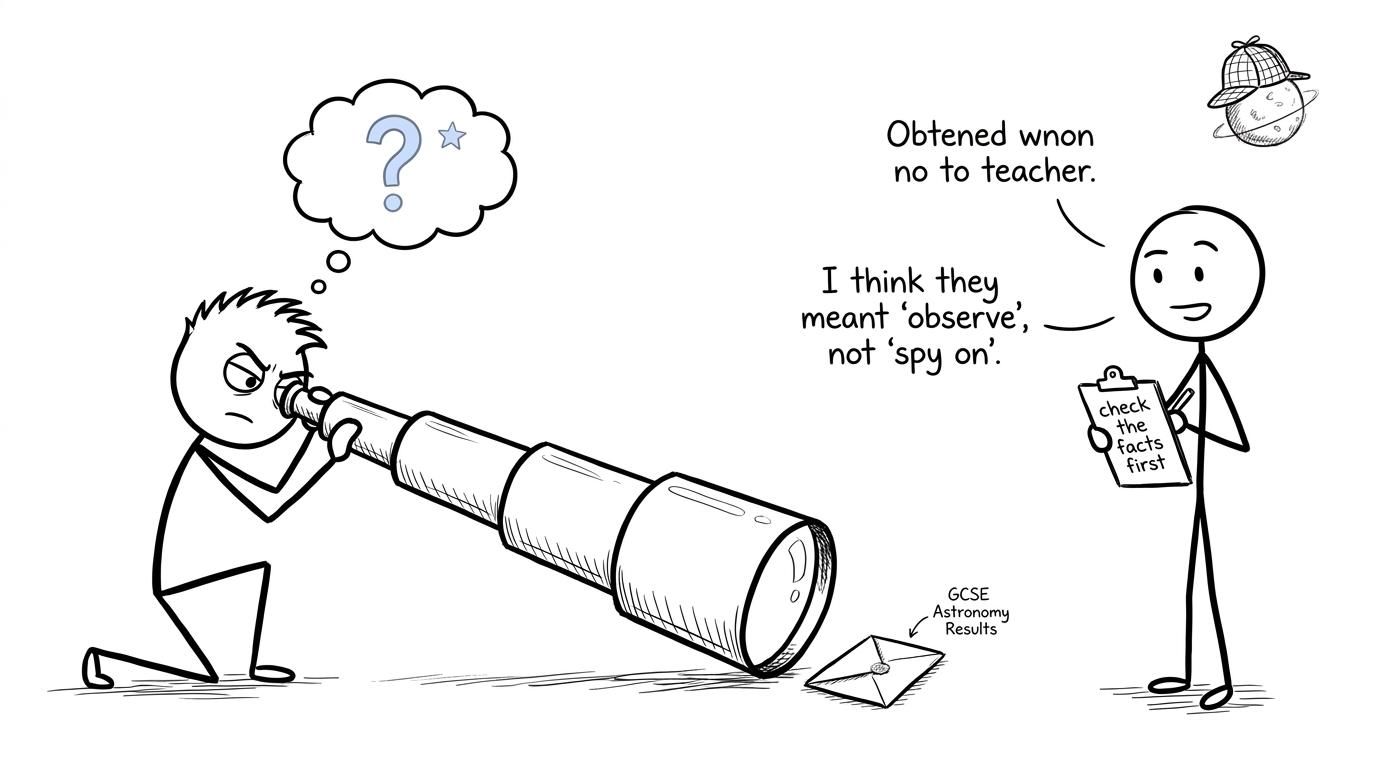 A student inspecting a surprising GCSE Astronomy result through an enormous telescope
Your first-hour checklist
If your GCSE Astronomy result looks wrong, work through this checklist:
- Check that your name, candidate number and qualification are correct.
- Photograph or safely store your results slip.
- Ask for your total mark and, if available, the mark for each paper.
- Check the official grade boundary for your exact examination series.
- Tell your Astronomy teacher why the result surprised you.
- Speak to your school's exams officer about access to scripts and post-results services.
- Explain immediately if the grade affects sixth-form admission or another deadline.
- Do not submit anything or pay a fee until you understand the possible outcomes.
Post-results requests normally go through the school or examination centre rather than directly from the student. The centre will also have the current exam-board deadlines, fees and consent requirements. These details can change between examination series, so follow the information supplied by your exams officer rather than an old social-media post.
What to do in the first hour
Check the result belongs to the right qualification
Begin with the ordinary details. Administrative errors are uncommon, but checking them costs nothing.
For Pearson Edexcel GCSE Astronomy, the current specification code is 1AS01\mathrm{AS}01AS0. Make sure you are looking at the GCSE Astronomy result rather than a mock result, internal assessment record or another science qualification. Check your personal and candidate details too.
Do not compare your grade with a boundary from a different year. Grade boundaries are set for a particular examination series because the difficulty of papers can vary. A boundary remembered from last summer may tell you very little about this summer's result.
Ask for marks, not just the grade
A grade gives you the outcome. Your marks provide the first useful clue.
Ask whether the school can show you:
- your total qualification mark;
- the mark awarded on each written paper;
- the maximum available mark;
- the relevant grade boundaries;
- whether any special consideration was applied.
Pearson Edexcel GCSE Astronomy has two written papers, each contributing 50%50\%50% of the qualification. Looking at the separate marks may reveal whether the result was broadly consistent across both papers or whether one paper was unexpectedly low.
The distance from the next boundary matters when deciding what to investigate, but being one mark below a boundary does not automatically mean one mark should be added. A review checks whether the mark scheme was applied correctly. It is not a discretionary award for being close.
Speak to your teacher while the exam is still fresh
Tell your teacher something specific. “My grade feels wrong” is understandable, but it gives them little to assess. More useful information includes:
- the grades and marks you usually achieved in timed mocks;
- whether those mocks used complete papers and official mark schemes;
- whether you finished both real papers;
- any question or section you may accidentally have missed;
- illness, disruption or another documented issue during the examinations;
- the grade required for your next course.
Mocks and predictions are useful context, not guarantees. Mock papers may differ in difficulty, grade boundaries may be estimated, and classroom marking can be more or less generous than live examination marking. Your teacher can judge whether the gap is genuinely unusual.
Find the exams officer
The exams officer manages formal contact with the exam board. Ask what services are available, what each costs, when the deadline falls and whether the school has an internal deadline before the board's deadline.
If a sixth form or college place depends on the result, say so clearly. Contact the admissions team as well and explain that you are discussing a post-results check with your school. Do not assume a review will be completed before an admissions deadline.
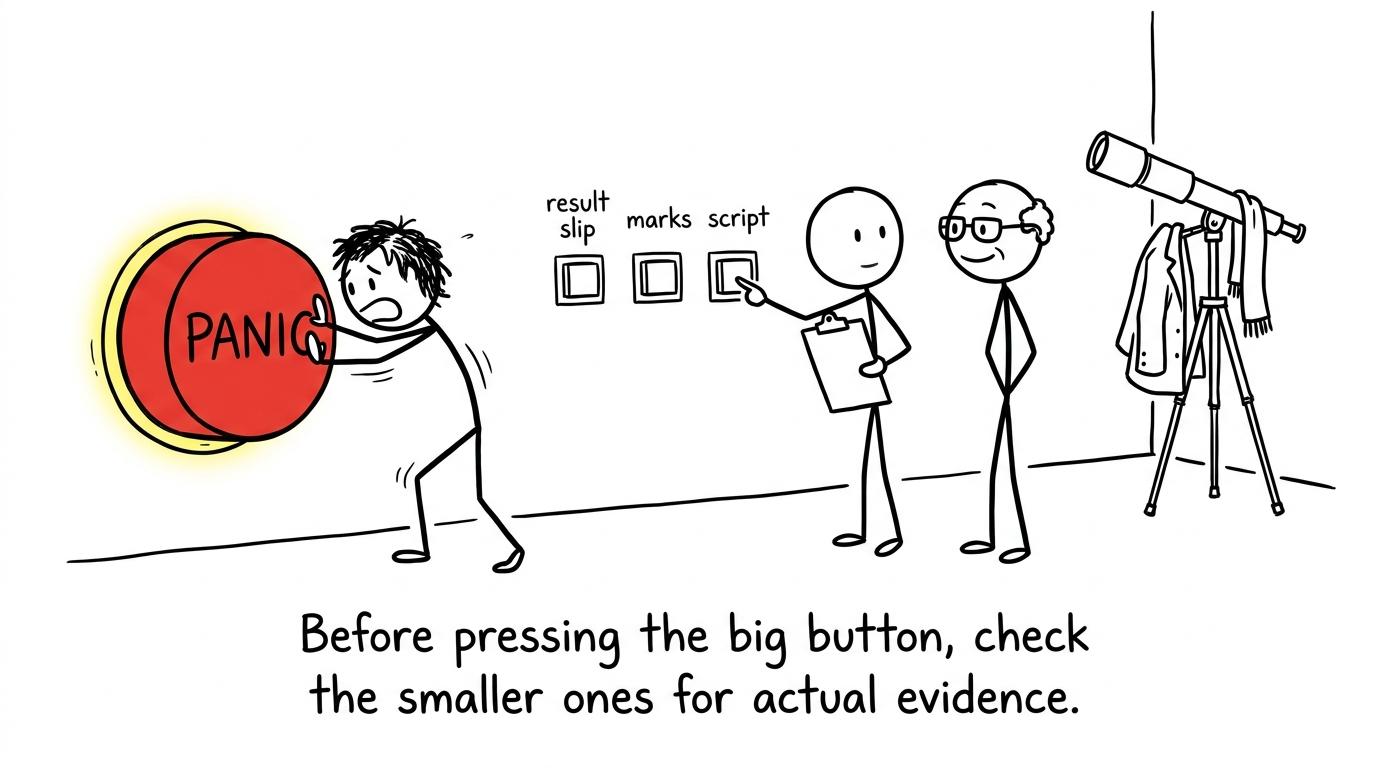 A calm exams officer steering a student away from the panic button
Could your grade genuinely be wrong?
Yes, examination results can change. However, several different situations can produce a surprising grade, and each calls for a different response.
A clerical or processing error
A clerical re-check typically looks for problems such as marks not being included correctly or the total not being transferred accurately. It does not reconsider the academic judgement applied to every answer.
This may be relevant if a component mark looks implausibly low or there appears to be a problem with the recorded total. Your exams officer can explain precisely what the current service covers.
A marking error
A review of marking checks whether the mark scheme was applied correctly. Despite the common word “remark”, this is not simply a fresh examiner starting again and awarding whatever mark they prefer.
The reviewer considers whether the original marking contains an error under the board's procedures. The mark can rise, stay unchanged or fall. Your school must obtain your consent because a lower mark could also produce a lower grade.
The result is accurate but unexpected
This is emotionally harder, but it remains possible. Astronomy questions may require precise terminology, complete reasoning, accurate calculations and careful interpretation of observations or data. An answer can feel convincing while missing a marking point.
That is why seeing the script, where available, can be more informative than comparing the grade with a prediction.
Access to scripts before requesting a review
An access-to-scripts service allows the centre to obtain a copy of your marked paper, subject to the board's current arrangements. Your teacher can then look for questions where:
- a response appears unmarked;
- a page or additional sheet may not have been considered;
- the awarded mark seems inconsistent with the mark scheme;
- the total appears incorrect;
- there is a plausible marking issue worth formally reviewing.
A script is evidence, not proof by itself. Teachers should compare it carefully with the relevant mark scheme and examiner guidance. Some judgements allow a legitimate range of professional interpretation.
Ask whether receiving the script affects the time available to request a review. Schools often use copies to make a better-informed decision, but all requests must still meet the current deadline.
Choosing the right post-results service
The best route depends on what the evidence suggests.
| What you notice | Sensible next question |
|---|---|
| The recorded total appears inconsistent | Could a clerical re-check help? |
| One paper is unexpectedly low | Can the school obtain and inspect the script? |
| A teacher identifies likely marking errors | Should the centre request a review of marking? |
| Illness or disruption affected the exam | Was it reported at the time, and was special consideration requested? |
| The grade affects a course place | What are the centre's and admissions provider's deadlines? |
Special consideration is not an alternative way to challenge marking after results day. It normally concerns temporary illness, injury or disruption affecting an assessment and should be raised with the centre at the appropriate time. Tell the exams officer what happened, but do not assume it can be applied retrospectively.
If the outcome of a review remains disputed, formal appeal routes may exist. These are generally pursued by the examination centre and concern whether procedures were followed correctly. Ask the school to explain the next stage rather than attempting to contact individual examiners.
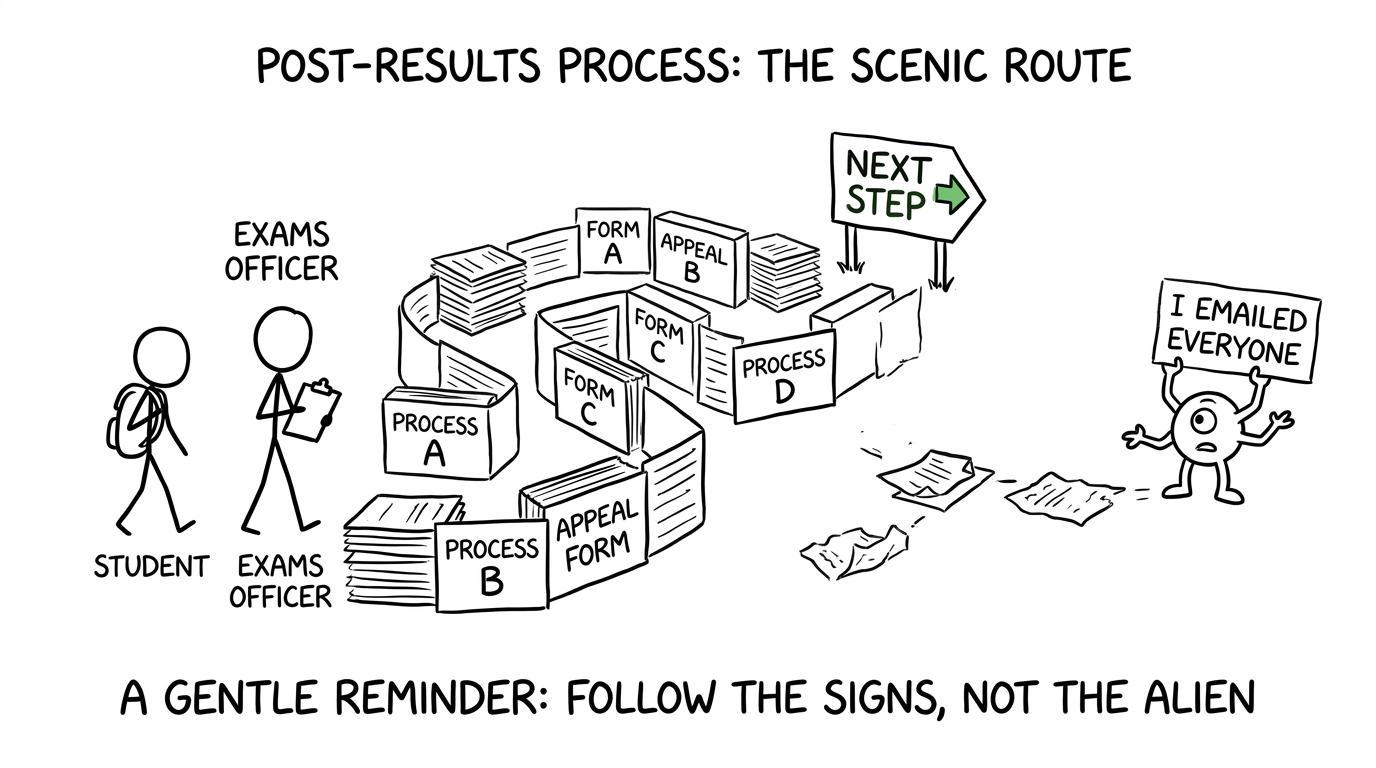 A student and exams officer navigating the official paperwork while an alien tries an unhelpful shortcut
What not to do on results day
Do not treat a predicted grade as a contract
Predicted grades are informed estimates. They can help your teacher recognise an unusual outcome, but the final grade is based on your assessed work and the official boundary for that examination series.
Do not request a review without discussing the risk
Marks can move down as well as up. Understand the fee, possible refund arrangements, consent requirements and effect on your grade before proceeding.
Do not wait silently when progression is affected
Post-results services have firm deadlines, while sixth forms and colleges may make decisions sooner. Speak to your school and admissions provider promptly.
Do not rely on another student's boundary
Check the board, qualification, specification and examination series. GCSE Astronomy boundaries are not interchangeable with GCSE Physics, Combined Science or any classroom mock boundary.
Do not post your script publicly
Your script contains personal information and is supplied under specific conditions. Share it only with the teachers and staff helping you make the decision.
Common mistakes when questioning a GCSE Astronomy grade
The most common mistake is moving straight from surprise to accusation. A calm request for marks and evidence is more effective than insisting that the examiner must have failed to read the paper.
Other mistakes include:
- confusing a clerical re-check with a review of marking;
- assuming that being close to a boundary guarantees an increase;
- overlooking the possibility that a mark or grade could fall;
- comparing the result with unofficial or outdated boundaries;
- missing the school's earlier internal deadline;
- failing to mention an urgent sixth-form decision;
- asking the exam board directly when the request must go through the centre.
A useful principle is to separate two questions: “Why does this result feel surprising?” and “What evidence suggests a marking or processing error?” The first starts the conversation. The second determines the next step.
Turning results day into better exam preparation
Astronomy and maths reward many of the same habits: reading scales accurately, handling units, interpreting graphs, using formulae and showing a logical method. Whatever happens after the result is checked, the evidence can improve how you prepare for future examinations.
Start with the free GCSE Maths revision hub, where revision lessons, exam-style questions and solutions are organised by topic and grade. If a disappointing result has unsettled your confidence, the guide to whether GCSE Maths is hard and how to improve offers a practical way to rebuild momentum.
Past papers are most useful when there is still time to act on what they reveal. MathsGenie's guide to when to start GCSE past papers explains how to move from mini tests to timed papers and detailed marking. Students following the Edexcel course can also use the plan for revising Edexcel GCSE Maths efficiently.
If you are moving into sixth form, the free A Level Maths revision hub brings together board-specific lessons, practice questions, past papers and mark schemes. The wider MathsGenie revision platform also provides predicted papers, mini tests, video solutions and revision tools.
A calm next step
A result can be surprising without being final, and disappointing without being wrong. In the first hour, your advantage comes from doing ordinary things well: keep the slip, obtain the marks, check the correct boundary, speak to your teacher and find the exams officer.
Then let evidence guide the decision. If the script suggests an error, your school can explain the proper review process. If the mark is accurate, you will at least understand the result and can carry the lessons forward.
When you are ready to focus on the next examination, return to MathsGenie. Use revision lessons to close knowledge gaps, practice questions and mini tests to test individual skills, then past papers and predicted papers to build timing. Mark every attempt carefully with the mark schemes and video solutions. Results day gives you one grade; thoughtful revision shapes what happens next.










