GCSE Astronomy Grade 8 Meaning: A Clear Guide
GCSE astronomy grade 8 meaning explained clearly: ability, marks, old letter-grade comparisons and the maths skills needed to reach this high grade.
The difference between a grade 777 and a grade 888 can feel strangely large. It is only one number on a results sheet, yet it may represent months of better explanations, cleaner calculations and fewer avoidable errors.
So, what is the GCSE astronomy grade 8 meaning in practical terms? A grade 888 is a very high result. It shows that you have demonstrated secure knowledge across the specification and can apply, analyse and evaluate astronomical ideas in familiar and unfamiliar contexts. It sits above a grade 777 and below the exceptional grade 999.
It is tempting to think of it as simply “nearly full marks”. That is not how GCSE grading works. Your grade depends on the total mark across both papers and the grade boundaries set for that examination series. A grade 888 therefore represents a standard of performance, not a permanent percentage.
Grade 8 at a glance
A grade 888 in GCSE Astronomy usually tells you that you can:
- recall detailed astronomical knowledge accurately;
- connect ideas across different areas of the specification;
- apply knowledge to unfamiliar observations, diagrams and data;
- complete calculations confidently and show suitable working;
- interpret graphs, tables and astronomical evidence;
- analyse observational methods and sources of uncertainty;
- construct clear, logically developed extended responses;
- perform consistently across both examination papers.
The qualification currently available is Pearson Edexcel GCSE Astronomy, specification code 1AS01\text{AS}01AS0. It is graded from 999 to 111, with 999 as the highest grade. The overall grade comes from your combined subject mark rather than a separate grade on each paper.
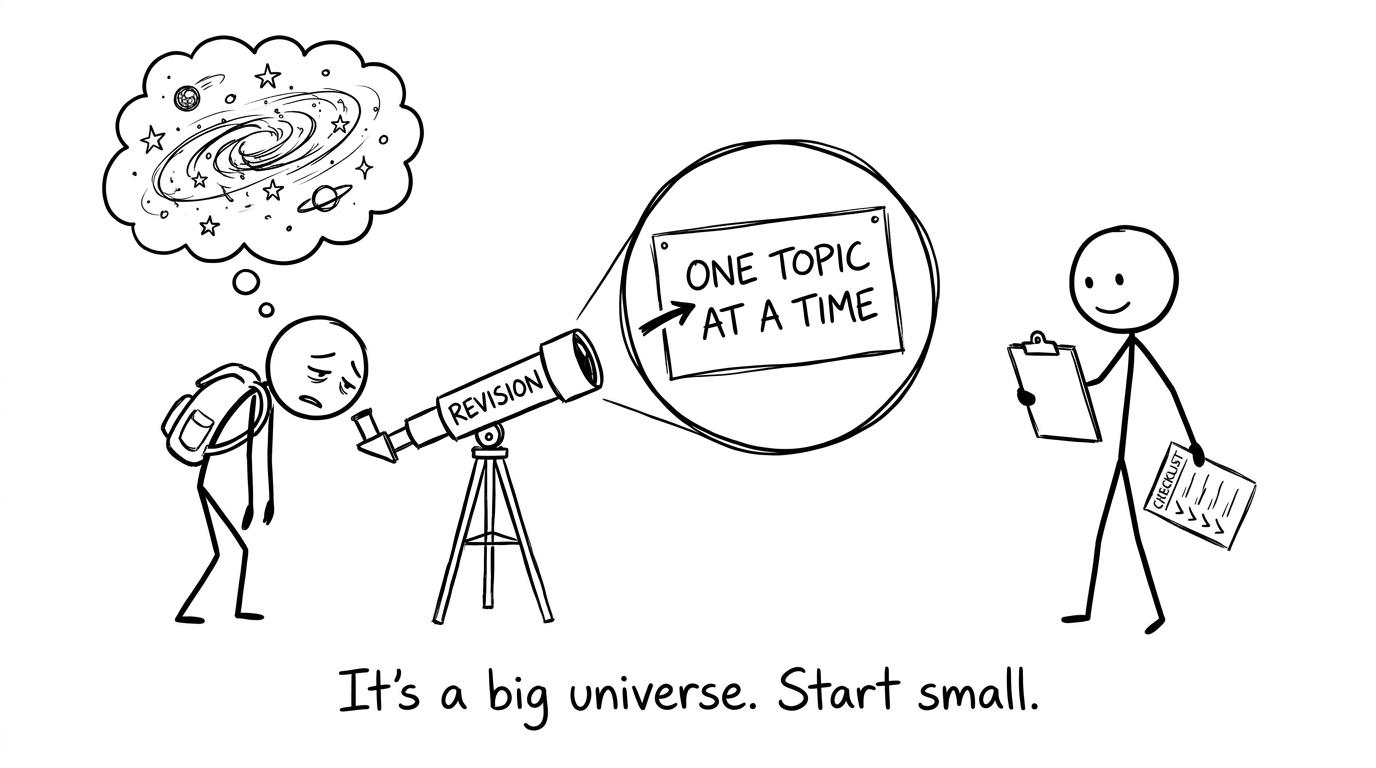 A student discovering that revision reveals one topic at a time
What does a grade 8 represent in terms of ability?
A grade 888 does not mean knowing every fact about the Universe. It means using GCSE-level knowledge with a high degree of accuracy, independence and judgement.
Pearson's specification divides assessment between three objectives. Across the qualification, AO1 accounts for 40%40\%40%, AO2 for 40%40\%40% and AO3 for 20%20\%20%.
Knowledge and understanding
AO1 concerns demonstrating knowledge and understanding of astronomical ideas, techniques and procedures. At grade 888, recall needs to be more than a collection of isolated facts.
You should understand relationships within systems: how motions produce observable effects, how evidence supports models, how instruments collect information and how stellar or cosmological processes connect over time. Accurate terminology matters because vague language can obscure otherwise sound knowledge.
Applying astronomical ideas
AO2 assesses whether you can apply knowledge and understanding. This is often where a high grade separates itself from competent recall.
The question may place familiar science inside an unfamiliar diagram, observation or dataset. A grade 888 student can identify the relevant principle, select useful information and adapt what they know rather than waiting for a question that resembles their notes exactly.
This is also why calculations matter. Ofqual's subject requirements state that at least 20%20\%20% of the total marks must reward mathematical skills. The maths is assessed in an astronomical context, so knowing a technique is only the beginning. You must recognise when to use it.
Analysis and evaluation
AO3 covers analysing information and ideas, interpreting evidence and making judgements. This includes evaluating observational procedures, discussing limitations and reaching conclusions supported by data.
Strong answers distinguish between what evidence shows and what it merely suggests. They consider reliability, validity, accuracy and improvements in context rather than adding a memorised sentence about “human error”.
That judgement is a central part of the GCSE astronomy grade 888 meaning. High attainment is not just fast recall. It is controlled reasoning.
How is GCSE Astronomy assessed?
Pearson Edexcel GCSE Astronomy has two externally examined papers. Each lasts 111 hour 454545 minutes, carries 100100100 marks and contributes 50%50\%50% of the qualification.
- Paper 1: Naked-eye Astronomy assesses Topics 111 to 888.
- Paper 2: Telescopic Astronomy assesses Topics 999 to 161616.
Both papers include a mixture of multiple-choice, short-answer, calculation, graphical and extended open-response questions. Calculators may be used.
Students must also complete at least one unaided and one aided astronomical observation during the course. The observations are mandatory, while knowledge and understanding of observational work are assessed through the written examinations. At least 15%15\%15% of the qualification's marks assess observational skills.
This balance matters. A student cannot normally build a grade 888 result by being brilliant at calculations but uncertain about observational design, or by memorising content while avoiding graphs and evidence. Both halves of the course contribute equally, and individual papers are not awarded separate final grades.
What mark is needed for a grade 8?
There is no fixed grade 888 percentage that applies every year. Grade boundaries are set after the papers have been taken so that differences in examination demand can be considered.
For context, Pearson's published June 202520252025 boundary for a grade 888 in GCSE Astronomy was 147147147 marks out of 200200200:
147200×100=73.5%\frac{147}{200}\times 100=73.5\%200147×100=73.5%In June 202420242024, the published grade 888 boundary was 140140140 out of 200200200, or 70%70\%70%. These figures describe those particular examination series. They are not predictions for a future paper.
You can review the latest available Edexcel GCSE Astronomy grade boundaries, but treat them as historical reference points. A safer revision target is to improve the quality and consistency of your answers rather than betting on a particular boundary.
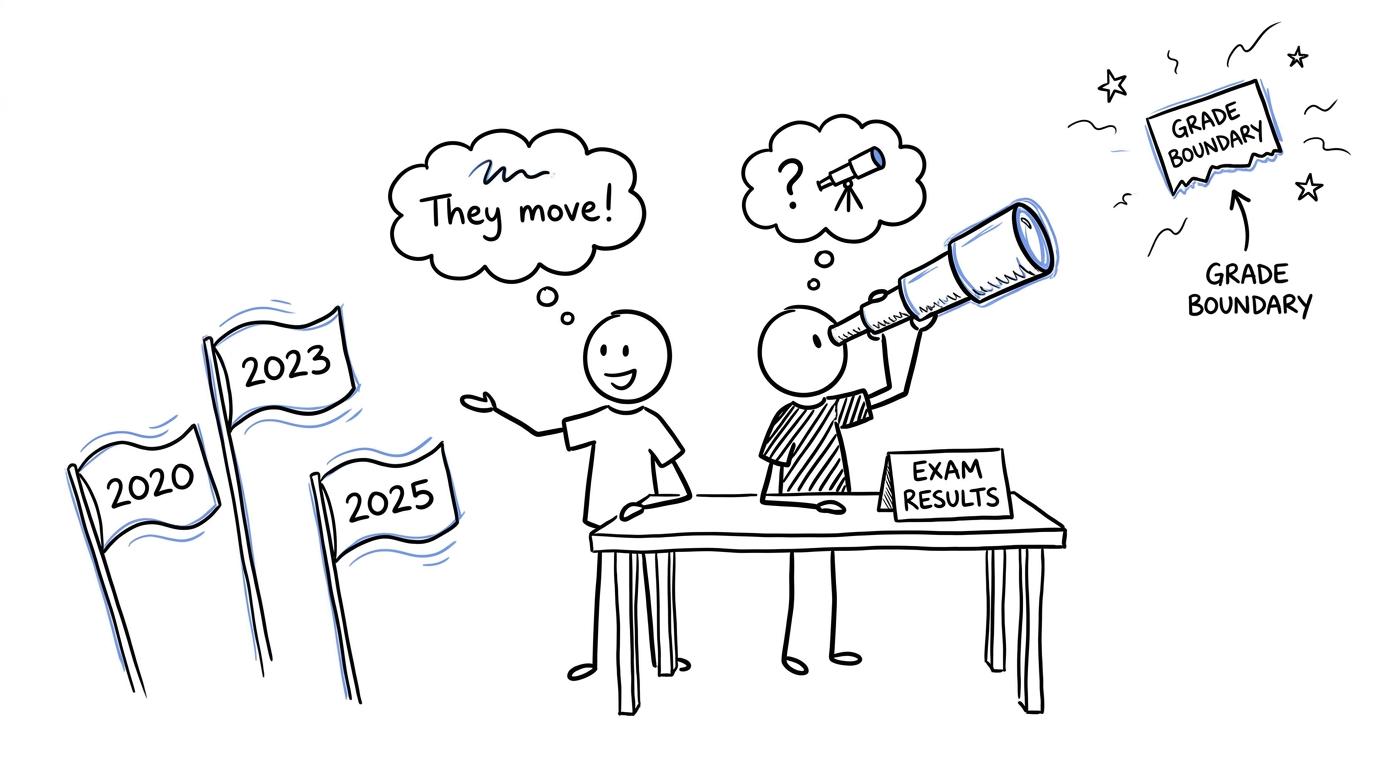 Students searching space for a fixed grade boundary while yearly boundary flags move
How does grade 8 compare with the old letter grades?
The old GCSE letter grades and the current grades 999 to 111 do not have a complete one-to-one conversion. Ofqual established certain alignment points when the numerical scale was introduced: broadly, the bottom of grade 777 aligns with the bottom of the old grade A, while grades 777, 888 and 999 collectively provide greater differentiation at the top of the former A and A* range.
A careful comparison is therefore:
| Current grade | Broad interpretation |
|---|---|
| 999 | Exceptional performance above the old A* threshold |
| 888 | Between grades 777 and 999, broadly within the former high A to A* region |
| 777 | Broadly aligned with the old grade A threshold |
| 444 | Broadly aligned with the old grade C threshold |
It is common to describe grade 888 informally as an A*, but that is an approximation rather than an official direct conversion. A grade 888 covers performance between the defined grade 777 and grade 999 standards. It should be understood as a high grade in its own right.
The maths behind a grade 8 in Astronomy
Astronomy makes the scale of mathematical ideas visible. Standard form stops enormous distances becoming long strings of zeros. Graphs turn observations into trends. Algebra lets a supplied relationship answer a different question.
The Department for Education's required mathematical content includes arithmetic, ratios, percentages, inverse-square relationships, logarithms, significant figures, specialist units, algebra, graphs, geometry and trigonometry. Grade 888 performance usually depends on selecting these skills accurately under examination pressure.
Standard form and numerical accuracy
Very large and very small quantities occur naturally in astronomy. You should be comfortable interpreting and calculating with expressions of the form
a×10n,1≤a<10.a\times 10^n, \qquad 1\leq a<10.a×10n,1≤a<10.You also need sensible significant figures, unit conversions and order-of-magnitude reasoning. MathsGenie's standard form revision resources provide lessons, questions and solutions for strengthening this foundation.
Algebra and formulae
Astronomy questions can require substitution, rearranging equations and maintaining consistent units. The formula sheet reduces the burden of memorising equations, but it does not choose the correct equation or rearrange it for you.
If manipulating symbols slows you down, revisit changing the subject of a formula before returning to astronomy questions.
Graphs, geometry and trigonometry
High-grade candidates need to move confidently between numerical, graphical and written information. That may involve plotting data, finding a gradient, identifying a trend or judging whether evidence supports a conclusion.
Geometry and trigonometry also support angular measurements and spatial reasoning. MathsGenie's SOHCAHTOA revision guide can help rebuild the underlying triangle skills, while scatter graph practice develops confidence in interpreting relationships within data.
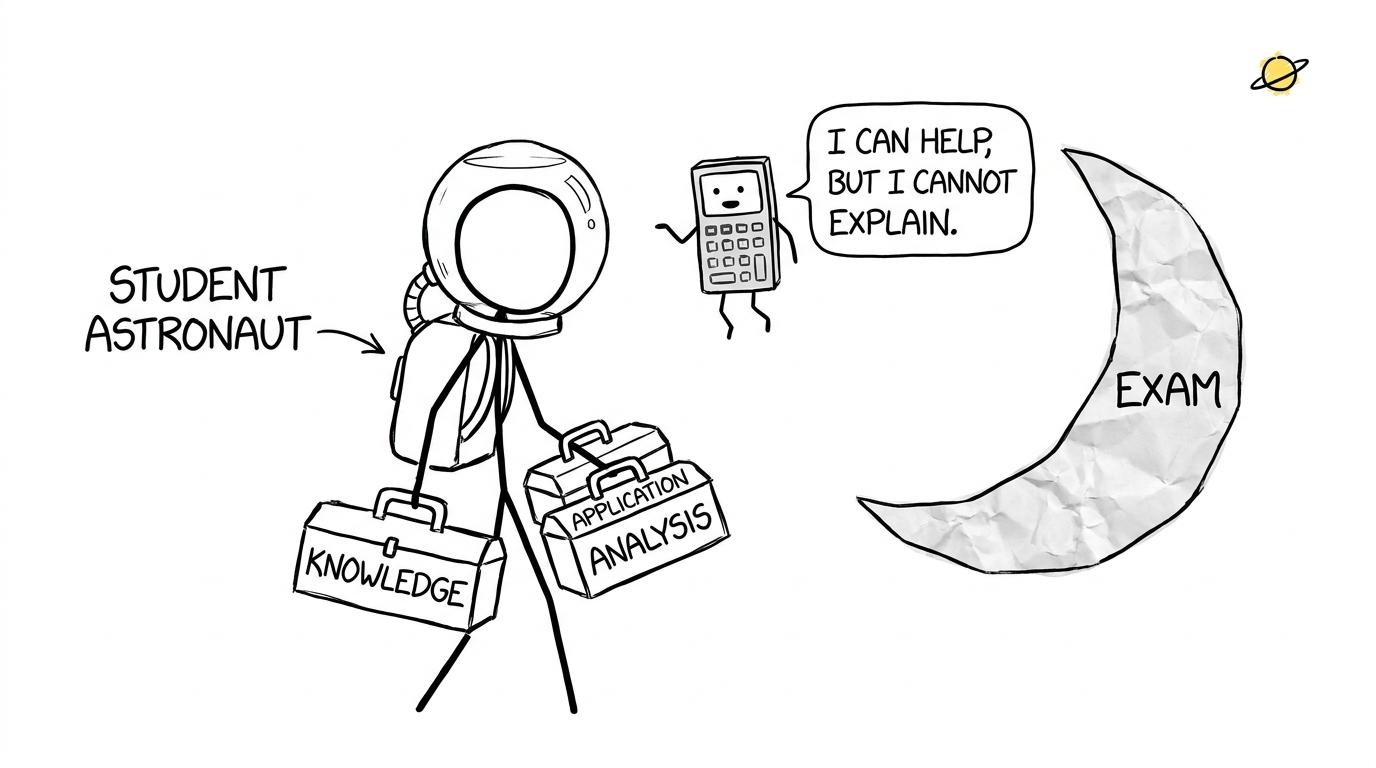 A student astronaut carrying knowledge, application and analysis towards an exam-paper moon
How to revise towards grade 8
Grade 888 revision should be diagnostic. The aim is not simply to spend longer looking at content. It is to discover why marks disappear and then repair that precise weakness.
Use this cycle:
- Review one defined topic from the specification.
- Answer closed-book questions on it.
- Mark them carefully using the mark scheme.
- Label each lost mark: knowledge, application, maths, interpretation or communication.
- Revisit the relevant lesson and complete fresh practice.
- Test the skill later under timed conditions.
For the mathematical side of the course, the GCSE Maths revision hub offers free revision lessons, practice questions, mini tests, mark schemes and video solutions across Edexcel, AQA, OCR, Eduqas and other boards. Although GCSE Astronomy is a separate qualification, the underlying mathematical habits transfer directly.
Past-paper work is particularly useful because it forces several skills to operate together. You can use Edexcel GCSE Maths past papers to strengthen calculation accuracy and exam discipline. Predicted papers can provide additional practice, but they should complement specification-wide revision rather than replace it. MathsGenie's guide to using GCSE predicted topics wisely explains this distinction.
Common mistakes that hold students below grade 8
Treating a historical boundary as a target
A past boundary is not a promise about the next examination series. Revise for secure understanding across the whole specification, not for an assumed percentage.
Knowing facts without applying them
A polished definition may earn little if the question asks you to interpret new evidence. Practise explaining how your knowledge applies to the information provided.
Giving generic evaluations
Comments such as “repeat the observation” need context. State what should be repeated, what variation is being reduced and how the resulting data would improve the conclusion.
Losing units or rounding too early
Keep units visible, retain sufficient calculator accuracy and round at the end unless instructed otherwise. A correct method can be undermined by careless presentation.
Neglecting one paper
The two papers contribute equally. Strong knowledge of stars and cosmology cannot completely compensate for major gaps in naked-eye astronomy, and the reverse is equally true.
Reading mark schemes passively
A mark scheme is most useful when it changes your next response. Compare its wording with your own, identify the missing idea and then answer a different question that tests the same skill.
A grade is evidence, not an identity
A grade 888 in GCSE Astronomy represents advanced GCSE performance across knowledge, application, mathematics and evaluation. It is broadly associated with the upper part of the former A/A* range, but it has no exact old-letter equivalent. Most importantly, it shows consistency across a demanding and varied subject.
The route towards it is less mysterious than the Universe itself. Find the lost marks. Repair one skill. Test it again.
Use MathsGenie to strengthen the mathematical foundations that astronomy depends on. Begin with a revision lesson, move into practice questions and mini tests, then use mark schemes and video solutions to understand every error. Finish by testing your progress with past papers and predicted papers, organised through a realistic revision plan. High grades are rarely built by one heroic evening. They are built by making the next answer slightly better than the last.