GCSE Astronomy Exam Conditions Practice at Home
GCSE astronomy exam conditions practice: create a realistic timed mock at home, manage distractions, use permitted equipment and review every mark.
A familiar room can make an exam paper feel deceptively easy. Your notes are nearby, your phone is within reach, and pausing the clock seems harmless. None of those comforts will be available in the real examination.
Effective GCSE astronomy exam conditions practice means reproducing the decisions, time pressure and restrictions of the exam as closely as you reasonably can at home. Use an official paper, follow its stated duration, remove unauthorised materials, work without help and mark it only after time has finished.
The purpose is not to make revision unpleasant. It is to discover what happens when knowledge must be retrieved under pressure. A realistic mock exposes hesitation, weak recall and poor timing while there is still time to improve them.
Your home exam checklist
Before beginning, make sure you have:
- an official Pearson Edexcel GCSE Astronomy paper that you have not attempted before
- the paper's front-cover instructions and any permitted materials
- the correct time allowance
- pens, pencils, a ruler, an eraser and permitted drawing equipment
- a suitable scientific calculator, if allowed by the paper
- a separate clock or timer that cannot receive messages
- a quiet desk cleared of notes, textbooks and revision cards
- paper for rough working, if permitted
- the corresponding mark scheme, hidden until the session ends
- someone at home who knows not to interrupt you
At the time of writing, GCSE Astronomy is offered by Pearson Edexcel and is assessed through two written papers: Naked-eye Astronomy and Telescopic Astronomy. Each paper is normally worth 100100100 marks and lasts 111 hour 454545 minutes. Always check the current specification, examination timetable and front cover of the particular paper you are using because official instructions take priority over general revision advice.
Choose the right GCSE Astronomy paper
A realistic session begins with a secure, complete paper. Use official past or sample assessment material from the awarding body rather than a collection of questions assembled by topic. Topic questions are useful for learning, but they do not reproduce the unpredictability of a full examination.
Choose a paper you have not recently seen. Recognising an answer tests memory of the paper rather than your ability to apply astronomy. Keep the mark scheme and any examiner commentary closed in another room or ask someone else to hold them.
Check which component you are attempting. Naked-eye Astronomy and Telescopic Astronomy cover different parts of the specification, although both can assess scientific understanding, observational skills, data interpretation and mathematical reasoning. Your practice record should identify the exact paper so that later scores can be compared meaningfully.
Mathematical confidence matters here. Astronomy questions may require you to rearrange formulae, interpret graphs, work with angles, handle units or express very large quantities efficiently. MathsGenie's free GCSE maths revision resources can help you strengthen those underlying skills before your next full mock.
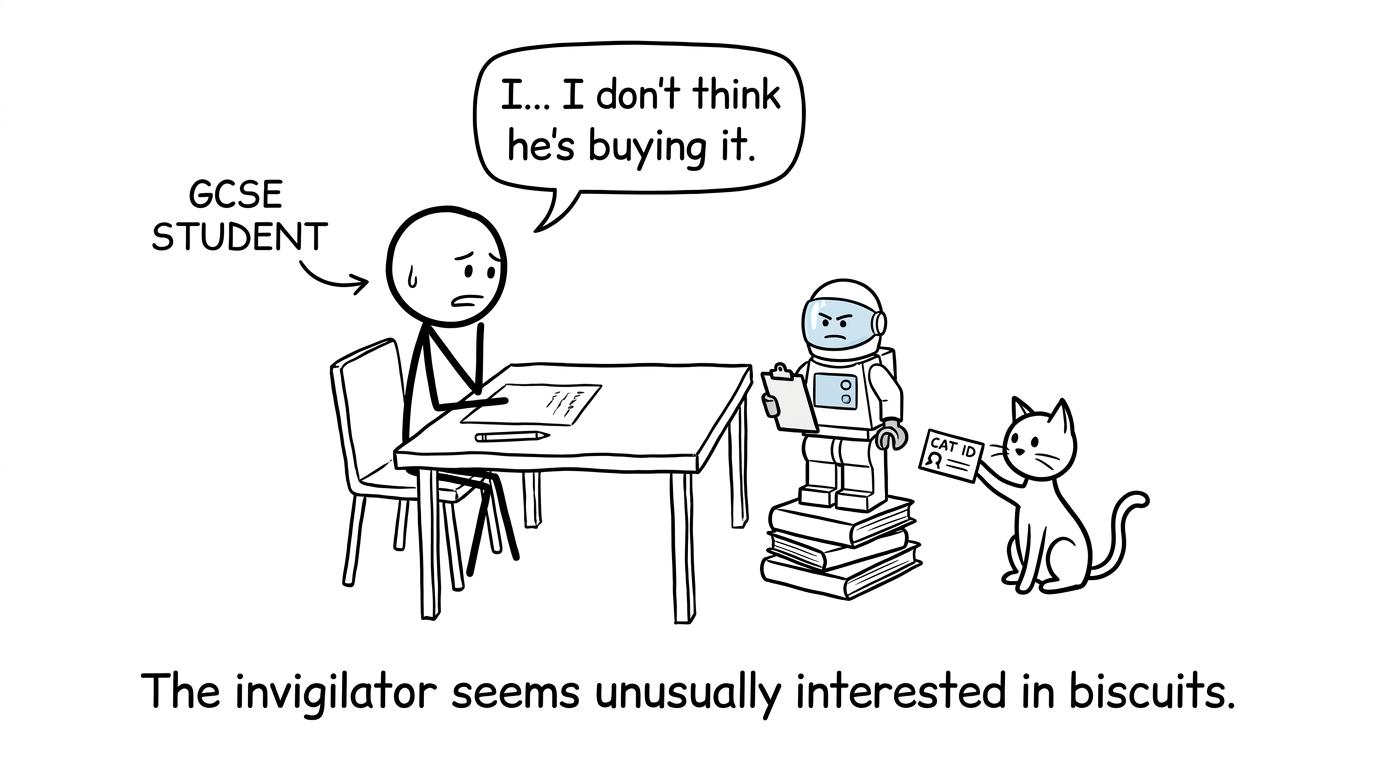 A toy astronaut invigilates a home mock while a cat presents its identification
Turn an ordinary room into an exam space
A classroom is not essential. Consistent rules are.
Clear your desk completely, then return only the items permitted on the paper. Remove posters, formula sheets and revision notes from your direct view. Sit at a table rather than on a bed or sofa. The slight formality helps distinguish an examination simulation from ordinary revision.
Tell other people in the house when you will finish. Put pets elsewhere if possible and deal with food, water and bathroom needs beforehand. You cannot guarantee silence at home, but you can remove predictable interruptions.
Remove connected devices
Switch off your mobile phone and place it outside the room. Do the same with smart watches, headphones and any device capable of storing information or communicating. Current examination rules are strict about unauthorised items, so practising without them builds the right routine.
If you need a timer, use an analogue clock, a basic digital clock or a device placed where you cannot access other functions. Do not use a timer that you will repeatedly pause whenever concentration slips.
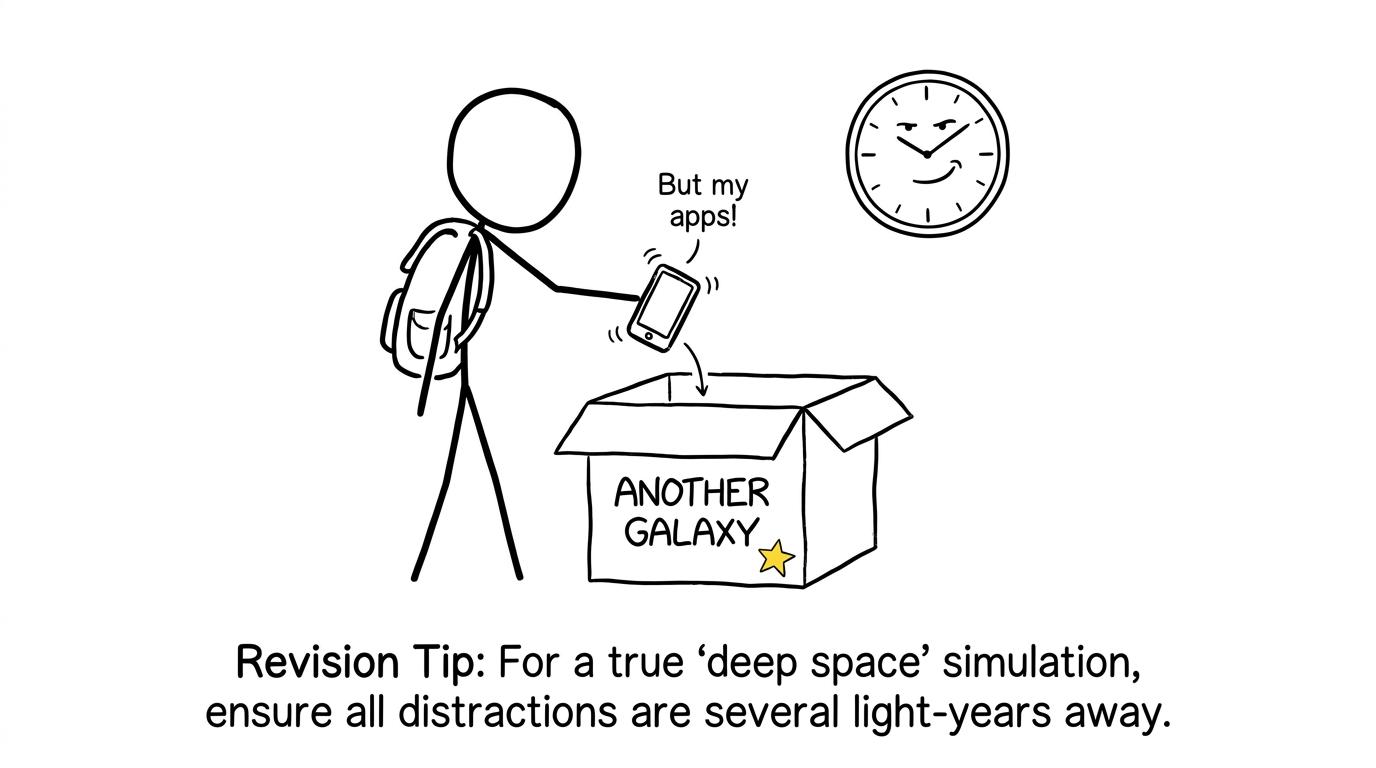 A student sends a mobile phone to another galaxy before starting revision
Match permitted equipment exactly
Read the paper's front cover before starting. Check calculator instructions and make sure your calculator is in the correct mode. Clear stored expressions where appropriate and avoid relying on functions you do not understand.
Astronomy also involves diagrams and measurements, so have sharpened pencils and an accurate ruler ready. Equipment problems consume attention. Discovering a flat calculator battery during home practice is inconvenient; discovering it during the real exam is worse.
If manipulating numbers or scientific notation is slowing you down, revisit standard form revision on MathsGenie. For angle and scale work, the same GCSE topic library provides lessons, practice questions, videos and answers across the grades 999-111 curriculum.
Run the timed practice properly
Write your start and finish times where you can see them. For a paper lasting 111 hour 454545 minutes, allow the full uninterrupted 105105105 minutes. Start only when the room is ready and the paper is face down.
Once the clock begins:
- read the information on the front cover
- write answers in the spaces provided
- show mathematical working clearly
- do not consult notes, websites or another person
- do not stop the timer for difficult questions
- move on when a question is consuming disproportionate time
- return to incomplete answers if time remains
You can estimate a neutral starting pace using:
minutes per mark=total available minutestotal marks.\text{minutes per mark}=\frac{\text{total available minutes}}{\text{total marks}}.minutes per mark=total markstotal available minutes.This is a guide, not a rule. Extended explanations, diagrams and unfamiliar data may need longer than short recall questions. The more useful habit is to notice when one question is taking time away from the rest of the paper.
Create two or three checkpoints before beginning. At each checkpoint, glance at your progress without conducting a lengthy calculation. If you are behind, shorten the time spent wrestling with one answer. A partially completed final section can contain several accessible marks; a blank section cannot.
Reproduce the mental pressure, not household discomfort
Realistic practice should copy exam constraints, not every unpleasant feature you can imagine. You do not need an uncomfortable chair, artificial noise or someone pacing behind you. You need uninterrupted retrieval, honest timing and no access to support.
Do not restart because the opening question feels difficult. This is one of the most valuable moments in the session. An unexpected first question can create the false impression that the entire paper will be beyond you. Practise pausing, reading again and moving forward calmly.
Equally, do not check an answer online halfway through. The instant correction may feel productive, but it changes the rest of the paper. Mark the question discreetly and investigate it after the timer ends.
Students also preparing for GCSE maths can use official-style maths past-paper practice to rehearse the same habits. Although Edexcel, AQA, OCR and Eduqas maths papers differ in structure, disciplined reading, visible working and sensible time management remain useful across exam boards.
Mark the paper like evidence, not a verdict
When time ends, stop writing immediately. Add a line beneath unfinished work so you know what was completed under timed conditions. Anything added afterwards should be written in a different colour and excluded from the timed score.
Use the official mark scheme carefully. Award marks only where your response satisfies the stated criteria. For extended responses, look for each required scientific idea rather than awarding marks because an answer sounds broadly convincing. Where the mark scheme allows alternatives, judge what you actually wrote rather than what you intended.
Record more than the total. Classify each lost mark as:
- knowledge: a fact, definition or process was not recalled
- application: knowledge was not connected to the unfamiliar context
- mathematics: working, units, substitution or interpretation failed
- question reading: a command word or detail was missed
- timing: a reachable question was left incomplete
- communication: the response lacked enough precise scientific detail
A score tells you where you are. Categories tell you what to do next.
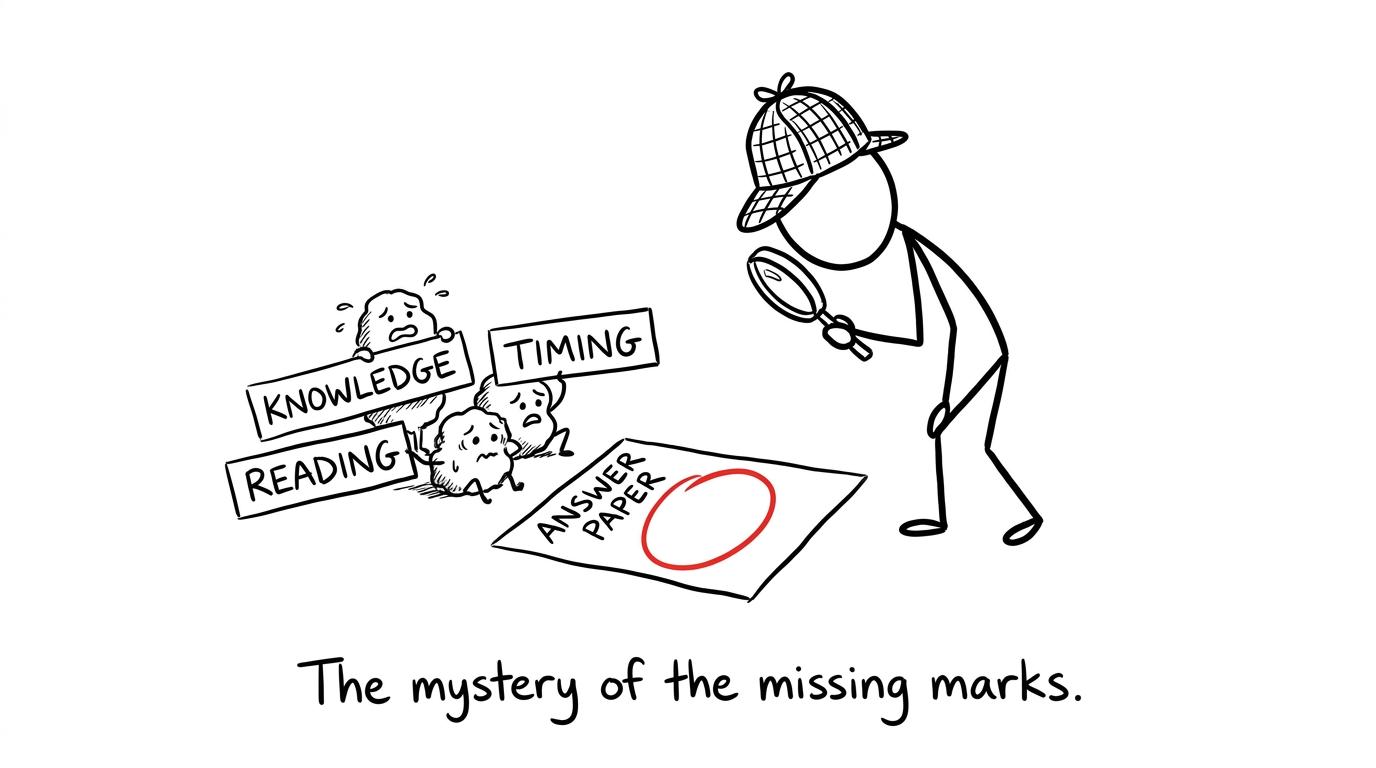 A student detective investigates knowledge, timing and reading mistakes
Turn the result into the next revision cycle
Do not repeat the whole paper immediately. First, repair the weaknesses it revealed.
Create a short correction list containing the relevant specification area, the reason marks were lost and the action required. That action might be relearning telescope resolution, revising celestial coordinates, practising graph interpretation or improving calculations involving ratios and units.
For mathematical gaps, use MathsGenie's free GCSE revision lessons, then answer practice questions without looking at the solution. Use GCSE maths past papers to develop mixed-topic stamina and MathsGenie predicted papers when preparing for upcoming maths examinations. Predicted papers are revision tools rather than forecasts of exact questions.
Once corrections are complete, attempt selected missed questions again without the mark scheme. Later, schedule a different full Astronomy paper under the same conditions. Keeping the room, timing rules and marking method consistent makes changes in performance easier to interpret.
Common mistakes in home exam practice
Choosing a familiar paper
A remembered paper can produce an encouraging score without testing genuine retrieval. Save unseen official material for timed sessions and use familiar questions for targeted practice.
Allowing small exceptions
Checking one definition, pausing for a message or extending the finish time by a few minutes breaks the simulation. Record interruptions honestly and reschedule if the session becomes seriously compromised.
Marking too generously
Marks are awarded for what appears on the page. If an idea is incomplete or a unit is missing where required, follow the mark scheme rather than filling in the gap mentally.
Focusing only on the final score
Two identical totals can reveal completely different needs. One may come from missing knowledge; another may result from poor timing. Always analyse the source of lost marks.
Practising full papers too often
Mocks diagnose problems; lessons and questions repair them. Constantly sitting papers without targeted revision can rehearse the same errors. Alternate realistic timed sessions with focused learning, mini tests and corrections.
Make the next mock more useful than the last
The goal of home practice is not to prove that you are ready. It is to find the parts of exam performance that are not ready yet, while the consequences are small.
Set up one unseen GCSE Astronomy paper, protect the full time allowance and follow the front-cover rules exactly. Then mark it honestly and turn every lost mark into a specific revision action. That cycle transforms an ordinary desk into something valuable: a safe place to encounter pressure before the pressure counts.
Use MathsGenie alongside your Astronomy revision to strengthen the mathematical skills behind data, graphs, formulae, scale and measurement. Begin with the free revision lessons and practice questions, then build stamina through past papers, predicted papers, mini tests, mark schemes and video solutions. Your next realistic session should not merely feel more comfortable; it should reveal better decisions.