GCSE Astronomy Command Words: What They Really Mean
GCSE astronomy command words explained clearly. Learn what calculate, describe, explain, compare and evaluate require for stronger exam answers.
You can know exactly why a lunar eclipse happens and still lose marks because the question asked you to explain, while your answer merely described. That is what makes GCSE astronomy command words so important: they tell you what kind of response the examiner expects.
The quick answer is simple. State means give the relevant fact. Describe means say what happens or identify the features. Explain means give reasons. Calculate requires a numerical method and answer. Evaluate asks you to weigh evidence before reaching a supported conclusion.
These small words act like instructions on a telescope. If the direction is wrong, knowing more astronomy does not automatically bring the answer into focus.
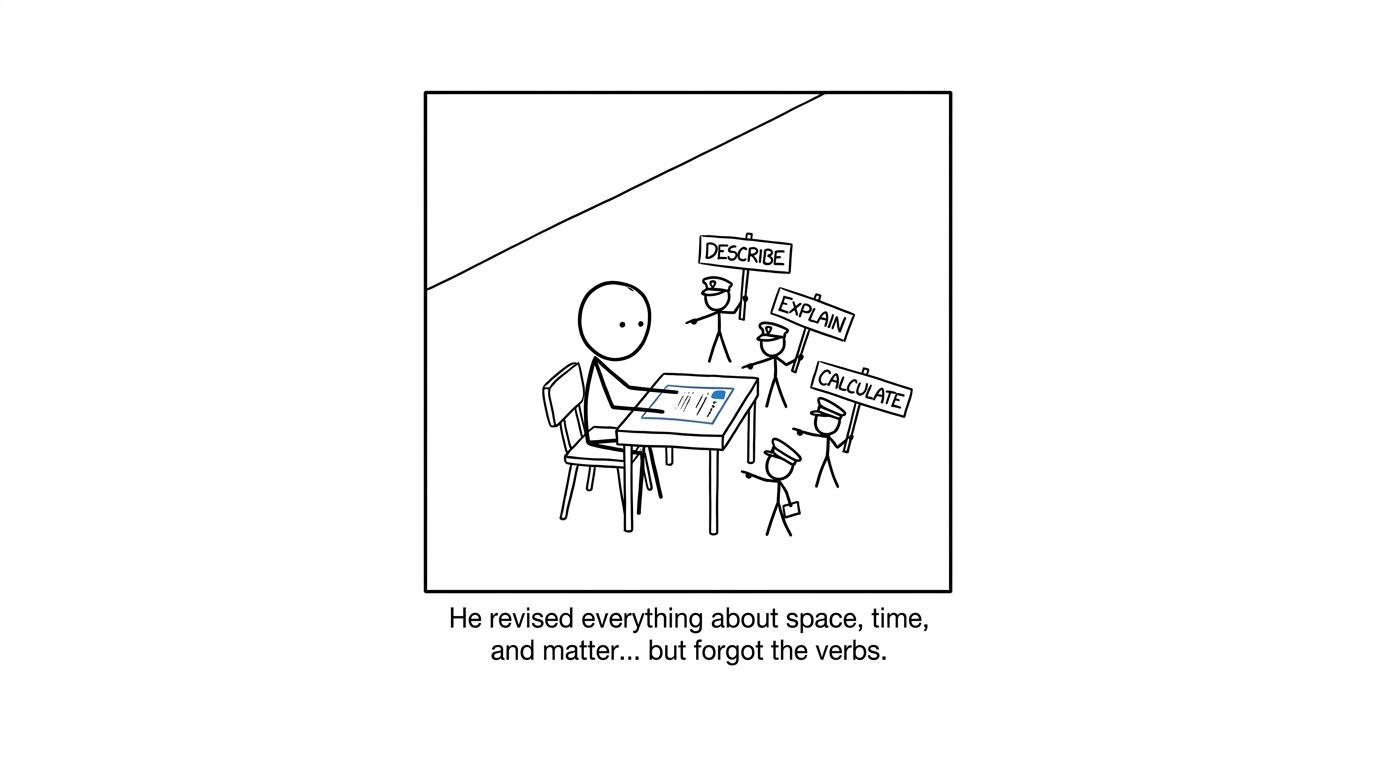 A student has revised the universe but not the command words
A quick command-word checklist
Before answering an astronomy question, identify four things:
- The command word: What action must you perform?
- The subject: Which object, observation or process must you discuss?
- The context: Are you expected to use data, a diagram or your own knowledge?
- The marks available: How much relevant development is likely to be needed?
GCSE Astronomy is offered by Pearson Edexcel under specification code 1AS0. Its questions combine astronomical knowledge, observational skills, data interpretation and mathematical reasoning. The precise wording of a question matters, and the number of marks gives an additional clue about the expected depth.
There is no safe rule that one mark always equals one sentence. One accurate sentence might contain several linked ideas, while three vague sentences may earn nothing. Treat the mark allocation as a guide, then make every line relevant.
What the main GCSE astronomy command words mean
State, give, name and identify
These usually request a short, direct answer.
- State means express a fact or conclusion clearly.
- Give means provide the requested information without unnecessary development.
- Name means supply the accepted scientific term.
- Identify means select or recognise the relevant feature, object or answer.
Do not turn a one-mark identification into a paragraph. Extra writing consumes time and can create contradictions. If the question asks you to state a unit, for instance, supply the unit rather than explaining its history or use.
Describe
Describe asks what something is like, what happens, or what pattern can be seen. Your answer may need characteristics, stages, changes or trends, but it does not necessarily need the underlying reason.
Useful descriptive language includes:
- increases or decreases;
- remains constant;
- reaches a maximum or minimum;
- appears brighter or fainter;
- moves from one position to another;
- repeats in a regular cycle.
When describing data, be precise. If the evidence supports it, refer to values and units rather than writing that something “goes up a lot”. The MathsGenie graphs revision resources can help you practise reading scales, coordinates and trends accurately.
Explain
Explain requires reasons. It asks you to connect a cause to an outcome, often through a chain of scientific ideas.
A useful mental frame is:
cause →\rightarrow→ mechanism →\rightarrow→ consequence
Words such as “because”, “therefore” and “so” can help form that chain, although inserting them does not guarantee a correct explanation. The scientific link must still be valid.
For a higher-mark response, several connected steps may be necessary. Avoid listing disconnected facts and hoping that the examiner constructs the explanation for you. Make the relationship explicit.
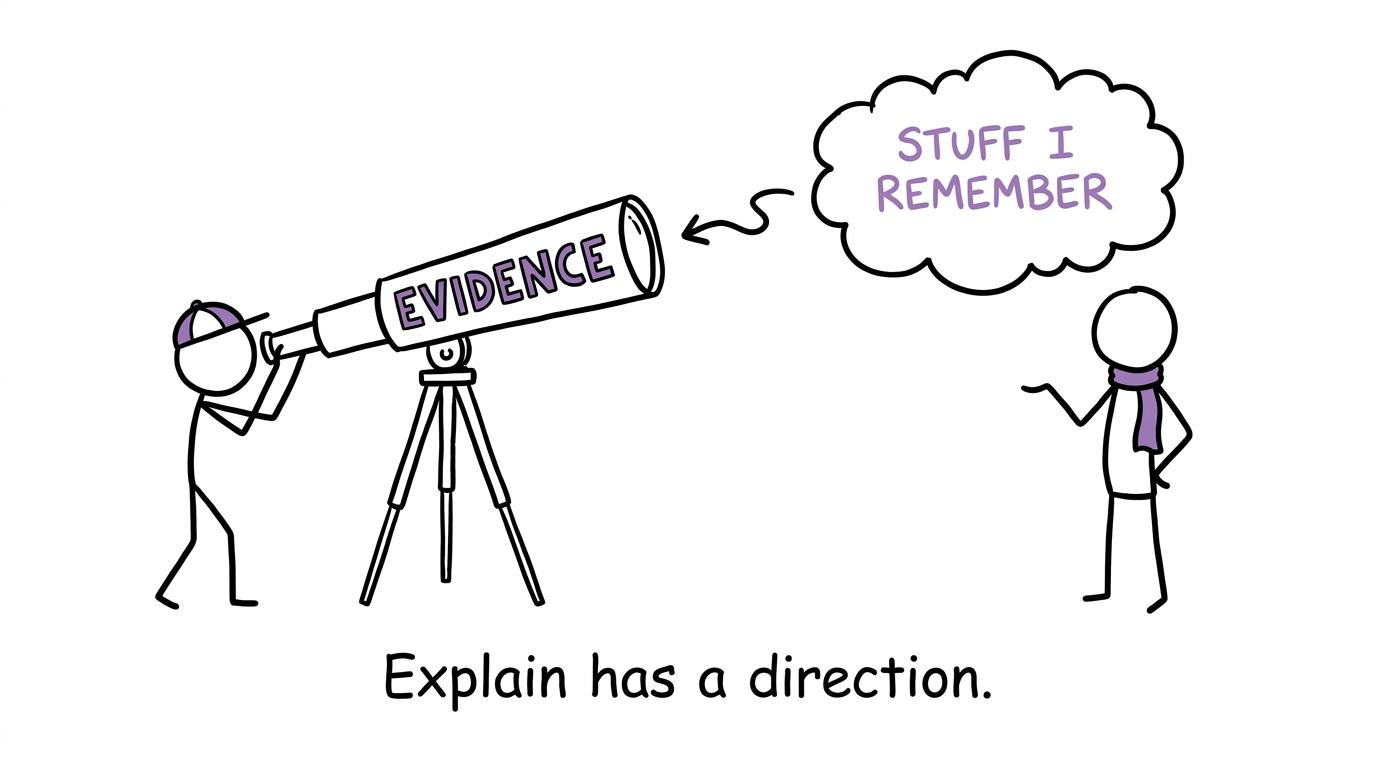 A telescope labelled evidence points an explanation in the right direction
Compare
Compare means identify relevant similarities and differences. Strong comparisons discuss the same feature for both objects, methods or sets of data.
Paired language keeps the comparison visible:
- “Both observations show…”
- “Object A is…, whereas object B is…”
- “Unlike the first method, the second…”
Two separate descriptions are not automatically a comparison. The examiner should not have to infer how the two sides relate. If numerical information is supplied, use it where relevant and include units.
Calculate and determine
Calculate requires a numerical answer obtained through mathematical working. Determine is slightly broader: you must use the available information to reach an answer, which may involve calculation, interpretation or deduction.
For calculation questions:
- select the correct relationship;
- substitute values carefully;
- show the main stages of working;
- keep sufficient calculator precision until the final step;
- round only as instructed or as the data justifies;
- include the correct unit where required.
Astronomy commonly uses large distances and small angles, so fluency with standard form is especially valuable. A quantity such as 1.50×10¹¹ m1.50 \times 10^{11}\text{ m}1.50×10¹¹ m should retain both its power of ten and its unit.
Scale diagrams and angular calculations may also draw on GCSE trigonometry revision. Even when your final answer is wrong, clear working may allow the mark scheme to award method marks. A calculator-only answer hides the method and makes checking harder.
Show that
A show that question gives you the result and asks you to demonstrate why it follows from the supplied information.
The printed answer is not permission to work backwards vaguely. Begin with the appropriate data or relationship, show the logical mathematical steps, and arrive at the stated result. Include enough intermediate working to establish that the value has been derived rather than copied.
Rounding matters here. Your unrounded result may be close to the displayed value because the question has presented it to a particular number of significant figures. Do not force an intermediate value to match by rounding too early.
Estimate
Estimate asks for an approximate value based on sensible assumptions, rounded information, a graph or an appropriate order of magnitude. It does not mean guess without reasoning.
Make your assumptions visible where the question requires them. An estimate should be plausible in context. After obtaining it, ask whether its size and unit make sense for the astronomical quantity involved.
Draw, plot and measure
These words test practical precision:
- Draw means produce the requested diagram, line or representation accurately.
- Plot means place data points at the correct coordinates using the given scales.
- Measure means use an appropriate instrument or scale to obtain a value.
Use a sharp pencil and ruler where suitable. Read both axes before plotting and check whether the divisions are linear. If asked for a line of best fit, it should represent the overall trend rather than join every point mechanically.
The mathematical habits behind this can be strengthened through the free GCSE Maths revision programme, where topics are organised by grade and supported by videos, questions and answers.
Suggest and predict
Suggest usually asks you to apply scientific understanding in a context where more than one reasonable response may be possible. Your idea still needs to be relevant and scientifically defensible.
Predict asks for a likely outcome based on a pattern, model or established principle. State the outcome clearly and, if the marks or wording require it, connect the prediction to the evidence.
Neither word means invent anything that sounds astronomical. Anchor the response in information from the question or knowledge from the specification.
Discuss and evaluate
These are broader command words, often attached to questions with more marks.
Discuss asks you to explore relevant aspects of an issue. Depending on the question, that could include evidence, limitations, advantages, disadvantages or alternative interpretations.
Evaluate requires a judgement. A strong response normally:
- considers relevant evidence on more than one side;
- distinguishes important points from minor ones;
- recognises limitations or uncertainty;
- reaches a conclusion supported by what has been discussed.
The conclusion is essential. “There are advantages and disadvantages” is a summary, not an evaluation. Your judgement may be qualified, but it must answer the question.
Let the whole question control your answer
The command word is the first instruction, not the only one. Compare these tasks conceptually:
- describe a pattern;
- describe a pattern using data;
- explain the pattern;
- evaluate whether the data support a conclusion.
Each demands something different. Underline qualifiers such as “using the graph”, “in terms of gravity”, “give two reasons” or “to three significant figures”. These phrases control the evidence, scope and accuracy expected.
Also pay attention to plural nouns. If a question asks for “advantages”, one advantage is unlikely to complete the task. If it asks for two differences, make two distinct comparative statements.
How to practise command words effectively
Reading definitions once creates recognition. Marks come from retrieval and application.
When completing an astronomy past paper, circle the command word before answering. Afterwards, compare your response with the mark scheme and ask two separate questions:
- Did I know the astronomy?
- Did I perform the action requested?
Keep a short error log. Label each lost mark as knowledge, command word, calculation, unit, data reading or insufficient precision. Patterns become easier to fix when they are named.
Mathematical accuracy can be developed alongside subject knowledge. Use MathsGenie GCSE past papers to practise interpreting instructions under timed conditions, then check the mark schemes and video solutions. MathsGenie predicted papers provide further exam-style practice, while the free revision planner helps turn weak areas into a manageable schedule.
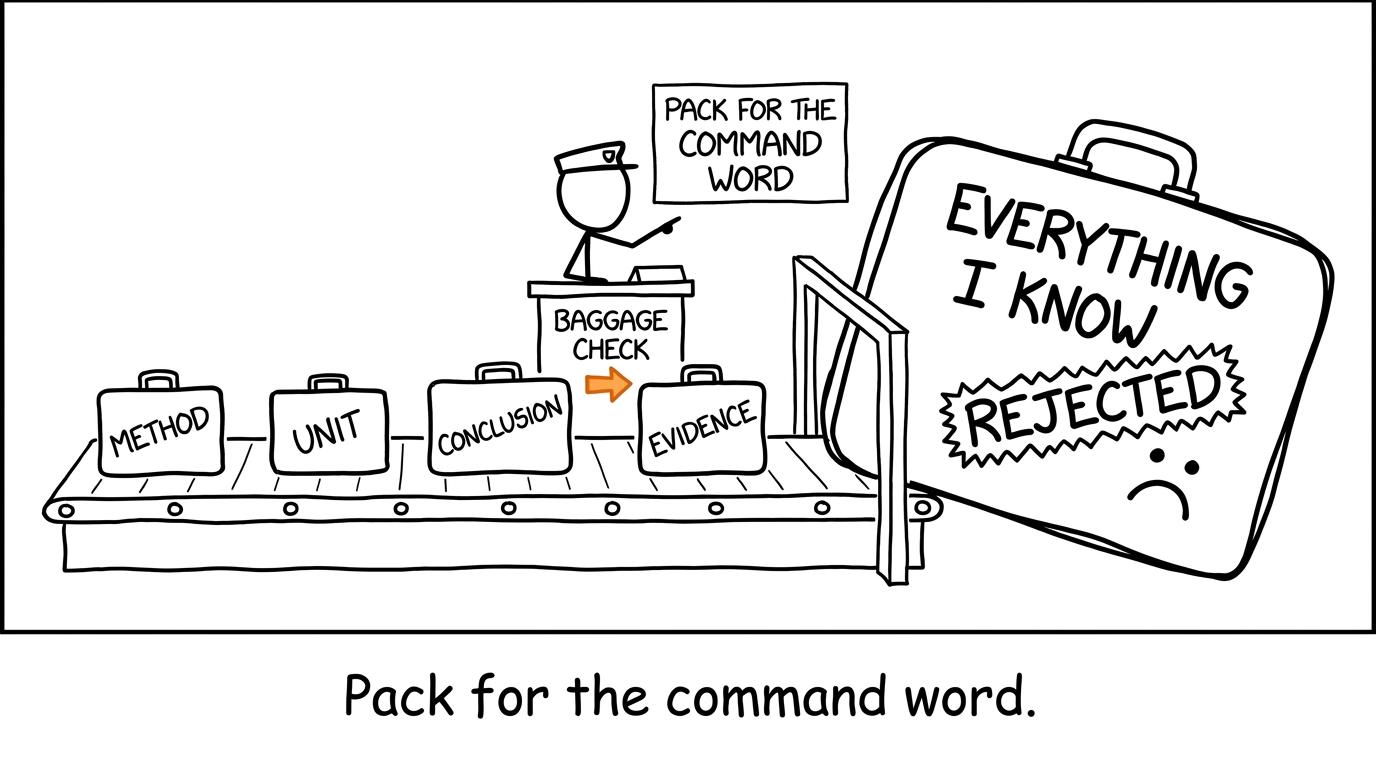 An examiner accepts method, unit and evidence but rejects everything remembered
Common mistakes with astronomy command words
Explaining when only a description has been given
A description tells the examiner what occurs. An explanation supplies the reason. After writing an explanation, check whether you have included a genuine causal link.
Writing everything remembered
A long answer is not automatically a complete answer. Select knowledge that addresses the named object, context and command word. Irrelevant facts do not compensate for a missing conclusion or reason.
Giving two descriptions instead of a comparison
Link the two subjects directly through words such as “both”, “whereas” and “however”. Compare the same characteristic on each side.
Hiding calculator work
Write the relationship, substitution and important intermediate steps. Check powers of ten, significant figures and units before moving on.
Evaluating without making a judgement
Evidence on both sides is useful, but evaluation must end with a supported conclusion. State which evidence carries the most weight and why.
Ignoring data supplied in the question
If a task says “use the data”, quote or process relevant values. General knowledge alone may not satisfy that instruction.
Turn the verb into marks
GCSE Astronomy can make the universe feel enormous, yet an exam answer often turns on one small verb. Pause long enough to notice it. Decide whether you are being asked for a fact, pattern, reason, calculation, comparison or judgement, then build only the response that does that job.
MathsGenie can support the numerical side of that process for free. Use the revision lessons, mini tests and practice questions to repair individual skills, then move to past papers, predicted papers, mark schemes and video solutions when you are ready to work under exam conditions. Start with the GCSE Maths revision hub, choose one weak skill, and make the next command word easier to obey.