GCSE Arabic Time Pressure Mistakes to Avoid
GCSE Arabic time pressure mistakes can cost easy marks. Learn how to manage listening, reading, writing and speaking calmly before the clock runs out.
The last few minutes of an exam can make familiar language look strangely unfamiliar. A student who could recognise a tense yesterday suddenly overlooks it. A clear opinion becomes a hurried sentence. An answer is left blank because one difficult question consumed too much time.
The most damaging GCSE Arabic time pressure mistakes are usually not dramatic gaps in knowledge. They are small losses of control: misreading the instruction language, missing a negative, writing beyond the task, leaving translation until too late or sacrificing accuracy for speed. The solution is to practise a repeatable exam routine before the real assessment.
This guide focuses on GCSE Arabic, but its central principle will also feel familiar to students preparing for maths exams: secure the available marks, move on when progress stops, and return with the time that remains.
Your quick time-pressure checklist
Before exploring each paper, remember these priorities:
- Read the task and identify exactly what must be answered.
- Notice whether instructions and responses are required in Arabic or English.
- Underline clues about tense, time, opinion and negation.
- Match the length of your answer to the marks and stated word count.
- Move on if a question is consuming time without producing progress.
- Leave a deliberate checking period rather than hoping one appears.
- Never leave an answer blank when a sensible attempt is possible.
Pearson Edexcel GCSE Arabic assesses listening, speaking, reading and writing. Under the current specification, each skill contributes 25%25\%25% of the qualification. That means time management matters across the whole course, not just in the writing paper.
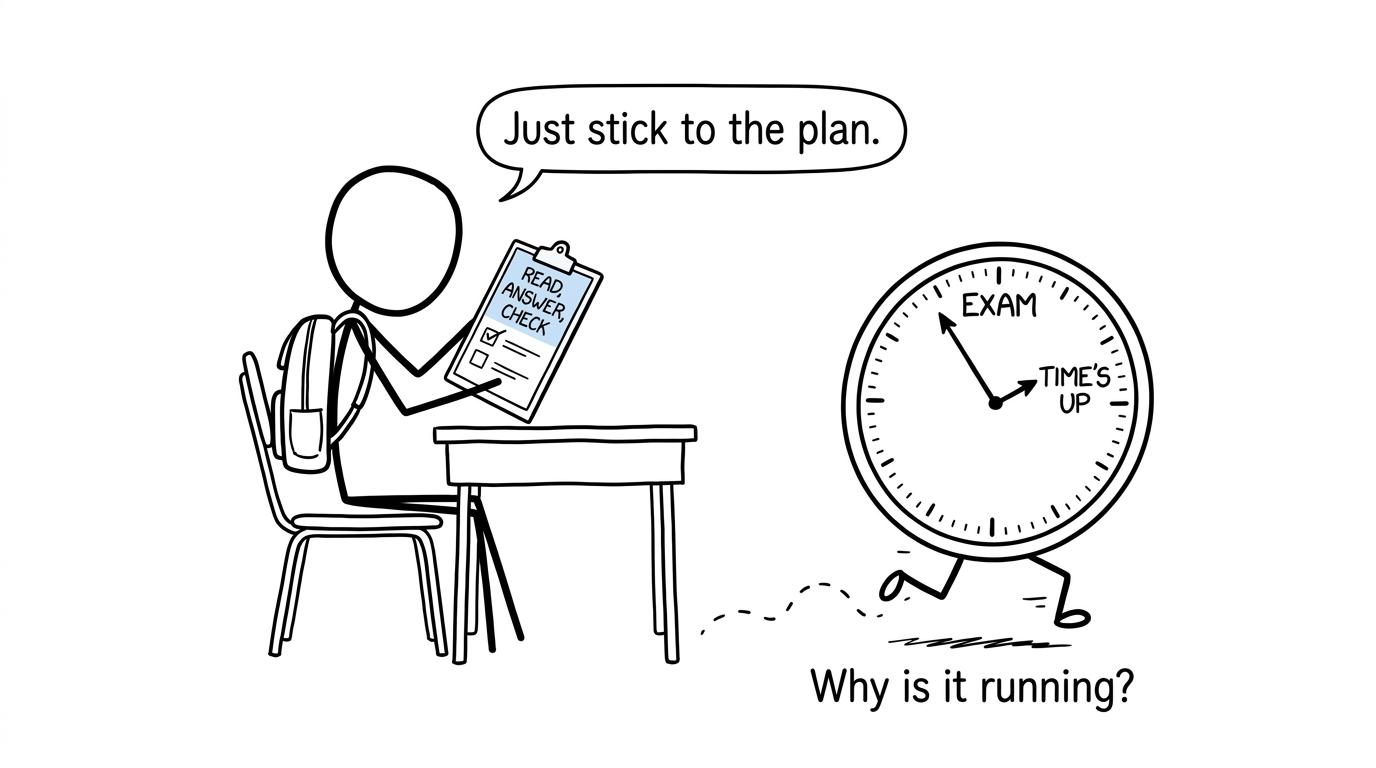 A student calmly follows a checklist while the exam clock tries to run away
Why time pressure creates avoidable mistakes
Time pressure changes the way students make decisions. Instead of asking, “What does this question require?”, the mind starts asking, “How quickly can I make this disappear?” Those are not the same question.
Rushing can produce three distinct problems:
- Attention errors: overlooking a negative, a time phrase or part of the prompt.
- Decision errors: spending too long on a difficult item while accessible marks remain elsewhere.
- Production errors: knowing the Arabic but writing or saying it inaccurately because checking disappears.
The cure is not simply to work faster. It is to make fewer decisions during the exam. Decide your routines in advance: how you will use reading time, when you will move on and what you will inspect during the final check.
Maths students use the same principle when they practise past papers properly. A timed paper reveals whether knowledge remains usable when the clock is visible. Arabic revision needs that same shift from comfortable practice to controlled rehearsal.
Listening mistakes when the recording will not wait
For Edexcel GCSE Arabic, the listening examination lasts 353535 minutes at foundation tier and 454545 minutes at higher tier, including 555 minutes of reading time. Students answer multiple-response and short-answer questions, and the paper does not require written responses in Arabic. Always follow the response language specified for the individual question.
Wasting the reading time
The opening reading period is not spare time. Use it to scan the questions, predict the kind of information required and mark critical words. Look for whether you need a person, reason, place, opinion, advantage or time reference.
Do not attempt to translate every line in advance. Your purpose is to build a listening target. A focused listener is more likely to recognise the relevant detail among distracting information.
Writing down the first familiar word
Recordings often contain several related details. Recognising one familiar word does not prove it answers the question. Wait for the full statement and listen for corrections, contrasts and changes of mind.
Words signalling “but”, “although”, “not” or “instead” can reverse the meaning. Under pressure, students hear the topic but miss the speaker’s actual view.
Getting trapped by one missed answer
If a detail has gone, let it go temporarily. Staying mentally attached to the previous question can make you miss the next one too. Add a small mark beside the uncertain item, reset your attention and use any later replay or checking time available under the paper’s instructions.
Reading and translation mistakes
Under the current Edexcel specification, the reading paper includes different text types, questions set in English and Arabic, and a translation from Arabic into English. Current timings are 505050 minutes for foundation tier and 111 hour 555 minutes for higher tier.
Reading every passage at the same speed
Not every line deserves equal attention. Begin with the question, then search the passage for relevant evidence. A short factual item should not receive the same time as a demanding literary extract or translation.
Skimming gives you the shape of the passage. Scanning helps you locate names, dates, places and repeated ideas. Close reading should then be reserved for the sentence containing the evidence.
Ignoring the language of the instruction
Some sections use English instructions and others use Arabic. A correct idea written in the wrong response language may not satisfy the task. Pause before each section and establish two things: what information is wanted, and which language you must use.
Translating word by word
Translation rewards accurate meaning, not a mechanical line of disconnected dictionary equivalents. Read the whole sentence before committing to English. Identify the subject, tense, negative expressions, pronouns and connecting words. Then produce natural English while preserving the original meaning.
Do not beautify the passage by adding ideas that are not present. Equally, do not omit a small word merely because the rest of the sentence seems obvious. Under time pressure, those small omissions accumulate.
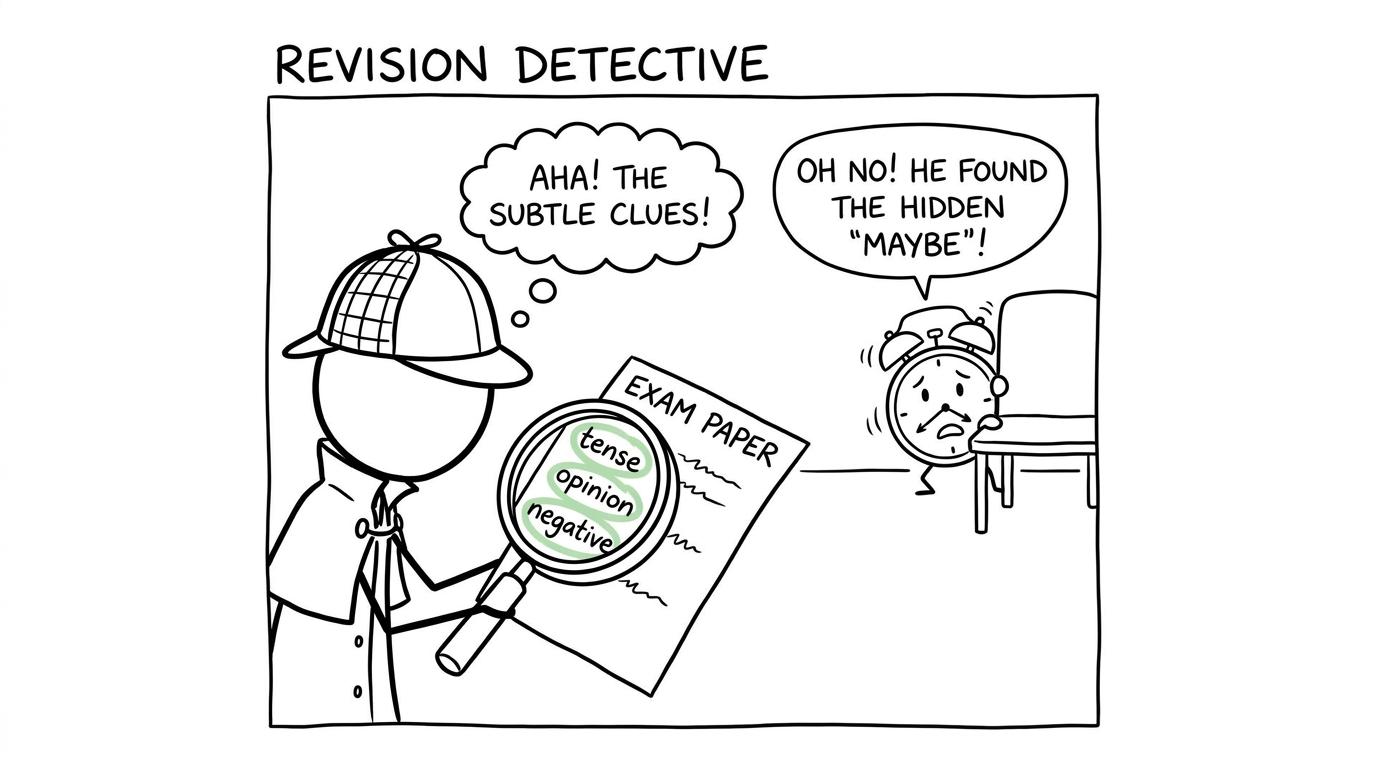 A student detective searches an exam paper for tense, opinion and negative clues
Writing mistakes that sacrifice easy marks
The Edexcel writing paper assesses communication in Arabic for different purposes and audiences. It includes open-response tasks and translation into Arabic, with specified word counts. Current timings are 111 hour 202020 minutes at foundation tier and 111 hour 252525 minutes at higher tier.
Starting before planning
A brief plan saves more time than it costs. Identify every bullet point, decide which tense or time frame each requires, and note a few reliable structures. Without that map, students often repeat one idea, overlook a bullet point or discover too late that their response lacks range.
Your plan should be compact. It is a route, not a first draft.
Writing far beyond the required length
Extra writing is not automatically better writing. It consumes checking time and creates more opportunities for agreement, spelling and tense errors. Aim to address the whole task with relevant detail rather than filling space.
A strong response is controlled. It communicates opinions and information clearly, uses appropriate structures and remains understandable throughout.
Choosing complexity that cannot be controlled
Ambition helps only when it remains accurate. Under pressure, an insecure complicated structure can collapse halfway through. Use language you can manipulate confidently, then add range where you have rehearsed it.
This resembles choosing a secure mathematical method rather than a flashy shortcut. MathsGenie’s GCSE revision mistakes guide makes the broader point: improvement comes from finding the precise error pattern and fixing it, not merely doing more work.
Failing to reserve checking time
Checking should have a job description. Do not just reread and hope something looks wrong. Inspect:
- whether every bullet point has been covered;
- whether time frames match the prompt;
- agreement and verb forms;
- missing words, dots and letter shapes;
- whether the translation preserves every element;
- whether your handwriting is unambiguous.
Speaking mistakes during preparation and delivery
Edexcel speaking includes a role play, picture-based task and conversation. Foundation assessments last 777 to 999 minutes and higher assessments last 101010 to 121212 minutes, with 121212 minutes of preparation for both tiers.
Trying to script everything
Preparation time should produce prompts, not a complete script you cannot naturally retrieve. Note essential content, useful vocabulary and possible time frames. If you attempt to memorise every sentence, one forgotten phrase can derail the rest of the response.
Giving answers that are too short
A minimal answer may communicate something, but it can restrict the evidence available for communication, interaction and linguistic range. Where the task permits, develop an answer with a reason, detail, opinion or contrasting idea.
Panicking after a correction
Self-correction is not failure. Correct the word or phrase clearly and continue. Spending several seconds apologising, restarting or mentally replaying the mistake loses more time than the original slip.
Common mistakes students make under time pressure
Across all four skills, the same patterns repeatedly drain marks:
- Answering from a keyword rather than the complete meaning. Read or listen for the whole message.
- Missing negatives and contrasts. Mark them whenever the format allows.
- Overinvesting in one difficult question. Protect the marks still available elsewhere.
- Leaving blanks. Make a sensible attempt unless the instructions make guessing inappropriate.
- Writing first and interpreting later. Understand the task before producing Arabic or English.
- Forgetting part of a multi-part prompt. Tick each requirement as it is completed.
- Using uncontrolled language to sound advanced. Reliable range is more valuable than avoidable confusion.
- Treating checking as leftover time. Build it into the plan from the beginning.
- Practising untimed until the exam. Knowledge and timed performance are related, but they are not identical skills.
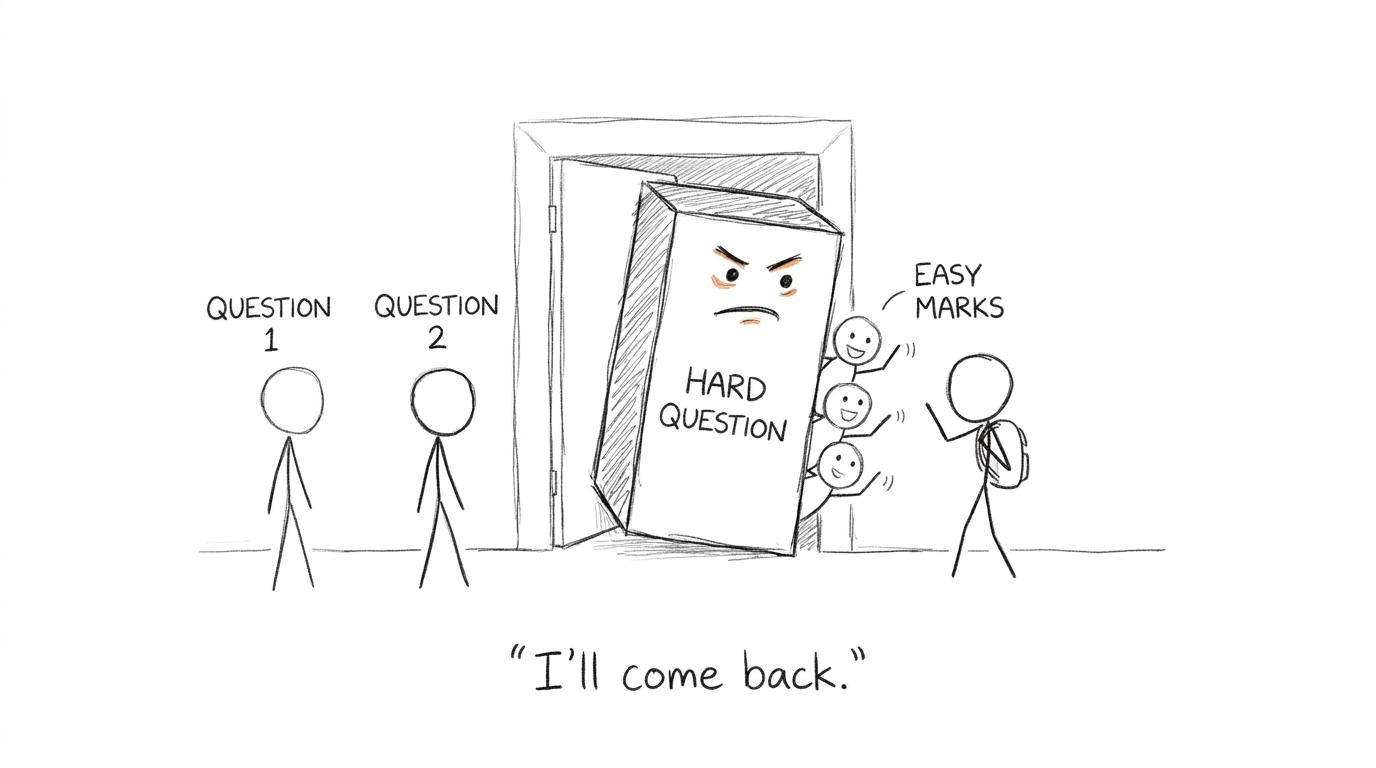 A student steps around one huge question to reach several accessible marks
A practical way to train before the exam
Use a simple cycle: attempt, diagnose, repair and retest.
First, complete an official Arabic past paper or timed section for your specification. Mark it using the official mark scheme and classify each loss. Was it vocabulary, grammar, misunderstood meaning, omitted content or time management?
Then turn each error into a specific rule. “Be more careful” is too vague. “Check every reading answer for a negative” is usable. “Reserve time for the Arabic translation” is usable. “Tick every writing bullet point” is usable.
Finally, repeat the skill under a slightly shorter or equally demanding time limit. The purpose is not to rush. It is to make your calm routine automatic.
For maths, you can build the same exam discipline through Edexcel GCSE Maths past papers, OCR GCSE Maths past papers or the AQA GCSE Maths revision hub. Shorter Edexcel GCSE Maths mini tests are useful when you want focused timed practice without completing a full paper.
Keep an error log for both subjects. Record the task, the mistake, its cause and the action that should prevent it next time. MathsGenie’s guide to finding your weakest GCSE topics explains how to turn lost marks into a focused revision plan rather than a vague sense of panic.
Calm routines protect marks
Time pressure does not usually reveal a completely different student. It exaggerates habits that already exist. If your normal practice includes skipping instructions, guessing from keywords or avoiding timed work, the exam clock magnifies those habits. If your practice includes planning, moving on and checking deliberately, pressure has less power.
Begin with one timed Arabic section and identify your three largest marks leaks. Then apply the same method to maths through MathsGenie’s free Edexcel revision guides, practice questions, mini tests and past papers. Nearer the maths exams, use Edexcel predicted papers alongside mark schemes and video solutions to rehearse unfamiliar questions.
The aim is not to become someone who never feels hurried. It is to become someone who still knows what to do when the clock becomes loud.