

GCSE Arabic Exam Dates 2026: Student Guide
GCSE Arabic exam dates 2026, paper times and speaking window, plus a practical checklist covering revision, equipment and the morning itself.
Exam timetables can look reassuringly simple until two subjects, a speaking assessment and half-term all compete for the same space. The confirmed GCSE Arabic exam dates 2026 for Pearson Edexcel are Friday 22 May for Listening and Reading, followed by Writing on Tuesday 2 June. Your school will arrange Speaking separately within Pearson's window from Thursday 16 April to Thursday 21 May 2026.
Those are the headline dates. The more useful task is turning them into a plan that protects your Arabic preparation without allowing maths revision to disappear. Confirm every arrangement against your individual school timetable because arrival times, speaking appointments and supervised breaks are decided locally.
GCSE Arabic exam dates 2026 at a glance
The dates below apply to Pearson Edexcel GCSE Arabic, specification code 1AA0. Pearson's final summer timetable lists Foundation and Higher papers in the same sessions, although their durations differ.
| Assessment | Date or window | Session | Foundation duration | Higher duration |
|---|---|---|---|---|
| Paper 2: Speaking | Thursday 16 April to Thursday 21 May 2026 | Set by your centre | 7-9 minutes, plus 12 minutes' preparation | 10-12 minutes, plus 12 minutes' preparation |
| Paper 1: Listening | Friday 22 May 2026 | Morning | 35 minutes | 45 minutes |
| Paper 3: Reading | Friday 22 May 2026 | Morning | 50 minutes | 1 hour 5 minutes |
| Paper 4: Writing | Tuesday 2 June 2026 | Afternoon | 1 hour 20 minutes | 1 hour 25 minutes |
Listening and Reading are both timetabled for the morning of Friday 22 May. Your centre will tell you the exact start time, paper order and arrangements between assessments. Do not estimate these details from the national timetable.
The Writing paper falls immediately after the late-May half-term period for many schools. That gap may feel generous, but unplanned time tends to vanish. Decide before half-term which Arabic tasks and GCSE maths revision resources you will complete.
Your essential checklist
Before exam season begins, make sure you have:
- confirmed that your board is Pearson Edexcel and your specification is 1AA0;
- checked whether you are entered for Foundation or Higher tier;
- copied your school's exact Speaking appointment into your calendar;
- recorded the arrival times and rooms for every written paper;
- told the exams officer immediately about any apparent timetable clash;
- checked approved access arrangements with your school;
- kept Wednesday 24 June 2026 available as the national contingency day;
- planned maths revision around the Arabic assessments rather than abandoning it.
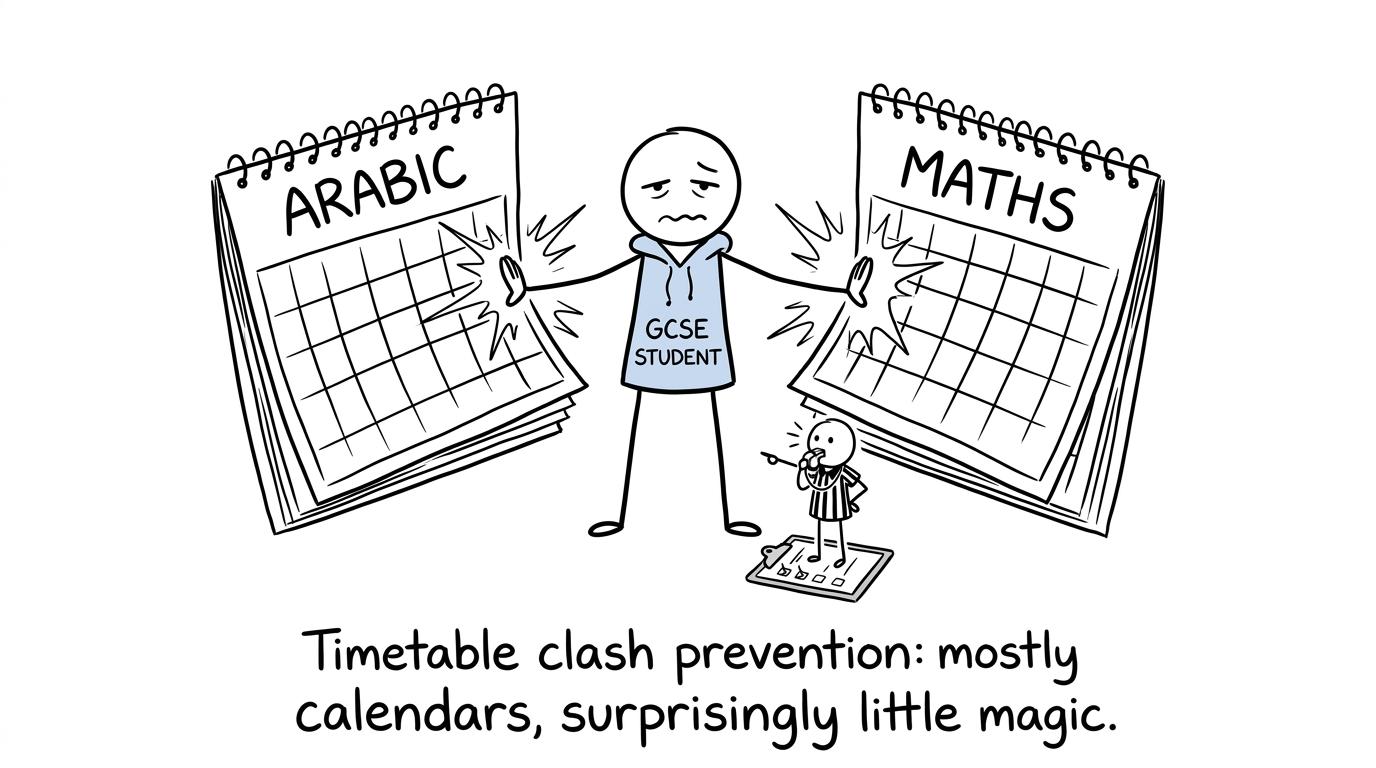 A student uses a checklist to referee colliding Arabic and maths calendars
What each GCSE Arabic assessment involves
Pearson Edexcel GCSE Arabic assesses Listening, Speaking, Reading and Writing. Each component contributes 25% of the qualification. You must normally take the same tier across all four papers, so check your entry rather than assuming it has stayed unchanged.
Speaking is a window, not one national date
Speaking is internally conducted by your centre and externally assessed by Pearson. For 2026, it must take place between 16 April and 21 May. Schools choose appointments within that period, which is why two students at different centres may have different dates without either timetable being wrong.
The assessment has 12 minutes of supervised preparation followed by three consecutive tasks: a role play, a picture-based task and a conversation. Ask your teacher when and where to report, what identification your centre expects and how preparation materials are handled.
Listening and Reading share one morning
Paper 1 tests understanding of spoken Arabic. Paper 3 tests reading comprehension and includes translation into English. Both take place on Friday 22 May in the morning session.
This is likely to be a longer and more structured morning than one isolated paper. Your school may require you to remain under supervision between assessments. Bring any permitted food or drink your centre recommends, but never assume that you can access your phone, notes or friends between papers.
Writing comes after half-term
Paper 4 is on Tuesday 2 June in the afternoon. It assesses written communication and translation into Arabic. The short calendar gap after 22 May is valuable because you can move from recognising language in Listening and Reading to producing accurate language in Writing.
Avoid treating that period as unlimited revision time. Other GCSE papers continue around it, including maths for many students. A brief, written plan is more reliable than deciding each morning what feels urgent.
Build one timetable for Arabic and maths
The hidden difficulty of GCSE season is not usually one exam. It is the sequence. A student may leave an Arabic paper feeling relieved, only to realise that a maths paper requires a different kind of concentration a few days later.
Start with your personal exam timetable, not a generic online calendar. Add every Arabic appointment, your maths papers, school arrival times and the contingency day. Then work backwards to assign small revision blocks.
For maths, use your actual board and tier. MathsGenie provides board-specific collections for Edexcel GCSE Maths past papers, AQA GCSE Maths past papers and OCR GCSE Maths past papers. A paper from the wrong board can still contain useful maths, but it should not replace practice matched to your specification.
Protect continuity with short sessions
During an Arabic-heavy week, maths does not need to dominate your evening. It does need to remain present. A short sequence works well:
- complete one focused set of practice questions;
- mark it immediately using the mark scheme;
- record the exact topic behind each lost mark;
- revisit one error before the next session.
If a full paper is unrealistic, use Edexcel GCSE Maths mini tests for compact timed practice. The aim is continuity. Twenty purposeful minutes can preserve a method that would otherwise need to be relearned after half-term.
Closer to your maths exams, move from topic repair to full papers and GCSE predicted papers. Predicted papers are practice tools, not forecasts of exact questions. Their value is in rehearsing unfamiliar combinations under time pressure.
What the exam morning usually looks like
Your school's instructions always take priority, but most exam mornings follow a recognisable pattern. You arrive before the published start, find the correct room or assembly point, leave prohibited items where directed and wait to be seated. Invigilators then check attendance, explain the conditions and tell candidates when to begin.
For Arabic Listening, the centre also manages the recording and any permitted pauses according to the assessment instructions. If there is a genuine sound problem, raise your hand immediately. Waiting until the paper has ended makes the issue harder to address.
Before leaving home
Check your timetable rather than relying on memory. Eat something familiar, allow extra travel time and take the equipment specified by your school. A black pen and permitted stationery should be in a transparent pencil case. Water should be in a clear bottle with labels removed if your centre permits it.
Leave notes, watches and internet-enabled devices at home where possible. JCQ candidate guidance prohibits phones and all types of watches in the examination room. Turning a phone to silent does not make it permitted.
Once you are seated
Check that the paper shows the correct subject, component and tier when instructed. Listen to the invigilator and do not open the paper early. If you have the wrong paper, cannot hear properly or feel unwell, raise your hand rather than trying to solve the problem quietly.
Your candidate details matter. Complete the required information exactly as directed and use your legal or registered candidate details where requested. These small administrative actions are not exciting, but calm exams are often built from ordinary checks completed early.
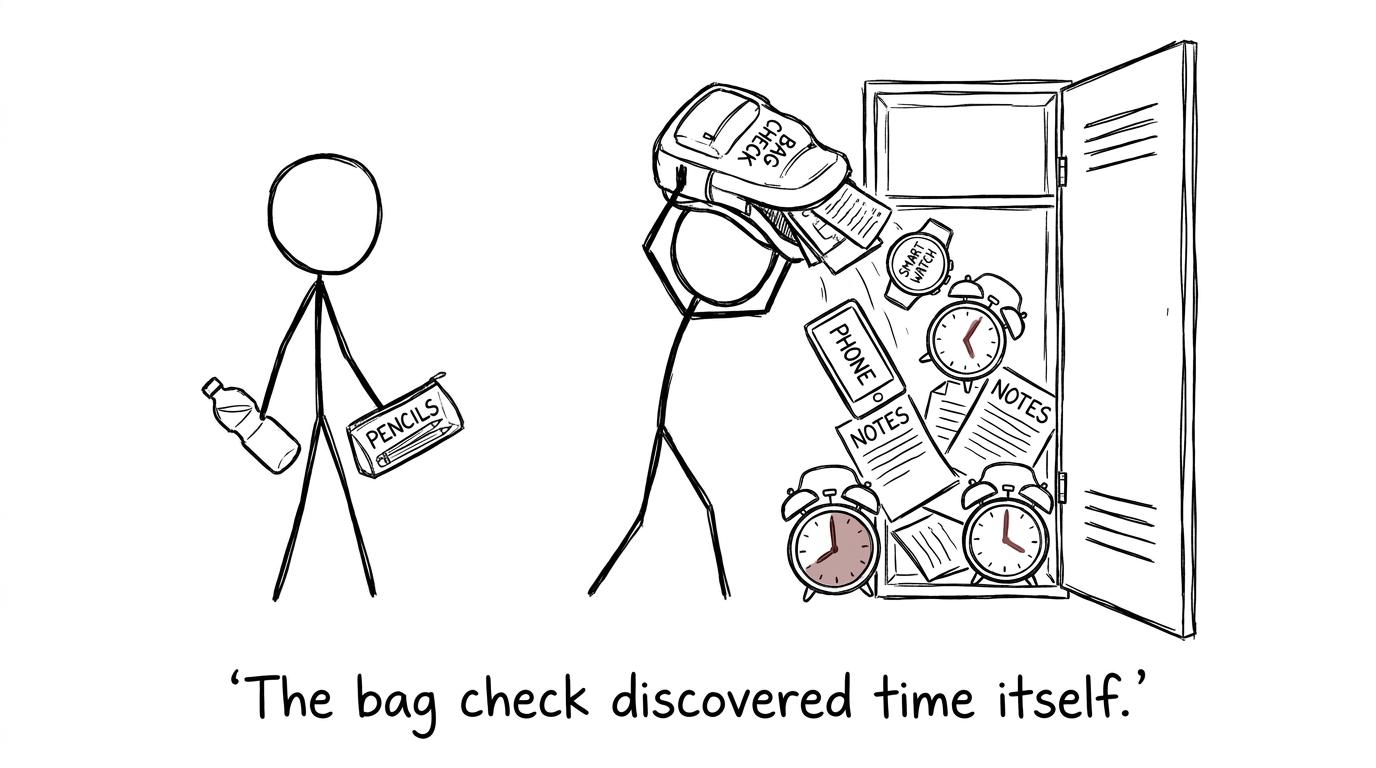 An exam bag check discovers phones, watches and several unnecessary alarm clocks
What to do in the final week
The final week is for retrieval and rehearsal, not rebuilding the entire course. For Arabic, rotate the four skills while giving extra attention to the next paper. Practise listening without repeatedly stopping the recording, read under a time limit and produce written Arabic without leaning on notes.
Keep maths active through a simple learn, practise, mark and fix cycle. If your time is fragmented, follow a 20-minute GCSE maths revision routine. If you have a longer block, complete a timed paper and use its mark scheme to choose the next topic lesson.
The evening before an exam should reduce uncertainty. Prepare permitted equipment, check transport, set alarms and stop at a sensible time. Late revision is most tempting when confidence feels low, but tiredness can make familiar instructions look unfamiliar.
Common mistakes before GCSE Arabic exams
Using the national session as an arrival time
“Morning” and “afternoon” are timetable sessions, not instructions to arrive at a particular minute. Your centre sets reporting and start arrangements. Use the time printed on your individual timetable.
Forgetting the separate Speaking appointment
Speaking does not appear as one fixed date on the national written timetable. Record the appointment supplied by your school and confirm it early if anything is unclear.
Revising for the wrong tier
Foundation and Higher papers have different durations and demands. Pearson requires a consistent tier across the components, so check the tier shown on your entry and personal timetable.
Assuming a timetable clash will fix itself
Schools can manage genuine clashes, but the exams officer needs to know. Report any concern immediately and follow the centre's instructions. Never decide independently to miss or leave an examination.
Taking prohibited items into the room
Phones, watches and revision notes can create serious problems even when you did not intend to use them. Follow JCQ and centre rules precisely. Put prohibited items away before entering.
Dropping maths until Arabic is finished
Subjects compete for attention, but they do not need equal time every day. Maintain maths with short topic questions, mini tests or one timed section. MathsGenie's revision lessons, mark schemes and video solutions make a small session easier to start and easier to review.
Finish with a timetable you can trust
The important dates are straightforward: Speaking between 16 April and 21 May, Listening and Reading on 22 May, and Writing on 2 June. The real preparation lies around them: confirming your tier, knowing where to report, keeping prohibited items out of the room and protecting time for your other GCSEs.
Put every confirmed arrangement into one calendar today. Then open the MathsGenie GCSE maths hub, choose your exam board and continue with one focused task. Use revision lessons and practice questions to repair weak topics, past papers and mark schemes to measure progress, and predicted papers, mini tests and video solutions to rehearse under pressure. A clear timetable will not sit the exams for you. It will make sure your effort arrives in the right room, on the right day, ready to count.










