GCSE Arabic Cram Guide: A 1-Week Plan
GCSE Arabic cram guide 1 week: follow a focused seven-day plan for listening, speaking, reading and writing, with practical daily exam tips.
A week before an exam, revision can feel less like a plan and more like opening ten cupboards at once. Vocabulary lists are unfinished. Speaking answers feel uncertain. Listening practice seems to move twice as fast as it did in class.
This gcse arabic cram guide 1 week plan gives you a simpler answer: spend each day on a defined task, practise all four language skills and use your mistakes to decide what happens next. You cannot relearn an entire course in seven days, but you can recover vocabulary, improve exam technique and make your remaining revision far more productive.
This guide focuses on Pearson Edexcel GCSE Arabic, the main UK specification students are likely to encounter. If your school uses another qualification, check its specification and follow your teacher's instructions before copying timings or task formats.
Your seven-day checklist
Keep the week deliberately narrow:
- Confirm your tier, papers and exam dates.
- Complete a short diagnostic before making new notes.
- Revise vocabulary through recall rather than rereading.
- Practise listening, speaking, reading and writing.
- Mark every available task and record recurring errors.
- Complete timed practice before the final day.
- Finish with calm retrieval, not an exhausting late-night session.
The current Edexcel GCSE Arabic qualification assesses listening, speaking, reading and writing. Each skill contributes 25%25\%25% of the qualification. Papers are available at foundation and higher tier, and candidates are entered for the same tier across the qualification. Dictionaries are not permitted in the assessments.
That structure should shape your week. Spending six days copying vocabulary and one day attempting a paper would leave too much of the qualification untouched.
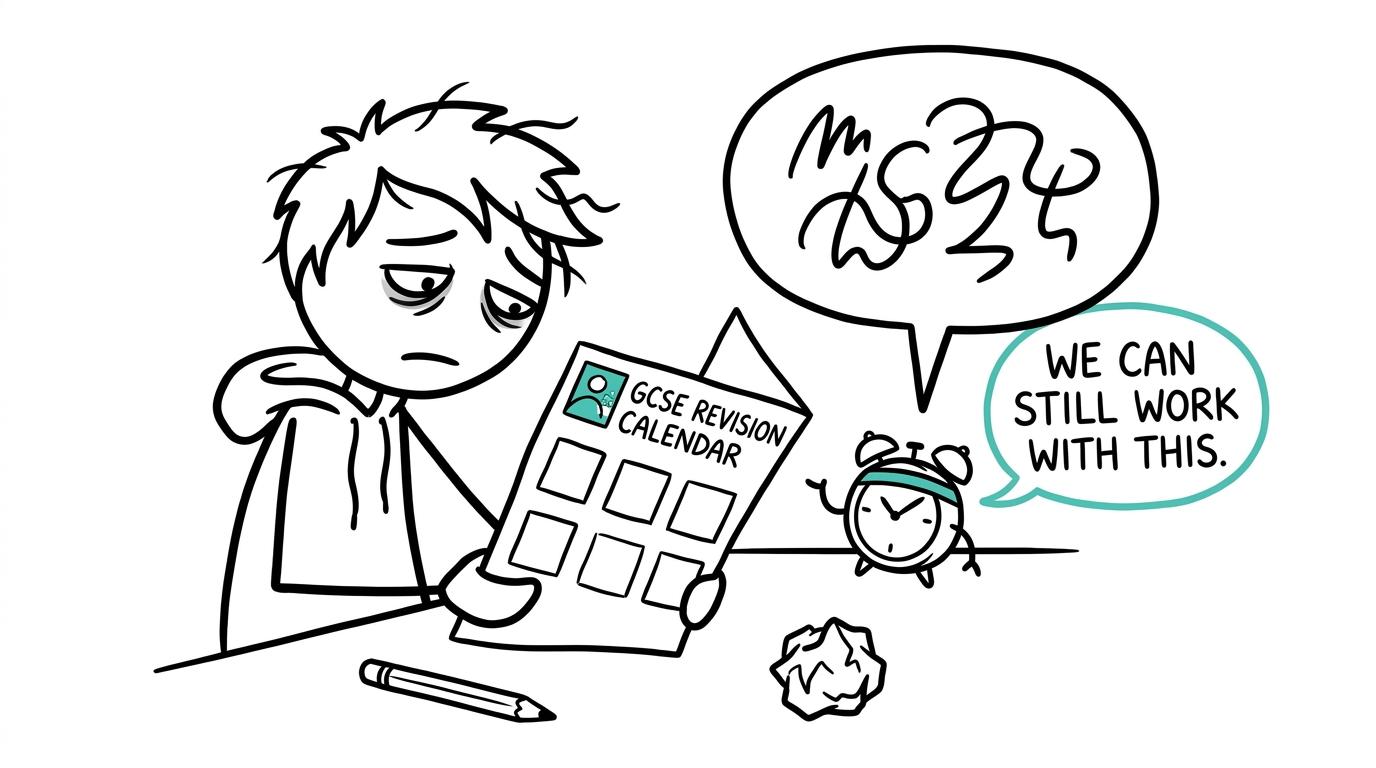 A student discovers that seven days can still become a workable revision plan
Before day one: remove uncertainty
Find your exam-board specification, statement of entry and information from your school. Confirm whether the approaching assessment is speaking, listening, reading or writing. The speaking assessment may take place earlier than the other papers, so your priorities must reflect your actual timetable.
Prepare one folder containing:
- the specification or official topic list;
- past or sample assessment materials supplied by your exam board;
- mark schemes;
- your vocabulary lists;
- corrected classwork;
- one blank error log.
Then block out your sessions. Aim for two focused blocks each day, separated by a proper break. A simple planner prevents repeated decisions when you are already tired. MathsGenie's free revision planner is designed for maths, but its timetable structure can also help you reserve Arabic sessions alongside your other GCSE subjects.
Day one: diagnose the real gaps
Do not begin with the topic you enjoy most. Begin by finding where marks are currently disappearing.
Complete a short selection of listening and reading questions under quiet, timed conditions. Add one speaking response and one brief writing task if suitable materials are available. You are not trying to predict your grade from a miniature test. You are collecting evidence.
Sort each mistake into one of four groups:
- Vocabulary: you did not know a key word or phrase.
- Grammar: you recognised the idea but formed or interpreted it incorrectly.
- Task understanding: you misunderstood the instruction or answered the wrong detail.
- Timing: you knew enough but worked too slowly.
Choose no more than three priority themes and three language problems. A short, honest list is more useful than a beautiful list containing the whole specification.
This diagnose, practise, mark loop is also central to MathsGenie's GCSE one-week revision plan. Although that article concerns maths, its main principle transfers well: let completed questions decide what you revise next.
Day two: rebuild high-utility vocabulary
Vocabulary revision becomes deceptive when words look familiar on a page. Recognition is not the same as recall.
Cover the Arabic and retrieve it from the English meaning. Then reverse the direction. Say each item aloud and use it in a short phrase where possible. Prioritise language that can serve several themes:
- opinions and reasons;
- time expressions;
- common verbs;
- connectives;
- descriptions of people and places;
- language for past, present and future events;
- question words and negatives.
Create three piles: secure, hesitant and unknown. Spend most of the session on the final two, but retest secure vocabulary briefly tomorrow. Include both recognition and production because reading and listening require you to understand language, while speaking and writing require you to generate it.
Avoid copying whole pages. The useful moment is the moment your brain has to retrieve the word without seeing it.
Day three: train listening and reading
Listening and reading both test understanding, but they create different pressures.
Listening practice
Read the questions before the recording begins where the paper permits this. Identify what each question is asking for: a person, place, opinion, reason, time or action. During the recording, listen for meaning rather than attempting to translate every word.
Pay particular attention to:
- negatives and changes of opinion;
- words that signal contrast;
- time references;
- similar-sounding vocabulary;
- whether the speaker is describing the past, present or future.
After marking, replay difficult sections if your practice resource allows it. Use a transcript only after making a genuine attempt. Find the precise word or phrase that carried the answer.
Reading practice
First locate evidence in the passage. Then write the answer. Do not rely on what the text appears to be about generally.
Edexcel reading can include different text types and a translation into English. When translating, preserve the complete meaning rather than replacing the sentence with a loose summary. Mark omitted negatives, people, time frames and opinions in your error log.
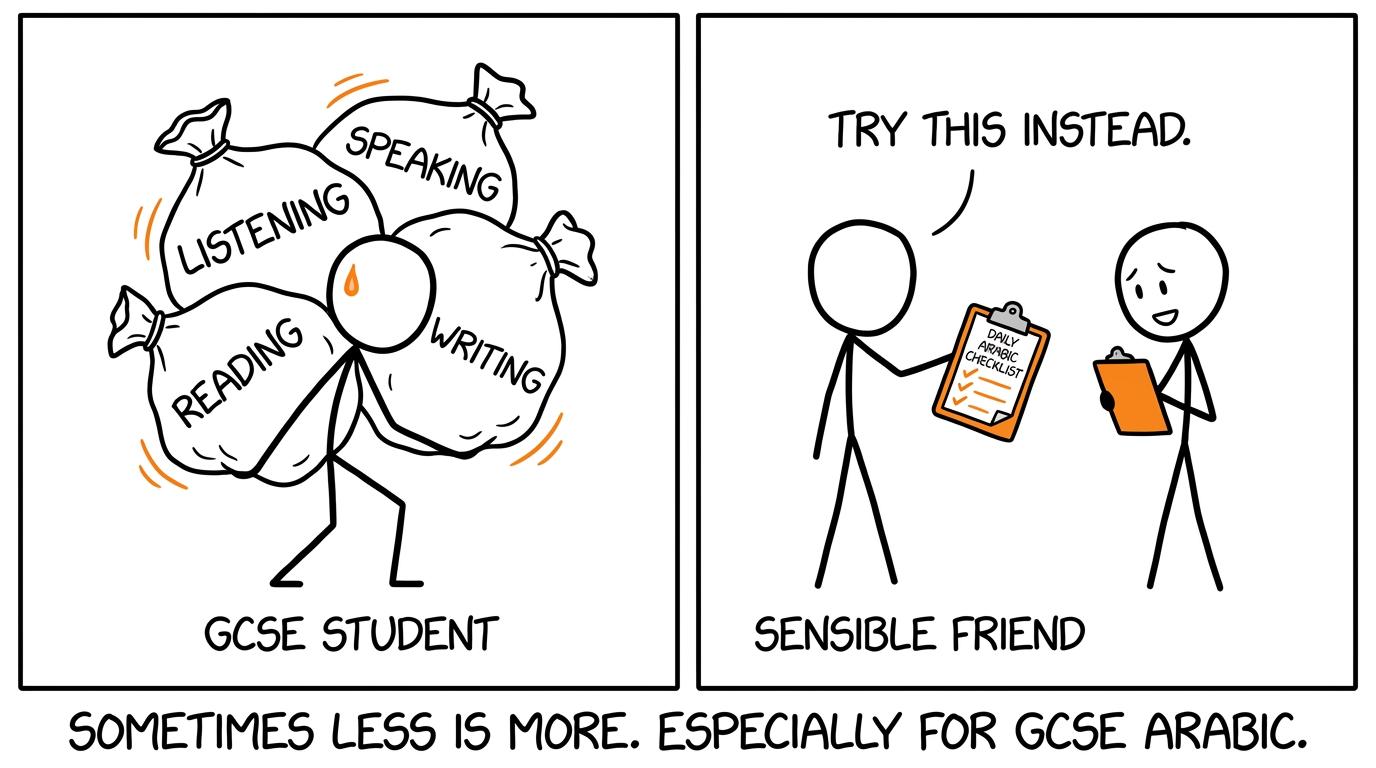 Four language skills become manageable when placed on one daily checklist
Day four: prepare speaking that can bend
For Edexcel GCSE Arabic, the speaking assessment includes a role play, a picture-based task and a conversation. The exact conduct and preparation rules are controlled by the exam board and your centre, so follow your teacher's guidance closely.
Do not memorise one enormous speech. A memorised answer can collapse when the question changes slightly. Prepare adaptable answer blocks instead:
- a direct response;
- an opinion;
- a reason;
- an extra detail;
- a past or future reference where relevant.
Record yourself answering likely questions. Listen once for content and once for clarity. Note where hesitation changes meaning, where endings become uncertain and where an answer fails to address the question.
Practise recovering when you lose a word. Use simpler language that you can control rather than stopping while searching for an impressive phrase. Communication matters more than sounding artificially complicated.
Finish with a realistic uninterrupted run-through. Ask a teacher or appropriate Arabic speaker for feedback if one is available, especially on pronunciation and whether your responses communicate the intended meaning.
Day five: improve writing through control
Writing revision should combine planning, accurate production and checking. Choose tasks that match your tier and current specification.
Before writing, identify every required bullet point. Plan one clear idea for each and decide where you can naturally demonstrate different time frames, opinions, reasons and varied structures. Do not force complicated language into every sentence.
Afterwards, check in separate passes:
- Have you answered every part of the task?
- Are verbs consistent with the intended person and time?
- Do nouns, adjectives and pronouns refer clearly to the right people or things?
- Have you used connectives accurately?
- Has spelling changed the meaning of any word?
- Does the response remain relevant?
Also practise translation into Arabic. Accuracy matters: preserve the subject, action, negative and time reference. If a sentence feels too ambitious during normal writing, simplify it without abandoning the required message.
Day six: complete timed exam practice
Today is the rehearsal. Choose an official past paper or sample assessment material that matches your tier and the skill being tested. Use the correct time and allowed materials. Put your phone away and do not pause to check notes.
Mark the work as soon as reasonably possible. A score is only the beginning. For every lost mark, record:
- what the task required;
- what you wrote or understood;
- the reason it went wrong;
- the rule, word or habit that would fix it.
Then redo selected mistakes without looking at the answer. This is the difference between seeing a correction and learning from it.
The same feedback principle appears throughout MathsGenie's GCSE Maths revision hub, where practice questions sit alongside mark schemes and solutions. Its GCSE mini tests also demonstrate why short, focused checks can reveal gaps more clearly than another hour of passive reading.
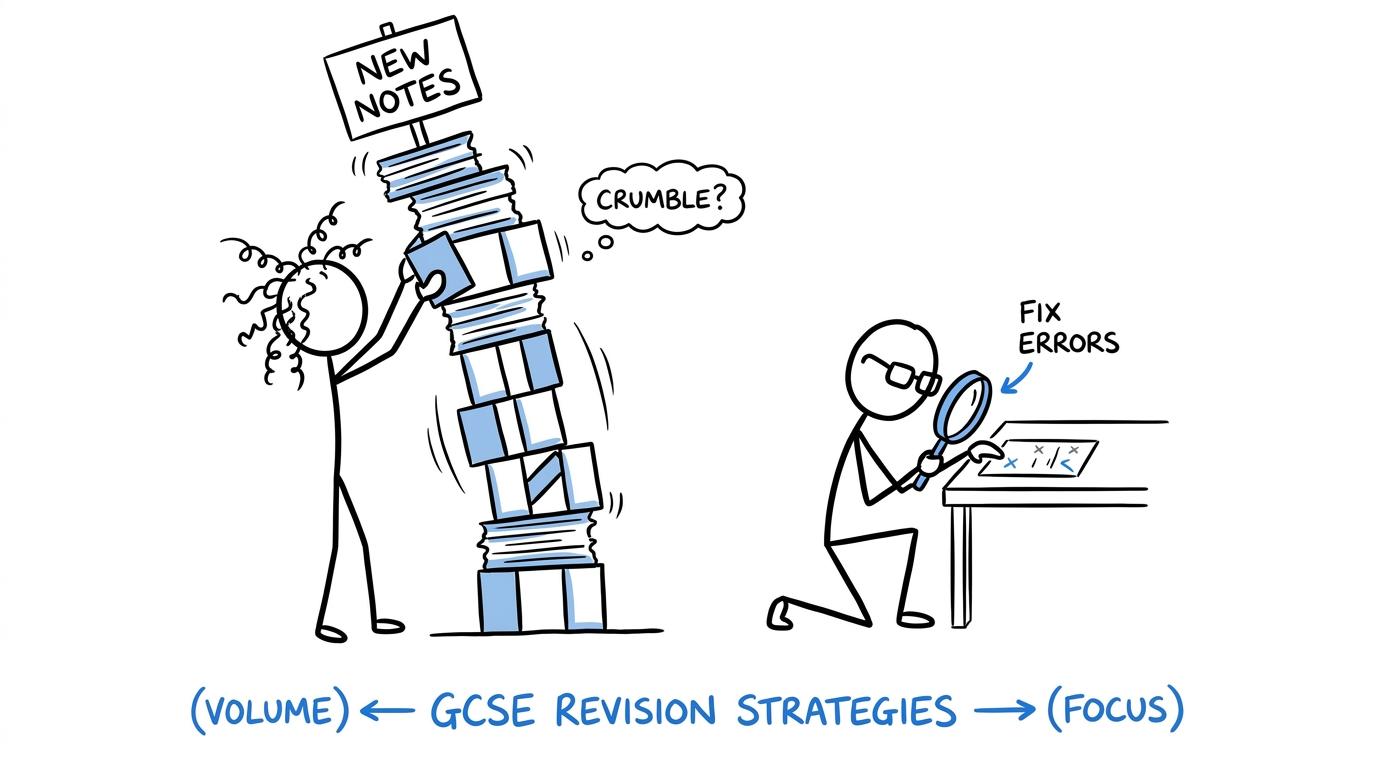 Fixing a short list of errors proves safer than building a tower of new notes
Day seven: consolidate without exhausting yourself
The final day is not the time to begin a new textbook chapter. Review the material most likely to prevent avoidable mistakes:
- your hesitant and unknown vocabulary piles;
- recurring grammar errors;
- key question words;
- flexible speaking prompts;
- translation traps;
- the corrections from yesterday's timed practice.
Complete one short task from each relevant skill, but stop before fatigue ruins the quality of your work. Prepare what you need for the exam, check the official time and location through your school, and protect your sleep.
If maths is also competing for attention, use MathsGenie's free GCSE maths resources rather than searching across dozens of tabs. The GCSE predicted papers can provide unseen maths practice, but they should not replace official past papers or be treated as guaranteed predictions.
Common mistakes in a one-week Arabic revision plan
Revising only vocabulary
Vocabulary matters, but isolated word learning does not train listening speed, speaking interaction, reading evidence or extended writing. Use new vocabulary in exam-style activity on the same day.
Treating familiar words as secure
If you can recognise a word but cannot say or write it from memory, it is not fully available for productive tasks. Test both directions.
Ignoring the question language
Students can understand a passage yet lose marks by giving the wrong type of detail. Circle or note the demand of the question before searching for an answer.
Memorising inflexible speaking scripts
Prepared language is useful. A single fixed speech is fragile. Practise responding to changed wording, follow-up questions and unfamiliar details.
Marking without correcting
Reading a mark scheme can create an impression of understanding. Close it and repeat the task, or produce a corrected response from memory.
Sacrificing sleep for one more session
Cramming rewards prioritisation, not endless hours. Set a stopping time. The final evening should reduce uncertainty rather than create more of it.
Make the week count
Seven days is not ideal, but it is enough time to become more deliberate. Diagnose first. Retrieve vocabulary. Practise every assessed skill. Work under time. Correct what goes wrong.
The deeper lesson is useful beyond Arabic: revision improves when feedback changes the next session. MathsGenie makes that cycle easy for your maths exams through free revision lessons and GCSE resources, practice questions, mini tests, past papers, predicted papers, mark schemes and video solutions. Open the MathsGenie revision planner, schedule today's Arabic task and protect a separate block for maths. One calm, completed session is worth more than a perfect plan you never begin.